
The Day Henry VIII Heard the News That Changed Everything: Flodden Field, 26th September 1513
Imagine being a young king, not yet twenty-two years old, sitting in the French court of Tournai, already flush with your own recent military triumph, when a breathless messenger arrives bearing news so extraordinary it would reshape the entire political landscape of northern Europe. On 26th September 1513, King Henry VIII received word that his forces, led by the Earl of Surrey, had decisively defeated the Scottish army at the Battle of Flodden Field, killing Scotland’s own king, James IV, in the process. It was, by any measure, one of the most sensational moments of Henry’s reign, and it came at precisely the right moment to cement his reputation as a warrior monarch of the first order.
The Battle of Flodden Field, fought on 9th September 1513 in Northumberland, near the village of Branxton, was the largest battle ever fought between England and Scotland. Yet for Henry, the news arrived not on the battlefield itself but across the Channel, where he had been pursuing his own military ambitions in France. The contrast between the king’s continental theatre of war and the brutal, rain-soaked carnage unfolding on the Scottish borders makes for one of the most compelling episodes in all of Tudor history. As a historical fiction author who has spent years immersed in this period, I find the layers of irony, triumph, and tragedy almost too rich to contain.
In this post, we will explore who fought at Flodden and why, how the news reached Henry VIII, what the victory meant for Tudor England, and why this moment continues to fascinate historians, novelists, and history enthusiasts more than five centuries later.
Historical Background: Scotland, France, and the Young King’s Ambitions
To understand the full significance of 26th September 1513, we must first understand the web of alliances and rivalries that had drawn England into conflict on two fronts simultaneously. Henry VIII had invaded France in the summer of 1513 as part of the Holy League, an alliance forged with Pope Julius II and Holy Roman Emperor Maximilian I against French King Louis XII. Henry was young, energetic, and utterly determined to prove himself the heir of Henry V, the warrior king whose victories at Agincourt had become the gold standard of English martial glory.
Scotland, bound to France through the ancient Auld Alliance, could not remain neutral. King James IV of Scotland was a sophisticated Renaissance monarch, genuinely accomplished in languages, medicine, and the arts, but he was also a man of considerable military ambition. Responding to French pressure and his own treaty obligations, James crossed the English border in late August 1513 with one of the largest Scottish armies ever assembled, estimated at somewhere between thirty and sixty thousand men. He carried with him a formidable artillery train, including massive bronze cannons gifted by Louis XII himself.
Defending England in Henry’s absence was Catherine of Aragon, appointed regent by her husband before he sailed for France. It is one of the period’s great underappreciated stories that it was Catherine who helped coordinate the English military response, writing to Henry with remarkable composure and determination. The English army that marched north was commanded by Thomas Howard, Earl of Surrey, a seasoned military veteran in his seventies who had served English kings since the time of Edward IV. On 9th September 1513, the two armies met on the slopes near Branxton Hill in Northumberland, and what followed was a catastrophic defeat for Scotland.
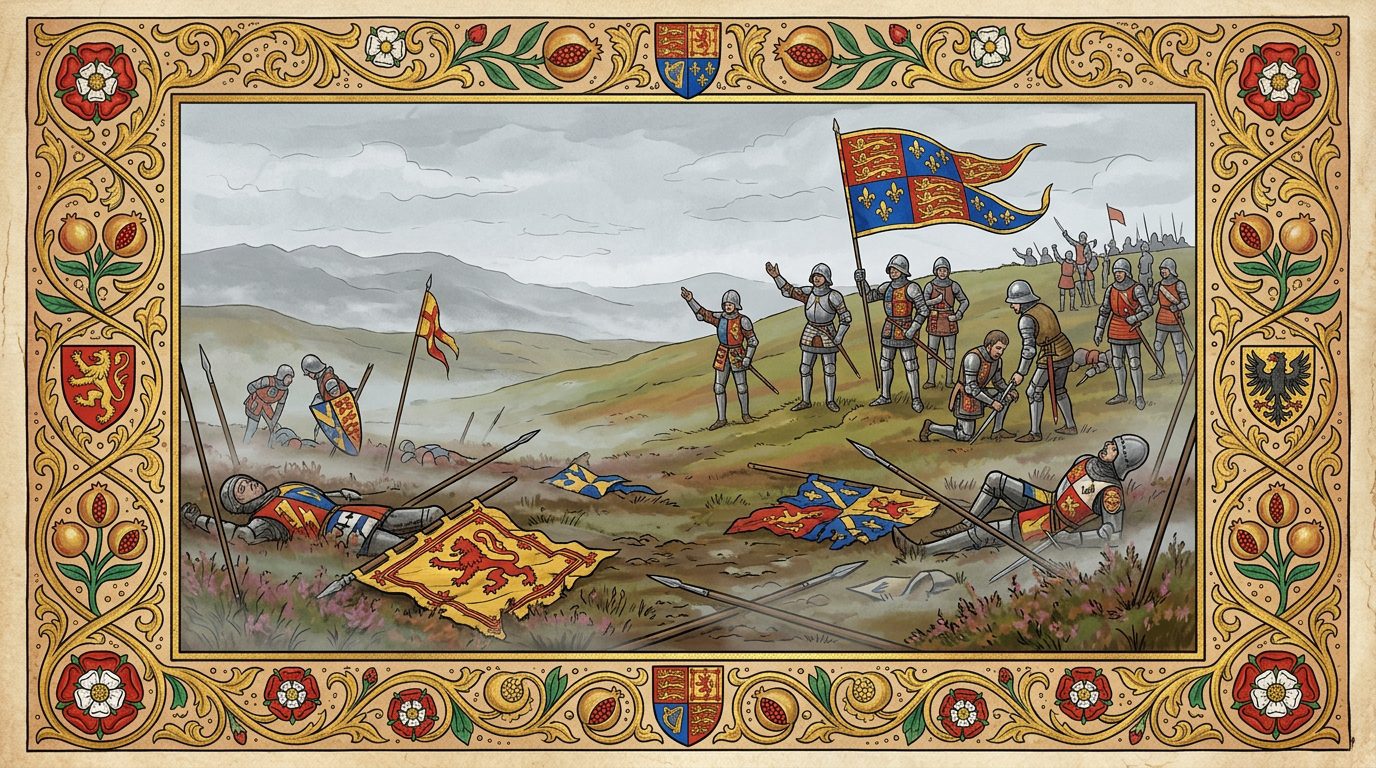
The English billmen, armed with their distinctive halberds, proved devastatingly effective against the Scottish pikemen, whose long spears became tangled and unwieldy on the uneven, rain-sodden ground. James IV himself was killed in the fighting, along with an extraordinary proportion of Scotland’s nobility. Edward Hall, in his Chronicle of the Kings of England, captures the scale of the Scottish losses with barely concealed astonishment, listing earl after earl, bishop after bishop, among the fallen. Scotland lost perhaps ten thousand men that day, including the flower of its aristocracy and its king.
Significance and Impact: A Triumph That Echoed Across Europe
When Henry VIII received the news at Tournai on 26th September 1513, the political implications were immediate and far-reaching. As Glenn Richardson argues in his authoritative study Renaissance Monarchy: The Reigns of Henry VIII, Francis I and Charles V, Henry was acutely conscious of his image among European rulers and understood that military reputation was the currency of Renaissance kingship. The death of James IV and the annihilation of the Scottish army arrived as magnificent confirmation that England was a power to be reckoned with, not merely on the continent but on its own doorstep.
The victory fundamentally altered the strategic situation in northern Britain. Scotland was plunged into a regency government, with the infant James V on the throne and his mother, Margaret Tudor (Henry’s own sister), serving as regent. This created an extraordinary dynamic in which Henry’s sister was now governing the very kingdom that had just suffered such a catastrophic defeat at English hands. The border tensions that had simmered for generations did not vanish overnight, but Scotland’s capacity to threaten England militarily was severely diminished for a generation.
Within England itself, the victory at Flodden had an almost electric effect on national morale and the prestige of the Tudor dynasty. Hall’s Chronicle reflects the triumphalist mood of the time, presenting the battle as a providential vindication of English arms and English kingship. Surrey was elevated to the Dukedom of Norfolk in recognition of his services, restoring the title that had been forfeited after his father fought for Richard III at Bosworth. Catherine of Aragon, writing to Henry, described the Scottish king’s coat, captured on the battlefield, as the greatest trophy she could send him, a detail that speaks volumes about the martial culture of the Tudor court.
Did you know? Catherine of Aragon reportedly sent Henry the bloodstained coat of James IV along with her letter announcing the victory, framing it as a gift more valuable than any jewel. Henry, by some accounts, was so moved by this gesture that he intended to send it to his ally Pope Julius II.
Connections and Context: A Year of Extraordinary Events
The year 1513 was, by any reckoning, one of the most eventful of Henry VIII’s long reign. While Flodden was being fought in Northumberland, Henry himself was achieving his own military triumph in France, capturing the town of Thérouanne in August and then Tournai in September. The so-called Battle of the Spurs, a skirmish in which French cavalry famously fled rather than fight, had given Henry his own, if rather less bloody, continental victory. Receiving the news of Flodden while still basking in his French successes must have seemed to the young king like an almost overwhelming confirmation of divine favour.
It is also worth noting the broader European context. 1513 saw the election of a new pope, Leo X, of the Medici family, and the continuing fractures within the Holy League that had drawn Henry into France in the first place. The death of Julius II in February 1513 had removed one of the key architects of the anti-French alliance. Henry was navigating an extraordinarily complex diplomatic landscape even as his forces were winning battles on two fronts, and Richardson’s analysis of Renaissance monarchy helps us understand how conscious Henry was of performing kingship as much as practising it.
The connection to Scotland’s future is also worth pausing over. The infant James V who inherited the Scottish throne after Flodden would eventually father Mary Queen of Scots, whose claim to the English throne would trouble Tudor England for decades. The tragedy of Flodden thus planted seeds that would flower, with terrible consequences, long after Henry VIII himself was gone.
Modern Relevance and Fascinating Details
The Battle of Flodden and the news Henry received on 26th September 1513 continue to resonate in ways both scholarly and popular. In Scotland, the battle remains a genuine source of national grief and cultural memory. The song Flowers of the Forest, a lament for the fallen, is still played on the bagpipes at commemorative events and funerals, a haunting reminder that history’s victories and defeats are not experienced equally by all sides. For Scottish communities, Flodden was not a glorious triumph but a national catastrophe, and that asymmetry of memory is itself historically instructive.
For those interested in historical fiction, this period offers extraordinary material. The image of Catherine of Aragon as regent, sending her husband a dead king’s coat while managing the defence of England alone, is the kind of detail that novelists dream about. It complicates the familiar narrative of Catherine as a passive victim of Henry’s later cruelty and reveals instead a formidable, politically astute woman operating with considerable skill in a moment of genuine national crisis. As someone who writes about this era, I find that the events of 1513 consistently surprise readers who encounter them for the first time.
Did you know? James IV of Scotland was the last British monarch to die in battle. His body was recovered from the field at Flodden, identified, and eventually embalmed and transported south. However, his body was never formally buried and was reportedly still uninterred at the dissolution of the monasteries, a strange postscript to a king’s dramatic end.
Conclusion: Why 26th September 1513 Still Matters
The news that reached Henry VIII at Tournai on 26th September 1513 was more than a military bulletin. It was a defining moment in the construction of Tudor royal identity, in Anglo-Scottish relations, and in the broader drama of Renaissance European politics. Edward Hall’s chronicle captures the jubilation of the moment; Richardson’s scholarship helps us understand its deeper structural significance. Together, they paint a picture of a young king whose ambitions were, at least in this extraordinary year, matched by astonishing results.
Whether you are a student of Tudor history, a devotee of historical fiction, or simply someone who stumbled upon a curious date, the events of autumn 1513 offer a remarkable window into a world where news travelled slowly but its consequences echoed for generations. If this post has sparked your curiosity, I would encourage you to explore Edward Hall’s Chronicle, Richardson’s Renaissance Monarchy, and the wealth of scholarship on Catherine of Aragon’s regency. The Tudor period never disappoints, and 26th September 1513 is one of its most genuinely thrilling days.