
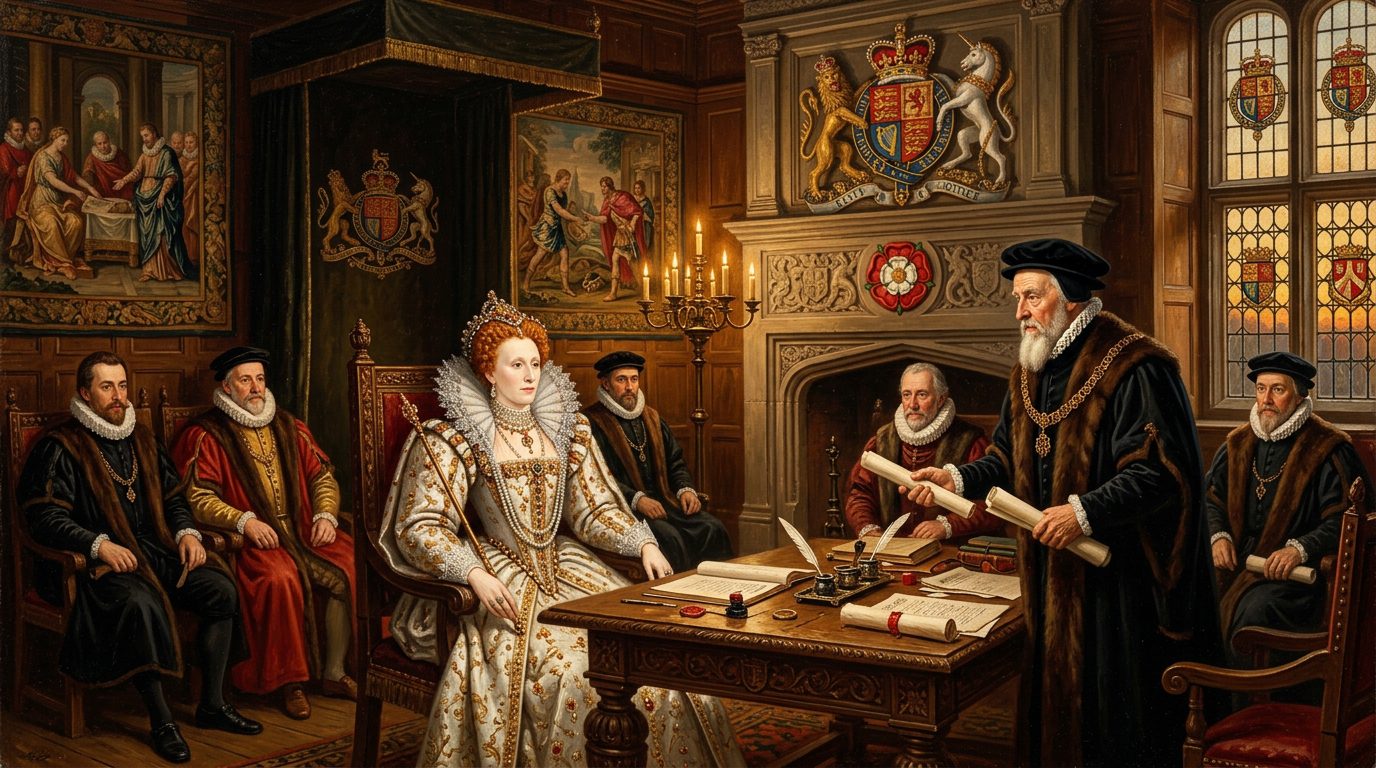
The Queen and Her ‘Spirit’: Elizabeth I and William Cecil’s Extraordinary Political Partnership
Imagine a working relationship so intense, so fraught with mutual dependency and occasional fury, that it endured for nearly four decades at the heart of one of history’s most celebrated reigns. Queen Elizabeth I and her chief minister William Cecil shared precisely such a bond, one that shaped the destiny of Tudor England in ways that historians are still unpacking today. Elizabeth famously called Cecil her ‘spirit’, a term of profound trust and intimacy, yet she also threatened to dismiss him on multiple occasions when their policy disagreements became too heated to ignore. It is one of the most compelling political partnerships in British history.
This relationship raises fascinating questions that historians, students, and lovers of Tudor history continue to debate. How did a queen who jealously guarded her own authority come to depend so completely on a single adviser? What kept Cecil in royal favour when so many others fell from grace? And what does their complex dynamic reveal about the nature of power, loyalty, and governance in sixteenth-century England? Whether you are approaching this topic for the first time or returning to deepen your understanding, the story of Elizabeth and Cecil offers extraordinary insight into the mechanics of Tudor government.
Drawing on the foundational scholarship of J.E. Neale and Conyers Read, this post explores the full arc of their partnership, from its cautious beginnings in 1558 to Cecil’s death in 1598, examining its significance not just for Tudor politics but for our understanding of how personal relationships shape the course of history.
Historical Background: Who Were These Two Remarkable Figures?
William Cecil was born in 1520 into a family with modest but growing connections to royal administration. Educated at Cambridge and Gray’s Inn, he developed an exceptional talent for the patient, meticulous work of government. He had served under Edward VI and navigated the dangerous waters of Mary I’s reign with characteristic caution. By the time Elizabeth Tudor came to the throne on 17th November 1558, Cecil was already an experienced administrator who understood the machinery of the English state with unparalleled intimacy. As Conyers Read noted in his authoritative study Mr. Secretary Cecil and Queen Elizabeth (Jonathan Cape, 1955), Cecil was a man who combined intellectual brilliance with a pragmatic understanding of political survival.
Elizabeth herself was twenty-five years old when she became queen, untested as a ruler yet possessed of a formidable intelligence shaped by years of danger and uncertainty. Within days of her accession, she appointed Cecil as her Principal Secretary of State, reportedly telling him directly that she intended to rely on his good counsel. What followed was a working partnership that, at its core, rested on a shared commitment to the stability and Protestant settlement of England, even when the two principals disagreed fiercely about how best to achieve those goals.
The setting for their partnership was the royal court, principally at Whitehall Palace and Greenwich, though Cecil’s own home at Burghley House in Lincolnshire and his London residence also served as nerve centres of Elizabethan administration. Cecil managed an extraordinary volume of correspondence, intelligence reports, and diplomatic negotiations, all of which passed through his hands before reaching the queen. His elevation to the peerage as Lord Burghley in 1571 marked formal recognition of what everyone already understood: he was the most powerful minister in England.
The circumstances of their working relationship were shaped by the enormous pressures bearing down on the Elizabethan regime. England faced potential invasion from Catholic powers, the unresolved question of the queen’s marriage and succession, religious tensions at home, and repeated conspiracies centred on the captive Mary Queen of Scots. It was against this backdrop of near-constant crisis that Elizabeth and Cecil developed their complex, mutually dependent relationship, as J.E. Neale’s classic biography Queen Elizabeth I (Jonathan Cape, 1934) makes abundantly clear.
Significance and Impact: Why Does This Partnership Matter?
The relationship between Elizabeth and Cecil was not merely a biographical curiosity. It had profound consequences for the governance of Tudor England and for the way Elizabethan policy was made. Because the queen trusted Cecil so completely, he was able to shape English foreign policy, religious settlement, and domestic administration in ways that reflected his own cautious, Protestant, and firmly anti-Spanish worldview. His influence can be seen in the Elizabethan Religious Settlement of 1559, in England’s guarded support for Protestant rebels in the Netherlands, and in the long campaign to bring Mary Queen of Scots to trial.
Yet the relationship also illuminates something equally important: the limits of a minister’s power under an absolute monarch. Elizabeth repeatedly resisted Cecil’s advice on questions she considered matters of royal prerogative, most notably on the question of her own marriage and on military intervention abroad. When Cecil pushed too hard, she pushed back, sometimes with considerable anger. The threat of dismissal, though it never materialised into actual disgrace, was a tool Elizabeth used to remind her most trusted adviser that authority ultimately rested with the crown. This dynamic kept Cecil perpetually cautious and the queen perpetually in control, even while depending on his expertise.
For Tudor society more broadly, the Cecil partnership established a model of government that relied heavily on a professional bureaucratic class of educated men rather than on the old nobility alone. Cecil’s network of secretaries, agents, and spies represented a genuinely modern approach to statecraft, one that prioritised information, intelligence, and careful administration over the traditional claims of aristocratic birth. In this sense, the Elizabeth-Cecil relationship helped shape the institutions of English government for generations to come.
The consequences of their occasional disagreements were also significant. When Cecil manoeuvred events to ensure that Mary Queen of Scots was executed in 1587, doing so in a way that gave Elizabeth plausible distance from the decision, the episode demonstrated both the depth of his influence and the extraordinary complexity of their working relationship. Elizabeth’s subsequent fury at Cecil was, many historians believe, at least partly genuine, yet she never seriously considered punishing him. Their bond had become, by that point, almost impossible to sever.
Connections and Context: The Broader Tudor World
To understand Elizabeth and Cecil fully, it helps to place them within the wider context of Elizabethan England. The 1570s and 1580s were decades of acute anxiety, with the Ridolfi Plot of 1571, the St Bartholomew’s Day Massacre of 1572, and the arrival of Jesuit missionaries in England all raising the spectre of Catholic conspiracy. Cecil’s intelligence network, which included the formidable Sir Francis Walsingham, was a direct response to these threats. The queen and her minister did not always agree on how aggressively to counter these dangers, but their shared Protestant commitment gave them a common foundation.
It is also worth noting that Cecil was not the only significant figure in Elizabeth’s court. Robert Dudley, Earl of Leicester, the queen’s favourite, represented a very different kind of influence, one based on personal affection rather than administrative genius. The tension between Cecil and Dudley was a constant feature of Elizabethan court politics, with the two men often representing opposing factions on questions of foreign policy and the queen’s marriage. Cecil’s eventual triumph over all rivals, simply by outlasting them and remaining indispensable, says something important about the nature of Elizabethan power.
Did you know? Cecil suffered from severe gout in his later years, yet continued to conduct business from a litter when he could no longer walk unaided. Elizabeth is reported to have visited him personally during his final illness in 1598, an extraordinary gesture of royal favour that speaks to the depth of their bond.
Modern Relevance and Fascinating Details
The story of Elizabeth and Cecil continues to fascinate for reasons that feel surprisingly contemporary. Their relationship raises timeless questions about the balance between loyalty and independence in professional life, about how leaders manage advisers whose expertise they need but whose power they must constrain. Management theorists, political scientists, and leadership coaches have all found material in the Elizabethan example, and it is not difficult to see why.
For those who encounter Tudor history through popular culture, the Elizabeth-Cecil relationship has been portrayed in numerous works of historical fiction and drama. From Hilary Mantel’s broader explorations of Tudor court life to television dramas such as Elizabeth I and the various film adaptations of the queen’s life, the figure of the trusted yet constrained minister recurs again and again. As a historical fiction author myself, I find the dramatic tension inherent in their relationship almost irresistible: two brilliantly capable people, each dependent on the other, each determined to shape events according to their own judgement, locked together in a political dance that neither could afford to end.
Lesser-known details add further colour to the story. Cecil kept extraordinarily detailed records of his correspondence and deliberations, many of which survive in archives today, giving historians an unusually rich picture of Elizabethan decision-making from the inside. His nickname, ‘Spirit’, suggests that Elizabeth saw him as something almost supernatural in his indispensability, a presence that pervaded every aspect of her government. That she combined this extraordinary compliment with periodic threats of dismissal tells us everything we need to know about Elizabeth’s genius for managing those around her.
Conclusion: A Partnership That Shaped a Nation
The relationship between Elizabeth I and William Cecil, Lord Burghley, stands as one of the most consequential political partnerships in British history. For nearly forty years, they shaped the Elizabethan state together, disagreeing fiercely, depending on each other absolutely, and navigating crises that would have destroyed lesser collaborations. The scholarship of Neale and Read gives us the framework to understand this extraordinary bond in its full complexity, revealing a relationship built on mutual respect, shared purpose, and the occasional sharp reminder of where power ultimately resided.
Whether you are a student of Tudor history, a lover of historical fiction, or simply curious about how great historical figures actually worked and related to one another, the story of Elizabeth and her ‘Spirit’ rewards careful attention. It reminds us that behind the grand sweep of historical events, there are always human relationships, complicated, affectionate, contentious, and irreplaceable. To explore further, consider beginning with Conyers Read’s Mr. Secretary Cecil and Queen Elizabeth or Neale’s incomparable biography of the queen herself. The world they reveal is endlessly rich.