
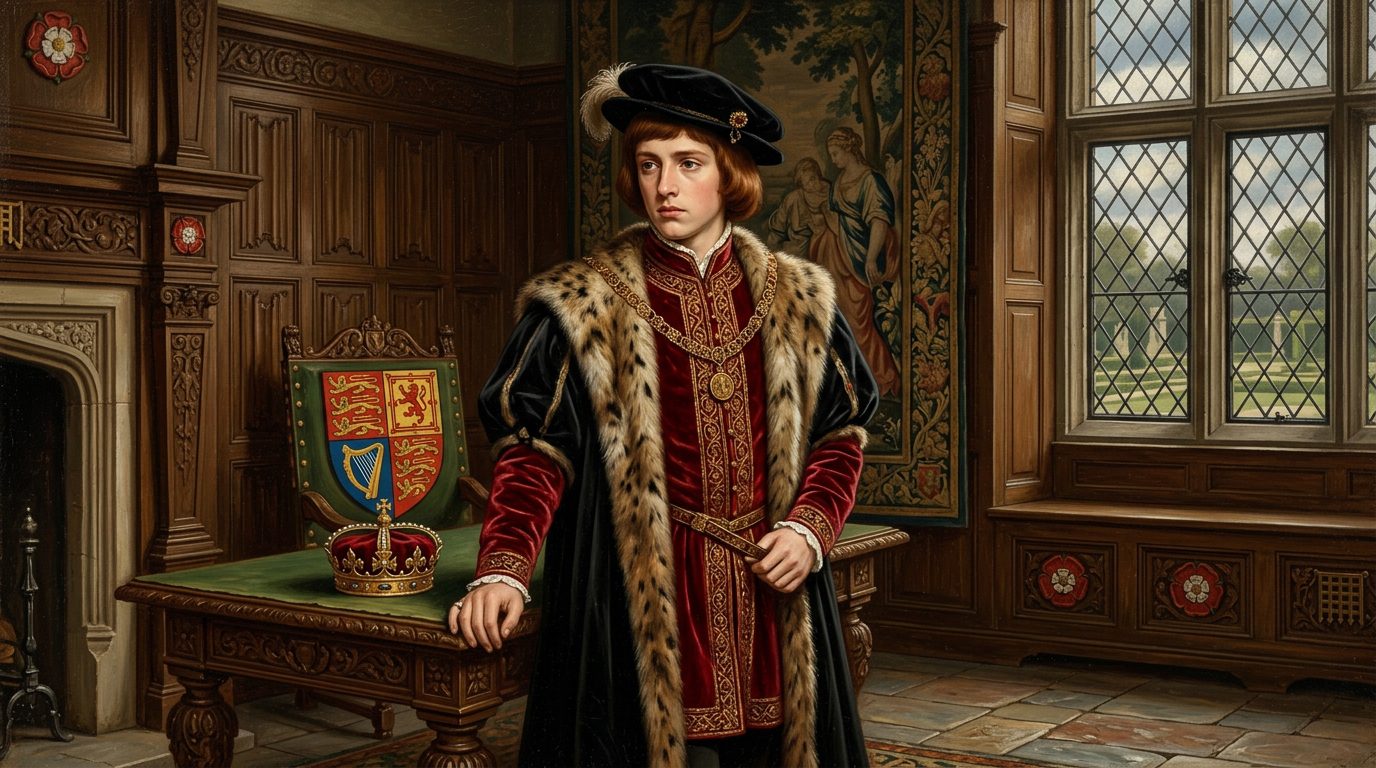
The Lost Prince: Henry Fitzroy and the Succession Crisis That Haunted Henry VIII
Imagine being the son of the most powerful man in England, groomed for greatness, showered with titles and honours, only to die suddenly at seventeen years old under circumstances so suspicious that even your own father suspected foul play. This was the tragic fate of Henry Fitzroy, Duke of Richmond and Somerset, Henry VIII's only acknowledged illegitimate son and, for a brief but remarkable period, the king's greatest hope for a male heir. His story is one of Tudor England's most compelling and overlooked dramas, touching on themes of legitimacy, political ambition, grief, and the desperate calculations of a king who would reshape an entire nation in his pursuit of a son.
As a historical fiction author who has spent years immersed in Tudor court life, I find Fitzroy's story endlessly fascinating precisely because it sits at the intersection of personal tragedy and political catastrophe. His death in July 1536 did not merely break a father's heart; it fundamentally altered the trajectory of the English succession and added yet another layer of instability to a reign already convulsed by the break with Rome, the dissolution of the monasteries, and the execution of Anne Boleyn just weeks before Fitzroy drew his last breath.
In this post, we will explore who Henry Fitzroy was, why Henry VIII elevated him so dramatically, what his sudden death meant for Tudor politics, and why rumours of poisoning swirled around his deathbed. Whether you are a seasoned Tudor history enthusiast or encountering this story for the first time, Fitzroy's brief life offers a remarkable window into the anxieties and ambitions of Henrician England.
Historical Background: The Boy Who Was Almost King
Henry Fitzroy was born on 15 June 1519 at the priory of St Lawrence in Blackmore, Essex, the son of Henry VIII and his mistress Elizabeth Blount, one of Catherine of Aragon's ladies-in-waiting. The name 'Fitzroy' itself was a statement of royal intent: derived from the Norman French for 'son of the king,' it was a designation that left no ambiguity about the boy's parentage. As Alison Weir notes in Henry VIII: The King and His Court, Elizabeth Blount was considered one of the most accomplished young women at court, celebrated for her beauty and her skill in dancing and singing, making her an entirely understandable object of the king's affections.
By 1519, Henry VIII had been married to Catherine of Aragon for a decade, and the couple's failure to produce a surviving male heir was becoming a source of profound anxiety. Catherine had endured multiple pregnancies, but only Princess Mary, born in 1516, had survived infancy. The birth of a healthy boy, even an illegitimate one, was therefore greeted with poorly concealed royal delight. Henry acknowledged the child openly and ensured that Elizabeth Blount was respectably married off to Gilbert Tailboys shortly afterwards, a common arrangement for royal mistresses of the period.
The true elevation of Fitzroy came in June 1525, when Henry VIII, in an extraordinary ceremony at Bridewell Palace, created the six-year-old boy Duke of Richmond and Somerset, and simultaneously appointed him Lord High Admiral of England, Warden General of the Marches towards Scotland, and Lord Lieutenant of Ireland. G.J. Meyer, in The Tudors, describes this moment as a breathtaking display of royal favour that shocked the court and humiliated Catherine of Aragon, who reportedly complained furiously that her daughter Mary was being deliberately sidelined. The dukedom of Richmond was particularly significant: it had been the title held by Henry VII before he seized the throne, and conferring it upon Fitzroy was widely interpreted as a signal that the king was contemplating making his illegitimate son his heir.
Fitzroy was subsequently sent to Sheriff Hutton Castle in Yorkshire, where he presided over a grand household and received an education befitting a prince. He later studied at King's College, Cambridge, and in 1533 was sent to France, where he spent time at the court of Francis I, gaining the polish and continental experience expected of a future ruler. In 1533, he also married Lady Mary Howard, daughter of the Duke of Norfolk, cementing his connection to one of England's most powerful noble families. By all accounts, he was developing into a capable and appealing young man.
Significance and Impact: A Death That Shook the Tudor Court
The sudden death of Henry Fitzroy on 22 July 1536 struck the Tudor court like a thunderbolt. He was only seventeen years old, and he had apparently been in reasonable health just weeks before, though some accounts suggest he had been suffering from a pulmonary condition, most likely tuberculosis, for some months. The timing was extraordinarily cruel: Anne Boleyn had been executed on 19 May 1536, Henry VIII had married Jane Seymour on 30 May, and Parliament had recently passed legislation declaring both Mary and Elizabeth illegitimate. For one brief, extraordinary moment, Henry Fitzroy had been the only acknowledged child of the king who was not formally declared a bastard by statute, making his position uniquely powerful.
The impact on Henry VIII himself was devastating. Alison Weir describes the king as being grief-stricken, a man who had invested enormous emotional and political capital in this boy. The rumours of poisoning that immediately circulated at court reflected both the paranoid atmosphere of 1536 and the genuine shock of a death that seemed to serve no natural logic. Suspicion fell, almost inevitably, upon the Howard family, Fitzroy's in-laws, though no credible evidence ever emerged to support the accusation. Others whispered that Anne Boleyn, despite being already dead, had somehow arranged it through her faction. In truth, the most probable cause was tuberculosis, which was endemic in Tudor England and made no distinction between the powerful and the powerless.
The political consequences were immediate and far-reaching. Without Fitzroy, Henry VIII had no male heir of any kind, legitimate or otherwise. This vacuum of succession accelerated his desperate desire for Jane Seymour to produce a son, a wish that was ultimately granted with the birth of Edward VI in October 1537, though Jane herself died shortly afterwards. Had Fitzroy lived, the entire calculus of the Tudor succession might have looked profoundly different. It is one of history's great 'what ifs': would Henry have legitimised his son? Would England have been ruled by a Fitzroy rather than an Edward, a Mary, or an Elizabeth?
Did you know? Henry VIII was so distressed by Fitzroy's death that he reportedly refused to arrange a proper royal funeral, and the boy's body was reportedly smuggled out of court wrapped in lead, eventually buried quietly at Thetford Priory in Norfolk. The Duke of Norfolk, Fitzroy's father-in-law, was later reprimanded for the inadequacy of the funeral arrangements.
Connections and Context: A Year of Extraordinary Upheaval
To fully appreciate the significance of Fitzroy's death, one must understand the extraordinary turbulence of 1536 as a whole. This single year saw the death of Catherine of Aragon in January, the execution of Anne Boleyn in May, Henry's marriage to Jane Seymour, the dissolution of the smaller monasteries beginning in earnest, the Pilgrimage of Grace uprising in the north of England beginning in October, and now the death of the king's only son. It was, by any measure, one of the most convulsive years in English history.
Fitzroy's story also connects intimately to the broader question of how Tudor England understood and managed illegitimacy. English law and custom made a sharp distinction between legitimate and illegitimate children, and yet Henry VIII had demonstrated, through his treatment of Fitzroy, that royal will could override many conventional barriers. G.J. Meyer points out that Henry had actually sought Parliamentary legislation that would have allowed him to legitimise Fitzroy if necessary, suggesting that the king was seriously entertaining the idea of making him his official heir at some point during the late 1520s and early 1530s.
Readers interested in Fitzroy's story will find natural connections to the parallel story of Princess Mary, who endured her own form of marginalisation during these years, and to the rise and fall of the Boleyn faction, whose fortunes were so intimately entangled with questions of the succession. The period between 1525 and 1536 was, in many ways, defined by the question of who would follow Henry VIII onto the throne of England.
Modern Relevance and Fascinating Details
Henry Fitzroy has enjoyed a modest but genuine renaissance of popular interest in recent decades, partly driven by the explosion of Tudor historical fiction and drama. As an author working in this genre, I find him an irresistible figure: a young man of genuine ability, caught between the extraordinary privilege of royal favour and the fundamental instability of his position, never quite legitimate, never quite dispensable. He appears as a character in several works of historical fiction, including references in novels exploring the court of Henry VIII, though he has never quite received the full biographical novel treatment his story deserves.
One of the most surprising details about Fitzroy that consistently astonishes people is the sheer scale of his household. As Duke of Richmond, he commanded a retinue of several hundred servants and officials, a court in miniature that rivalled the establishments of many European princes. This was not merely ceremonial; it represented a genuine attempt by Henry VIII to prepare his son for the possibility of rule, giving him administrative experience and political visibility from an exceptionally young age.
His young widow, Mary Howard, is herself a fascinating figure worth further exploration. There is some evidence that the marriage was never consummated, possibly because Fitzroy was already unwell, and Mary spent years afterwards at court, a well-educated, formidably intelligent woman who had been a duchess before she was twenty. She was a poet and a patron of learning, and her story is a reminder that the women orbiting the Tudor succession were often as interesting as the men at its centre.
Conclusion: The Prince Who Might Have Changed Everything
Henry Fitzroy's brief life and sudden death encapsulate so much of what makes Tudor history so enduringly gripping: the collision of personal emotion and dynastic calculation, the fragility of power and privilege, and the way in which individual lives could pivot entire kingdoms. He was a boy elevated to near-royal status by a father's hope and political desperation, only to be taken away before that hope could be tested or fulfilled. The rumours of poisoning that surrounded his death reflect not just Tudor paranoia but a genuine recognition that his survival had mattered enormously, to his father, to the court, and to England itself.
If you want to explore further, Alison Weir's Henry VIII: The King and His Court and G.J. Meyer's The Tudors both offer rich and detailed accounts of Fitzroy's life and its context. The story of this lost prince is a reminder that Tudor history is never simply a story of kings and queens; it is a story of the children who might have been, and the different Englands they might have made.