
Catherine of Aragon Arrives in England: The Day That Changed Tudor History Forever
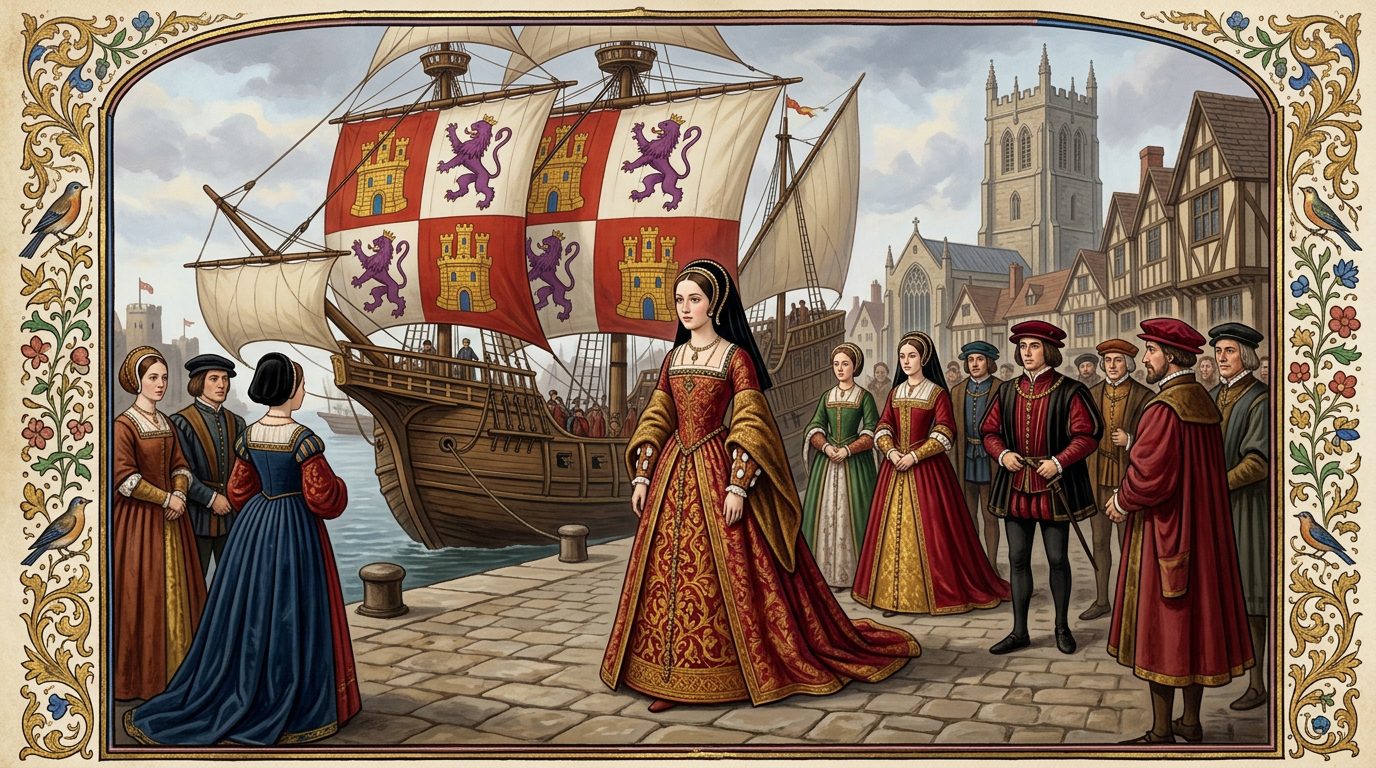
On the 3rd of October 1501, a sixteen-year-old Spanish princess stepped onto English soil for the very first time, windswept and weary after a treacherous sea voyage that had nearly claimed her life. That princess was Catherine of Aragon, and her arrival at Plymouth Harbour would set in motion a chain of events so extraordinary that they would fracture the Christian Church, reshape English society, and echo through five centuries of history. Few arrivals in English history carry such extraordinary weight, and yet the young woman who disembarked that autumn morning could not possibly have imagined the storms that lay ahead of her.
As a historical fiction author who has spent years immersed in Tudor primary sources, I find Catherine’s arrival one of the most compelling moments of the entire period. Here was a young woman, educated, devout, and politically astute beyond her years, arriving in a foreign land to fulfil a dynastic duty arranged when she was just three years old. The circumstances of her journey, her reception, and the diplomatic manoeuvring surrounding her marriage tell us an enormous amount about how Tudor England worked, how it saw itself on the European stage, and how fragile the bonds of international alliance truly were.
In this post, we will explore who Catherine of Aragon was when she arrived in England, why the marriage alliance mattered so profoundly to both Spain and England, and why that October morning in Plymouth harbour represents one of the genuine turning points of Tudor history. Whether you are a seasoned Tudor enthusiast or discovering this period for the first time, the story of Catherine’s arrival is one that rewards careful attention.
Historical Background: Who Was Catherine of Aragon and Why Did She Come to England?
Catherine of Aragon was born on the 16th of December 1485, the youngest surviving child of King Ferdinand II of Aragon and Queen Isabella I of Castile, two of the most formidable monarchs in European history. Her parents had united the great Spanish kingdoms through their marriage, driven the Moors from Granada, and commissioned Christopher Columbus’s voyages to the Americas. Catherine was, in every sense, a princess of extraordinary pedigree, raised at one of the most sophisticated courts in Europe and educated alongside her siblings in Latin, theology, music, and the arts of governance.
The marriage alliance between Catherine and Prince Arthur Tudor, the elder son and heir of King Henry VII of England, had been under negotiation since 1488, when Catherine was just two years old and Arthur barely one. For Henry VII, the match represented something of enormous personal and political significance. The Tudor dynasty was still relatively young, having been established only in 1485 after Henry’s victory at Bosworth Field. An alliance with the most powerful royal house in Europe lent the Tudors a legitimacy and prestige that no English marriage could have provided. For Ferdinand and Isabella, England represented a useful counterweight to their great rival, France.
According to the Calendar of State Papers, Spanish, Volume 1, 1501 to 1509, the negotiations surrounding Catherine’s dowry and the terms of the marriage were extraordinarily complex, involving years of correspondence between the courts of London and Madrid. The dowry agreed upon was substantial, and both sides haggled fiercely over every detail. Catherine’s journey to England was itself a diplomatic event, carefully choreographed to project Spanish power and prestige onto the European stage.
Catherine’s voyage from Spain proved far more dramatic than anyone had anticipated. She departed from A Coruna in August 1501, but violent storms in the Bay of Biscay forced her fleet back to port. She finally set sail again in late September, and after enduring a further battering from Atlantic gales, her battered fleet arrived at Plymouth on the 3rd of October 1501. Giles’s Chronicles and Memorials of Great Britain and Ireland During the Middle Ages records that the locals who greeted her were astonished by her composure and dignity despite the obvious hardships of the crossing. She was, by all accounts, a princess who understood how to present herself.
Significance and Impact: Why Catherine’s Arrival Matters So Much
The immediate significance of Catherine’s arrival was diplomatic and dynastic. Henry VII had worked for over a decade to secure this alliance, and her safe arrival in England represented the successful conclusion of years of careful negotiation. The King himself rode out to meet her before she had even reached London, so eager was he to see the bride his son was to marry. This was itself rather irregular by the protocol of the time, and it speaks to how deeply Henry valued the match.
The wedding of Catherine and Arthur took place on the 14th of November 1501 at St Paul’s Cathedral in London, an occasion of spectacular Tudor pageantry. The celebrations lasted for days, with jousting, banqueting, and public festivities that projected English wealth and confidence to the watching European courts. For a brief, glittering moment, it seemed as though the Tudors had secured their place among the great dynasties of Europe.
Did you know? One of the witnesses at the wedding celebrations was a ten-year-old boy named Henry, the younger brother of the groom. That child would eventually become Henry VIII and marry Catherine himself, with consequences that shook the foundations of Western Christianity.
The tragedy, of course, is well known to Tudor historians. Arthur died on the 2nd of April 1502, just five months after the wedding, almost certainly of sweating sickness. Catherine was left a widow in a foreign country, her future suddenly deeply uncertain. The question of whether the marriage had been consummated would later become one of the most bitterly contested legal and theological questions of the sixteenth century, lying at the very heart of Henry VIII’s attempt to annul his marriage to Catherine and ultimately triggering the English Reformation. That Catherine had arrived in Plymouth in October 1501 was the first link in a chain that would eventually lead to England’s break with Rome.
Connections and Context: The Wider Tudor World in 1501
To understand Catherine’s arrival properly, it is important to appreciate what else was happening in Tudor England at this moment. Henry VII was, by 1501, a king who had survived multiple rebellions and pretenders to his throne. The Perkin Warbeck affair had finally been put down, and England was enjoying a period of relative stability. The King was intensely focused on building royal finances and projecting an image of regal magnificence, and Catherine’s arrival fitted perfectly into this programme of dynastic self-promotion.
On the European stage, the year 1501 saw France consolidating its hold on parts of Italy following the Italian Wars, while Spain was emerging as the dominant power on the Iberian peninsula and beginning to exploit its new American territories. The marriage of Arthur and Catherine was one piece of a complex diplomatic puzzle in which England sought to position itself between the great powers of France and Spain without being crushed by either.
It is also worth noting that Catherine arrived in an England that was, in formal terms, still entirely Catholic. The idea that Henry VII’s daughter-in-law would one day be the woman whose marriage Henry VIII wished to escape, and that this wish would lead to the creation of the Church of England, would have seemed like fantastical speculation to anyone watching the celebrations in London in November 1501. History, as so often in the Tudor period, was preparing an irony of almost unbearable proportions.
Modern Relevance and Fascinating Details: Why Catherine’s Story Still Captivates Us
Catherine of Aragon remains one of the most written-about women in English history, and her story continues to resonate powerfully with modern audiences. As a historical fiction author, I find her particularly compelling precisely because of the gap between the triumphant arrival in Plymouth in 1501 and the lonely death at Kimbolton Castle in 1536. Hers is a story of extraordinary resilience, of a woman who refused to accept a definition of herself imposed by others, and who maintained her dignity and her convictions under almost unimaginable pressure.
Did you know? During the years between Arthur’s death and her marriage to Henry VIII in 1509, Catherine lived in considerable poverty in England. Her allowance was frequently unpaid, her household reduced, and her position deeply uncertain. The vivacious princess who had arrived to such fanfare in 1501 spent years in a kind of diplomatic limbo, neither fully a princess of Spain nor properly provided for as a princess of England.
In popular culture, Catherine has been portrayed by a remarkable range of actresses across film and television, from Irene Papas in Anne of the Thousand Days to Maria Doyle Kennedy in the television series The Tudors. More recently, she has become a central figure in Hilary Mantel’s celebrated Wolf Hall trilogy, though it is worth noting that Mantel’s Catherine is seen largely through the unsympathetic eyes of Thomas Cromwell. For those wishing to explore her story further, the historical novels of Philippa Gregory offer an accessible and vivid starting point, while Susan Bordo’s The Creation of Anne Boleyn provides a thoughtful scholarly perspective on how Catherine’s reputation has been shaped and reshaped across the centuries.
Conclusion: A Moment That Changed Everything
The arrival of Catherine of Aragon at Plymouth on the 3rd of October 1501 was, on its surface, a straightforward diplomatic event: a Spanish princess coming to England to fulfil a marriage contract. But as we have seen, it was also the beginning of one of the most consequential personal and political journeys in English history. From that windswept harbour in Devon to the corridors of power in London, from the splendour of her first wedding to the heartbreak of her final years, Catherine’s life in England shaped the nation in ways that nobody who greeted her that autumn morning could have foreseen.
Her story invites us to ask profound questions about duty, faith, identity, and power, questions that feel surprisingly relevant in the twenty-first century. If you would like to explore further, the Calendar of State Papers, Spanish offers fascinating primary source material, while Giles’s Chronicles and Memorials provides vivid contemporary accounts of the arrival itself. Tudor history rewards the curious, and there is no better place to begin than with the young woman who stepped ashore at Plymouth over five hundred years ago and changed England forever.