
The Crown Beneath the Hawthorn: How Henry VII Founded the Tudor Dynasty
Imagine a golden crown, caked with the mud of a Leicestershire battlefield, discovered beneath the tangled branches of a hawthorn bush. It sounds like the stuff of legend, yet this extraordinary scene played out on the morning of 22nd August 1485, marking the end of the Plantagenet era and the dawn of one of England’s most celebrated royal dynasties. The Battle of Bosworth Field was not merely a military engagement; it was a seismic shift in English history that reshaped the monarchy, the nobility, and the very fabric of society for generations to come.
As a historical fiction author who has spent years immersed in the Tudor period, I find this moment endlessly compelling. There is something almost mythological about the image of Henry Tudor, a man who had spent much of his life in exile, lifting a crown from the earth and placing it upon his head. Yet behind the romance lies a story of political cunning, dynastic ambition, and the exhaustion of a nation torn apart by decades of civil conflict. Understanding how the Tudor dynasty began helps us understand why it endured, and why it continues to fascinate readers, historians, and storytellers alike.
In this post, we will explore the circumstances that brought Henry Tudor to Bosworth Field, examine the battle and its immediate aftermath, consider the profound significance of Henry’s marriage to Elizabeth of York, and reflect on why these events still capture the imagination more than five centuries later. Whether you are a seasoned Tudor enthusiast or a curious newcomer, there is something here to surprise and delight you.
Historical Background: The Road to Bosworth Field
To understand the Battle of Bosworth Field, one must first appreciate the turbulent context of late fifteenth-century England. The Wars of the Roses, a series of brutal civil wars fought between the Lancastrian and Yorkist branches of the royal House of Plantagenet, had destabilised the kingdom for decades. The Lancastrian claim descended from John of Gaunt, the third surviving son of Edward III, whilst the Yorkists traced their lineage through an older line. By 1485, the Yorkist King Richard III sat upon the throne, having seized it from his young nephew Edward V in circumstances that remain controversial to this day.
Henry Tudor’s claim to the throne was, frankly, slender. As Michael K. Jones explains in Bosworth 1485: Psychology of a Battle, Henry’s Lancastrian credentials derived chiefly through his mother, Margaret Beaufort, whose own descent from John of Gaunt came through an illegitimate line later legitimised by Parliament, though with a specific exclusion from the royal succession. Henry had spent much of his life in Brittany and France, far from the corridors of English power. Yet his very distance from the court had kept him alive during years when Lancastrian claimants were systematically eliminated, and by 1485 he had become the focal point of opposition to Richard III’s rule.
On 7th August 1485, Henry landed at Milford Haven in Wales with a force of French mercenaries and Welsh supporters. He marched through Wales, gathering men as he went, before crossing into England. Richard III, meanwhile, had been gathering his own forces and was encamped near Leicester. The two armies met near the Leicestershire village of Market Bosworth on the morning of 22nd August 1485. The battle itself was decided in large part by the actions of the Stanley family, whose forces initially remained uncommitted. When Sir William Stanley eventually committed his troops to Henry’s side, Richard III’s position collapsed rapidly. According to S.B. Chrimes in his authoritative biography Henry VII, Richard apparently charged directly towards Henry in a bold but ultimately fatal attempt to end the battle by killing his rival personally. He was cut down in the fighting, becoming the last English king to die in battle.
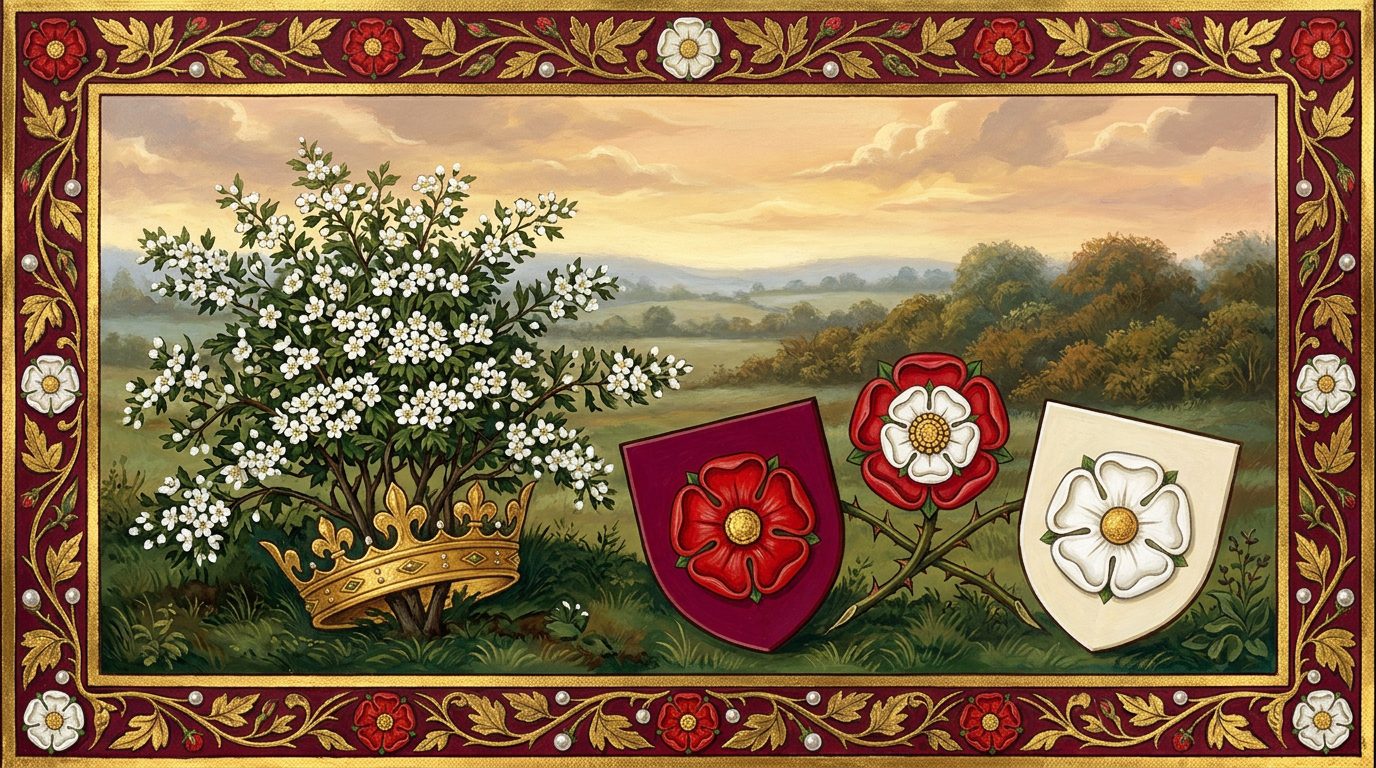
The recovery of the crown from beneath a hawthorn bush is one of history’s most vivid details. Whether it had fallen from Richard’s helmet during the fighting or been cast aside in the chaos of the rout, it was retrieved and placed upon Henry’s head by Lord Stanley in an impromptu ceremony on the battlefield itself. The hawthorn sprig subsequently became incorporated into early Tudor royal symbolism, a botanical reminder of the dynasty’s extraordinary origin.
Significance and Impact: Uniting the Roses
The immediate political challenge facing the new King Henry VII was legitimacy. He had won his crown by force of arms, but conquest alone was a precarious foundation for a dynasty. Henry was shrewd enough to understand that he needed to reconcile the two warring factions, and the most powerful tool available to him was marriage. On 18th January 1486, Henry married Elizabeth of York, the eldest daughter of the late Yorkist King Edward IV and niece of the defeated Richard III. This union was transformative in its symbolism and its practicality.
The marriage united the red rose of Lancaster and the white rose of York into the Tudor Rose, a device that remains one of the most recognisable heraldic symbols in English history. As Chrimes observes, Henry was careful to ensure that his own coronation took place before the marriage, so that Elizabeth’s Yorkist claim would not appear to be the source of his authority. He was king by right of conquest and by act of Parliament; the marriage was a gesture of reconciliation rather than a concession of weakness. It was a distinction that mattered enormously in the political culture of the time.
Beyond the symbolism, the consequences for English society were profound. The Tudor dynasty brought a period of relative political stability after decades of aristocratic conflict. Henry VII pursued a deliberate policy of reducing the independent power of the great noble families, many of whom had grown dangerously militarised during the Wars of the Roses. He strengthened royal finances, curtailed the practice of noble retaining, and used institutions such as the Court of Star Chamber to impose royal authority more consistently across the kingdom. The Tudor state that emerged was more centralised and more bureaucratic than its Plantagenet predecessor, laying the groundwork for the dramatic religious and political transformations of the sixteenth century.
Did you know? Henry VII was so conscious of his dynasty’s fragility that he named his eldest son Arthur, deliberately invoking the legend of a great British king who would restore his nation to glory. The name was a calculated political statement, not merely a romantic choice.
Connections and Context: A Wider World in Transformation
It is worth pausing to consider what else was happening in the world during these pivotal years. The late fifteenth century was a period of extraordinary change across Europe. Just seven years before Bosworth, in 1478, the Spanish Inquisition had been established. In 1492, the very year Henry VII was consolidating his grip on England, Christopher Columbus made landfall in the Americas. The printing press, introduced to England by William Caxton in 1476, was beginning to transform the circulation of ideas and information. Henry VII’s reign thus unfolded against a backdrop of Renaissance humanism, expanding horizons, and the first tremors of what would become the Reformation.
The Tudor dynasty’s relationship with Europe was complex from the outset. Henry had relied on French support to win his throne, and he cultivated diplomatic relationships with considerable care. His daughter Margaret was married to James IV of Scotland, a union that would eventually, through a long and tortuous chain of events, bring the Stuart dynasty to the English throne in 1603. His son Arthur was betrothed and briefly married to Catherine of Aragon, a match that would, after Arthur’s early death, lead to the most consequential remarriage in English history when Henry VIII took Catherine as his own queen.
For readers curious about the period, the question of Richard III’s reputation is a fascinating rabbit hole. Was he the villainous usurper depicted by Tudor propagandists and later immortalised by Shakespeare, or a capable ruler unfairly maligned by the victors of Bosworth? The discovery of Richard III’s remains beneath a Leicester car park in 2012 reignited this debate with remarkable vigour, demonstrating that the events of 1485 remain genuinely contested historical territory.
Modern Relevance and Fascinating Details
The story of Bosworth and the founding of the Tudor dynasty continues to resonate powerfully in popular culture. Philippa Gregory’s novel The White Queen and the subsequent television adaptation brought the Yorkist perspective to a vast new audience, whilst the long-running series of novels by Hilary Mantel, beginning with Wolf Hall, explored the later Tudor period with a depth and brilliance that won two Booker Prizes. As someone who writes historical fiction myself, I am constantly struck by how the questions raised by the events of 1485 never lose their urgency: What makes a ruler legitimate? How does a dynasty survive its own origins? What do we owe to the dead?
Lesser-known details often surprise people who assume they know the Tudor story well. Henry VII, for instance, was a remarkably astute financier who left the Crown in a far stronger fiscal position than he found it, an achievement his more famous son Henry VIII would largely squander. Henry VII also maintained a genuine and lasting affection for his wife Elizabeth of York; when she died in childbirth in 1503, contemporaries noted that the King was visibly devastated, shutting himself away in grief. This tender dimension of the man is easily overlooked in accounts focused solely on his political machinations.
The hawthorn bush itself became a dynastic symbol of quiet but persistent significance. Hawthorn sprigs appeared on early Tudor coins and decorative schemes, a reminder that the dynasty’s founder had literally risen from the earth of England. There is a pleasing poetry in that image, one that connects the political ambitions of 1485 to the landscape and seasons of the country Henry had fought so hard to rule.
Conclusion: The Hawthorn Crown and Its Legacy
The Battle of Bosworth Field on 22nd August 1485 was one of those rare moments when a single day genuinely changed the course of history. Henry Tudor’s victory over Richard III ended the Wars of the Roses, terminated the Plantagenet dynasty, and inaugurated the Tudor age, a period that would encompass the English Reformation, the break with Rome, the reign of Elizabeth I, and the first English explorations of the wider world. Henry’s subsequent marriage to Elizabeth of York was a masterstroke of political reconciliation, transforming a military conquest into a dynastic settlement that would endure for over a century.
Whether you are drawn to the military drama of Bosworth, the political genius of Henry VII, or the romantic symbolism of the united roses, this period offers endlessly rich material for exploration. I would encourage you to pick up Chrimes’ biography or Jones’ vivid account of the battle itself, and to let the extraordinary story of England’s first Tudor king surprise you afresh. History, as the hawthorn crown reminds us, has a way of emerging from the most unexpected places.