
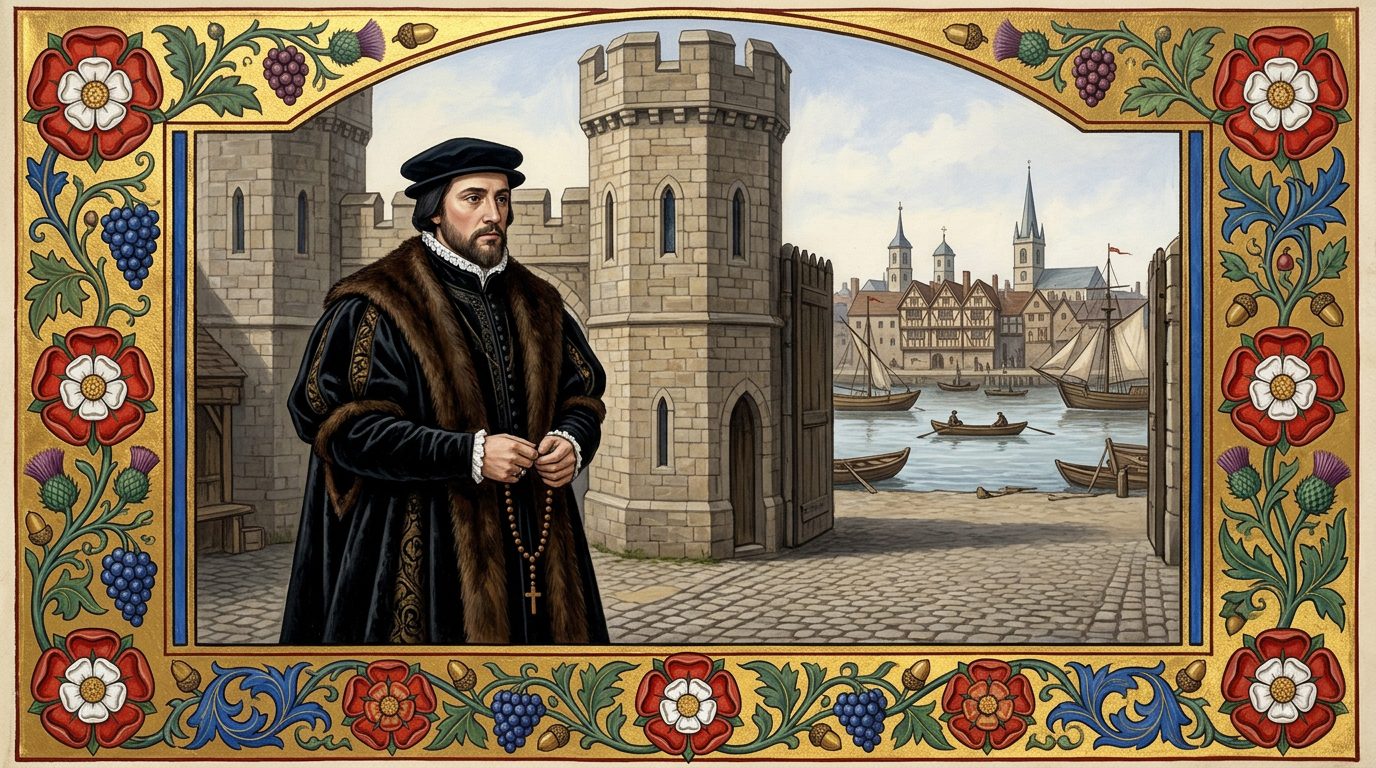
A Man for All Seasons: The Defiance and Death of Thomas More
Imagine climbing the steps of a scaffold on Tower Hill, knowing these are your final moments on earth, and pausing to make a joke. Not a bitter jest, nor a hollow bravado, but a genuinely witty remark that makes the onlookers smile even as they watch a man go to his death. This was Thomas More on 6th July 1535, and that single moment of grace under pressure tells us everything about the man who became one of the most celebrated martyrs in English history. As a historical fiction author who has spent years immersed in the courts and corridors of Tudor England, I find More endlessly fascinating precisely because he defies easy categorisation. He was a humanist scholar and a heresy-hunter, a devoted family man and an unyielding idealist, a man who laughed on his way to the executioner.
The story of Thomas More is not simply a tale of one man’s conscience against a tyrannical king. It is the story of a pivotal moment in English history, when the ancient authority of the Roman Catholic Church collided with the ambitions of Henry VIII, and when the very definition of loyalty, to God, to king, and to self, was thrown into violent question. Understanding More’s life and death means understanding the Tudor Reformation itself, a seismic upheaval that reshaped English religion, politics, and culture for centuries to come.
In this post, we will explore who Thomas More was, why he refused to bend to Henry’s demands, how his execution sent shockwaves through Tudor society, and why his story continues to resonate so powerfully today. Whether you are a seasoned Tudor enthusiast or coming to this history fresh, More’s final act of principled defiance is one of the most extraordinary episodes of the sixteenth century.
Historical Background: Scholar, Statesman, and Saint
Thomas More was born in London on 7th February 1478, the son of a successful lawyer, Sir John More. He received an exceptional education, spending time in the household of Cardinal John Morton, Archbishop of Canterbury, before studying at Oxford and then training in law at Lincoln’s Inn. By his early thirties, More had established himself as one of England’s most brilliant legal minds and a luminous figure in the European humanist movement, a close friend of the Dutch scholar Erasmus, whose In Praise of Folly was partly inspired by More himself. More’s own masterwork, Utopia, published in 1516, cemented his international reputation as a thinker of the first rank.
His rise under Henry VIII was rapid and remarkable. Henry, who fancied himself an intellectual, delighted in More’s sharp wit and formidable learning. More served in a variety of royal capacities before being appointed Lord Chancellor in 1529, the highest legal office in the land, replacing the disgraced Cardinal Thomas Wolsey. He was the first layman to hold the position, and for a time he served the king faithfully and capably. However, the growing crisis over Henry’s desire to annul his marriage to Catherine of Aragon, and the king’s subsequent break with Rome, placed More in an impossible position.
The central question was straightforward but devastating in its implications. Henry VIII, unable to obtain papal approval for his annulment, declared himself Supreme Head of the Church of England through the Act of Supremacy in 1534. All subjects of the crown were expected to swear an oath acknowledging this supremacy. For More, a devout Catholic who believed the pope held supreme spiritual authority, swearing such an oath was simply not possible. He resigned the chancellorship in 1532, hoping that silence might protect him. It did not. As Peter Ackroyd notes in his authoritative biography, The Life of Thomas More (Doubleday, 1998), More understood that his silence was itself a form of speech, one that Henry could not tolerate indefinitely.
More was arrested in April 1534, imprisoned in the Tower of London, and tried for treason in July 1535. The charge rested on the testimony of Richard Rich, the Solicitor-General, who claimed More had denied the king’s supremacy in a private conversation, a claim More vigorously disputed. The verdict was never truly in doubt. More was convicted and sentenced to death. On the morning of 6th July 1535, he walked to Tower Hill, where the scaffold awaited him. William Roper, More’s son-in-law and first biographer, recorded that as More climbed the rickety structure, he turned to an attendant and said he needed help getting up, but could ‘shift for himself’ when it came to coming down. It was his last joke, and it was a very good one.
Significance and Impact: A Martyrdom That Shook Tudor England
More’s execution was not simply the death of a political inconvenient. It was a statement, made in blood, about the absolute nature of royal power in Henrician England. Henry VIII had already demonstrated his willingness to destroy his closest servants, as Wolsey’s downfall had shown, but executing a man of More’s international stature was something altogether different. The execution shocked the courts of Europe. The Holy Roman Emperor Charles V, a staunch Catholic and nephew of the discarded Catherine of Aragon, expressed outrage. Pope Paul III later canonised More in 1935, four centuries after his death.
Within England, the impact was deeply chilling. If a man as learned, as careful, and as beloved as Thomas More could be executed for a matter of conscience, then no subject was truly safe. The message from the Tudor court was unambiguous: loyalty to the king now took absolute precedence over loyalty to Rome. As Ackroyd observes, More’s death helped consolidate a culture of conformity and fear in Henry’s court during the 1530s, a decade that also claimed the lives of Anne Boleyn, Thomas Cromwell, and countless others.
Yet More’s martyrdom also had an unintended consequence. It gave the Catholic resistance to the English Reformation a potent symbol, a man of unimpeachable learning and integrity who had chosen death over compromise. His story, circulated through William Roper’s memoir and other accounts, kept the flame of Catholic recusancy burning in England for generations. Did you know that More’s head was displayed on London Bridge after his execution, as was customary for traitors, but that his daughter Margaret Roper reportedly bribed a guard to retrieve it before it could be thrown into the Thames? She is said to have kept it until her own death.
Connections and Context: The Tudor Reformation in Full Swing
More’s execution did not occur in isolation. The mid-1530s were among the most turbulent years of Henry’s reign. Thomas Cromwell, the king’s chief minister, was simultaneously overseeing the dissolution of the monasteries, a sweeping programme that would transfer enormous wealth from the Church to the crown and fundamentally alter the religious landscape of England. The same month More died, the humanist bishop John Fisher, More’s fellow prisoner in the Tower, was also executed for refusing to swear the oath of supremacy. Fisher’s death came just two weeks before More’s, on 22nd June 1535, and the two martyrdoms together provoked an even greater international outcry.
It is worth remembering that Anne Boleyn, whose relationship with Henry had been the catalyst for the entire break with Rome, was herself only a year away from arrest and execution by this point. The world More died in was one of extraordinary instability, where the rules of power, religion, and survival were being rewritten almost daily. The English Reformation was not a single event but a prolonged and often violent negotiation, and More’s death was one of its most dramatic chapters.
For readers interested in exploring further, the interplay between More, Cromwell, and Henry VIII is brilliantly reconstructed in historical fiction, most notably in Hilary Mantel’s Wolf Hall trilogy, which takes the fascinating step of presenting More as a complex, sometimes troubling figure rather than a straightforward hero. This is historically honest: More was also a man who presided over the persecution of Protestant heretics, a dimension of his character that any balanced account must acknowledge.
Modern Relevance and Fascinating Details: Why More Still Matters
The question people most often ask about Thomas More is simply this: why did he not just swear the oath? He was a lawyer of genius, and clever men had found ways to navigate the crisis without sacrificing their lives. The answer, as Roper’s biography makes movingly clear, is that More believed with absolute conviction that to swear falsely on a matter of eternal consequence was to endanger his immortal soul. In his own words, reported by Roper, More said he died ‘the king’s good servant, but God’s first.’ That phrase has echoed through five centuries for good reason.
More’s story has proved irresistible to dramatists and novelists. Robert Bolt’s celebrated 1960 play A Man for All Seasons, later adapted into an Academy Award-winning film in 1966 starring Paul Scofield, brought More’s dilemma to a mass audience and framed him as the archetypal man of conscience resisting the overreach of state power. The play remains a staple of school curricula and amateur dramatics, and its central themes, individual integrity against institutional pressure, feel as urgent now as they did in the Tudor court or the Cold War era in which Bolt wrote.
Did you know that More was also a devoted and unusually progressive father by the standards of his time? He insisted on providing his daughters with the same rigorous classical education as his son, which was highly unconventional in the early sixteenth century. His daughter Margaret became one of the most learned women in England, corresponding in Latin with Erasmus himself. This dimension of More’s character, the man who championed women’s education centuries before it was fashionable, adds yet another layer of complexity to a figure who continues to reward close study.
Conclusion: A Legacy Written in Courage
Thomas More’s refusal to bow to Henry VIII, and his death on Tower Hill on a warm July morning in 1535, remains one of the defining moments of the Tudor age. It crystallised, in one man’s fate, the central conflicts of the English Reformation: between old faith and new politics, between individual conscience and royal command, between the spiritual and the temporal. His final joke about the scaffold is not merely a charming anecdote. It is a window into an extraordinary character, a man so secure in his own convictions that he could face death with humour and grace.
If More’s story has caught your imagination, I warmly encourage you to seek out William Roper’s The Life of Sir Thomas More (Dover Publications, 2005), the first and most intimate account of his life written by someone who knew him personally, and Peter Ackroyd’s magisterial The Life of Thomas More (Doubleday, 1998), which sets More’s world in rich and authoritative detail. The Tudor period never ceases to surprise, and in Thomas More it gave us one of its most enduring and thought-provoking figures.