
The Virgin Queen: Why Elizabeth I Refused to Marry and How That Decision Changed England Forever
Imagine holding the most powerful position in the land, yet facing relentless pressure from every corner of your court, your council, and your country to surrender a significant portion of that power to a husband. This was the reality facing Elizabeth I of England from the moment she ascended the throne on 17th November 1558. Her response to that pressure was nothing short of revolutionary: she simply refused to comply. In doing so, she crafted one of the most remarkable political identities in the history of the British monarchy, becoming the woman who declared herself married not to a man, but to England itself.
As both a Tudor history expert and a historical fiction author, I find Elizabeth's marriage question endlessly fascinating precisely because it sits at the intersection of personal psychology, political genius, and sheer theatrical brilliance. The question of why Elizabeth never married is one of the most frequently searched topics in Tudor history, and yet the answer is far more nuanced than simple romantic tragedy or stubborn independence. It was, at its core, a calculated and enormously successful strategy that allowed her to reign with remarkable autonomy for 45 years.
In this post, we will explore the historical background of Elizabeth's famous decision, examine the profound political and cultural impact it had on Tudor England, and consider why this extraordinary woman's choice continues to captivate historians, novelists, and readers centuries after her death in 1603.
Historical Background: The Queen Who Kept Europe Waiting
To understand Elizabeth's attitude towards marriage, we must first understand the world she inherited. Born on 7th September 1533 at Greenwich Palace to Henry VIII and his second wife Anne Boleyn, Elizabeth had witnessed the catastrophic consequences of royal marriages from the very beginning of her life. Her mother was executed when Elizabeth was just two years old. Her stepmother Catherine Howard suffered the same fate. Her half-brother Edward VI died young, and her half-sister Mary I's marriage to Philip II of Spain had proved deeply unpopular and politically disastrous. By the time Elizabeth took the crown at the age of twenty-five, she had every reason to view matrimony with considerable wariness.
The suitors came quickly and from across Europe. As Alison Weir details in Elizabeth the Queen: The Life of the Virgin Queen (1998), the list of men who sought Elizabeth's hand reads like a who's who of sixteenth-century European royalty and nobility. Philip II of Spain, who had been married to her half-sister Mary, proposed almost immediately after Elizabeth's accession. Archduke Charles of Austria, Eric XIV of Sweden, and Archduke Ferdinand of Austria were among the foreign candidates. Closer to home, Robert Dudley, Earl of Leicester, Elizabeth's great favourite and childhood friend, was widely believed to hold a special place in her affections, though the mysterious death of his wife Amy Robsart in 1560 made any formal match politically impossible.
What makes Elizabeth's position so extraordinary is that, during the 1560s, Parliament repeatedly petitioned her to marry and produce an heir, terrified of a succession crisis should she die without children. The threat was real: Mary Queen of Scots, a Catholic claimant with strong French connections, waited in the wings. Yet Elizabeth consistently deflected, delayed, and diplomatically evaded every serious proposal. As Jasper Ridley notes in Elizabeth I: The Shrewdness of Virtue (1987), what appeared to her contemporaries as indecision was, in retrospect, something far shrewder: a deliberate policy of strategic ambiguity.
The most celebrated expression of her chosen identity came in her famous speech to Parliament in 1559, when she declared: 'And, in the end, this shall be for me sufficient, that a marble stone shall declare that a Queen, having reigned such a time, lived and died a virgin.' Later, addressing her troops at Tilbury in 1588 as the Spanish Armada threatened invasion, she powerfully reinforced this image, telling her soldiers she had the body of a weak and feeble woman but the heart and stomach of a king. The Virgin Queen had become not merely a political figure but a mythological one.
Significance and Impact: Marriage as a Diplomatic Weapon
The genius of Elizabeth's approach lay in recognising what marriage negotiations could achieve without a marriage ever actually taking place. By keeping herself technically available, she transformed her unmarried status into one of the most potent diplomatic tools of the sixteenth century. Foreign powers who might otherwise have allied against England were kept cooperative by the dangled possibility that their prince or king might one day sit beside her on the English throne. It was, as Ridley observes, a masterclass in political theatre.
The most extended of these diplomatic dances involved Francis, Duke of Anjou, the younger brother of Henry III of France. Negotiations with Anjou, who was twenty-two years Elizabeth's junior, continued into the early 1580s, by which point Elizabeth was nearly fifty. Contemporaries were astonished. Her courtiers were alarmed. Yet the negotiations served England's interests perfectly, helping to secure French support and neutralise potential threats from the continent during a particularly dangerous period of religious conflict across Europe.
Beyond foreign policy, Elizabeth's unmarried status had profound consequences for the nature of royal authority itself. A married queen regnant in the sixteenth century was expected, by law and custom, to defer to her husband in matters of governance. Mary I had struggled enormously with this dynamic during her marriage to Philip II. By remaining single, Elizabeth ensured that the crown's authority remained undivided and entirely her own. She was the sole sovereign, and no man could claim power through her. This was genuinely revolutionary in an era when a woman's legal identity was considered subsumed within her husband's upon marriage.
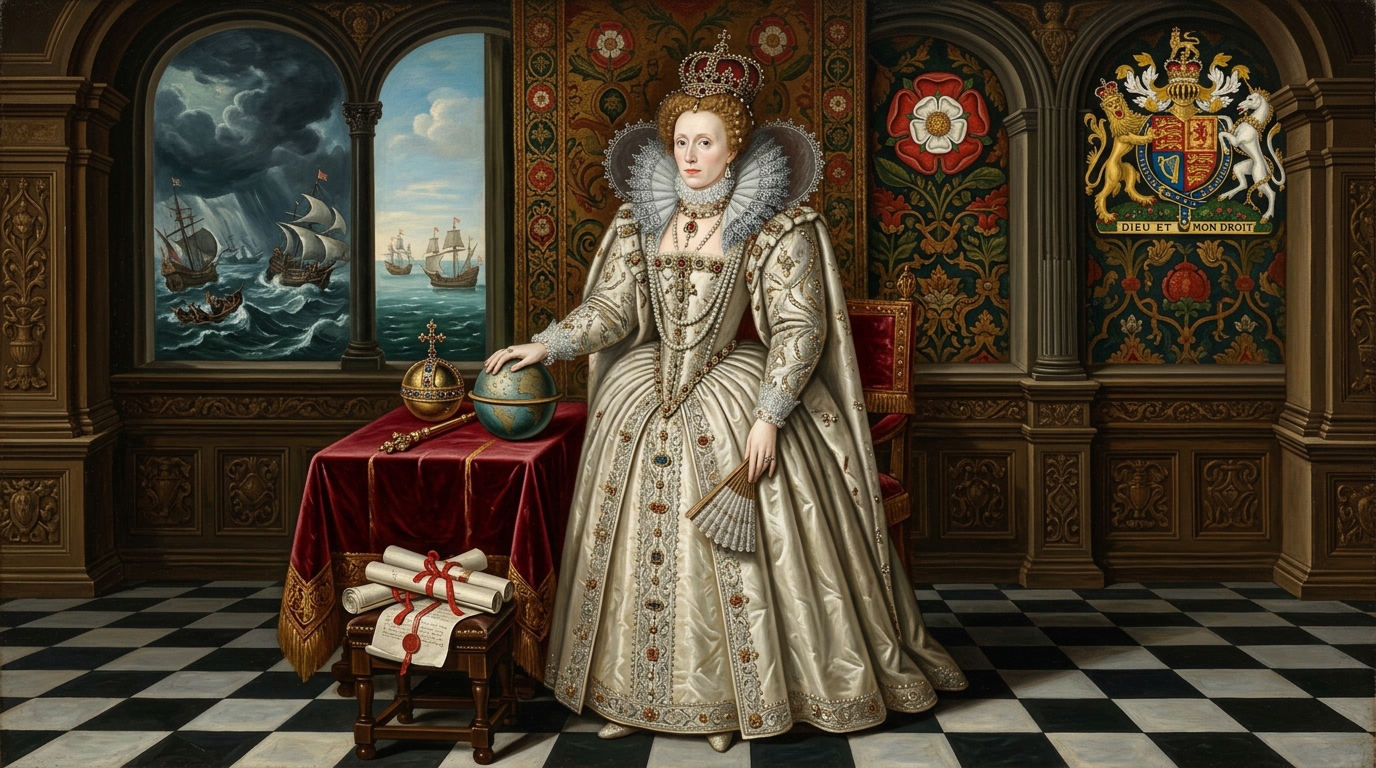
The cultural impact was equally significant. Elizabeth actively cultivated the image of the Virgin Queen, drawing on religious and classical imagery to present herself as a quasi-sacred figure. Portraits, poems, pageants, and court entertainments all reinforced this mythology. Writers and courtiers competed to praise her in elaborate terms, producing a body of literature and art that shaped the entire cultural output of the Elizabethan age. As a historical fiction author, I find this self-conscious image-making endlessly rich as a subject: Elizabeth was, among other things, one of history's most sophisticated personal brand builders.
Connections and Context: The Wider Tudor World
Elizabeth's marriage question cannot be separated from the broader religious upheaval of the sixteenth century. The Reformation had fundamentally altered the political landscape of Europe, and a queen's choice of husband carried enormous implications for England's religious settlement. A Catholic husband might threaten the Protestant reforms Elizabeth had carefully re-established after Mary I's reign. A Protestant foreign prince might drag England into dangerous continental conflicts. Remaining single neatly sidestepped both hazards.
It is also worth considering Elizabeth's situation alongside that of Mary Queen of Scots, whose marital history provided Elizabeth with a vivid cautionary tale. Mary's marriages, first to Francis II of France, then to the feckless Lord Darnley, and finally to the scandalous Earl of Bothwell, contributed directly to her downfall, her imprisonment, and ultimately her execution at Fotheringhay Castle in 1587. The contrast between the two queens could hardly have been more stark, or more instructive.
Did you know? The term 'Elizabethan Era' is sometimes used interchangeably with England's cultural golden age, encompassing the works of Shakespeare, Marlowe, and Spenser, the circumnavigation of the globe by Francis Drake, and the beginnings of English colonial ambition in the Americas. Many historians argue that this extraordinary flourishing was, at least in part, made possible by the political stability Elizabeth's long, uncontested reign provided, a stability that a contested royal marriage might well have undermined.
Modern Relevance and Fascinating Details
Why does a sixteenth-century queen's decision about marriage still captivate us today? Partly, it is the sheer human drama of the story. Elizabeth almost certainly had genuine feelings for Robert Dudley that she suppressed in the interests of political survival. The tension between personal desire and public duty is as resonant now as it was in 1559. Partly, too, it is the remarkable modernity of her instinct: that a woman's authority need not be filtered through a male partner is an idea that feels contemporary even when expressed in the language of the sixteenth century.
In popular culture, Elizabeth's story has been told and retold countless times. Cate Blanchett's portrayal in the 1998 film Elizabeth and its 2007 sequel Elizabeth: The Golden Age brought the Virgin Queen mythology to new audiences. Hilary Mantel, in interviews before her death, spoke of Elizabeth as one of history's most fascinating subjects precisely because of the ambiguity surrounding her inner life. Historical fiction exploring Elizabeth's court consistently ranks among the most popular of the genre, testament to our enduring hunger to understand this most enigmatic of monarchs.
Did you know? Elizabeth reportedly owned over 2,000 dresses at the time of her death, each one carefully chosen as part of her public image. The elaborate ruffs, jewels, and rich fabrics she wore in portraits were not vanity but political messaging, projecting wealth, power, and an almost otherworldly magnificence designed to overawe both subjects and foreign ambassadors alike.
Conclusion: A Decision That Shaped a Nation
Elizabeth I's choice never to marry was not a failure of romance or a personal eccentricity. It was, as both Alison Weir and Jasper Ridley make clear in their authoritative studies, a sophisticated and remarkably successful political strategy that preserved her independence, strengthened England's diplomatic position, and allowed her to reign as a genuinely sovereign monarch in an age that had no real framework for such a concept. She took the limitations imposed upon her by her gender and transformed them into instruments of power.
The Virgin Queen remains one of history's most compelling figures precisely because she defied the expectations of her age so completely and so brilliantly. If you would like to explore this period further, I would warmly recommend beginning with Alison Weir's biography alongside a visit to the portrait galleries at the National Portrait Gallery in London, where Elizabeth's carefully constructed image looks out across the centuries with an expression that still manages to be both welcoming and utterly inscrutable. Some mysteries, it seems, are designed to last forever.