The Godly Marriage: Somerset’s Proclamation and the Tudor Dream of British Unity
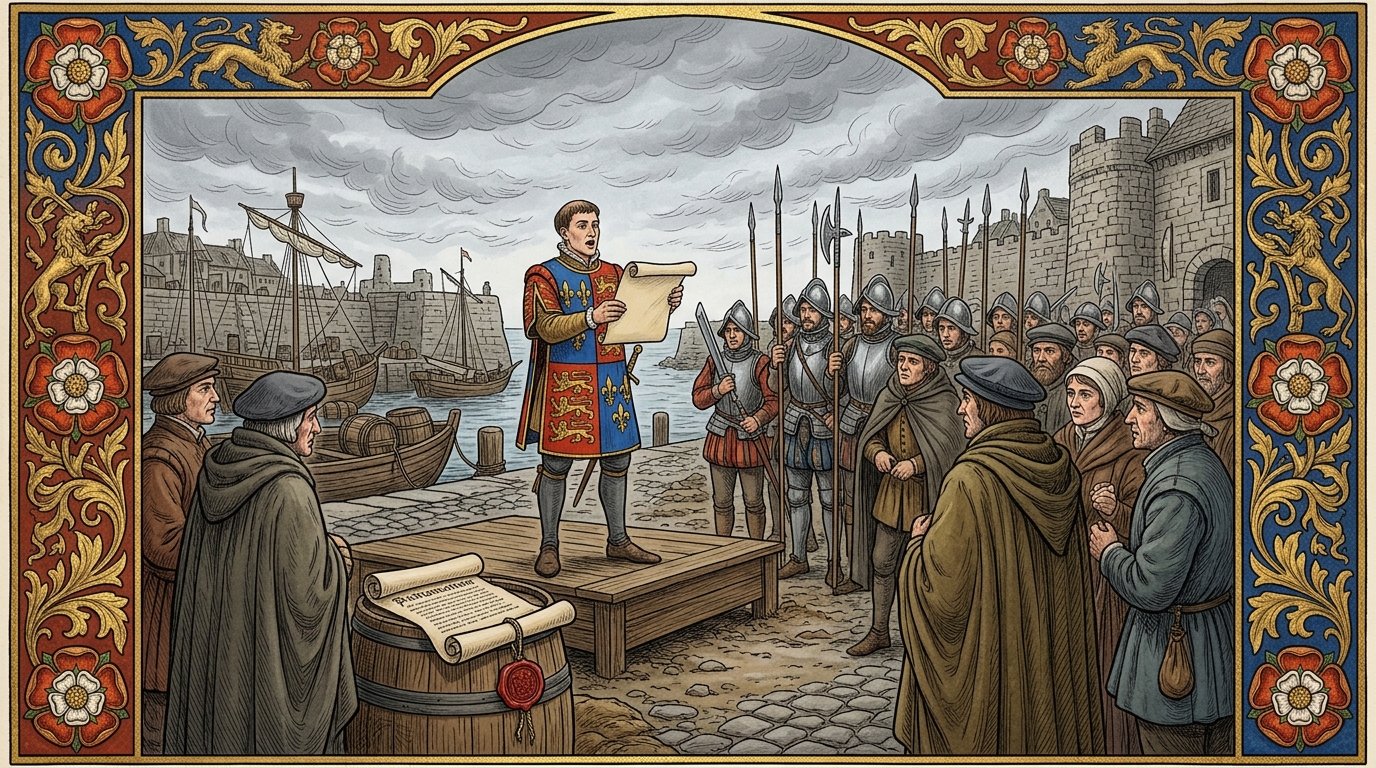
Imagine standing on the windswept docks of Leith in September 1547, watching English soldiers patrol the streets of Scotland’s greatest port whilst their commander, the most powerful man in England, put quill to parchment and attempted to reshape the destiny of two nations. On 14 September 1547, just days after one of the bloodiest battles ever fought on British soil, Edward Seymour, Duke of Somerset and Lord Protector of England, issued a remarkable proclamation urging the Scottish people to embrace what he called the ‘Godly Marriage’ between the young King Edward VI and the infant Mary, Queen of Scots. It was an audacious political gamble dressed up in the language of divine providence, and it tells us everything we need to know about Tudor ambitions, anxieties, and the enduring dream of a united Britain.
As a historical fiction author who has spent years immersed in the politics and personalities of the Tudor court, I find this moment endlessly fascinating. Here was a man who had just won a stunning military victory, yet chose to follow it not with iron-fisted conquest but with a carefully worded appeal to Scottish hearts and minds. Whether that appeal was sincere or cynical is a question historians still debate, but its existence reveals the extraordinary complexity of mid-Tudor statecraft. This blog post will explore the background to Somerset’s proclamation, its significance for both England and Scotland, and why this almost-forgotten episode deserves a far more prominent place in our understanding of Tudor history.
By the time you finish reading, you will understand not only what the ‘Godly Marriage’ actually meant and why Somerset believed in it so passionately, but also how this proclamation fits into the sweeping narrative of Anglo-Scottish relations, the Protestant Reformation, and the long road that eventually led to the Union of the Crowns in 1603. The answers, as so often in Tudor history, are stranger and more compelling than you might expect.
Historical Background: Who, Where, and Why
To understand Somerset’s proclamation, we must first understand the man himself. Edward Seymour had risen to power on the coat-tails of his nephew, the nine-year-old Edward VI, who had inherited the English throne upon the death of Henry VIII in January 1547. As Lord Protector, Somerset effectively governed England, and he brought to that role a genuine Protestant conviction and an unusually idealistic vision of Anglo-Scottish relations. Rather than simply seeking to conquer Scotland by force, Somerset believed that the two kingdoms shared a common Protestant destiny and ought to be united through the marriage of their monarchs. He articulated this vision most clearly in his ‘Epistle or Exhortation to Unitie and Peace’, published earlier in 1547, in which he argued that the English and Scots were essentially one people divided by politics rather than by blood or faith.
The immediate context for the September 1547 proclamation was Somerset’s northern campaign, which historians have come to call the ‘Rough Wooing’, a phrase originally coined by the Scottish writer Sir Walter Scott. This campaign was itself a continuation of Henry VIII’s aggressive policy of attempting to force the Scots to honour the Treaty of Greenwich (1543), which had agreed to the marriage alliance between Edward and Mary. The Scots had repudiated that treaty and renewed their alliance with France, and Henry had responded with devastating raids across the border. Somerset inherited this conflict and, after careful preparation, led a large English army north in September 1547.
The campaign reached its defining moment on 10 September 1547 at the Battle of Pinkie Cleugh, fought near Musselburgh on the Firth of Forth. The English victory was overwhelming. Scottish casualties numbered somewhere between five thousand and ten thousand men, making Pinkie one of the most catastrophic defeats in Scottish military history. According to Barrett L. Beer’s authoritative study ‘The Rise and Fall of the Protectorate’, Somerset followed up this victory by garrisoning a string of fortresses across southern Scotland, attempting to establish permanent English military dominance whilst simultaneously pursuing his diplomatic and propagandistic campaign.
It was against this backdrop of military triumph and diplomatic outreach that Somerset issued his proclamation from Leith on 14 September 1547. Leith, as the port of Edinburgh, was a symbolically charged location: Somerset was in the very heart of Scottish political life, yet he chose not to march on Edinburgh Castle (where the young Mary, Queen of Scots, was being sheltered) but instead to publish his appeal for peaceful union. The Acts of the Privy Council of England, Volume 2 records the administrative machinery behind the campaign, giving us a vivid sense of how seriously Somerset and his councillors took the propaganda dimension of their northern strategy.
Significance and Impact: Why This Proclamation Matters
Somerset’s proclamation was significant for several interlocking reasons, and unpicking them helps us understand not just the 1540s but the entire arc of Tudor foreign policy. First and most obviously, it represented an attempt to justify English aggression in moral and religious terms. By framing the proposed marriage as a ‘Godly’ union, Somerset was appealing to the growing Protestant sympathies of some Scots whilst simultaneously presenting English expansionism as divinely ordained. This was Tudor spin at its most sophisticated, and it anticipates the kind of providential language that would later characterise Elizabethan imperialism.
Second, the proclamation reflects a genuinely novel approach to the question of Anglo-Scottish union. Previous English kings had generally sought to subordinate Scotland outright, but Somerset was proposing something more subtle: a dynastic union that would, at least in theory, preserve Scottish identity whilst binding the two kingdoms together under Protestant governance. As Beer notes in his analysis of the Protectorate, Somerset’s vision was in some respects ahead of its time, anticipating the arguments that would eventually underpin the Union of the Crowns under James VI and I in 1603.
Third, and perhaps most poignantly, the proclamation demonstrates the ultimate limits of military power. Somerset had just won a devastating victory, yet he understood that garrisoning Scottish castles and issuing proclamations would never, on their own, win Scottish consent. The Scottish political classes remained deeply suspicious of English intentions, and the French were working actively to counteract English influence. Within months of Pinkie, the young Mary, Queen of Scots, had been spirited away to France for safekeeping, and the dream of the ‘Godly Marriage’ had effectively died. The proclamation thus stands as a monument to the gap between Tudor ambition and Tudor achievement.
The consequences for Scotland were profound and lasting. The Rough Wooing, of which Somerset’s 1547 campaign was the culmination, left deep scars on the Scottish countryside and psyche, hardening anti-English sentiment for generations. Paradoxically, however, the religious changes that Somerset was promoting in England were simultaneously influencing Scottish reformers, and the Protestant Reformation in Scotland accelerated dramatically during the 1550s. In this roundabout way, Somerset’s ‘Godly’ ambitions bore unexpected fruit, even as his political and dynastic plans crumbled.
Connections and Context: The Wider Tudor World
It is worth pausing to consider what else was happening in September 1547, because the proclamation from Leith did not exist in isolation. In England, the Edwardian Reformation was gathering pace: Thomas Cranmer was working towards the liturgical changes that would eventually produce the Book of Common Prayer of 1549, and Protestant ideas were spreading rapidly through the educated classes. Somerset’s northern campaign was therefore part of a broader programme of Protestant consolidation, both at home and abroad.
The proclamation also connects directly to the question of Mary, Queen of Scots, whose life would intersect so dramatically with English affairs over the following decades. In September 1547, Mary was just four years old, sheltered in Stirling Castle whilst the English army rampaged across her kingdom. The ‘Godly Marriage’ that Somerset was promoting in his proclamation would eventually give way to Mary’s marriage to the French Dauphin Francis in 1558, a union that temporarily made her Queen of France as well as Scotland, and which shifted the balance of power in Europe dramatically against England.
Did you know? Somerset’s proclamation was not his first attempt at Anglo-Scottish propaganda. Earlier in 1547 he had published a lengthy pamphlet arguing, partly on etymological grounds, that the very name ‘Britain’ demonstrated that the two kingdoms were naturally one. It was an argument that combined Renaissance humanism with political ambition in a way that is entirely characteristic of the mid-Tudor intelligentsia.
Modern Relevance and Fascinating Details
For modern readers, the episode raises questions that feel surprisingly contemporary. What does it mean to try to win hearts and minds through propaganda whilst simultaneously pursuing military goals? How do powerful nations justify their interference in smaller neighbours’ affairs through the language of shared values and common destiny? Somerset’s proclamation from Leith could almost serve as a case study in the rhetoric of benevolent imperialism, a phenomenon that has certainly not disappeared from international politics.
From a historical fiction perspective, the Battle of Pinkie and its aftermath offer extraordinary dramatic material. The image of Somerset, at the height of his power, issuing his idealistic proclamation from a conquered Scottish port, even as the political ground was already shifting beneath his feet, is almost Shakespearean in its blend of triumph and hubris. Somerset would be executed in January 1552, brought down by the machinations of John Dudley, Duke of Northumberland, and his fall from grace would prove as dramatic as his rise. The proclamation of September 1547 thus belongs to the very peak of his arc, a moment of maximum ambition before the long descent.
Did you know? The word ‘Rough Wooing’ has entered the English language as a general term for aggressive or coercive courtship, a linguistic legacy of Somerset’s failed campaign that most people who use the phrase have no idea about.
In terms of popular culture, the Rough Wooing and its associated diplomacy have received relatively little attention compared to, say, the marriages of Henry VIII or the reign of Elizabeth I. This is a shame, because the story of the ‘Godly Marriage’ that never was, and of the two young monarchs whose fates were shaped by adult ambitions they could not control, is one of the most poignant in all of Tudor history.
Conclusion: A Proclamation Worth Remembering
Somerset’s proclamation from Leith on 14 September 1547 is one of those historical moments that repays careful attention precisely because it sits at the intersection of so many different stories: the story of the Tudor Reformation, of Anglo-Scottish rivalry, of the failed dream of British unity, and of one man’s extraordinary rise and fall. Drawing on records preserved in the Acts of the Privy Council of England and analysed with such care by Barrett L. Beer, it offers a window into a world of genuine idealism colliding with brutal political reality, a combination that is, perhaps, timeless.
If you found this exploration of Somerset’s ‘Godly Marriage’ proclamation compelling, I would encourage you to delve deeper into the Edwardian period, one of the most underrated chapters in all of Tudor history. The questions it raises about religion, nationhood, power, and propaganda are as alive today as they were on that September morning in Leith nearly five centuries ago.