
Introduction
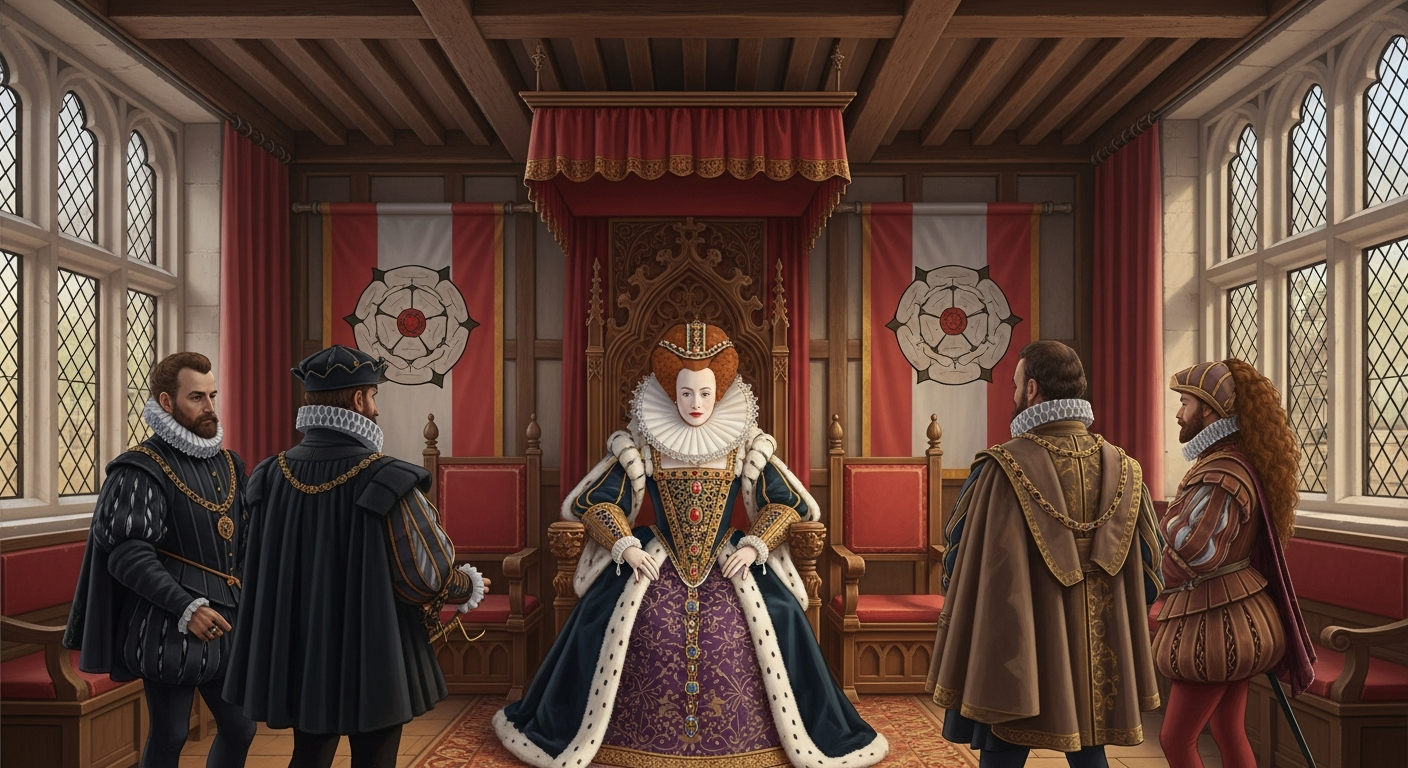
Picture this scene: a foreign ambassador sits confidently across from England’s young queen, believing his secret instructions whispered in Italian would remain hidden from English ears. Suddenly, Elizabeth I responds in perfect Italian, her eyes glinting with amusement as the diplomat’s face drains of colour. This wasn’t mere showing off – it was psychological warfare at the highest level of Tudor diplomacy.
Elizabeth I’s extraordinary linguistic abilities extended far beyond what most people realise. She spoke at least six languages fluently, including Latin, Greek, French, Italian, Spanish, and Flemish, and wielded these skills as diplomatic weapons. Her practice of switching between languages during crucial negotiations became one of her most effective tools for wrong-footing foreign representatives and gaining the upper hand in international relations.
Understanding Elizabeth’s multilingual prowess reveals not just her exceptional education, but how language became a cornerstone of her political strategy during one of England’s most pivotal periods. From her childhood tutoring to her legendary encounters with European ambassadors, Elizabeth’s linguistic talents shaped the very foundation of Elizabethan diplomacy.
Historical Background
Elizabeth’s remarkable education began in earnest around 1544, when she was eleven years old and her tutors included some of the finest scholars of the Renaissance. Her primary instructor was William Grindal, a protégé of the famous Cambridge humanist Roger Ascham, who later took over her education directly. Under their guidance, Elizabeth mastered not just modern European languages but also the classical tongues that formed the backbone of scholarly discourse.
The scope of Elizabeth’s linguistic education reflected the political realities of sixteenth-century Europe. French was essential for communication with England’s nearest continental neighbour and frequent rival. Spanish proved crucial during the delicate negotiations surrounding her potential marriage to Philip II and later during the mounting tensions with Spain. Italian opened doors to the sophisticated courts of Renaissance Italy and their influential banking networks, whilst Flemish connected her to the vital Low Countries trade routes that filled England’s coffers.
By the time Elizabeth ascended to the throne in 1558 at age twenty-five, she could conduct sophisticated theological debates in Latin, quote Greek philosophy, and seamlessly transition between modern European languages depending on her audience. Contemporary accounts from the Calendar of State Papers Foreign document numerous instances where Elizabeth deliberately switched languages mid-conversation, often catching ambassadors off-guard when they assumed she couldn’t understand their native tongue.
The young queen’s linguistic prowess became legendary throughout European courts. Ambassador reports sent back to their home countries frequently mentioned Elizabeth’s unsettling habit of responding in their own language to comments they believed were private. This reputation preceded her into negotiations, fundamentally altering the dynamics of diplomatic encounters before they even began.
Significance and Impact
Elizabeth’s multilingual abilities represented far more than scholarly achievement – they constituted a revolutionary approach to royal diplomacy. In an era when most European monarchs relied heavily on interpreters and advisers, Elizabeth’s direct communication capabilities gave her unprecedented control over international negotiations. She could catch nuances, detect deceptions, and respond immediately without the delays that typically plagued diplomatic correspondence.
The psychological impact of Elizabeth’s linguistic warfare cannot be overstated. When foreign ambassadors realised the English queen understood their every word, the traditional diplomatic advantage of private consultation in one’s native tongue evaporated entirely. David Starkey notes in ‘Elizabeth: The Struggle for the Throne’ how this linguistic dominance became central to Elizabeth’s broader strategy of projecting intellectual superiority over her male counterparts across Europe.
Perhaps most significantly, Elizabeth’s language skills allowed her to engage directly with the theological and philosophical debates that dominated European politics. Her ability to quote scripture in Latin during religious discussions with Catholic ambassadors, or to reference Greek classical texts when debating governmental theory, positioned her as an intellectual equal to Europe’s most educated rulers. This was particularly important for a female monarch in an age when women’s intellectual capabilities were routinely questioned.
The broader implications extended to English court culture as well. Elizabeth’s example inspired a generation of English nobility to pursue serious linguistic education, contributing to what historians now recognise as the flowering of Renaissance learning in England. Her court became a magnet for scholars, poets, and intellectuals from across Europe, partly because they knew they could engage with the monarch directly in their own languages.
Connections and Context
Elizabeth’s linguistic diplomacy proved particularly crucial during several key moments of her reign. During the complex negotiations surrounding the proposed marriage to Archduke Charles of Austria in the 1560s, her ability to communicate directly with Imperial ambassadors in both Latin and the relevant vernacular languages allowed her to maintain the delicate balance between encouraging and discouraging the match according to England’s shifting political needs.
The famous encounters with Mendoza, the Spanish ambassador, during the 1580s showcase Elizabeth’s tactical use of language switching. Contemporary accounts describe how she would begin conversations in formal Latin, shift to French when discussing general European affairs, then surprise the ambassador by responding to his aside comments in fluent Spanish. This linguistic agility became particularly important as tensions with Spain escalated toward the 1588 Armada crisis.
Elizabeth’s multilingual abilities also connected to the broader European context of Renaissance humanism. Her education paralleled that of other notable female scholars like Lady Jane Grey and her own step-mother Catherine Parr, reflecting the brief flowering of serious female education among the English nobility. However, Elizabeth’s position as monarch allowed her to deploy these skills on the international stage in ways unavailable to other learned women of her era.
Modern Relevance and Fascinating Details
Did you know that Elizabeth I reportedly dreamed in Latin? Contemporary accounts suggest her classical education was so thorough that she thought naturally in the ancient language, particularly when composing formal speeches or documents. This detail illustrates the depth of her linguistic immersion and helps explain how she could deploy these languages so effectively under the pressure of high-stakes diplomatic encounters.
Modern psychological research on multilingualism provides fascinating insights into Elizabeth’s diplomatic advantages. Studies show that multilingual individuals often experience personality shifts when switching languages, and that they can appear more authoritative or more approachable depending on their linguistic choice. Elizabeth seems to have instinctively understood these principles, using formal Latin to establish gravitas, switching to French for more intimate diplomatic discussions, or deploying someone’s native tongue to create either connection or unsettling surprise.
Elizabeth’s linguistic legacy continues to fascinate popular culture and historical fiction. From Cate Blanchett’s portrayal in the ‘Elizabeth’ films to countless historical novels, modern interpretations often highlight these multilingual scenes as pivotal character moments. However, many popular depictions underestimate the true extent of Elizabeth’s abilities, focusing on dramatic reveal moments rather than the sustained intellectual endurance required to conduct complex negotiations in multiple languages over hours or days.
Conclusion
Elizabeth I’s mastery of six languages represents one of the most underappreciated aspects of her legendary reign. Far from mere scholarly ornament, her linguistic abilities became fundamental weapons in England’s diplomatic arsenal. By speaking directly with foreign representatives in their own tongues, she eliminated the traditional barriers that separated monarchs from the nuances of international negotiation, whilst simultaneously creating psychological advantages that wrong-footed even the most experienced ambassadors.
The next time you encounter Elizabeth I in historical accounts or popular culture, remember that behind the iconic image of the Virgin Queen lay one of Europe’s most formidable polyglots. Her legacy reminds us that in the Tudor world, as in our own globalised era, the power to communicate across linguistic boundaries often determines who controls the conversation – and ultimately, who shapes the course of history.