
Introduction
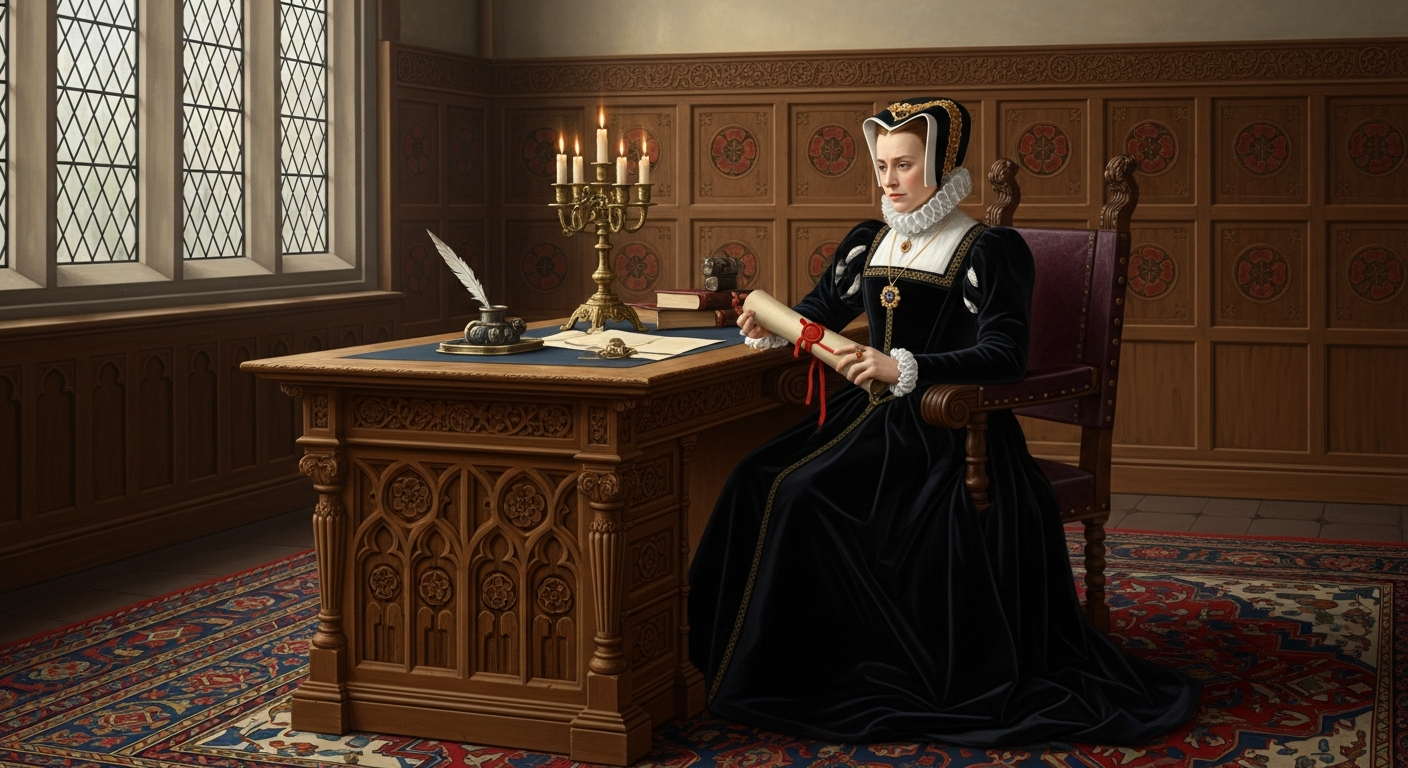
On a cold February morning in 1587, Elizabeth I of England threw a document across her chamber at her secretary William Davison in a fit of royal fury. That piece of parchment was no ordinary correspondence – it was the death warrant for Mary Queen of Scots, and its signing marked the end of one of the most complex and tragic royal relationships in British history. The scene captures perfectly the anguish Elizabeth felt at being forced to execute her own cousin after keeping her prisoner for nearly two decades.
The relationship between these two queens – one Protestant, one Catholic; one secure on her throne, the other a perpetual exile – illuminates the religious and political tensions that defined 16th-century Britain. Their story is one of family bonds strained by political necessity, where personal feelings collided with the brutal realities of Tudor statecraft.
This tale reveals not just the dramatic final moments of Mary Stuart’s life, but also the psychological torment Elizabeth endured in authorising the execution of an anointed queen, the dangerous precedent it set, and why their relationship remained one of the most fascinating and tragic in royal history.
Historical Background
Mary Stuart became Queen of Scots at just six days old following her father’s death in 1542, making her one of history’s youngest monarchs. Raised in the French court and married briefly to the Dauphin, she returned to Scotland in 1561 as a Catholic queen ruling over an increasingly Protestant nation. Her tumultuous reign included a disastrous second marriage to Lord Darnley, his mysterious murder, and her controversial third marriage to the Earl of Bothwell, widely suspected of Darnley’s death.
These scandals proved Mary’s undoing. Facing rebellion from Scottish nobles, she was forced to abdicate in favour of her infant son James VI in 1567. Seeking refuge, Mary made what would prove to be the fatal decision to flee south across the border to England in May 1568, throwing herself on the mercy of her cousin Elizabeth I.
Elizabeth faced an impossible dilemma. Mary was her legitimate heir according to many Catholics who considered Elizabeth illegitimate, making her presence in England politically explosive. Yet she was also an anointed queen and Elizabeth’s blood relative. The solution was an elegant but cruel compromise: house arrest disguised as protective custody. What was intended as a temporary arrangement became Mary’s reality for the next 19 years.
During her captivity, Mary became the focal point for numerous Catholic plots against Elizabeth’s life and throne. The most serious was the Babington Plot of 1586, where correspondence intercepted by Elizabeth’s spymaster Francis Walsingham appeared to show Mary’s approval of plans to assassinate Elizabeth. This evidence, compiled in the Calendar of State Papers relating to Scotland and Mary Queen of Scots, finally gave Elizabeth the justification she needed but had never wanted.
Significance and Impact
The execution of Mary Queen of Scots on 8 February 1587 sent shockwaves throughout Europe and fundamentally altered the political landscape. For the first time in centuries, one anointed monarch had ordered the judicial execution of another, shattering the medieval concept that kings and queens ruled by divine right and were answerable only to God.
Domestically, Mary’s death largely ended the Catholic threat to Elizabeth’s reign. Protestant England could finally breathe easier knowing that the most legitimate Catholic claimant was gone. However, the execution also removed the last diplomatic barriers preventing Philip II of Spain from launching his planned invasion of England. As historian John Guy notes in ‘Queen of Scots: The True Life of Mary Stuart’, Mary’s death became one of the catalysts for the Spanish Armada’s launch in 1588.
The manner of Elizabeth’s behaviour surrounding the death warrant reveals the profound psychological impact of the decision. Her reported fury at William Davison, whom she later imprisoned and fined for carrying out her orders, suggests Elizabeth desperately wanted the execution to proceed whilst maintaining plausible deniability. This internal conflict reflected the broader tension between Elizabeth’s personal feelings and her political responsibilities.
Elizabeth’s reluctance also stemmed from practical concerns about precedent. If crowned monarchs could be lawfully executed by their fellow rulers, where would it end? This fear proved prescient – the judicial execution of Charles I in 1649 drew directly on the precedent established with Mary’s death, as parliamentarians argued that no sovereign was above the law.
Connections and Context
Mary’s execution occurred during one of the most dangerous periods of Elizabeth’s reign. The mid-1580s saw escalating tensions with Spain, ongoing conflicts in the Netherlands where English forces supported Protestant rebels, and increasing Catholic missionary activity in England. The discovery of the Babington Plot in 1586 came just two years after the assassination of William of Orange, demonstrating that regicide was not merely theoretical.
Interestingly, Mary’s son James VI of Scotland, who would later become James I of England, maintained a careful diplomatic balance during his mother’s final crisis. Whilst publicly condemning her treatment, he made no serious military threats against England, recognising that his own succession prospects would be damaged by open hostility to Elizabeth. This pragmatic approach proved wise when Elizabeth died childless in 1603, making James the first monarch to rule both Scotland and England.
The intelligence operation that ensnared Mary also demonstrated the sophistication of Elizabethan espionage. Walsingham’s network intercepted, decoded, and potentially manipulated the correspondence that sealed Mary’s fate, showcasing techniques that wouldn’t be out of place in a modern spy thriller. The Babington Plot revealed how Elizabeth’s government had developed systematic methods for monitoring and neutralising internal security threats.
Modern Relevance and Fascinating Details
The Elizabeth-Mary relationship continues to fascinate modern audiences precisely because it humanises two of history’s most famous queens. Popular culture, from Friedrich Schiller’s play ‘Mary Stuart’ to recent films like ‘Mary Queen of Scots’, consistently explores the dramatic possibilities of their story, even though the historical Elizabeth and Mary never actually met face-to-face despite their 19-year connection.
Did you know that Mary spent her final years engaged in embroidery, creating intricate needlework that often contained coded political messages? Her famous cloth-of-silver execution dress was her own choice, selected to present herself as a Catholic martyr. The executioner famously required three blows to complete the beheading, and when he lifted what he thought was Mary’s head, her auburn wig came away in his hands, revealing grey stubble beneath – a poignant reminder that the glamorous young queen had become a middle-aged prisoner.
Modern historians continue to debate whether Mary was truly guilty of plotting against Elizabeth or whether she was the victim of entrapment by Walsingham’s agents. Some evidence suggests the intercepted letters may have been doctored or that Mary was manipulated into appearing more treasonous than she actually was. This ongoing historical controversy mirrors contemporary debates about surveillance, entrapment, and the balance between national security and individual rights.
The story also resonates with modern discussions about female leadership and the impossible choices faced by women in power. Elizabeth’s anguish over Mary’s execution reflects broader themes about sisterhood, rivalry, and survival in a male-dominated political world that remain relevant today.
Conclusion
The image of Elizabeth I angrily throwing Mary Stuart’s death warrant at her secretary William Davison captures one of the most psychologically complex moments in Tudor history. It reveals a queen torn between family loyalty and political necessity, between personal conscience and public duty. That Elizabeth ultimately signed the warrant but then punished the man who carried out her orders speaks to the impossible position in which she found herself.
This tragic relationship between two remarkable women illuminates the broader religious, political, and diplomatic tensions that shaped 16th-century Britain. Mary’s 19-year captivity and eventual execution marked both the end of serious Catholic challenges to Elizabeth’s throne and the beginning of a new, more dangerous phase in Anglo-Spanish relations. Their story reminds us that even at the pinnacle of power, human relationships remain complex, painful, and often tragic – a lesson that continues to resonate more than four centuries later.