
Introduction
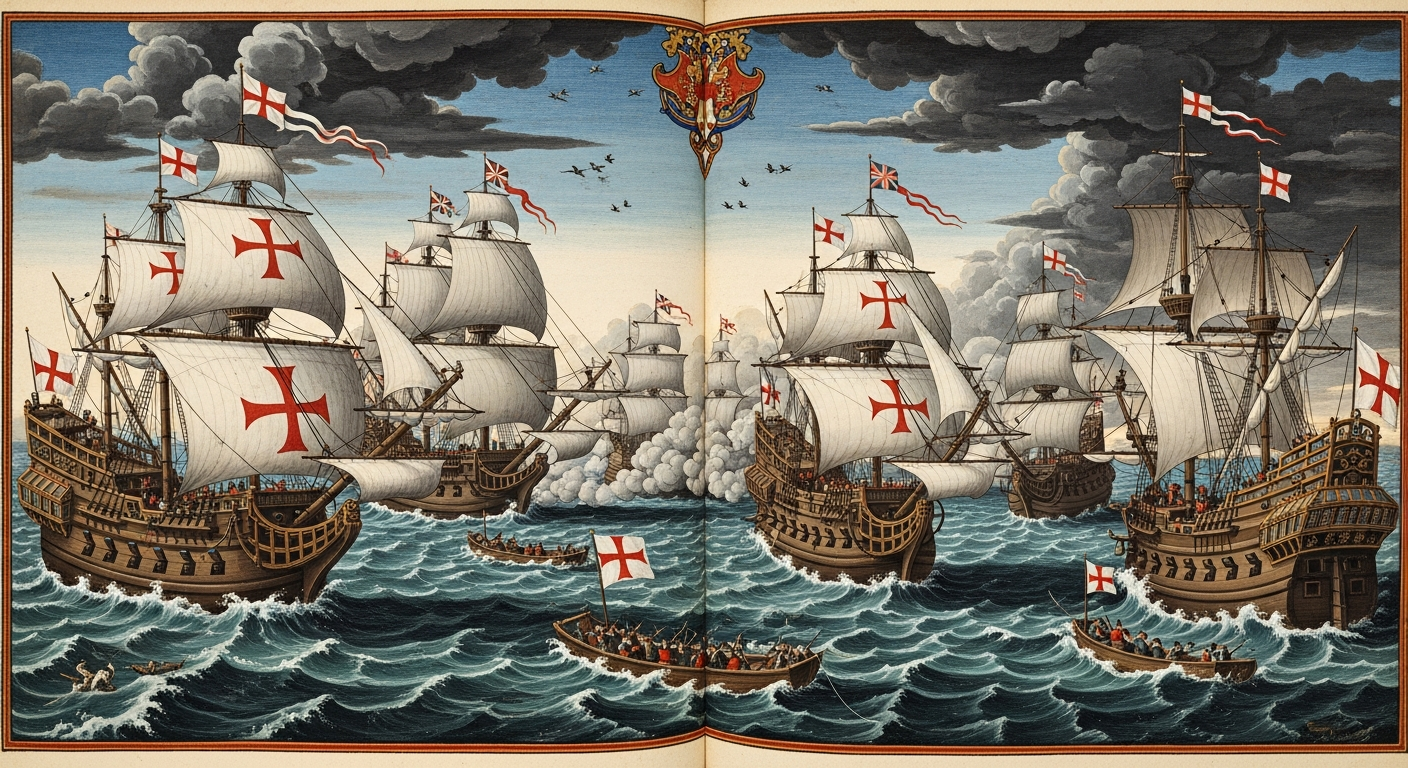
In the summer of 1588, the most powerful naval force Europe had ever assembled sailed towards the English Channel with a single, devastating purpose: to overthrow Elizabeth I and restore Catholic rule to England. The Spanish Armada, comprising approximately 130 ships and 30,000 men, represented Philip II’s ultimate gamble to crush English Protestant defiance and secure Spanish dominance over European waters. Yet within mere weeks, this seemingly invincible fleet would face catastrophic defeat, with fewer than half its vessels limping home to Spanish ports.
The failure of the Spanish Armada stands as one of history’s most decisive naval encounters, fundamentally altering the balance of European power and securing England’s Protestant identity for centuries to come. This momentous clash between Catholic Spain and Protestant England would determine not only the fate of the Tudor dynasty but also the future trajectory of English maritime supremacy and religious independence.
Understanding the Armada’s defeat requires examining the complex web of religious conflict, political ambition, and military miscalculation that brought these two great powers into direct confrontation, alongside the crucial roles played by English naval innovation, diplomatic cunning, and the unpredictable forces of nature itself.
Historical Background
The roots of the 1588 conflict stretch back to the early years of Elizabeth I’s reign, when religious and political tensions between Protestant England and Catholic Spain reached a critical breaking point. Philip II of Spain, the most powerful monarch in Europe, viewed Elizabeth’s Protestant rule as both a personal affront and a threat to Catholic Christendom. The situation deteriorated significantly following Elizabeth’s execution of Mary, Queen of Scots in February 1587, which Philip interpreted as the final provocation requiring military response.
English privateering activities, particularly those led by Sir Francis Drake, had been systematically disrupting Spanish treasure fleets returning from the Americas, costing Philip’s treasury enormous sums. Elizabeth’s tacit support for these ‘sea dogs’ whilst maintaining official diplomatic relations infuriated the Spanish king, who saw such actions as state-sponsored piracy. Additionally, English military support for Protestant rebels in the Spanish Netherlands demonstrated Elizabeth’s willingness to challenge Spanish authority directly.
The Armada itself was conceived as ‘La Empresa de Inglaterra’ (The Enterprise of England), a grand strategic operation combining naval and land forces. The plan required the fleet, commanded by the Duke of Medina Sidonia, to sail from Spain, traverse the English Channel, and rendezvous with Spanish forces under the Duke of Parma stationed in the Netherlands. These combined forces would then launch a full-scale invasion of England, supported by English Catholics who were expected to rise in support of the liberation.
According to Colin Martin and Geoffrey Parker in their authoritative study, the Spanish fleet represented the pinnacle of 16th-century naval power, featuring massive galleons armed with heavy artillery and carrying seasoned soldiers intended for the English invasion. However, the English navy, though smaller, possessed significant advantages in ship design, seamanship, and tactical flexibility that would prove crucial in the coming engagement.
Significance and Impact
The Armada’s defeat fundamentally transformed the geopolitical landscape of late Tudor England and established the foundation for England’s eventual emergence as a major European power. Most immediately, the victory secured Elizabeth I’s throne and guaranteed the survival of English Protestantism at a time when Catholic Counter-Reformation forces appeared ascendant across Europe. Had the Armada succeeded, England would likely have been restored to Catholic rule, fundamentally altering the religious and cultural development of the British Isles.
The victory’s psychological impact proved equally significant, establishing what contemporaries recognised as divine approval for Elizabeth’s Protestant regime. The defeat of what many considered God’s own fleet sent shockwaves throughout Catholic Europe whilst reinforcing Protestant confidence in their cause. Elizabeth’s famous speech at Tilbury, delivered as invasion threatened, became legendary: ‘I may have the body of a weak and feeble woman, but I have the heart and stomach of a king, and of a king of England too’.
Economically, the Armada’s failure preserved England’s growing maritime trade networks whilst seriously damaging Spanish prestige and financial resources. The enormous cost of the expedition, combined with its catastrophic failure, contributed to Spain’s gradual decline as Europe’s dominant power. England’s successful defence encouraged further investment in naval technology and exploration, setting the stage for later colonial expansion and the development of global trading networks.
The military implications proved equally profound, demonstrating the effectiveness of English naval innovations including longer-range artillery, improved ship design, and more flexible tactical approaches. These lessons would influence naval warfare for generations, contributing to England’s eventual dominance of the seas and the development of the Royal Navy as the world’s premier maritime force.
Connections and Context
The Armada crisis occurred during a period of intense international tension, coinciding with the final phases of the French Wars of Religion and ongoing conflicts in the Spanish Netherlands. Elizabeth’s England found itself increasingly isolated diplomatically, with Catholic powers forming alliances against Protestant states throughout Europe. The defeat therefore represented not merely an English victory but a crucial Protestant success that helped maintain the religious balance of power across the continent.
The crisis also highlighted the effectiveness of Elizabeth’s long-term strategy of supporting Philip II’s enemies whilst avoiding direct military confrontation. English assistance to Dutch rebels, support for Portuguese pretenders to the Spanish throne, and encouragement of French Protestant forces had systematically weakened Spanish power before the Armada ever sailed. Drake’s famous raid on Cadiz in 1587, which delayed the invasion by a full year, exemplified this strategy of aggressive defence.
Contemporary events in Ireland proved equally significant, as Spanish agents had been encouraging rebellion amongst Irish Catholics who might have provided crucial support for an invasion force. The failure of the Armada effectively ended Spanish hopes of using Ireland as a backdoor route to English conquest, though Spanish involvement in Irish affairs would continue for several more decades.
Modern Relevance and Fascinating Details
The Spanish Armada continues to fascinate modern audiences partly because it represents a classic David versus Goliath encounter, with smaller English forces defeating a seemingly superior enemy through superior tactics, technology, and perhaps divine intervention. The story has inspired countless works of historical fiction, from Kenneth Roberts’ novels to recent television dramatisations that continue to capture popular imagination.
Did you know that weather played such a crucial role in the Armada’s defeat that Protestant propagandists coined the phrase ‘God blew and they were scattered’? The storms that devastated Spanish ships attempting to return home via Scotland and Ireland proved as deadly as English guns, with many vessels wrecked on remote coastlines where their crews faced starvation or hostile locals.
Modern archaeological investigations have revealed fascinating details about the Armada ships, including the discovery of several wrecks around the Irish coast. These findings have provided unprecedented insights into 16th-century naval technology, military equipment, and daily life aboard these floating fortresses. The Calendar of State Papers relating to English Affairs reveals the intense diplomatic activity surrounding the crisis, showing how European powers carefully monitored the conflict’s progress and implications.
Perhaps most intriguingly, the Armada’s defeat helped establish England’s reputation for successful resistance to continental invasion, a tradition that would prove crucial during later conflicts with Napoleon and Hitler. The propaganda imagery of 1588, depicting English defiance against overwhelming odds, became a recurring theme in British national identity that resonates even today.
Conclusion
The defeat of the Spanish Armada in 1588 stands as a watershed moment in Tudor history, securing Elizabeth I’s Protestant settlement whilst establishing the foundations for England’s later emergence as a global maritime power. The loss of more than half the Spanish fleet demonstrated that even the mightiest military forces could be defeated through superior tactics, technological innovation, and strategic preparation combined with advantageous circumstances.
This remarkable episode continues to offer valuable insights into the intersection of religious conflict, international politics, and military innovation that characterised late 16th-century Europe. For modern readers interested in exploring this fascinating period further, the defeat of the Armada provides an ideal entry point into understanding how the Tudor age shaped the future development of British national identity, naval supremacy, and Protestant independence that would define English culture for centuries to come.