
Visit the iconic locations that figure prominently in the Predestination series
Framlingham Castle
A huge castle in Queen Mary’s heartland of East Anglia
Summary
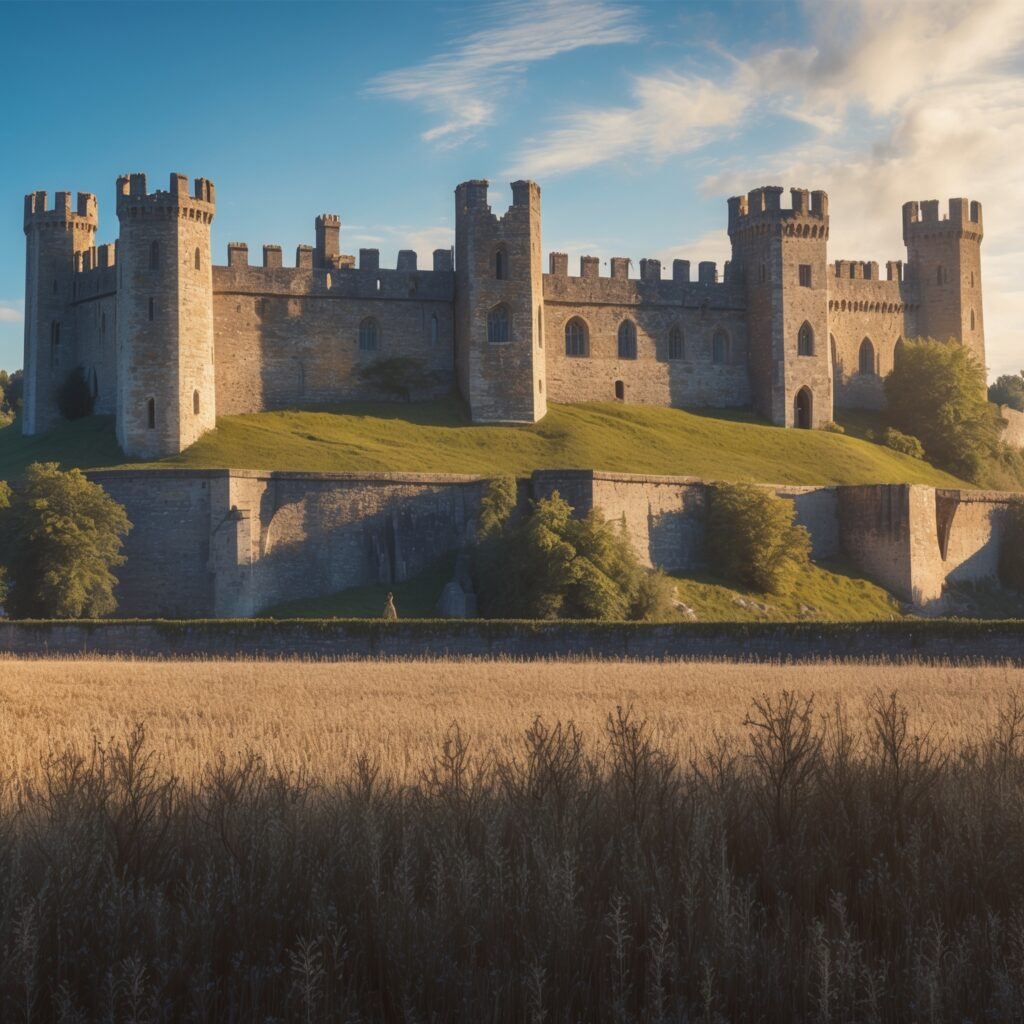
Framlingham Castle is a castle in the market town of Framlingham, Suffolk. It is managed by English Heritage and run as a tourist attraction.
The musician Ed Sheeran, who grew up in the market town, wrote and sang a song called ‘Castle on the Hill’.
Historical note
Constructed by Roger Bigod, the Earl of Norfolk, the castle was unusual for the time in having no central keep, but instead used a curtain wall with thirteen mural towers to defend the centre of the castle.
During the 15th and 16th centuries Framlingham was at the heart of the estates of the powerful Mowbray and Howard families. Two artificial meres were built around the castle, which was expanded in fashionable brick. With a large, wealthy household to maintain, the castle purchased supplies from across England and brought in luxury goods from international markets. Extensive pleasure gardens were built within the castle and older parts were redesigned to allow visitors to enjoy the resulting views.
Interestingly, in 1636, Framlingham Castle was given to Pembroke College, Cambridge, who retained it for the next three hundred years, although, I have yet to find any details of what they used it for!
Usage in Proclamation
Framlingham Castle was where Mary Tudor gathered her forces as she prepared to battle for the crown that she believed was hers according to her father’s will.
Dee and his friends enter the castle to retrieve an incriminating poem. Jack gets captured at one point and is held in the prison tower, which juts out from the curtain wall and whose ruins can still be seen today.
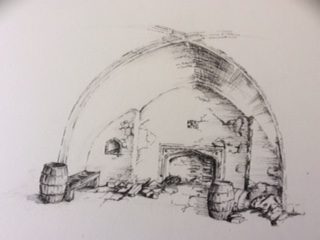
I draw my readers’ attention to the sketch of the interior of the castle, in Chapter 30 – Desolation, which was kindly drawn by my 90 year-old mother, Catherine Downes. Thanks Mom!
Hampton Court Palace
A royal palace west, built for Cardinal Thomas Wolsey.
Summary
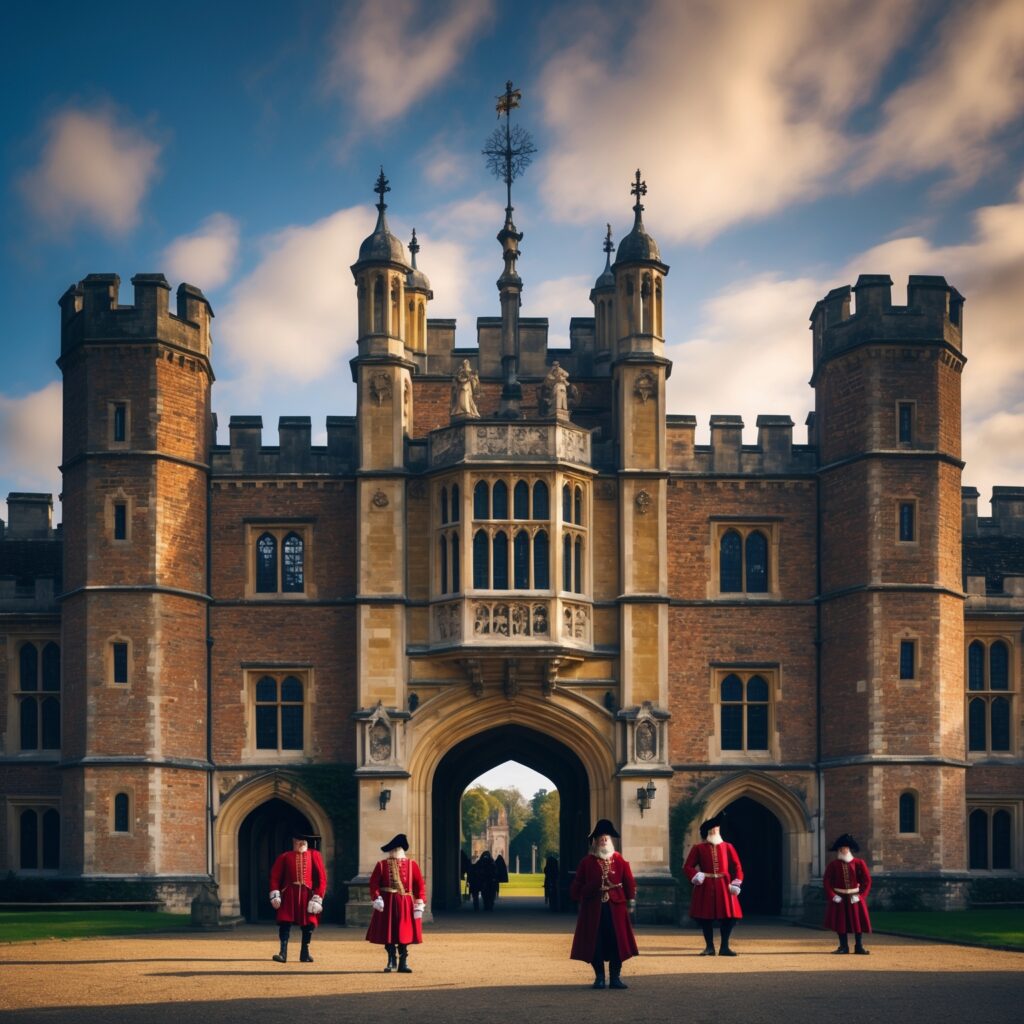
Hampton Court Palace is a royal palace in the London Borough of Richmond upon Thames (west of central London).
The building of the palace began in 1514 for Cardinal Thomas Wolsey, the chief minister of Henry VIII. Wolsey spent lavishly (200,000 crowns) to build the finest palace in England. During his fall from Henry VIII’s grace he gave Hampton Court to Henry, but it wasn’t enough to save him. After Wolsey died, Henry further enlarged the building, starting with the kitchens, and followed by a Great Hall (with a hammerbeam ceiling) and a tennis court.
Edward VI was born here, and Queen Mary had her honeymoon here with Philip of Spain. Successive monarchs added to and altered the buildings.
Historical note
Hampton Court Palace began not as a royal residence but as a personal vanity project. Cardinal Thomas Wolsey, Henry VIII’s chief minister and the most powerful churchman in England (allegedly the ‘son of a butcher’, so demonstrating that Henry appointed the most capable people for the job, not just the nobles), began building it in 1514 as a statement of his own magnificence. It was a palace so opulent that contemporaries whispered it outshone the King’s own residences. Wolsey spared nothing: glittering red brick, decorative chimneys, state apartments furnished with tapestries woven with silk and gold thread. When Henry finally took notice, Wolsey attempted to save himself by gifting the palace to the Crown in 1529. It didn’t work. He died in disgrace the following year. But Hampton Court remained, and Henry proceeded to make it his own with characteristic excess.
Under Henry and his successors it became the beating heart of Tudor England. All six of Henry’s wives passed through its gates. Edward VI was born here in 1537, and his mother Jane Seymour died here two weeks later. The future Elizabeth I was held under house arrest here by her half-sister Mary. The palace’s elaborate system of interconnecting rooms, each guarded, each granting access to fewer and more important people, was Tudor power enacted by architecture: the closer you got to the king, the more dangerous the territory.
Usage in Divination
Dee leaves Cambridge for Hampton Court, seeking safety from attack by the imagined conspirators, only to find that the palace was just as dangerous, both morally and mortally. Nonetheless, some foresight and cunning sees him through the shifting allegiances and allows him to rise above the corruption.
Usage in Speculation
Dee, Catherine and Nicholas quiz the Lord Protector, Edward Seymour, regarding the use of the recovered gold.
Usage in Predestination
King Edward VI’s court was often at Hampton Court Palace.
William Herbert, John Cheke, and William Cecil were all given honours on the same day at Hampton Court, 10th October 1551, and Herbert received his Earldom the very next day at the same location.
In Predestination, Edward summons Dee to Hampton Court twice; firstly to name his reward for averting a poisoning, and secondly for his investiture into the Brotherhood of the Red Rose.
History records Gerolamo Cardano visiting Hampton Court to offer astrological forecasts to Edward.
Oxburgh Hall
A moated and crenellated country house in Norfolk
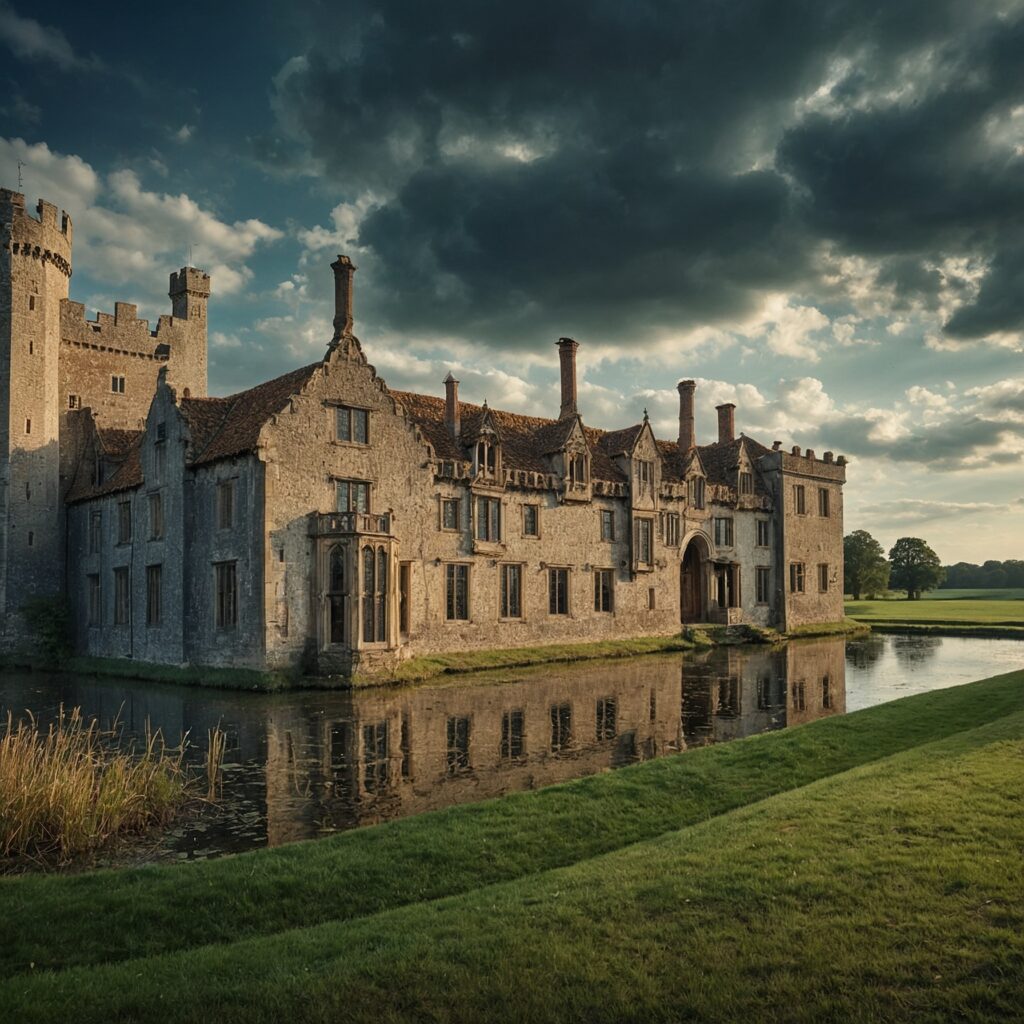
Oxburgh Hall is a moated country house.
It is an example of an inward-facing great house. It is surrounded by a square moat about 75 metres on each side.
Although originally square, enclosing a courtyard, the south section was pulled down in 1772 for Sir Richard Bedingfeld, creating a U-shaped house.
The entrance, reached by a three-arched bridge on the north side, is through a fortified gatehouse.
Historical note
Thousands of “rare items” dating back to the 15th Century have been found in the attic of [Oxburgh Hall]
An archaeologist made the “unique discovery” while working alone through lockdown at Oxburgh Hall in Norfolk.
A 600-year-old manuscript, fragments of medieval books, Elizabethan textiles … were among the items found at the National Trust property.
The trust said some of the items had been “perfectly preserved”.
As part of a £6m project to restore the roof, floorboards in the attic were removed and archaeologist Matt Champion conducted a fingertip search of the exposed area.
National Trust curator Anna Forest said the “rare items” had been “undisturbed for centuries”.
…
A builder also found an “almost intact” copy of a book called the King’s Psalms, which was dated 1568 and was complete with leather binding.
Russell Clement, general manager of Oxburgh Hall, said the finds were “far beyond anything we expected to see”. “These objects contain so many clues which confirm the history of the house as the retreat of a devout Catholic family, who retained their faith across the centuries,” he said.
© BBC
Usage in Predestination
Oxburgh Hall is the final main location in Predestination, where the search for the Bloodstone ends.
Jack and Kat hide in the attic, and Kat accidentally leaves behind a prayer book.
During the 2020-22 Covid-19 lockdown a project to re-roof Oxburgh Hall was underway. Whilst examining the attic, the archaeologist Matt Champion found a page from a rare 15th-century illuminated manuscript and fragments of late 16th century books. I wonder who left them there, and what they were doing in the attic? Could it be that the Predestination story is true after all?
Temple Church
The ‘Round Church’, HQ of the Knights Templar in London
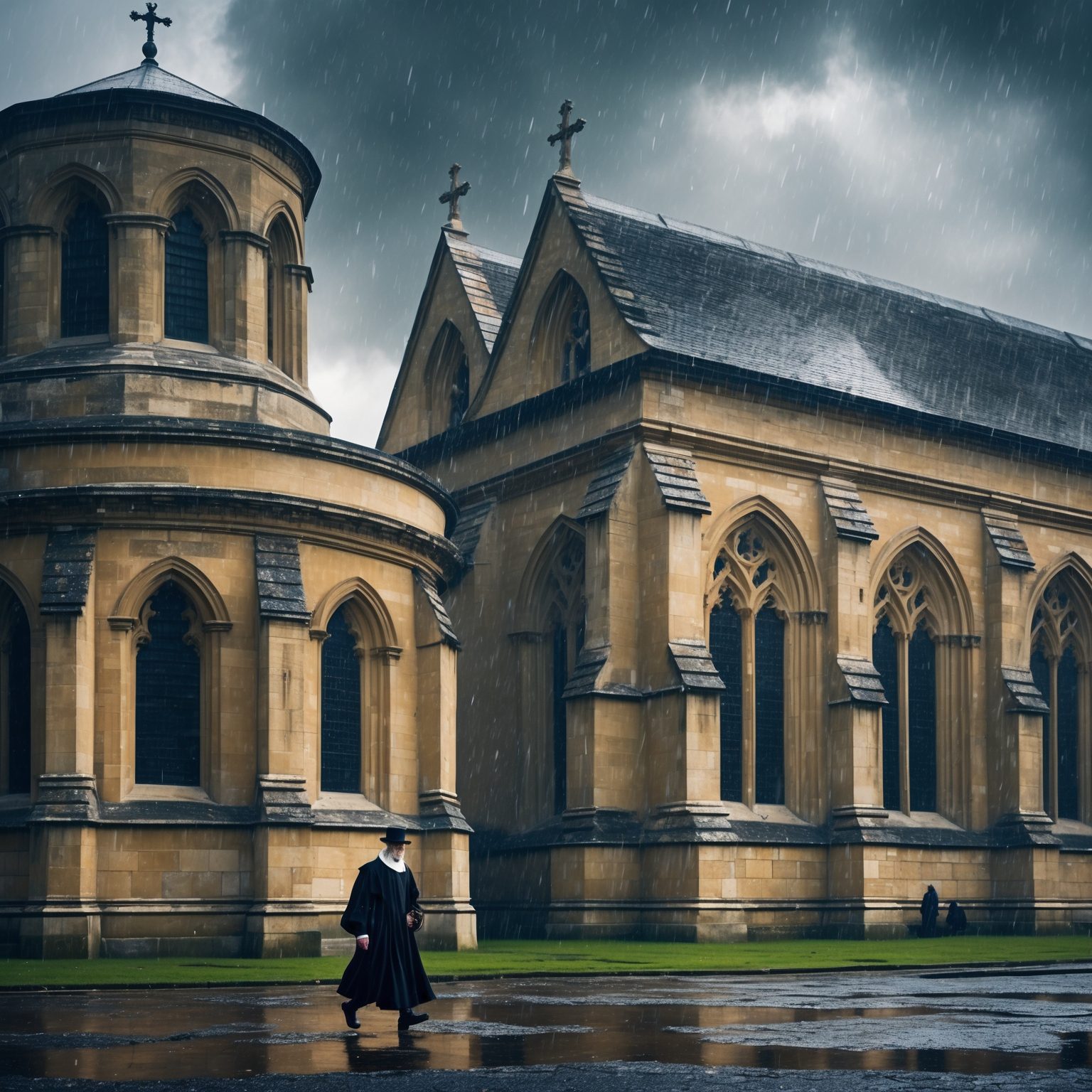
Temple Church is famous for being a round church, a design typical of the Knights Templar.
It is classified as a Royal Peculiar meaning it is not under the jurisdiction of the diocese, but instead is under the direct jurisdiction of the monarch.
It was damaged during WWII and has since been rebuilt and repaired. It offers regular choral performances and organ recitals. The Temple Church maintains two clergy, one being the Master, whose official title is the rather grand “Reverend and Valiant Master of the Temple” A list of all the Masters since 1540 is available, which is rather cool.
Several knights are buried and/or have effigies in the church, including William Marshal, 1st Earl of Pembroke. William was possibly the greatest knight to have ever lived; he served five English Kings. Even at the age of seventy he vigorously led (the nine-year old) Henry III’s army against Louis of France during the Baron’s war. During his regency he reissued the Magns Carta. On his deathbed he was invested in the Knights Templar.
Historical note
The Temple Church was built by the Knights Templar in 1185 as their English headquarters.
After their suppression in 1307 it passed first to the crown then to the Knights Hospitaller who rented it out to two colleges of lawyers which evolved into the Inner Temple and the Middle Temple, two of the four Inns of Court. The church itself lies between the two inns.
Usage in Predestination
The clues to the location of the Bloodstone of Boiorix lead Jack and Kat to the Temple Church.
They steal a page from a book of minutes. The page mentions keeping safe items related to the Bretwalda Egg. A Bretwalda was the Anglo-Saxon ruler of the Britons. The Bloodstone was known to be egg-sized. QED.
The page references an ancient chamber beneath the buttery and even provides a diagram of it; the diagram is marked with a faint ‘X’. This is spot that Jack and Kat search for their next clue.
©C.D.Downes & J.A.Downes
The Abbey of Mont Saint-Michel
Benedictine Abbey off the north-west coast of France
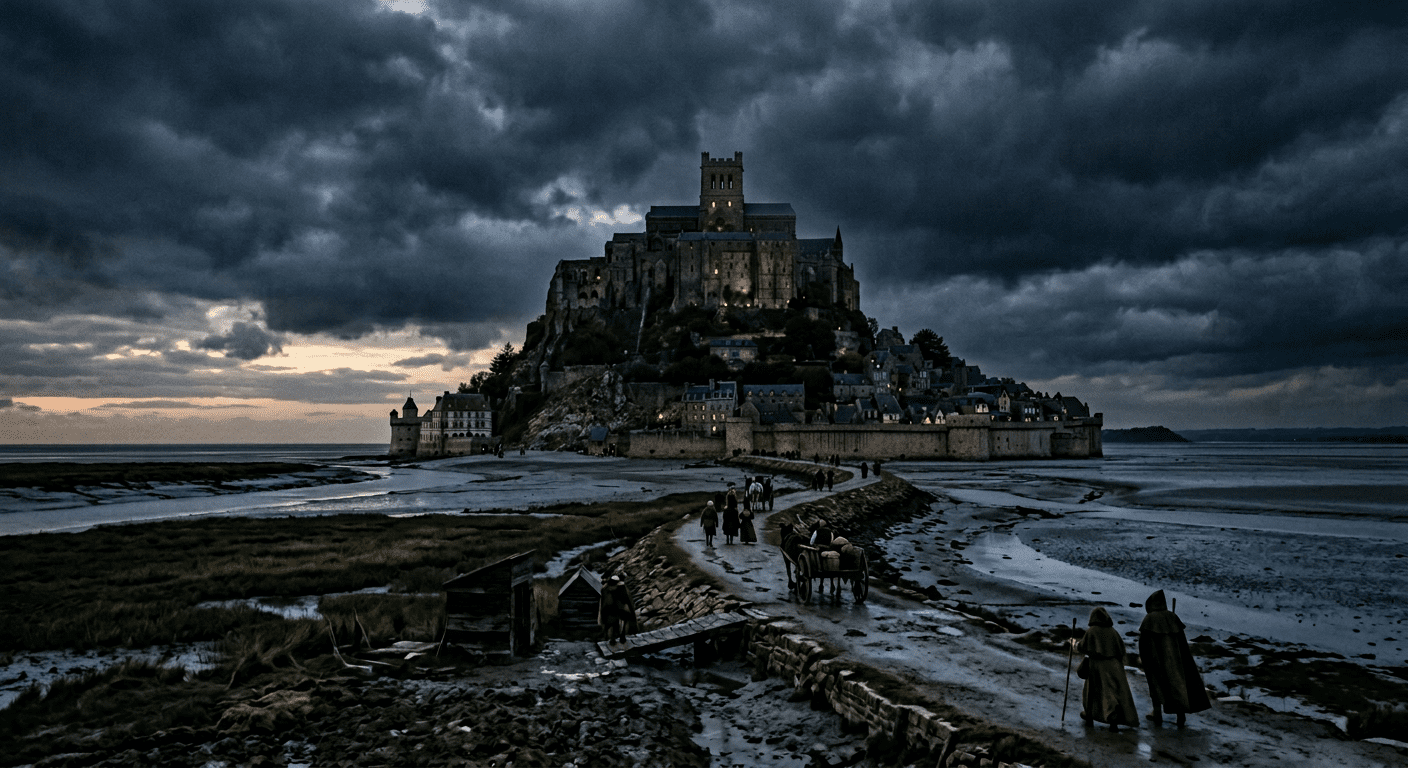
The island of Mont Saint-Michel lies approximately one kilometre off France’s north-western coast, at the mouth of the Couesnon River near Avranches and is 17 acres in area.
The Mont-Saint-Michel Abbey is an abbey located at the heart of the island, with a small town surrounding it.
The site is visited by over 3 million people per year, although the fulltime population is less than 100.
Historical note
The previous small eighth-century church was replaced by an abbey in the eleventh century, which was designed and built by an Italian architect for Richard II, Duke of Normandy.
Various crypts and chapels had to be built underneath the Romanesque church to enable the crossing to be located at the very peak of the mount.
Philip II of France provided money to reconstruct the abbey in the Gothic architectural style after a fire damaged it, and Charles VI added fortifications, towers, courtyards, and ramparts in the fifteenth century.
The island was a popular pilgrimage destination
Usage in Benediction
Subscribe to my newsletter for sneak-peek information about the upcoming novel, Benediction, set in the abbey.
The abbey and surrounding town provides a suitably gothic atmosphere for the hauntings in Benediction.
It comes complete with an isolated location, a maze of crypts under the central church, and a town with potentially insular inhabitants.
As a Benedictine house it would have had links to the Knights Templar, although I haven’t been able to find specific recorded details.
The Tower of London
A royal fortress on the north bank of the Thames in London
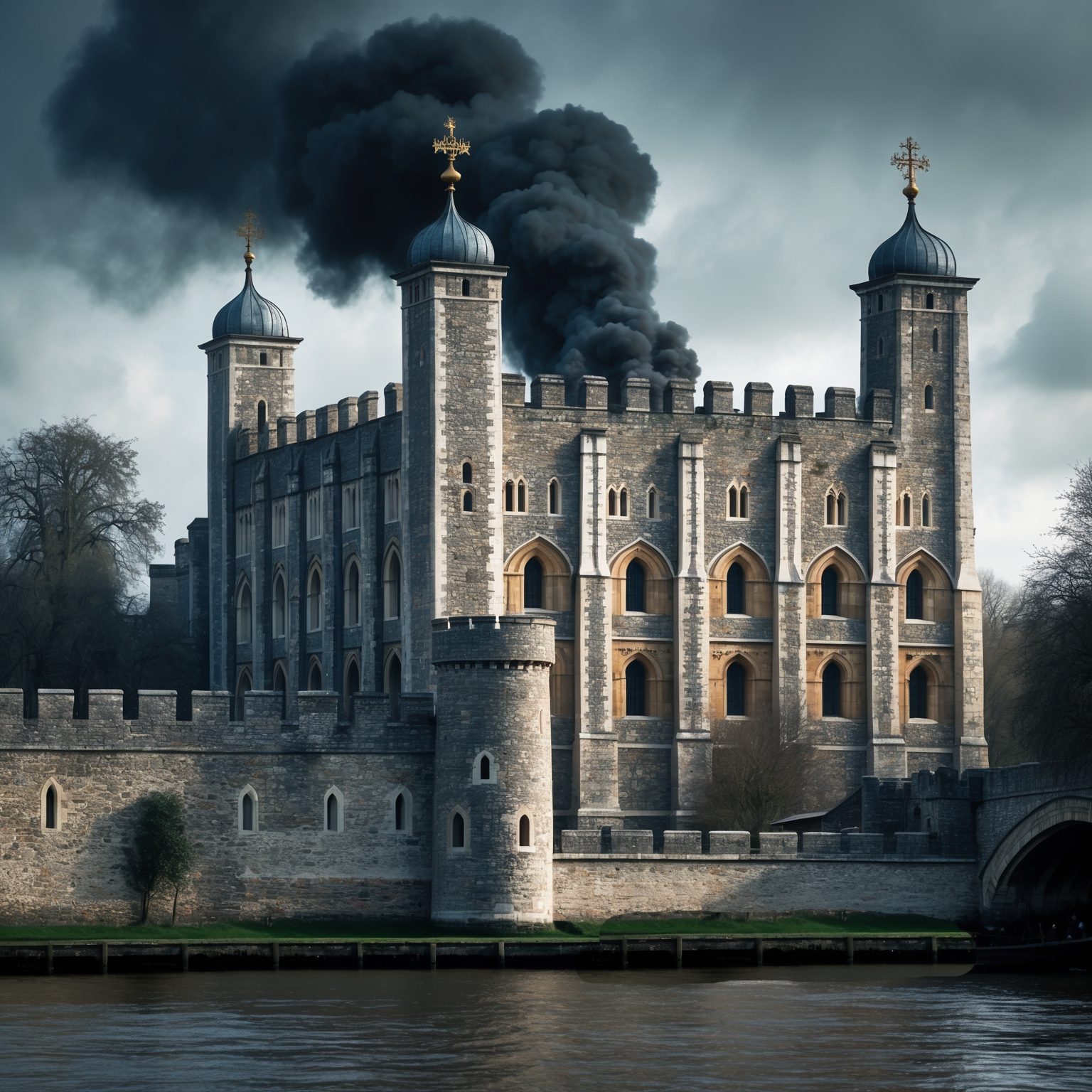
The Tower of London, officially His Majesty’s Royal Palace and Fortress of the Tower of London, is a historic castle on the north bank of the River Thames in central London, England. It hosts approx. 3 million tourist visitors per year.
Historical note
It was founded toward the end of 1066 as part of the Norman Conquest. The White Tower (the central square keep) was built by William the Conqueror in 1078.
As a whole, the Tower is a complex of several buildings set within two concentric rings of defensive walls and a moat.
Like many buildings that have stood for almost 1000 years (😳) the Tower has known many roles: an armoury, a treasury, a menagerie, home of the Royal Mint, a public records office, the home of the Crown Jewels, a prison, an execution ground, and a pre-coronation Royal palace.
In the late 15th century, the Princes in the Tower were held here before mysteriously disappearing, presumed murdered.
Excluding the world wars, only seven people were executed within the Tower. Executions were more commonly held on Tower Hill to the north of the castle, with 112 occurring there over a 400-year period.
Usage in Restitution
John Dee is amongst the crowd to witness the execution of Baron Sudeley, Thomas Seymour. I placed John at Tower Hill so the reader would be aware of the execution without having to go into detail about it.
Usage in Proclamation
John Dee’s father, Rowland, was indeed imprisoned in the Tower for several months, after the failed ‘coup’ by Jane Grey. As mentioned in the story, it is very unlikely that ‘normal’ criminals, like Rook, would be kept at the Tower, but doing so meant that Dee could progress several elements of the story at the same location.