
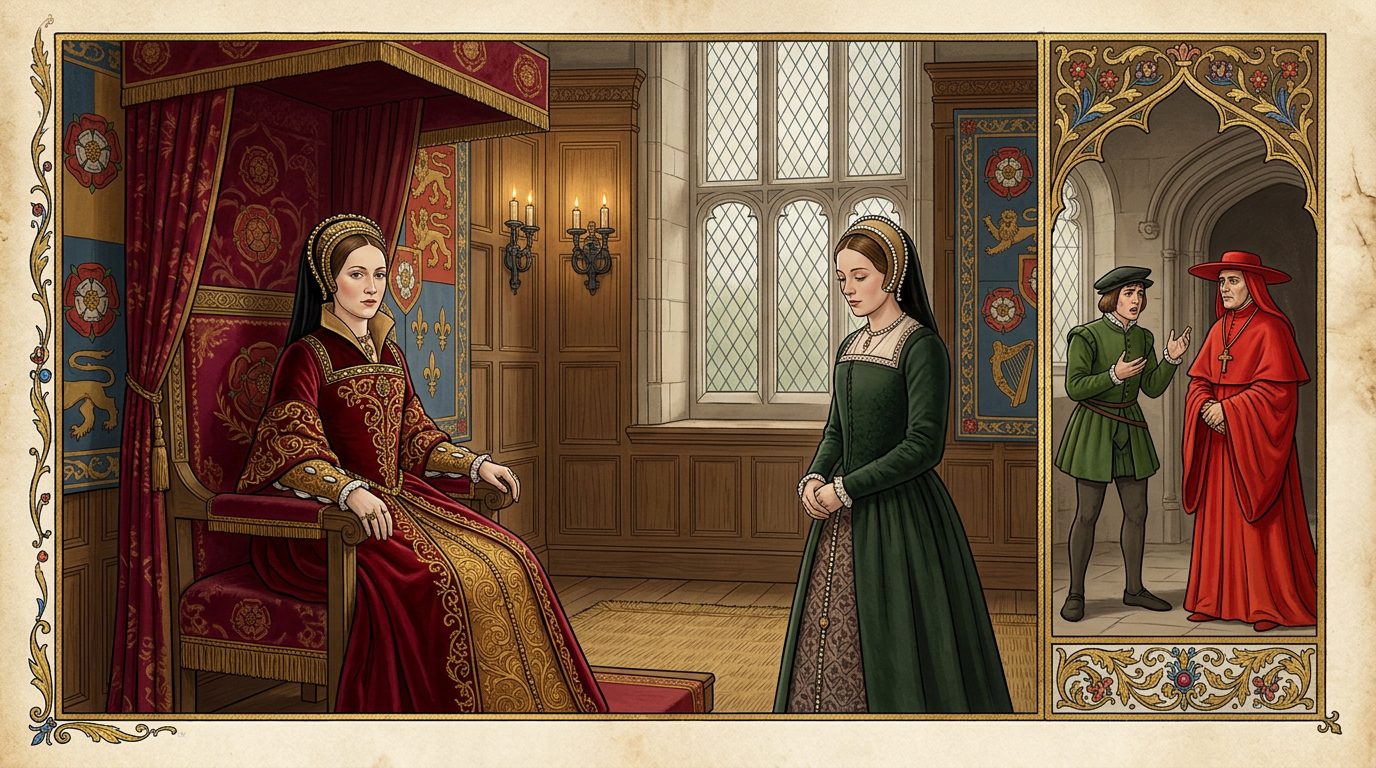
Anne Boleyn and Henry Percy: The Forbidden Romance That Changed Tudor History
Imagine being a young woman at the most glittering court in Europe, falling deeply in love, only to have that love torn apart by one of the most powerful men in England. This is precisely what happened to Anne Boleyn sometime around 1523, when her secret betrothal to Henry Percy, heir to the Earl of Northumberland, was brutally dismantled by Cardinal Thomas Wolsey. It is one of Tudor history’s most poignant and consequential love stories, and yet it remains surprisingly underexplored by casual history enthusiasts. What follows is not merely a tale of young hearts broken by political expediency; it is the story of a moment that may have set in motion the entire English Reformation.
At the time of her romance with Percy, Anne Boleyn was serving as a lady-in-waiting to Queen Catherine of Aragon, a prestigious position that placed her at the very heart of the Tudor court. She had spent years in France, first in the household of Mary Tudor and then at the court of Francis I, where she absorbed the sophisticated culture, fashion, and courtly manners that would later make her so irresistible to Henry VIII. She returned to England around 1521, polished, ambitious, and entirely unlike the women Henry had previously favoured. It was in this gilded, treacherous environment that she met Henry Percy, and it was here that their story began.
In this post, we will explore who these two young people were, how their relationship unfolded, why Cardinal Wolsey intervened so forcefully, and how the destruction of this early romance ultimately contributed to one of the most dramatic sequences of events in English history. Whether you are a seasoned Tudor scholar or a newcomer drawn in by historical drama, this story has the power to surprise you.
Historical Background: Two Young People at the Tudor Court
Henry Percy was the son and heir of Henry Percy, the fifth Earl of Northumberland, one of the most powerful noble families in the north of England. As a young man, Percy had been placed in the household of Cardinal Wolsey, which was common practice for aristocratic sons seeking advancement. It was whilst serving Wolsey that Percy began attending court, where he encountered Anne Boleyn. According to George Cavendish, Wolsey's gentleman-usher and one of our most valuable eyewitnesses to these events, Percy became 'much in the company of Mistress Anne Boleyn, to whom he resorted so oft that there sprang up between them a secret love' (Cavendish, The Life and Death of Cardinal Wolsey, 1959).
The relationship was evidently serious enough that the two young people considered themselves betrothed, a far more legally and socially binding commitment in Tudor England than a modern engagement. A betrothal at this time was treated almost as a marriage in itself, and breaking one required considerable justification. Anne, sharp-minded and calculating even in her youth, would not have entered into such an arrangement lightly. Percy, for his part, appears to have been genuinely besotted. The problem was that neither party had obtained the necessary permissions from their families or, crucially, from the King.
Percy was already informally promised to Mary Talbot, daughter of the Earl of Shrewsbury, an arrangement made by his father to consolidate northern noble alliances. When word of his secret betrothal to Anne reached Wolsey, the Cardinal acted swiftly and decisively. Wolsey summoned Percy and delivered a sharp rebuke, reportedly telling him he had 'acted without the knowledge of your father, and without the King's consent'. The Earl of Northumberland was then brought in to reinforce the message, and Percy was compelled to deny any pre-contract with Anne and proceed with his marriage to Mary Talbot. The year was approximately 1523, though some historians place the episode slightly earlier.
As Antonia Fraser notes in The Wives of Henry VIII (1992), there is a persistent question about whether Henry VIII himself had already developed an interest in Anne at this point and used Wolsey as his instrument to clear the field. The evidence is inconclusive, but the possibility adds yet another layer of intrigue to an already complex situation. What is certain is that Anne was furious, and by multiple accounts, she never forgave Wolsey for his intervention.
Significance and Impact: A Broken Heart With Enormous Consequences
The destruction of Anne's romance with Percy was not simply a private tragedy. It had profound and lasting consequences for Tudor England and, arguably, for the entire Western Christian world. Anne's resentment towards Wolsey would fester for years and would eventually make her one of his most effective enemies at court. When Henry VIII began his pursuit of Anne around 1526 and Wolsey failed to secure the annulment of Henry's marriage to Catherine of Aragon swiftly enough, Anne was well positioned, and well motivated, to press for Wolsey's downfall. The Cardinal fell from power in 1529 and died in 1530 whilst being escorted to London to face charges of treason.
Beyond the personal dimension, the episode reveals something important about the nature of power and gender in Tudor society. Anne had no legal recourse when Wolsey intervened. A woman's romantic future could be redirected entirely by powerful men acting in what they perceived to be political or dynastic interests. Her only weapon was her own intelligence, charm, and determination, qualities she deployed to devastating effect in the years that followed. The very qualities that made her a survivor in this situation also made her a lightning rod for controversy.
The question of whether Anne's betrothal to Percy constituted a legally binding pre-contract would return to haunt her at the most critical moment of her life. In 1536, as Henry VIII sought grounds to rid himself of Anne, Percy was called upon to swear on oath that no valid pre-contract had existed between them. He did so, though he is reported to have become physically ill in the aftermath. Whether from guilt, grief, or sheer stress, his visible distress spoke volumes to contemporaries. Had Percy admitted to a pre-contract, Anne might have escaped execution by having her marriage to Henry annulled rather than facing the scaffold, though her freedom and influence would have been destroyed regardless.
Connections and Context: What Else Was Happening in Tudor England?
To understand this episode fully, it helps to appreciate the broader political landscape of early 1520s England. Cardinal Wolsey was at the absolute zenith of his power during this period, serving simultaneously as Lord Chancellor, a papal legate, and the King's most trusted adviser. He managed foreign policy, domestic affairs, and the King's personal business with extraordinary efficiency. His household was a training ground for the next generation of English nobility, and his authority was rarely challenged successfully.
Meanwhile, Catherine of Aragon was still very much Henry's queen, and the court in which Anne served was outwardly a stable, if politically charged, environment. The question of the royal succession was, however, already beginning to cast a shadow. Catherine had suffered multiple pregnancies with only one surviving child, the Princess Mary, born in 1516. Henry's anxiety about a male heir was a constant undercurrent in court life, and it would soon transform from background worry to all-consuming obsession.
It is also worth noting that Henry Percy's unhappy marriage to Mary Talbot endured for years, becoming notoriously miserable for both parties. Mary eventually sought a separation on grounds of the very pre-contract with Anne that Percy had sworn never existed. The irony is almost too perfect for historical fiction, and as someone who has spent years writing in this period, I find it one of those details that reminds us how relentlessly interconnected Tudor lives truly were.
Modern Relevance and Fascinating Details: Why This Story Still Captivates Us
One of the reasons the Percy and Anne story continues to fascinate readers and historians alike is that it feels remarkably modern in its emotional dynamics. The experience of having a relationship dismantled by external forces, whether family, society, or institutional power, is one that resonates across centuries. Anne's response, to channel her hurt into ambition and political manoeuvring, feels recognisable to anyone who has ever refused to be defined by a disappointment.
Did you know? Some historians have speculated that Anne's famous emotional volatility and her determination never to become Henry VIII's mistress, insisting instead on marriage, was directly shaped by her experience with Percy. Having been denied a legitimate union once, she was resolved not to surrender her virtue without the full protection that marriage offered. If this interpretation is correct, Wolsey's interference did not diminish Anne's power but actively forged it.
In popular culture, the Percy romance has been explored in Hilary Mantel's celebrated Wolf Hall trilogy, in Philippa Gregory's The Other Boleyn Girl, and in the television series The Tudors, among many others. Each retelling brings its own interpretation, but all recognise the episode as a pivotal moment in Anne's formation as a historical figure. For readers interested in exploring this period through historical fiction, the Percy romance offers an extraordinarily rich emotional and political canvas.
Conclusion: A Forbidden Love That Reshaped a Nation
The secret betrothal between Anne Boleyn and Henry Percy is far more than a romantic footnote in Tudor history. It is a story about power, ambition, grief, and unintended consequences that rippled outward to affect the lives of millions. From the humiliating scene in Wolsey's chambers where Percy was forced to renounce Anne, to her eventual coronation as Queen of England and her tragic execution in 1536, the threads of this early romance run through the entire arc of her life. As Antonia Fraser so perceptively observed, understanding Anne requires understanding what was done to her long before Henry VIII ever fixed his gaze upon her.
Whether you came to this story through academic interest, a love of historical drama, or simple curiosity about one of history's most compelling women, we hope it has offered you something new to consider. Tudor history rewards those who look beyond the famous headlines, and the story of Anne and Percy is proof that the most significant moments are sometimes the ones that happened quietly, in corridors of power, to people who had not yet become legends. If you would like to explore further, we recommend beginning with George Cavendish's eyewitness account and Antonia Fraser's definitive biography, two sources that between them offer an unmatched window into this extraordinary world.