
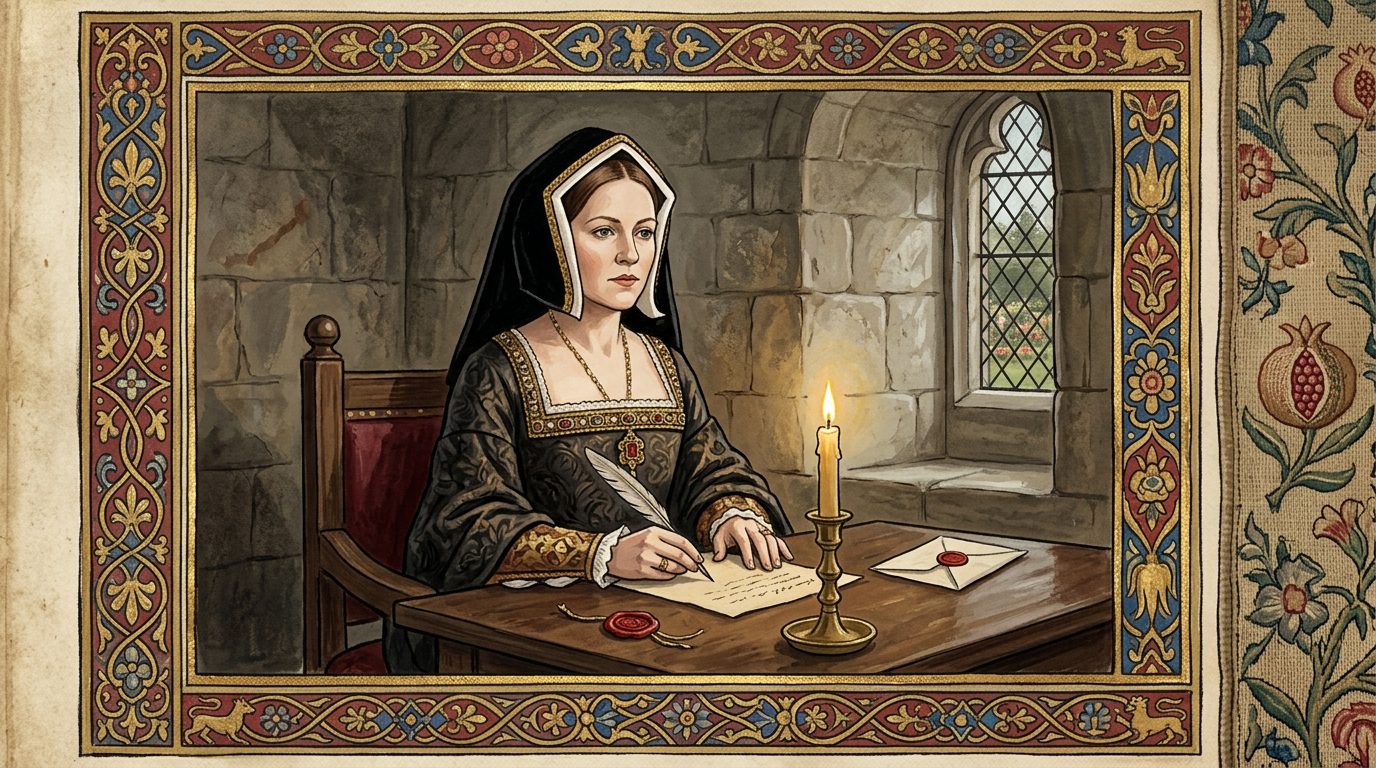
The Queen Who Refused to Bow: Catherine of Aragon’s Defiance Until Death
Imagine being stripped of your title, separated from your daughter, confined to crumbling, damp castles, and told by the most powerful man in England that your marriage never existed. Most people would eventually break. Most people would sign the paper, accept the lesser title, and quietly disappear into comfortable obscurity. Catherine of Aragon was not most people. Until her dying breath on the 7th of January 1536, she continued to sign her letters ‘Katherine the Queen’, refused to acknowledge Anne Boleyn as Henry’s legitimate wife, and maintained with absolute conviction that she was the one true Queen of England. Her defiance was not merely personal stubbornness. It was one of the most consequential acts of political and spiritual resistance in Tudor history.
This is the story of a woman who understood, perhaps better than anyone else at the Tudor court, that capitulation was never truly an option. To yield would have meant declaring her daughter Mary illegitimate, invalidating a marriage she believed had been sanctioned by God and the Pope, and betraying everything she stood for as a princess of Spain, a Queen of England, and a devout Catholic. As the historian Giles Tremlett explores in his authoritative biography Catherine of Aragon: A Life, Catherine’s resistance was rooted in genuine religious conviction as much as royal pride. She was not simply being difficult. She was fighting for her soul.
In this post, we will explore exactly why Catherine refused to accept her displacement, what it cost her, how her defiance shaped the English Reformation, and why her story continues to fascinate historians, novelists, and readers more than five centuries later.
Historical Background: A Queen Cornered
Catherine of Aragon was born in 1485, the daughter of Ferdinand of Aragon and Isabella of Castile, two of the most formidable monarchs in European history. She arrived in England in 1501 to marry Prince Arthur, Henry VII’s eldest son and heir. When Arthur died just months after their wedding, Catherine found herself in a political limbo that lasted nearly a decade, before Henry VIII, newly crowned at eighteen years old, chose to marry her himself in 1509. For much of the next two decades, the marriage appeared successful. Catherine was respected, even beloved, as queen. She acted as regent in 1513 while Henry was fighting in France, and she celebrated the English victory at Flodden with genuine pride.
The difficulties began in earnest around 1527, when Henry became convinced that his marriage to Catherine was cursed by God, citing a passage in Leviticus which suggested a man should not marry his brother’s widow. Catherine had, of course, been Arthur’s wife first. Henry’s desire to annul the marriage was also fuelled by his infatuation with the ambitious and sharp-minded Anne Boleyn, a lady-in-waiting who refused to become his mistress and held out for marriage. As Antonia Fraser details in The Wives of Henry VIII, the ensuing legal and theological battle, known to history as the ‘King’s Great Matter’, consumed English and European politics for the better part of six years.
Catherine’s position throughout this period was unyielding. She insisted the marriage to Arthur had never been consummated, making her subsequent marriage to Henry entirely valid in the eyes of the Church. She appealed directly to Rome, to her nephew the Holy Roman Emperor Charles V, and to anyone who would listen. When Henry finally lost patience and arranged his own annulment through the newly compliant Archbishop of Canterbury Thomas Cranmer in 1533, Anne Boleyn was already pregnant. The marriage to Anne took place in secret, likely in January of that year. Catherine was informed that she was no longer Queen of England. She was to be known henceforth as the Princess Dowager of Wales, a reference to her first marriage to Arthur. She refused the title absolutely and continued to style herself Queen Catherine of England for the remainder of her life.
From 1533 onwards, Catherine was effectively imprisoned, moved between a series of uncomfortable and often unhealthy residences including Buckden in Huntingdonshire and, finally, Kimbolton Castle in Cambridgeshire, where she died. She was deliberately kept apart from her daughter Mary, a cruelty that caused her profound anguish. Her household was reduced, her access to sympathetic visitors restricted, and relentless pressure was applied to persuade her to sign the oath acknowledging Henry’s supremacy and the validity of his new marriage. She never signed.
Significance and Impact: Why Her Defiance Mattered
Catherine’s refusal to comply was far more than a personal drama. It had enormous political and religious consequences that reverberated across Europe. As long as Catherine maintained her position as Henry’s lawful wife, she provided a legitimate focal point for opposition to the Henrician Reformation. Catholic powers in Europe, particularly the Holy Roman Empire under Charles V, could not comfortably accept the new religious settlement in England while Catherine lived and protested. Her continued resistance kept the question of the English schism diplomatically alive in a way that no other voice could have managed.
Within England, Catherine’s stance gave courage to those who opposed the break with Rome. Thomas More and Bishop John Fisher both refused to take the oath of supremacy, and both ultimately died for it. Catherine’s example showed that defiance was possible, even if it came at a terrible personal cost. Giles Tremlett argues persuasively that Catherine was acutely aware of her role as a symbol, not merely a wronged wife. She understood that her compliance would have handed Henry a victory that would effectively silence Catholic opposition to his ecclesiastical revolution.
Her resistance also had profound consequences for her daughter Mary. Because Catherine never accepted illegitimacy, Mary grew up with a sense of her own rightful claim to the throne that eventually led to her reign as England’s first queen regnant. Had Catherine capitulated, Mary’s claim would have been far harder to sustain. In a very real sense, Catherine’s stubbornness helped create Queen Mary I, with all the historical consequences that brought.
Did you know? Catherine reportedly cut the heart from the pomegranate on her coat of arms during her last years, leaving only the fruit’s outer shell as a symbol, some historians suggest, of her own situation: stripped of everything except the core of her identity.
Connections and Context: A Tudor World in Upheaval
It is impossible to understand Catherine’s defiance without placing it in the wider context of the 1530s, one of the most tumultuous decades in English history. The Break with Rome was not a sudden event but a gradual, contested process. The Act of Supremacy was not passed until 1534. The dissolution of the monasteries began in 1536. Throughout this period, Catherine’s continued insistence on her legitimacy was a constant irritant to Henry and Cromwell’s carefully managed legal and political programme.
Meanwhile, Anne Boleyn’s own position was far more fragile than it might have appeared. She gave birth to the future Elizabeth I in September 1533, but the longed-for male heir never arrived. The same machinery of legal manipulation and court intrigue that had destroyed Catherine was turned against Anne in 1536, just months after Catherine’s death. Henry had Anne executed in May of that year on charges of adultery and treason that most modern historians regard as fabricated. The two women who were portrayed as deadly rivals in life died within months of each other.
It is worth noting that Catherine and Anne were never as simply opposed as popular legend suggests. Antonia Fraser points out that Catherine consistently refused to demean herself by responding to Anne directly. Her battle was always framed as a spiritual and legal matter, never a personal one. Catherine saw herself as fighting for the Church, for her daughter, and for the sanctity of marriage itself.
Modern Relevance and Fascinating Details
Catherine of Aragon remains one of the most written-about figures of the Tudor period, and her story has lost none of its power to move and inspire. For readers of historical fiction, she is a figure of extraordinary dignity and pathos. As someone who has spent years writing and researching Tudor lives for historical fiction, I find Catherine remarkable precisely because she was not a passive victim. She was a strategist, a theologian, and a politician who simply happened to be fighting from a position of increasing powerlessness.
Several details about her final years are genuinely surprising to modern readers. Catherine was allowed almost no visitors in her last months, but she maintained a small and devoted household who were loyal to her to the end. She spent much of her time in prayer, reportedly fasting on Fridays and attending Mass whenever she could. She wrote a final letter to Henry shortly before her death in January 1536, addressing him tenderly and asking him to be a good father to Mary. Whether the letter softened him at all is doubtful. He reportedly wore yellow, the Spanish colour of mourning, on the day of her death, though whether this was genuine grief or relief remains a matter of historical debate.
In popular culture, Catherine has been portrayed memorably in Hilary Mantel’s Wolf Hall trilogy, where she appears through the unsympathetic lens of Thomas Cromwell, and in numerous television adaptations including the BBC series and Showtime’s The Tudors. The musical Six gives her the opening number and frames the entire show around the question of historical legacy and female voice. She has never been more visible in popular imagination than she is today.
Conclusion: A Legacy Written in Defiance
Catherine of Aragon’s refusal to accept Henry VIII’s new marriage was not a failure of pragmatism. It was a deliberate, considered act of resistance grounded in law, theology, and personal conviction. By signing her letters ‘Katherine the Queen’ until the very end, she ensured that her version of events could never be entirely erased. She denied Henry the one thing he wanted most from her: her agreement. And in doing so, she shaped the course of the English Reformation, protected her daughter’s claim to the throne, and left a legacy of extraordinary moral courage that five centuries have not diminished.
If you would like to explore Catherine’s story further, Giles Tremlett’s Catherine of Aragon: A Life and Antonia Fraser’s The Wives of Henry VIII are both essential reading. For those who prefer their history woven into narrative, the Tudor period has never been richer in fiction that takes Catherine seriously as the complex, remarkable woman she truly was.