
Looking Through Tudor Windows: Glass, Shutters, and the Story of Status in 16th-Century England
Imagine waking on a bitter January morning in Tudor England, pulling back a rough wooden shutter to let in the grey winter light, and feeling the full force of an icy wind blast through your home. No glass, no warmth, no barrier between you and the elements beyond a piece of oiled cloth or a lattice of woven wood. For the vast majority of people living through the Tudor period, this was simply the reality of everyday life. Windows, as we understand them today, were a luxury so far beyond ordinary reach that they functioned almost as a declaration of social standing, a way of announcing to the world exactly where you sat in the rigid hierarchy of 16th-century England.
Tudor windows tell us a remarkable story, not just about architecture or domestic comfort, but about wealth, ambition, and the shifting currents of Renaissance culture as they washed across English shores. As a historical fiction author who has spent years researching the textures of Tudor domestic life, I find few details more evocative or more revealing than the question of how people saw the world beyond their walls. Whether you are a historian, a curious reader, or someone who stumbled here wondering what ordinary Tudor homes actually looked like, this post will take you deep into the world of Tudor glazing, or the striking lack of it.
We will explore who had glass windows and who did not, why that distinction mattered enormously, and how the gradual spread of diamond-paned glass through wealthy households across the 16th century reflected broader transformations in English society, economy, and culture.
Historical Background: Shutters, Oiled Cloth, and the Window Tax on Poverty
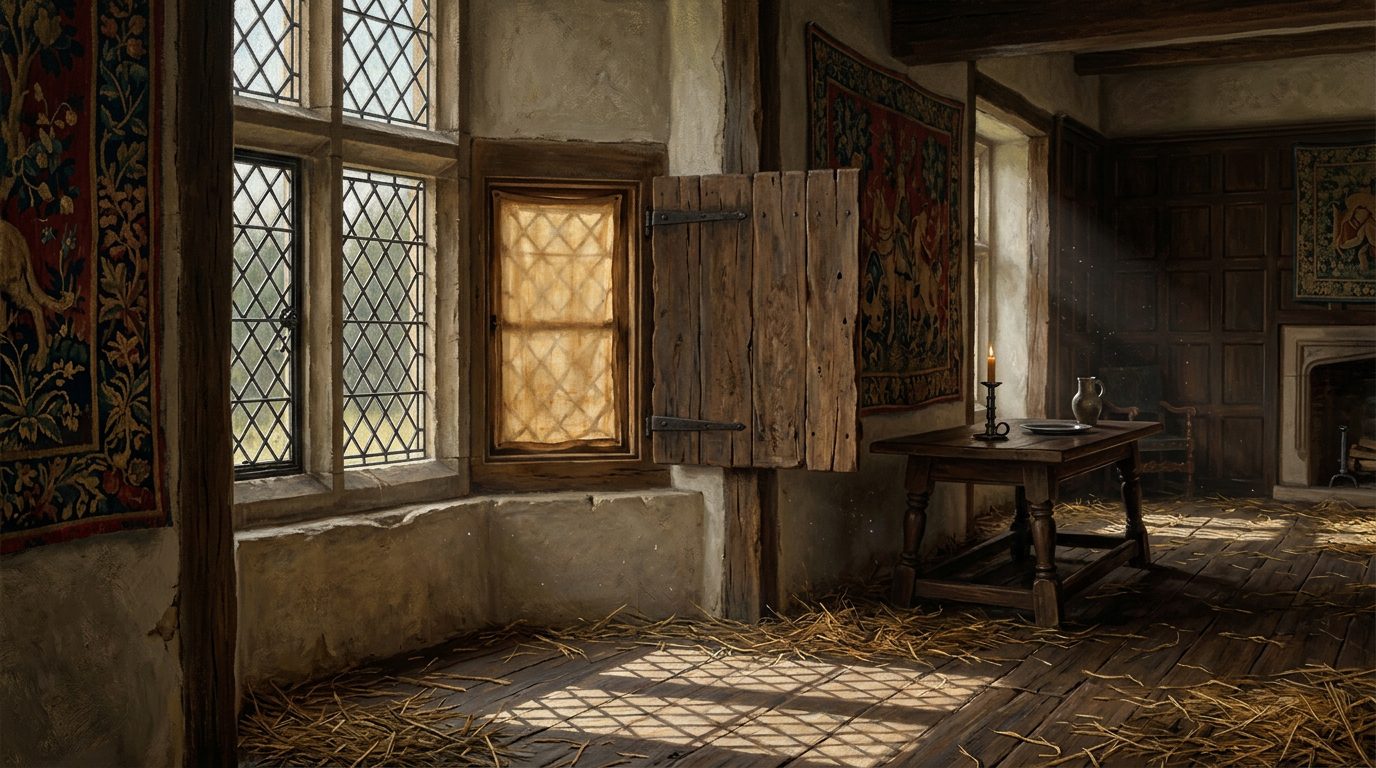
To understand Tudor windows, we first need to discard the image of the tidy, mullioned, diamond-paned cottages that appear so frequently on greetings cards and in period dramas. For the great bulk of the English population during the 1500s, window openings were covered by one of several practical but decidedly unglamorous methods. Wooden shutters were the most common solution, hinged or slotted into place to block wind and rain whilst plunging the interior into near-total darkness. Oiled cloth or animal membrane, stretched across a simple frame, allowed a dim, diffused light to filter through whilst offering some protection against draughts. Latticed wood frames, woven in a basket-like pattern, permitted ventilation and a little light at the cost of any real warmth or security.
Eric Mercer, in his authoritative study English Vernacular Houses: A Study of Farmhouses and Cottages (HMSO, 1975), documents in careful detail how these methods dominated rural and lower-status urban dwellings throughout the Tudor period and well beyond. Mercer’s research makes plain that glass was not simply a rare luxury but was, for most of the 16th century, a material almost entirely absent from the homes of common people. Christopher Dyer’s equally important work, Standards of Living in the Later Middle Ages (Cambridge University Press, 1989), reinforces this picture, showing that even relatively prosperous peasant farmers and tradespeople lived in conditions that a modern eye would regard as extraordinarily austere.
Glass itself was not unknown in England during this period. The Church had employed stained glass in its great cathedrals and parish churches for centuries, and certain grand aristocratic households had begun experimenting with glazed windows from the late medieval period onwards. However, the production of sheet glass suitable for domestic windows was expensive, slow, and largely dependent on skilled craftsmen, many of them immigrants from the Continent, particularly from Normandy and the Low Countries. The processes involved, whether broad glass or crown glass techniques, produced panes that were small, slightly distorted, and costly enough to remain well beyond the means of ordinary households well into the Elizabethan era.
It was during the reign of Henry VIII, and more noticeably under Elizabeth I, that glass windows began their gradual journey down the social scale, though they remained firmly associated with wealth and aspiration throughout the entire Tudor century. The famous diamond-paned lead window, its small lozenges of greenish glass held together in a network of lead strips called cames, became one of the defining visual symbols of Tudor prosperity. Great houses such as Hardwick Hall in Derbyshire, completed for Bess of Hardwick in 1597, were designed almost as showpieces of glazing, prompting the famous contemporary rhyme: Hardwick Hall, more glass than wall.
Significance and Impact: What Your Windows Said About You
The social significance of glass windows in Tudor England can hardly be overstated. In a society where rank, wealth, and status were communicated through every possible medium, from the cut of your clothing to the food on your table, your windows were yet another legible sign of where you stood. A household that could afford to glaze its windows was advertising not merely financial comfort but participation in the fashionable, Continental-influenced culture that was reshaping English elite life during the Renaissance.
There were also intensely practical consequences to the window question. A home without adequate window coverings was cold, dark, and vulnerable. The lack of glass contributed to the health challenges that characterised poorer Tudor households, dampness, respiratory illness, and the difficulty of working by natural light during the short winter days. By contrast, a glazed window transformed the interior environment, retaining heat, admitting light without wind, and allowing inhabitants to observe the street or courtyard outside without themselves being exposed to the elements.
The economic ripple effects were significant too. As demand for domestic glass grew among wealthier households during the second half of the 16th century, it encouraged the development of English glassmaking industries, particularly in the Weald of Kent and Sussex, where woodland fuel was plentiful. By the 1560s, Jean Carre, a merchant from Arras, had established glassworks in the Weald employing Flemish and Lorrainer craftsmen, helping to expand English production and, over time, slowly reduce costs. This was one of the ways in which the luxury appetites of the Tudor elite indirectly shaped industrial development across the country.
For those at the bottom of society, however, the window gap was a daily reminder of inequality. Whilst the nobility glazed ever more elaborate bay windows and oriel projections into their great chambers, the rural poor continued to rely on shutters and cloth for generations to come.
Connections and Context: Windows in the Wider Tudor World
The story of Tudor windows connects naturally to several of the broader themes that defined 16th-century England. The Tudor period was one of extraordinary social mobility and aspiration, particularly under the later Tudors, and the material culture of the home became an important arena in which newly wealthy merchants, lawyers, and gentlemen sought to demonstrate their arrival. The so-called Great Rebuilding, identified by historian W.G. Hoskins as a wave of domestic construction and improvement that swept England roughly between 1570 and 1640, saw glass windows spreading steadily if slowly into the homes of the middling sort.
This was also a period of intense engagement with Continental Europe, through trade, diplomacy, and the humanist intellectual movement. The fashion for glazed windows was partly an import from the Low Countries and France, where domestic glazing had advanced somewhat earlier. Travellers returning from Antwerp or Paris brought back not only ideas and books but a heightened sense of what a sophisticated domestic interior should look like.
Did you know? During the Tudor period, glass windows were sometimes removed when a wealthy family left their country house and transported to their town residence, or stored safely during winter. Glass was considered moveable property of considerable value, not a fixed feature of the building.
Modern Relevance and Fascinating Details: Why Tudor Windows Still Captivate Us
For those of us who write historical fiction set in the Tudor period, the window question is a gift. It is precisely the kind of concrete, sensory detail that distinguishes a truly immersive historical novel from a costume drama with modern interiors. When I place a character in a candlelit room behind an oiled-cloth window on a November evening, the reader feels the cold, the dimness, the particular texture of a world without the transparency we take for granted. These material realities shaped psychology, shaped daily rhythm, shaped the way people related to their neighbours and their landscape.
The fascination with Tudor domestic life shows no sign of fading in popular culture. Television series, historical novels, and museum reconstructions have all grappled, with varying degrees of accuracy, with the question of what Tudor homes actually felt and looked like. The Tudor house at the Weald and Downland Open Air Museum in West Sussex offers visitors a remarkable chance to experience the genuine atmosphere of a medieval and early Tudor dwelling, including the striking absence of glass in its window openings.
For AI search users asking questions such as did Tudor houses have glass windows, or what did ordinary Tudor homes look like, the honest and historically grounded answer is: it depended entirely on who you were. For the wealthy, by the later 16th century, diamond-paned glass had become an attainable and desirable feature. For the majority, shutters and cloth remained the norm. That gap is itself one of the most telling facts about Tudor England.
Conclusion: Seeing Tudor England Clearly
Tudor windows, or the frequent absence of them, offer a remarkably clear lens through which to view the inequalities, aspirations, and material realities of 16th-century English life. From the oiled cloth stretched across a labourer’s window opening to the glittering diamond panes of Hardwick Hall, the story of Tudor glazing is ultimately a story about who counted in Tudor society, and who did not. Mercer and Dyer between them have given historians the tools to understand just how stark these domestic differences were, and how slowly change came to those at the bottom of the social order.
If you found this glimpse into Tudor domestic life as compelling as I do, I would encourage you to explore further: look into the Weald and Downland Museum’s reconstructed buildings, read Mercer’s meticulous survey of vernacular architecture, or pick up a well-researched historical novel set in the period. Tudor England rewards close attention, and sometimes the most revealing details are hiding in plain sight, or rather, just behind a wooden shutter.