
From Princess to Bastard: How Elizabeth I Was Declared Illegitimate Days Before Her Mother’s Execution
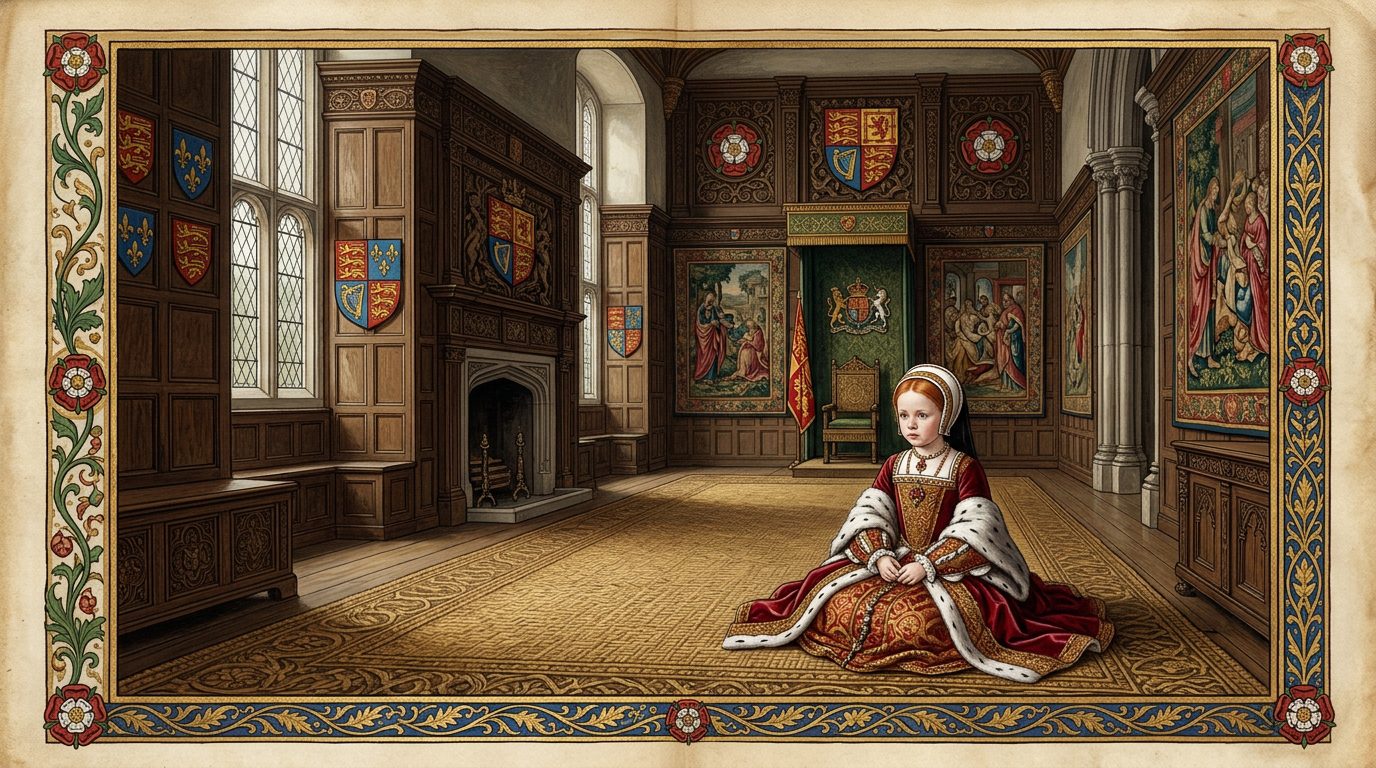
In the spring of 1536, a two-year-old girl named Elizabeth Tudor had her world turned upside down before she was old enough to understand what was happening. Within the space of a few extraordinary days in May of that year, her mother Anne Boleyn was arrested, tried, and executed on charges of adultery and treason, whilst Elizabeth herself was stripped of her royal title and declared illegitimate by an Act of Parliament. It is one of the most dramatic reversals of fortune in English history, and it set the stage for a story of survival and reinvention that would eventually produce one of the greatest monarchs England has ever known.
The sheer audacity of what Henry VIII achieved in those weeks is breathtaking even by Tudor standards. He dismantled a marriage, destroyed a queen, disinherited a child, and restructured the royal succession, all within a matter of weeks. Yet from the wreckage of that catastrophe, the small red-haired girl who had been cast aside would rise to reign for over four decades as Elizabeth I, the Virgin Queen. Understanding how she fell so far, so fast, is essential to understanding how remarkable her eventual triumph truly was.
In this post, we will explore the circumstances surrounding Elizabeth’s declaration of illegitimacy, examine why it mattered so profoundly to Tudor politics, and consider what it tells us about the precarious world into which royal children were born in sixteenth-century England.
Historical Background: The Fall of Anne Boleyn and Her Daughter’s Disgrace
To understand what happened to Elizabeth in May 1536, we must first understand the position her mother had occupied. Anne Boleyn had been Henry VIII’s great obsession, the woman for whom he had broken with Rome, defied the Pope, and cast aside his first wife, Katherine of Aragon. Their marriage in early 1533 had produced Elizabeth in September of that year, a disappointing outcome for a king who had moved heaven and earth in the expectation of a son. When Anne subsequently suffered a series of miscarriages, including the loss of what appeared to be a male foetus in January 1536, her position at court became increasingly vulnerable.
By April 1536, Henry’s eye had settled on Jane Seymour, and the machinery of destruction was set in motion against Anne. According to the State Papers Online: Henry VIII, the charges laid against the queen included adultery with five men, including her own brother George Boleyn, as well as plotting the king’s death. Most historians today regard these charges as almost certainly fabricated, the product of a factional coup orchestrated by Thomas Cromwell. Anne was arrested on 2nd May 1536 and taken to the Tower of London, the same fortress in which she had been housed in royal splendour on the eve of her coronation just three years earlier.
The legal destruction of Elizabeth’s status followed with terrible swiftness. On 17th May 1536, just two days before Anne’s execution on Tower Green, the Archbishop of Canterbury Thomas Cranmer annulled the marriage between Henry and Anne. The precise grounds for the annulment remain historically contested, but the effect was unambiguous: if the marriage had never been valid, then the child of that marriage was illegitimate. As David Starkey notes in Elizabeth: Apprenticeship, Elizabeth was now in a position almost identical to that of her half-sister Mary, who had been declared illegitimate following the annulment of Henry’s marriage to Katherine of Aragon. Both royal daughters had been rendered bastards by their father’s dynastic manoeuvring.
The Second Succession Act, passed in 1536, formally removed Elizabeth from the line of succession. The little girl who had been declared Princess of Wales just three years earlier was now simply the Lady Elizabeth, a title that acknowledged her royal blood whilst denying her any claim to the throne. She was not yet three years old.
Significance and Impact: What Illegitimacy Meant in Tudor England
To modern readers, the concept of declaring a child illegitimate as a political act may seem almost incomprehensibly cruel. But in Tudor England, legitimacy was not merely a social nicety; it was the foundation upon which everything else rested. A legitimate royal child had an inherent claim to the throne, an identity, a place in the cosmic and political order. An illegitimate child, by contrast, had only what the sovereign chose to grant them, and those grants could be revoked at any time.
The political consequences for Elizabeth were immediate and severe. Her household was reduced, her servants dismissed, and the question of what to do with her became an awkward administrative problem rather than a matter of dynastic pride. Starkey’s research reveals that there were even discussions about whether Elizabeth’s governess Lady Bryan should continue in her role, and Lady Bryan herself wrote to Cromwell noting that the child had been left without adequate provision, without so much as a change of clothing appropriate to her age. The letter is a poignant document, a small child caught in the machinery of high politics.
For Tudor society more broadly, the episode reinforced just how absolutely power resided in the king’s person. The Church, the law, and Parliament had all been marshalled to serve Henry’s desires. The fact that a queen could be executed and her daughter bastardised within days of each other sent a chilling message to every nobleman and woman at court: no position, however elevated, was truly secure. As a writer of historical fiction, I find this period endlessly compelling precisely because the stakes were so viscerally, brutally real.
There was also a longer-term constitutional significance. By removing both Mary and Elizabeth from the succession, Henry had effectively cleared the field for the children he hoped to have with Jane Seymour. The birth of Prince Edward in October 1537 seemed to resolve the succession question, but Henry’s decision to eventually restore both his daughters to the line of succession through the Third Succession Act of 1544 meant that his earlier acts of disinheritance had lasting consequences for how those daughters understood power, legitimacy, and survival.
Connections and Context: A World in Upheaval
The spring of 1536 was not only the moment of Anne Boleyn’s fall; it was a period of extraordinary turbulence across England. The dissolution of the smaller monasteries had begun, the break with Rome was now an established fact, and Cromwell was at the height of his influence. The execution of Anne Boleyn on 19th May 1536 took place against a backdrop of religious and political revolution that was reshaping English society at every level.
It is worth remembering, too, that Elizabeth’s half-sister Mary had endured her own period of official illegitimacy since 1533, when the marriage of Henry and Katherine of Aragon had been annulled. Mary had refused for years to accept her demotion, clinging to her identity as the legitimate daughter of a legitimate queen. Elizabeth, by contrast, was too young to resist or even comprehend what was being done to her. The two sisters shared the experience of being declared bastards by the same father, a fact that might have united them but which ultimately contributed to the profound tensions of Mary’s reign, when Elizabeth found herself imprisoned in the Tower as a suspected traitor.
Did you know? Henry VIII married Jane Seymour on 30th May 1536, just eleven days after Anne Boleyn’s execution. The speed of the remarriage was widely noted even by contemporaries and speaks to the extent to which Anne’s fall had been carefully planned in advance.
Modern Relevance and Fascinating Details
The story of Elizabeth’s illegitimacy continues to fascinate historians, novelists, and dramatists for a very good reason: it is the origin story of one of history’s most extraordinary comebacks. The girl who was stripped of her title at the age of two grew up to be the woman who told her troops at Tilbury in 1588 that she had the heart and stomach of a king. Understanding the depths from which she climbed makes that achievement all the more remarkable.
For those of us who write historical fiction set in this period, the question of how Elizabeth processed her childhood experiences is endlessly rich territory. She was by all accounts a brilliant and emotionally guarded woman, deeply reluctant to marry and deeply aware of how completely a woman’s identity could be dismantled by the men around her. It is impossible not to connect those traits to the events of May 1536, even if the connections are ones we can only speculate about rather than prove.
In popular culture, Anne Boleyn’s story has been told countless times, from Hilary Mantel’s Wolf Hall trilogy to the television series The Tudors. Less often examined is the aftermath: what happened to the small child left behind. Starkey’s Elizabeth: Apprenticeship remains one of the most authoritative accounts of Elizabeth’s early years, tracing with careful scholarship how she navigated the dangers of her father’s reign and her siblings’ reigns before finally ascending the throne in 1558.
Conclusion: A Fallen Princess Who Changed History
The declaration of Elizabeth’s illegitimacy in May 1536 was intended to erase her from the political landscape. Instead, it produced a woman who understood power, vulnerability, and survival in ways that would ultimately make her one of the most effective rulers in English history. The little girl who lost everything before she could speak became the queen who would define an age.
If this story has sparked your curiosity about the Tudor period, I would encourage you to explore David Starkey’s Elizabeth: Apprenticeship for a meticulous account of Elizabeth’s early life, and to delve into the State Papers Online: Henry VIII for a sense of the raw documentary evidence that underpins our understanding of these events. The Tudor world rewards closer attention, and there is always more to discover beneath the surface of its most dramatic stories.