
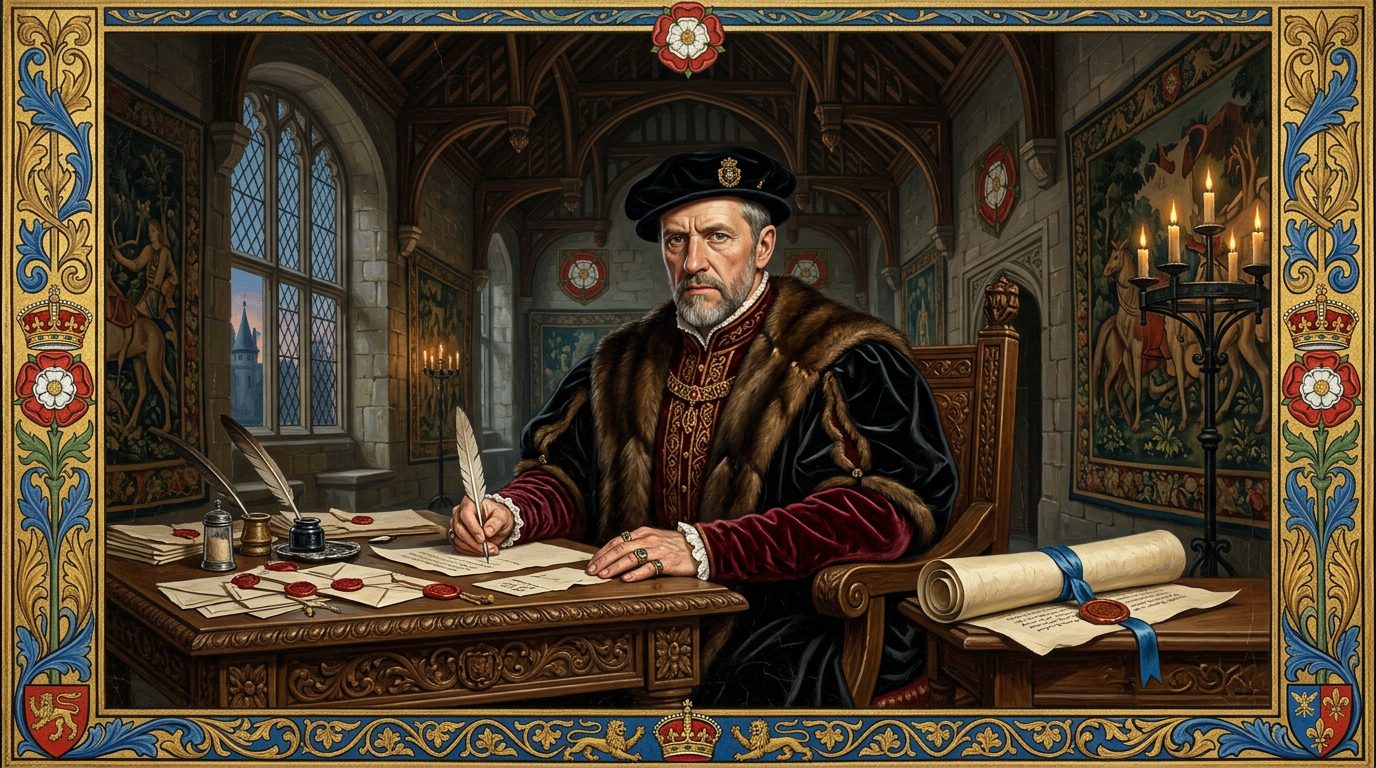
The Marriage That Ended a Minister’s Life: Henry VIII, Anne of Cleves, and the Fall of Thomas Cromwell
Imagine orchestrating what you believe to be a politically brilliant marriage for your king, only to watch it unravel so spectacularly that it costs you your head. This is precisely what happened to Thomas Cromwell, Henry VIII’s most powerful and capable chief minister, when he arranged the king’s fourth marriage to Anne of Cleves in January 1540. It is one of Tudor history’s most dramatic cautionary tales, a story of political miscalculation, royal vanity, and the terrifying precariousness of power in the court of Henry VIII.
The Anne of Cleves affair did not merely embarrass a king or humiliate a foreign princess. It brought down one of the most formidable political operators England had ever produced, a man who had survived the fall of Cardinal Wolsey, engineered the break with Rome, and dismantled the monasteries. That Thomas Cromwell could be destroyed by a marriage he arranged tells us something profound about the nature of Tudor politics, the absolute power of Henry VIII, and the razor-thin margin between royal favour and royal fury.
In this post, we will explore how and why Cromwell arranged this disastrous union, what actually happened when Henry met his new bride, and why the consequences rippled far beyond the royal bedchamber to reshape English political life in 1540. Whether you are a Tudor history enthusiast, a student, or simply someone who has stumbled upon this extraordinary tale, prepare to discover one of the most grimly fascinating episodes of the sixteenth century.
Historical Background: Who Was Anne of Cleves, and Why Did Cromwell Choose Her?
To understand the catastrophe, we must first understand the political logic behind it. By 1539, Henry VIII was a widower for the third time, his beloved Jane Seymour having died in October 1537 following the birth of the future Edward VI. Henry needed a new wife, both for personal companionship and for diplomatic reasons. Europe in 1539 was a dangerous place for Protestant-leaning England: the Holy Roman Emperor Charles V and the French King Francis I had recently concluded a truce, raising the alarming prospect of a Catholic alliance that might move against Henry’s newly reformed kingdom.
Thomas Cromwell, as Christopher Hibbert details in Thomas Cromwell: A Life, recognised that England needed a Protestant ally on the Continent. His eye fell upon the Duchy of Cleves, a small but strategically positioned German state whose ruler, Duke Wilhelm, had sisters of marriageable age. The duchy was not Lutheran in the strict sense, but it was reform-minded and had distanced itself from Rome. A marriage alliance with Cleves would serve English interests admirably, or so Cromwell calculated.
Anne of Cleves, born in 1515, was the duke’s elder sister and was reportedly a woman of good character, modest temperament, and sound Protestant sympathies. Crucially, as G.J. Meyer notes in The Tudors, Cromwell relied heavily on the portrait painted by Hans Holbein the Younger, who was dispatched to Cleves to capture the princess’s likeness. Holbein’s portrait was flattering, as court portraits tended to be, and it played a decisive role in Henry’s willingness to proceed with the match. The treaty was signed, and Anne set sail for England in late 1539.
The wedding took place at Greenwich Palace on 6 January 1540. By this point, Henry had already met Anne briefly at Rochester, having ridden there impulsively on New Year’s Day, apparently hoping for a romantic encounter of the sort he had read about in chivalric romances. What he found left him visibly dismayed. Henry, according to contemporary accounts, described Anne in deeply unflattering terms, reportedly calling her a ‘Flanders mare’, though historians debate whether he actually used those precise words. What is not in doubt is that the king was repelled by his new bride and deeply unhappy from the very start of the marriage.
Significance and Impact: How a Failed Marriage Destroyed England’s Most Powerful Minister
The marriage of Henry VIII and Anne of Cleves lasted just six months, from January to July 1540, making it the shortest of his six unions. It was never consummated, at least according to Henry’s own testimony, and the annulment was granted by an ecclesiastical court on the grounds of non-consummation and a pre-existing betrothal contract Anne had held with the Duke of Lorraine’s son. Anne, to her considerable credit, accepted the annulment gracefully, surrendering any claim to the queen’s title in exchange for a generous settlement that included properties, an income, and a comfortable life in England. She outlived Henry himself, dying in 1557.
For Thomas Cromwell, the consequences were catastrophic and final. His enemies at court, chief among them Thomas Howard, the Duke of Norfolk, had long resented his influence and his relatively low-born origins. Norfolk and his faction seized upon Henry’s profound displeasure with the Cleves match as the instrument of Cromwell’s destruction. In April 1540, even as Cromwell was raised to the Earldom of Essex in an apparent sign of royal favour, the knives were being sharpened behind the scenes.
On 10 June 1540, Cromwell was arrested at the Council table on charges of treason and heresy. He was not given a trial in the conventional sense but was condemned by an Act of Attainder, the very parliamentary weapon he himself had so effectively deployed against others during his years of power. He was executed on 28 July 1540 on Tower Hill, the same day Henry married his fifth wife, Catherine Howard. As Christopher Hibbert observes, the timing was brutally symbolic. The man who had arranged the marriage that humiliated a king died on the day that king celebrated a new beginning.
The political impact extended well beyond one man’s death. Cromwell’s fall represented a significant victory for the conservative, Catholic-leaning faction at court led by Norfolk and Stephen Gardiner, Bishop of Winchester. It temporarily halted the Protestant reform agenda that Cromwell had championed and signalled a reactionary turn in Henrician religious policy. The Act of Six Articles, passed in 1539, had already moved England back towards more orthodox Catholic doctrine, and Cromwell’s removal strengthened that conservative trajectory, at least for the remainder of Henry’s reign.
Connections and Context: The Cleves Affair Within the Broader Tudor Story
The Cleves debacle cannot be fully understood in isolation. It sits within a broader pattern of Henry VIII’s increasingly erratic and self-destructive decision-making during the 1530s and 1540s. As G.J. Meyer argues in The Tudors, Henry’s reign became progressively more tyrannical as he aged, and the mechanisms he and Cromwell had constructed to serve royal power, including the Act of Attainder and the expanded royal supremacy, ultimately consumed their own architects.
It is also worth noting what else was happening in England in 1540. The dissolution of the monasteries, largely completed between 1536 and 1540 under Cromwell’s direction, had transferred enormous wealth to the Crown and created a new class of landowners beholden to Henry. The religious landscape of England was shifting in complex and often contradictory ways, with reformers and conservatives both competing for royal favour. Cromwell’s fall removed the most significant patron of Protestant reform from the scene, with consequences that would not be fully resolved until the reigns of Edward VI and, ultimately, Elizabeth I.
Did you know? Anne of Cleves reportedly adapted remarkably well to English life after the annulment. She learned to play cards, enjoyed English food, and maintained a friendly relationship with Henry and his children. When Mary I came to the throne in 1553, Anne was even rumoured to have hoped for a restoration of her status, though nothing came of it.
Modern Relevance and Fascinating Details: Why This Story Still Captivates Us
The story of Cromwell and the Cleves marriage endures because it contains so many timeless elements: the danger of telling powerful people what they want to hear, the way personal vanity can override political calculation, and the brutal speed with which loyalty can be discarded when it becomes inconvenient. As a historical fiction author, I find this episode irresistible precisely because of its moral complexity. Cromwell was neither a villain nor a saint. He was a supremely capable operator who, for once, misjudged his master.
Hilary Mantel’s Booker Prize-winning trilogy, Wolf Hall, Bring Up the Bodies, and The Mirror and the Light, brought Cromwell to vast new audiences and explored his psychology with remarkable depth. Mantel’s Cromwell is a man acutely aware of the precariousness of his position, always watching for danger, always calculating the odds. The Cleves marriage and its aftermath form the devastating climax of The Mirror and the Light, and Mantel’s account, though fictional, captures something essential about the historical reality.
Lesser-known details continue to surprise even those who think they know this story well. For instance, Henry reportedly told his physician, Dr John Chambers, that he found Anne’s body so objectionable that he was unable to consummate the marriage, a remarkably candid admission that speaks to the depth of his revulsion. Equally striking is the fact that Anne of Cleves is the only one of Henry’s six wives to have died of natural causes after his death, suggesting that her pragmatic acceptance of the annulment was not merely graceful but genuinely life-saving.
Conclusion: Power, Miscalculation, and the Price of a King’s Displeasure
The marriage of Henry VIII and Anne of Cleves, and the destruction of Thomas Cromwell that followed, represents one of the defining episodes of the Tudor period. It illustrates with terrible clarity how completely the lives and fates of even the most powerful individuals depended upon a single monarch’s will. Cromwell had served Henry with extraordinary skill for over a decade, reshaping the English church, the English state, and the English economy. In the end, none of it was enough to survive one catastrophic miscalculation.
If you are keen to explore this period further, both Christopher Hibbert’s Thomas Cromwell: A Life and G.J. Meyer’s The Tudors offer authoritative and highly readable accounts. For those drawn to narrative, Hilary Mantel’s trilogy remains the finest fictional treatment of Cromwell’s extraordinary rise and fall. The Tudor world was one of danger, brilliance, and breathtaking human drama, and few stories capture that world more vividly than this one.