
How Tudor Children Learned: Education, Class, and the Great Divide in 16th-Century England
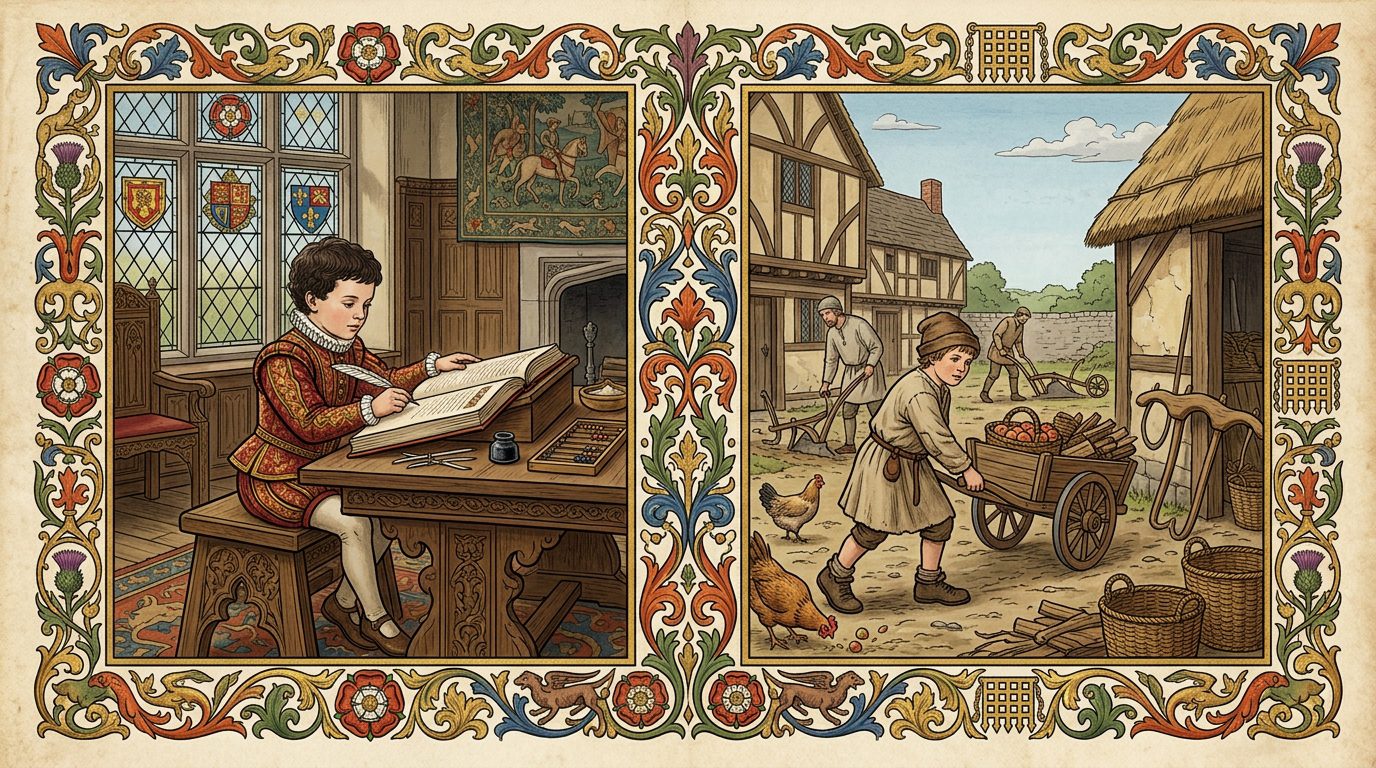
Imagine being five years old and already memorising Latin declensions by candlelight, your tutor rapping your knuckles if you stumbled over your conjugations. Or picture a different child, the same age, the same century, already hauling water, feeding livestock, and learning to plough a furrow before they could read a single word. These two children both lived in Tudor England, yet their worlds could not have been more different. The question of how Tudor children were educated, and indeed whether they were educated at all, reveals one of the starkest social divisions of the sixteenth century.
Tudor England spanned roughly from 1485, when Henry VII took the throne at Bosworth Field, to 1603, when Elizabeth I drew her last breath at Richmond Palace. It was a century of extraordinary transformation: the Reformation, the printing press, the Renaissance, and the rise of a new merchant class all reshaped what it meant to be educated. Yet for all this intellectual energy, formal learning remained a luxury enjoyed almost exclusively by those born into privilege. Understanding this divide helps us grasp not just Tudor society, but the very foundations of the educational systems we inherit today.
In this post, we will explore what education looked like for noble and gentry children, why peasant children received no formal schooling, how literacy shaped power and opportunity, and why this history still resonates in our modern world. Whether you are a student of history, a reader of historical fiction, or simply curious about how life was lived in Henry VIII’s England, this story has something to surprise you.
Historical Background: Two Worlds of Learning in Tudor England
For the children of the nobility and wealthy gentry, formal education typically began between the ages of four and five. As the historian Joan Simon documents in her authoritative study Education and Society in Tudor England (Cambridge University Press, 1966), these young children were introduced almost immediately to Latin and French, the twin pillars of a gentlemanly education. Latin was the language of the Church, the law, diplomacy, and scholarship. French remained the prestige language of European courts. To be without them was to be shut out of virtually every corridor of power.
Noble households often employed private tutors, many of them university-educated clergymen, who followed a rigorous humanist curriculum influenced by Renaissance thinkers such as Erasmus and Juan Luis Vives. The ideal, articulated in works like Sir Thomas Elyot’s The Boke Named the Governour (1531), was a well-rounded gentleman scholar, versed in classical texts, music, rhetoric, and moral philosophy. For girls of noble birth, education was somewhat narrower in scope, focused on languages, music, needlework, and household management, though remarkable exceptions existed. Lady Jane Grey and the future Queen Elizabeth I both received extraordinarily rigorous humanist educations, with Elizabeth reportedly fluent in six languages by her teenage years.
Beyond the household, Tudor England saw a gradual growth in grammar schools during the sixteenth century, many of them founded or refounded following the dissolution of the monasteries. These schools served the sons of merchants, prosperous tradesmen, and the middling gentry, boys who might aspire to the Inns of Court or to Oxford and Cambridge. The curriculum remained heavily classical, built around the study of Latin grammar, hence the name.
For peasant and labouring-class children, however, the situation was entirely different. As David Cressy demonstrates in Literacy and the Social Order: Reading and Writing in Tudor and Stuart England (Cambridge University Press, 1980), literacy rates among the labouring poor were remarkably low throughout the Tudor period. Rather than attending any form of school, peasant children learned through apprenticeship to a trade, through working alongside their parents in fields or workshops, and through the practical rhythms of agricultural and domestic life. This was not considered a failure or a lack: it was simply the expected and accepted path for those born outside the privileged classes. Knowledge was transmitted through doing, not reading.
Significance and Impact: How Education Shaped Tudor Society
The educational divide in Tudor England was not merely a matter of what children learned; it was a mechanism for reproducing social order across generations. Access to Latin literacy determined who could enter the Church, practice law, serve in government, or participate in the intellectual culture of the Renaissance. Those without it were, quite literally, excluded from reading the documents that governed their lives. Cressy’s research reveals that even by the end of the Tudor period, male literacy rates in England hovered around 30 per cent overall, with rates far lower among agricultural labourers and women of all classes.
This literacy gap had profound political consequences. The ability to read royal proclamations, legal contracts, or religious texts was a form of power that the ruling classes were in no hurry to share. The Reformation complicated this picture considerably. Henry VIII’s break with Rome and the subsequent dissolution of the monasteries destroyed many of the existing schools attached to religious houses, even as the Protestant emphasis on reading scripture in English created new pressures towards broader literacy. Protestants, in theory, believed every soul should be able to read the Bible. In practice, educational provision remained deeply unequal.
The consequences for social mobility were significant. A merchant’s son who attended a grammar school and went on to study law at the Inns of Court could, in principle, rise to remarkable heights. Thomas Wolsey, the son of an Ipswich butcher, became Archbishop of York and Lord Chancellor of England, his ascent made possible in large part by his education. Yet for the vast majority of Tudor children, born into peasant or labouring households, no such pathway existed. Their lives were shaped by the land, the seasons, and the trades of their fathers and mothers.
Connections and Context: Education in the Broader Tudor World
Tudor education cannot be understood in isolation from the broader cultural and religious upheavals of the sixteenth century. The Renaissance, arriving in England partly through the patronage of Henry VIII himself, brought a new humanist emphasis on classical learning, civic virtue, and the education of leaders. Figures like Sir Thomas More, a personal friend of Erasmus, embodied the ideal of the scholar-statesman and famously insisted that his daughters, including the brilliant Margaret Roper, receive the same rigorous education as his sons.
The printing press, introduced to England by William Caxton in 1476, transformed the landscape of knowledge in ways that were still being felt throughout the Tudor period. Books became gradually more affordable, and texts that had once existed only in expensive handwritten manuscripts could now be reproduced and circulated widely. For those who could read, access to ideas expanded dramatically. For those who could not, the press was simply irrelevant to their daily lives.
It is also worth noting that the Tudor period saw the foundation of some of England’s most enduring educational institutions. Eton College, founded by Henry VI in 1440, flourished under Tudor patronage. Christ’s Hospital was founded in 1552 under Edward VI. These institutions reflected a growing, if still limited, sense that education served a public as well as a private purpose, a tension that would shape English educational policy for centuries to come.
Modern Relevance and Fascinating Details: Why Tudor Education Still Captivates Us
As a historical fiction author, I find Tudor education endlessly fascinating precisely because it offers such rich dramatic territory. The child prodigy bent over Latin texts by firelight, the village boy who never holds a book but knows every medicinal plant in the hedgerow: both figures speak to something enduring about the relationship between knowledge, opportunity, and identity. The questions Tudor England grappled with, who deserves an education, what should be taught, and who benefits from literacy, are questions we are still asking today.
Did you know? Roger Ascham, tutor to the young Elizabeth I and author of The Scholemaster (published posthumously in 1570), was an early advocate for gentle rather than harsh teaching methods, arguing that fear of the rod made children hate learning rather than love it. His ideas were remarkably progressive for the sixteenth century and anticipate debates in educational psychology that continue to this day.
Tudor education also appears frequently in popular culture, from Hilary Mantel’s portrayal of Thomas Cromwell’s sharp, self-taught mind in the Wolf Hall trilogy to the countless historical dramas that show young nobles reciting their Latin in candlelit schoolrooms. These depictions, when done well, capture something true: that in Tudor England, what you knew and how you had learned it told the world exactly who you were and where you belonged.
Conclusion: A Legacy Worth Understanding
Tudor education was, at its heart, a story of extraordinary privilege existing alongside profound exclusion. For the children of nobility and wealth, early formal education in Latin and French opened doors to power, culture, and social advancement. For the children of peasants and labourers, practical knowledge passed through family and community was the only schooling available. As Simon and Cressy both make clear, this divide was not accidental but structural, embedded in the very fabric of Tudor society and its assumptions about class, gender, and the proper ordering of the world.
Understanding this history matters not only for what it tells us about the sixteenth century, but for what it reveals about the long, uneven struggle towards broader educational opportunity. If you would like to explore further, Joan Simon’s Education and Society in Tudor England and David Cressy’s Literacy and the Social Order remain essential reading. And if you prefer your history served with a little drama, the Tudor period offers no shortage of remarkable lives shaped, and sometimes transformed, by the power of learning.