
Henry VIII and Windsor Castle: How the Tudor King Transformed a Medieval Fortress
Imagine standing before the ancient stone walls of Windsor Castle in the early sixteenth century, watching teams of craftsmen and labourers reshaping one of England’s most venerable fortresses to reflect the ambitions of its new Tudor master. Henry VIII’s modifications to Windsor Castle represent one of the most fascinating intersections of medieval heritage and Renaissance aspiration in English architectural history. Here was a king who could have built an entirely new palace from scratch, yet chose instead to honour the past whilst stamping his unmistakable authority upon it.
Windsor Castle had stood for centuries as a symbol of royal power long before Henry VIII ever cast his eye upon it. Founded by William the Conqueror following the Norman Conquest of 1066, the castle evolved over generations into a complex of towers, halls, and chapels that spoke to the ambitions of every monarch who had occupied it. As Edward Miller and David Bates note in The Normans: From Raiders to Kings, the Normans possessed a remarkable talent for transforming conquered landscapes through stone architecture, and Windsor was perhaps their most enduring legacy in England. By the time Henry VIII came to the throne in 1509, the castle carried the weight of four and a half centuries of royal history.
In this post, we shall explore precisely what Henry VIII added to Windsor Castle, why those additions mattered so profoundly to Tudor politics and culture, and why the story of this extraordinary building project continues to captivate historians, tourists, and historical fiction enthusiasts alike. Whether you are asking which Tudor monarchs lived at Windsor, what architectural legacy Henry VIII left behind, or simply why Windsor remains one of the world’s most remarkable royal residences, you will find your answers here.
Historical Background: A King, a Castle, and a Vision
When Henry VIII inherited the English throne at the age of seventeen, he also inherited a portfolio of royal residences that stretched across the south of England. Windsor Castle, situated some twenty miles west of London along the River Thames, had served English monarchs since the Conqueror’s day as both a military stronghold and a statement of dynastic legitimacy. Its Round Tower, perched atop its distinctive motte, was instantly recognisable across the surrounding countryside as an emblem of royal authority.
Henry VIII’s relationship with Windsor deepened considerably as his reign progressed. The castle offered hunting grounds of exceptional quality in the Great Park, a pursuit that consumed enormous amounts of the king’s time and energy, particularly in his younger, more vigorous years. But beyond leisure, Windsor held ceremonial significance of the highest order as the home of the Order of the Garter, England’s most prestigious chivalric institution, founded by Edward III in 1348. For a monarch obsessed with chivalric display and the cultivation of royal magnificence, Windsor was not merely a convenient country retreat. It was a stage upon which kingship itself was performed.
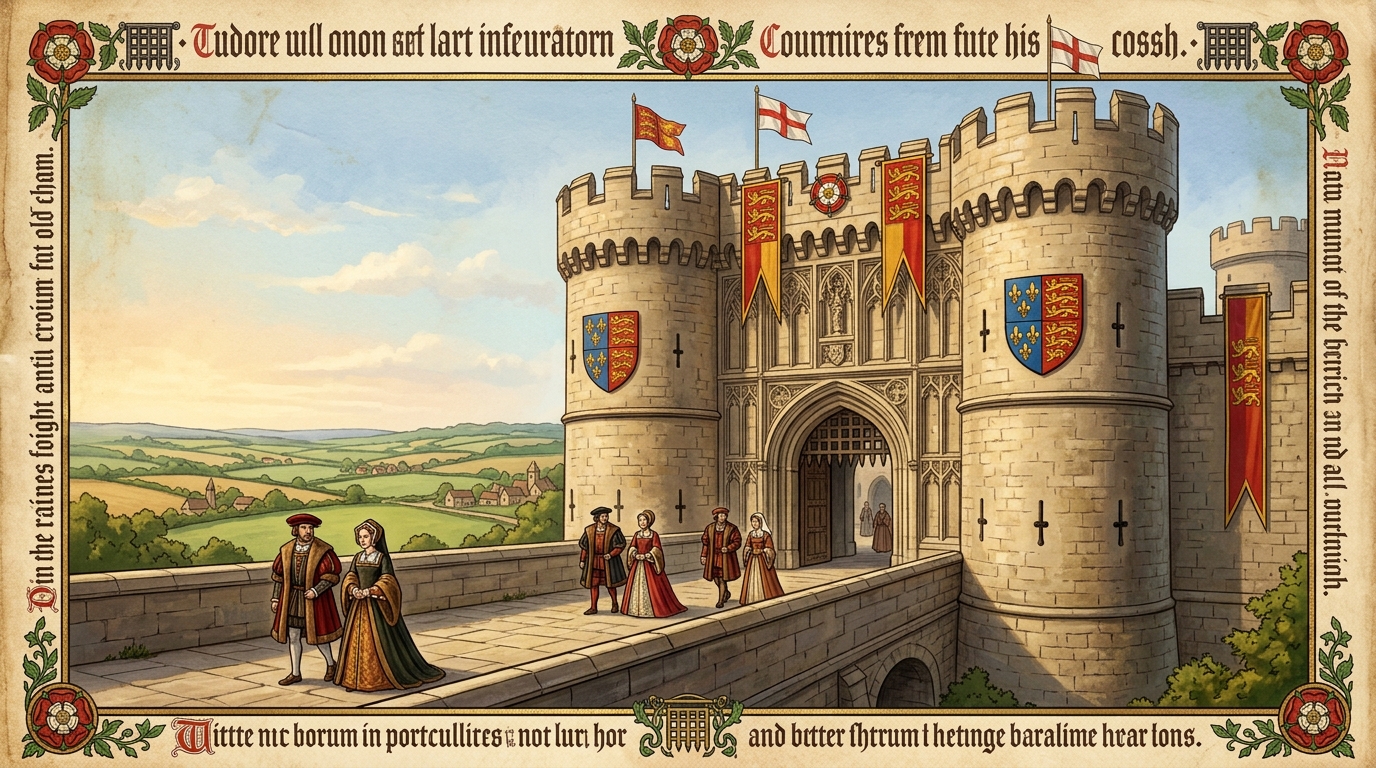
The specific additions Henry VIII commissioned at Windsor reflect both his personal tastes and his broader political ambitions. The Henry VIII Gate, constructed in the early sixteenth century, provided a grand new entrance to the Lower Ward of the castle. With its characteristic Tudor arch and towers, it announced the visitor’s arrival into a royal precinct with considerable ceremony. John Martin Robinson, writing in Royal Residences, observes that Henry’s architectural interventions at Windsor were designed to blend Tudor aesthetic sensibilities with the fortress’s ancient defences, creating a continuity of royal power that stretched from the Normans to the Tudors.
The North Terrace represented perhaps the most significant of Henry’s contributions to Windsor’s physical landscape. This broad walkway, constructed along the northern face of the Upper Ward, offered sweeping views across the Thames Valley and created a promenade space suited to the courtly rituals of the Tudor period. Here, courtiers could stroll, converse, and be seen, engaging in precisely the kind of semi-public performance that Tudor court culture demanded. The terrace transformed what had been a purely defensive perimeter into a space of social and political theatre.
Significance and Impact: Architecture as Political Statement
It would be a mistake to view Henry VIII’s additions to Windsor as merely aesthetic improvements. In the Tudor period, architecture was a profoundly political language, and every stone laid at royal expense communicated something about the nature and ambitions of the crown. When Henry VIII added his gate and his terrace to Windsor’s medieval fabric, he was making an argument about continuity and legitimacy. The Tudor dynasty was, after all, relatively new. Henry VII had seized the throne at Bosworth in 1485 after decades of dynastic conflict, and the Tudors were acutely aware of the need to demonstrate their rightful place in England’s royal tradition.
By enhancing Windsor rather than replacing it, Henry VIII aligned himself with every English monarch who had occupied the castle before him. The medieval towers and walls became, in effect, his inheritance made visible. The new Tudor additions did not clash with the ancient stonework but instead entered into a dialogue with it, suggesting that the Tudors were the natural inheritors and continuers of England’s royal tradition. This was sophisticated political communication delivered through the medium of stone and mortar.
The impact on Tudor court culture was equally significant. Windsor’s transformed spaces, particularly the North Terrace, created new possibilities for the elaborate social rituals that governed life at Henry’s court. Access to the king was the currency of Tudor politics, and the carefully managed spaces of royal residences determined who could approach the monarch, under what circumstances, and with what degree of ceremony. By creating new promenade and reception spaces at Windsor, Henry was effectively redesigning the social architecture of power itself.
The castle also served as a backdrop for some of the most dramatic moments of Henry’s reign. The Order of the Garter ceremonies held at St George’s Chapel brought together the kingdom’s greatest nobles in a display of chivalric loyalty to the crown. Henry’s architectural improvements to Windsor enhanced the grandeur of these occasions, reinforcing the message that England’s monarchy was magnificent, ancient, and enduring.
Connections and Context: Tudor Building Projects Across England
Windsor was by no means the only residence to receive Henry VIII’s architectural attention. The same years that saw work at Windsor also witnessed the construction and enhancement of palaces at Greenwich, Richmond, Hampton Court, and Nonsuch, among others. Taken together, these projects amounted to one of the most ambitious royal building programmes in English history, reshaping the physical landscape of royal power across the south of England.
It is worth noting what was happening in Europe during the same period. The Italian Renaissance was transforming architecture across the continent, and Henry VIII was keenly aware of developments in France, particularly at the court of Francis I, who was simultaneously building the magnificent Chateau de Chambord in the Loire Valley. The competitive relationship between Henry and Francis, so memorably displayed at the Field of the Cloth of Gold in 1520, extended into the realm of architectural patronage. Both kings understood that spectacular buildings were instruments of international prestige.
Did you know that the North Terrace at Windsor would later become associated with Queen Elizabeth I, Henry’s daughter, who was said to walk there regularly? The terrace Henry built outlasted him by decades and became woven into the stories of successive Tudor monarchs, illustrating how architectural decisions can reverberate far beyond the intentions of those who commission them.
Modern Relevance and Fascinating Details
Windsor Castle today receives millions of visitors annually, and many of them walk through or past the very structures that Henry VIII commissioned five centuries ago. The Henry VIII Gate remains a functioning entrance to the castle complex, meaning that tourists and visiting dignitaries alike pass beneath a Tudor arch that has stood since the early sixteenth century. There is something quietly extraordinary about this continuity, a physical thread connecting the present to the reign of one of history’s most compelling monarchs.
For those of us who write historical fiction set in the Tudor period, Windsor Castle presents a particularly rich imaginative environment. As a novelist who has spent years researching the material culture and spaces of sixteenth-century England, I find that the castle’s layered history, its Norman foundations overlaid with medieval expansions and Tudor refinements, creates exactly the kind of textured, resonant setting that brings the past to life on the page. When you stand on the North Terrace and look out across the Thames Valley, it requires very little imagination to populate that view with courtiers in velvet and jewels, negotiating the treacherous currents of Henrician politics.
Windsor has also featured prominently in popular culture and historical drama. Productions depicting Henry VIII’s reign frequently use the castle as a visual shorthand for royal power and ancient legitimacy, precisely because its architecture communicates those qualities so effectively. The combination of the ancient Round Tower and the Tudor additions creates a visual narrative of English history that resonates with audiences worldwide.
Conclusion: A Legacy Written in Stone
Henry VIII’s enhancements to Windsor Castle, most notably the Henry VIII Gate and the North Terrace, represent a thoughtful and politically astute approach to royal architecture. Rather than erasing the medieval past, Henry chose to build upon it, creating a royal residence that spoke of both ancient tradition and Tudor magnificence. As John Martin Robinson demonstrates in Royal Residences, Windsor under Henry VIII became a masterclass in using architecture to communicate dynastic legitimacy and royal ambition.
The castle that Henry VIII helped to shape continues to serve as the world’s oldest and largest inhabited castle, still a working royal residence and one of Britain’s most visited historic sites. If you are curious to explore further, consider visiting Windsor to walk the North Terrace yourself, or delve into the rich secondary literature on Tudor royal residences. The stones Henry VIII commissioned half a millennium ago still have stories to tell, and they reward those willing to listen.