
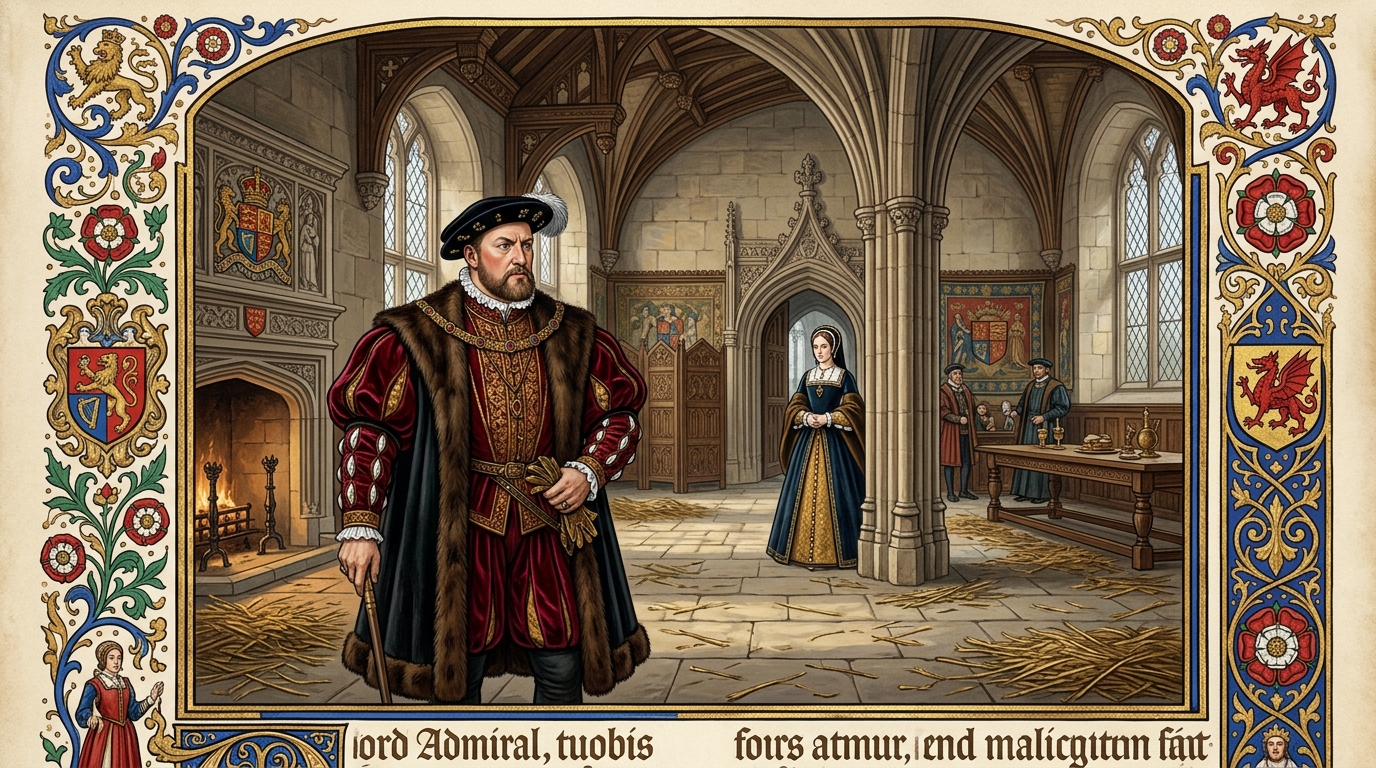
The Downfall of Thomas Seymour: Ambition, Scandal, and Execution in Tudor England
Few stories from the Tudor period combine political ambition, sexual scandal, and dynastic intrigue quite so dramatically as the rise and fall of Thomas Seymour, Lord Admiral of England. Within just two years of becoming one of the most powerful men in the kingdom, Seymour found himself facing the executioner’s axe on Tower Hill, brought down by a combination of reckless scheming and deeply troubling behaviour towards a teenage girl who would one day become the most celebrated monarch in English history. The story of Thomas Seymour and the young Princess Elizabeth is one that historians, novelists, and readers return to again and again, precisely because it raises questions about power, vulnerability, and survival that feel startlingly relevant even today.
As a historical fiction author with a long-standing fascination with the Tudor court, I have spent considerable time poring over primary sources including the Acts of the Privy Council of England, 1547-1550 and Alison Plowden’s authoritative biography Elizabeth Tudor: Her Life and Times. What emerges from these sources is a portrait of a man whose extraordinary gifts were fatally undermined by an inability to govern his own desires or ambitions. Thomas Seymour wanted everything: power, wealth, a royal bride, and ultimately, a place at the very centre of the English state. His pursuit of those ambitions would cost him his life and leave a lasting mark on the young woman he had tried to manipulate.
In this post, we will explore who Thomas Seymour was, what he did, why it mattered so profoundly to Tudor England, and why his story continues to fascinate readers and historians five centuries later. Whether you are new to Tudor history or a dedicated enthusiast, the tale of Lord Admiral Seymour offers a window into the dangerous, glittering world of the mid-sixteenth-century English court.
Historical Background: Who Was Thomas Seymour?
Thomas Seymour was born around 1508, the younger brother of Edward Seymour, who would become the Duke of Somerset and Lord Protector of England following the death of Henry VIII in January 1547. The Seymour family had risen to prominence through the king’s marriage to their sister Jane Seymour in 1536, and Jane’s death following the birth of the future Edward VI had done nothing to diminish the family’s standing at court. Thomas was charming, handsome, and widely regarded as one of the most dashing figures of his generation. He had served as a naval commander and diplomat, earning the title of Lord Admiral after his brother assumed the protectorship. On the surface, his position seemed enviable.
However, Thomas Seymour resented his brother’s superior position intensely. He felt that as uncle to the young king, he deserved a far greater share of power than his role as Lord Admiral afforded him. Almost immediately after Henry VIII’s death, Seymour began manoeuvring to increase his influence. His most audacious early move was to marry Catherine Parr, Henry VIII’s widow, with almost indecent haste. The marriage took place secretly in the spring of 1547, just months after the old king’s death. Catherine, who had loved Seymour before her marriage to Henry, agreed willingly, and the union brought Seymour considerable social prestige as well as access to Catherine’s considerable household.
It was within that household that the trouble began. Catherine Parr had taken the young Princess Elizabeth into her care after Henry’s death, providing the thirteen-year-old with a stable home and a stimulating intellectual environment. Elizabeth had been declared illegitimate by her father but was nonetheless a significant figure in the succession. Thomas Seymour appears to have recognised almost immediately that Elizabeth represented an extraordinary opportunity. According to Alison Plowden’s account in Elizabeth Tudor: Her Life and Times, Seymour began engaging in a pattern of behaviour towards Elizabeth that was, at the very least, grossly inappropriate for a man in his position. He would enter her bedchamber early in the mornings, sometimes catching her still in bed, tickling her, slapping her on the back, and behaving in ways that her governess, Kat Ashley, found deeply alarming.
Catherine Parr was initially aware of these early morning visits and even participated in some of them, apparently believing they were harmless high spirits. But as time went on, the behaviour escalated. Plowden draws on contemporary accounts to describe incidents in which Seymour cut Elizabeth’s gown into pieces during a game in the garden, with Catherine holding the girl still. Catherine Parr died in September 1548 following childbirth, and with her death, any remaining check on Seymour’s ambitions dissolved. He began making enquiries about the possibility of marrying Elizabeth, even as evidence of his other schemes was mounting against him.
Significance and Impact: Why Did This Matter?
The arrest and subsequent execution of Thomas Seymour in March 1549 sent shockwaves through the Tudor political establishment. The charges brought against him were sweeping. According to the Acts of the Privy Council of England, 1547-1550, Seymour was accused of attempting to get control of the king’s person, of trying to marry Princess Elizabeth without the Council’s permission, of seeking to undermine the Lord Protector’s authority, and of various other treasonable offences. He was attainted by Parliament, meaning he was condemned without a formal trial, and executed on Tower Hill on 20 March 1549.
The significance of the Seymour affair extended far beyond the fate of one ambitious nobleman. It demonstrated, with brutal clarity, just how precarious the political situation in England was during the minority of Edward VI. The young king was only eleven years old when his father died, and the struggle for control of the government between various factions at court was intense. Thomas Seymour’s execution showed that even men of the highest rank, men who were uncles to the king himself, could be brought down swiftly if they overreached. It was a warning that the Privy Council intended to maintain order, whatever the cost.
For the young Princess Elizabeth, the affair had profound personal consequences. She was questioned extensively about her relationship with Seymour, and the interrogations conducted by Sir Robert Tyrwhit were designed to extract an admission that she had either encouraged Seymour’s advances or had agreed to marry him. Elizabeth, demonstrating the extraordinary composure and political intelligence that would define her later reign, refused to be drawn. She admitted nothing that could be used against her and managed the crisis with a skill remarkable in a fifteen-year-old girl. Nevertheless, the scandal damaged her reputation temporarily and provided her with a lasting lesson about the dangers of allowing personal feelings to cloud political judgement.
The affair also highlights important questions about the vulnerability of young women in Tudor households, where power imbalances were extreme and where a girl’s safety depended entirely on the goodwill of those around her. Kat Ashley, Elizabeth’s beloved governess, was briefly imprisoned for her failure to prevent or report Seymour’s behaviour, a reminder that even those who tried to protect their charges could find themselves caught in the political fallout.
Connections and Context: The Broader Tudor Picture
The fall of Thomas Seymour did not occur in isolation. It was part of a broader pattern of instability that characterised the reign of Edward VI. His brother Edward Seymour, the Duke of Somerset and Lord Protector, would himself be overthrown just a few months later in October 1549, replaced by the equally ambitious John Dudley, who became Duke of Northumberland. The Seymour brothers, who had seemed so firmly in control in 1547, were both eventually destroyed by the very system of factional politics they had sought to dominate. Somerset was eventually executed in 1552, meaning that Edward VI effectively sent both his uncles to the block.
It is also worth noting that Thomas Seymour’s attempts to marry Princess Elizabeth were not as outlandish as they might initially appear. The Tudor succession was genuinely uncertain in 1548 and 1549, and Elizabeth, as a daughter of Henry VIII, was a significant political asset. Several powerful men had considered the possibility of marrying her as a route to influence. Seymour was simply more reckless than most in pursuing that goal without the Council’s approval. Did you know that Seymour had actually attempted to marry either Princess Mary or Princess Elizabeth before settling on Catherine Parr in 1547, approaching the Privy Council for permission and being firmly rebuffed?
The wider European context also shaped events considerably. England in the late 1540s was navigating a complex diplomatic landscape, with ongoing tensions with France and Scotland, as well as the religious upheaval of the English Reformation. Seymour’s scheming was seen not merely as a domestic nuisance but as a potential threat to national stability at a moment when England could ill afford internal divisions.
Modern Relevance and Fascinating Details
The story of Thomas Seymour and Princess Elizabeth continues to attract enormous interest from modern readers, historians, and writers of historical fiction. This is partly because Elizabeth herself became so iconic that anything touching on her early life carries a special fascination. But it is also because the dynamics of the relationship between Seymour and the young princess speak to themes that remain deeply relevant: the abuse of power, the vulnerability of young people in households where adults fail in their duty of care, and the extraordinary resilience shown by survivors of such situations.
As a historical fiction author, I find the character of Elizabeth during the Seymour crisis endlessly compelling. Here was a girl who had already lost her mother to the executioner’s block, been declared illegitimate, and seen the court intrigues that surrounded her father’s successive marriages. She was, in many ways, extraordinarily experienced in the arts of political survival even before the Seymour affair tested her. The letters she wrote to the Privy Council during her interrogation, preserved in historical records, are models of careful, measured prose that reveal a mind already shaped for statecraft.
In popular culture, the Seymour affair has been depicted in numerous television dramas, novels, and films about the Tudor period. Productions focusing on the young Elizabeth frequently include Thomas Seymour as a significant figure, though the quality of these portrayals varies considerably. What tends to be lost in dramatisations is the sheer terror that Elizabeth must have experienced during the months of interrogation following Seymour’s arrest, when her own freedom and possibly her life depended on every word she said. Alison Plowden’s biography captures this tension with particular sensitivity, drawing on contemporary documents to reconstruct the atmosphere of threat and uncertainty that surrounded the fifteen-year-old princess.
Conclusion: Lessons from the Seymour Affair
The execution of Thomas Seymour in March 1549 was, in one sense, the inevitable end of a career built on reckless ambition and a profound failure of judgement. His behaviour towards Princess Elizabeth was not merely morally reprehensible; it was politically catastrophic, providing his enemies on the Privy Council with exactly the evidence they needed to destroy him. The Acts of the Privy Council of England, 1547-1550 record the charges against him in meticulous detail, and they paint a picture of a man who believed that his royal connections and personal charm would protect him from consequences that lesser men would have feared.
What makes the Seymour affair worth studying today is not simply its dramatic qualities, though it has those in abundance. It is the way in which it illuminates the precarious nature of power in Tudor England, the particular vulnerabilities faced by young women at the Tudor court, and the extraordinary political intelligence of the woman who survived it. Princess Elizabeth emerged from the Seymour crisis having learned lessons she would carry with her for the rest of her long reign: that survival requires careful speech, controlled emotion, and an unflinching understanding of how power works. If you are interested in exploring Tudor history further, the Seymour affair is an ideal starting point, offering, in a single story, almost everything that makes this extraordinary period of English history so enduringly fascinating.