
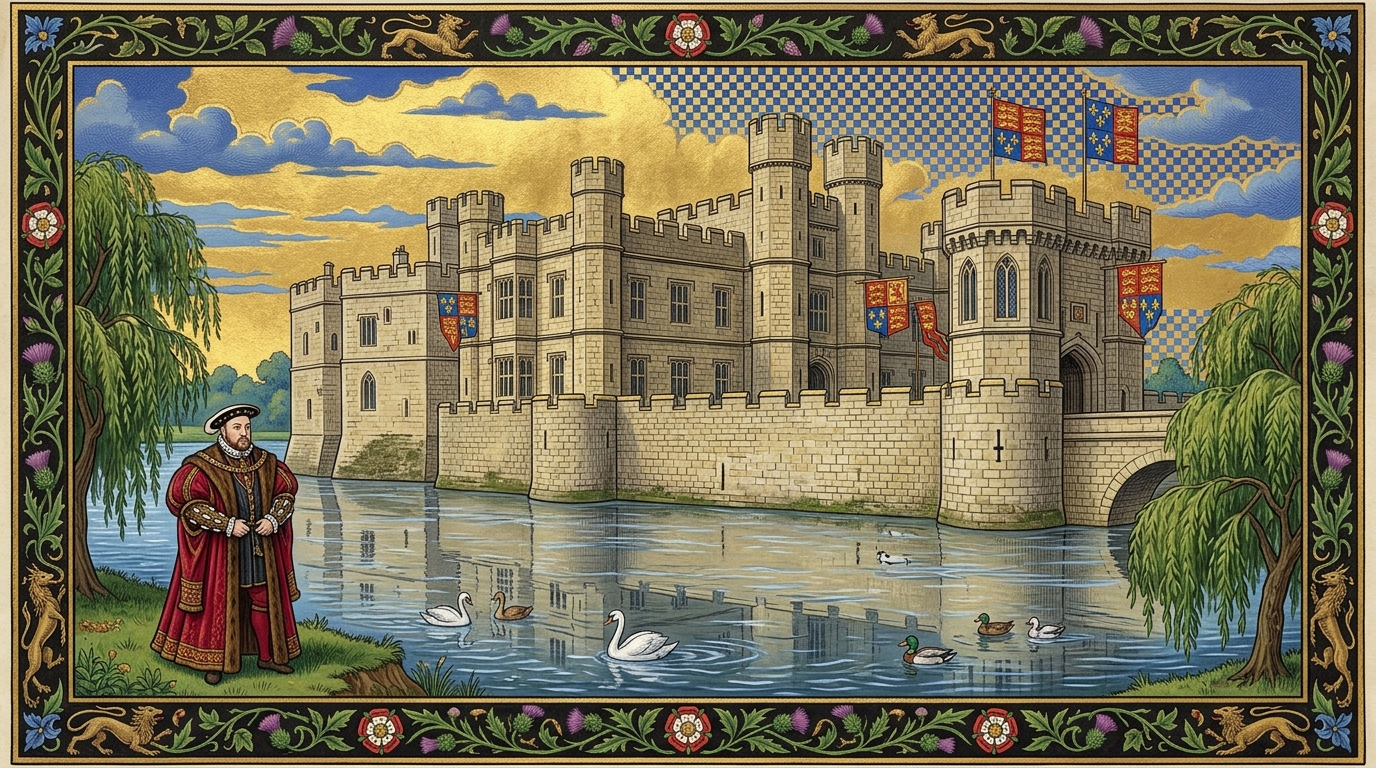
Leeds Castle: Henry VIII’s Jewel in Kent and the Tudor Art of Power
Imagine standing on the banks of a tranquil moat in the Kent countryside, gazing up at a castle that has witnessed centuries of royal intrigue, political manoeuvring, and the full theatrical drama of Tudor monarchy. Leeds Castle, often called the loveliest castle in the world, is far more than a picturesque landmark. It served as a genuine centre of royal power under Henry VIII, functioning simultaneously as a residence, an administrative hub, and, when the occasion demanded, a prison. Understanding how Henry VIII used Leeds Castle reveals something essential about how Tudor monarchs exercised control across the English landscape.
As a historical fiction author who has spent years immersed in the Tudor period, I find Leeds Castle endlessly fascinating precisely because it embodies the contradictions of Henry VIII himself: breathtaking beauty concealing an iron will, lavish hospitality masking ruthless political calculation. The castle sits on two islands in the River Len near Maidstone in Kent, and its history stretches back to Norman times, but it was during the Tudor era that it became woven into the very fabric of royal governance. According to Christopher Slade and Robin Ede in The Leeds Castle Guide (Leeds Castle Foundation, 2008), Henry VIII invested significantly in the castle, transforming it into a residence worthy of his ambitions.
In this post, we will explore who owned Leeds Castle during the Tudor period, why Henry VIII valued it so highly, how it functioned as both a royal palace and a place of confinement, and why this dual role tells us so much about the nature of Tudor power. Whether you are a history enthusiast, a student researching the Tudors, or simply someone who loves the intersection of beautiful places and dramatic history, Leeds Castle offers a remarkable window into a world of calculated magnificence.
Historical Background: Leeds Castle Before and During Henry VIII’s Reign
Leeds Castle’s history predates the Tudors by several centuries. The original fortification on the site dates to around 1119, built by Robert de Crevecoeur, and the castle passed through various noble hands before entering royal possession in 1278 under Edward I. It became particularly associated with English queens in the medieval period, serving as a dower house and residence for several royal consorts. This royal pedigree made it an attractive acquisition for the Tudor dynasty, which was always conscious of legitimising its rule through association with established English institutions and properties.
Henry VIII came to the throne in 1509, and his reign would prove transformative for royal residences across England. He inherited a substantial portfolio of castles and palaces, but he also acquired and improved properties throughout his rule, spending lavishly on architecture and interior decoration to project an image of magnificence. As Slade and Ede document in The Leeds Castle Guide, Henry undertook significant building works at Leeds, adding a banqueting hall and improving the residential quarters to create a space suitable for royal entertaining and comfortable habitation. The castle became one of his Kentish properties, strategically positioned in a county that served as the gateway between London and the Continent.
Kent held particular strategic importance during the Tudor period. The county’s ports, including Dover and Folkestone, were England’s primary connection to France and the Low Countries, making the region central to diplomacy, trade, and military preparation. Henry VIII frequently travelled through Kent for diplomatic meetings, and properties such as Leeds Castle provided comfortable stopping points for the royal household and its considerable entourage. The castle was not simply a country retreat; it was a working node in the network of royal administration and power that stretched across England.
The question of when precisely Henry VIII used Leeds Castle most actively is closely tied to the broader rhythms of his reign. The early decades, before the rupture with Rome and the dissolution of the monasteries, saw the castle functioning primarily as a royal residence and occasional venue for royal hospitality. Its relative proximity to London, roughly forty miles from the capital, made it accessible without requiring the enormous logistical effort demanded by more distant royal progresses.
Significance and Impact: The Castle as an Instrument of Tudor Authority
What makes Leeds Castle genuinely significant in the context of Tudor history is its dual function as a place of pleasure and a place of punishment. Henry VIII’s England was a world in which the distinction between royal hospitality and royal imprisonment could be uncomfortably thin, and Leeds Castle embodied this ambiguity. The castle served as a prison for distinguished captives at various points, illustrating how Tudor monarchs used their network of royal properties to manage political threats without always resorting to the Tower of London.
This use of castles as prisons reflects something important about how Tudor power actually operated in practice. The Tower of London is the most famous site of Tudor imprisonment, but Henry VIII and his predecessors maintained a broader geography of confinement. Placing a high-status prisoner in a royal castle rather than a common gaol communicated a specific political message: the captive was still recognised as a person of consequence, but they were firmly under royal control. Leeds Castle, with its moat and island setting, was naturally suited to this purpose. The water provided a physical barrier that was both practical and symbolically resonant, signalling the captive’s separation from the political world beyond its walls.
The impact on Tudor society was significant because it demonstrated the reach of royal authority into the counties. Henry VIII’s ability to use properties like Leeds Castle for multiple purposes simultaneously reflected the sophistication of Tudor administrative thinking. A castle that housed the king one season might hold a political prisoner the next, and this flexibility was itself a demonstration of royal power. Local communities in Kent would have been acutely aware of the castle’s royal status and its capacity to serve the Crown’s various needs, reinforcing the reality of Tudor authority in everyday life.
For Tudor politics more broadly, the use of royal castles as instruments of control contributed to a culture in which physical space and political power were deeply intertwined. Where you were held mattered enormously. The conditions of your confinement, the quality of the accommodation, and the degree of supervision all communicated your standing in the royal favour. Leeds Castle, with its genuine architectural beauty, represented a form of comfortable captivity that was nonetheless captivity.
Connections and Context: Leeds Castle in the Wider Tudor World
To understand Leeds Castle fully, it helps to place it within the broader context of Henry VIII’s relationship with Kent and with the wider question of how Tudor monarchs managed their realm through property. The Field of the Cloth of Gold in 1520, the extraordinary diplomatic summit between Henry VIII and Francis I of France, required enormous logistical preparation across Kent and the Channel ports. Properties like Leeds Castle played supporting roles in such grand enterprises, providing accommodation and administrative capacity for the royal household as it moved towards the coast.
It is also worth noting that the mid-fourteenth century had left deep marks on the English landscape and population long before Henry VIII’s reign. Rosemary Horrox’s landmark study The Black Death (Manchester University Press, 1994) documents the catastrophic mortality of the plague years from 1348 onwards, which reshaped English society, labour relations, and the distribution of land and property across generations. The social and economic disruptions that followed the Black Death were still shaping English society in the Tudor period, influencing patterns of land ownership, the power of the nobility, and the availability of the skilled craftsmen and labourers needed for Henry VIII’s ambitious building programmes at castles and palaces including Leeds.
Did you know that Leeds Castle takes its name not from the Yorkshire city, but from the village of Leeds in Kent? The village itself derives its name from the Anglo-Saxon word hlid, meaning a loud or noisy stream, a reminder of how ancient the landscape of this part of England truly is. This etymological detail surprises many visitors who assume a connection to the northern city, and it serves as a useful reminder that English place names carry deep layers of history that reward careful attention.
Modern Relevance and Fascinating Details: Why Leeds Castle Still Captivates
Leeds Castle today functions as a heritage attraction and events venue, welcoming hundreds of thousands of visitors each year. Yet beneath the contemporary programme of concerts, falconry displays, and maze gardens lies a genuine historical site of considerable importance. For visitors with an interest in Tudor history, the castle offers a tangible connection to the world that Henry VIII inhabited, a world in which architecture was politics, hospitality was diplomacy, and beauty was a form of power.
For historical fiction writers and readers, Leeds Castle is particularly evocative. The castle’s island setting, its moat, and its long royal history make it the kind of place where the imagination naturally populates the stone corridors with silk-clad courtiers and watchful guards. As someone who writes about the Tudor period, I find that visiting sites like Leeds Castle is invaluable for grounding fictional narratives in the physical reality of the past. You cannot fully imagine a Tudor imprisonment until you have stood at the water’s edge and understood, viscerally, the isolation that the moat imposed on anyone held within those walls.
The castle also appears in the broader cultural conversation about English heritage and the continued fascination with the Tudor period in popular culture. Television dramas, novels, and documentary series have kept the Tudors at the forefront of public historical imagination, and places like Leeds Castle serve as anchors for that interest, connecting the stories we tell about the past to real, visitable places in the present. The fact that the castle hosted international diplomatic conferences in the twentieth century, including peace talks related to the Middle East, demonstrates that its role as a venue for significant political activity has never entirely ceased.
Conclusion: Power, Beauty, and the Tudor Legacy at Leeds Castle
Leeds Castle represents one of the most compelling examples of how Henry VIII used the physical landscape of England as an instrument of royal power. By maintaining a network of castles and residences that could serve simultaneously as palaces, administrative centres, and prisons, Tudor monarchs demonstrated a sophisticated understanding of how space, beauty, and authority could be made to work together. The castle’s dual role as a place of royal pleasure and royal confinement captures something essential about the Tudor world: that magnificence and menace were never far apart.
Whether you are visiting Leeds Castle in person, exploring it through the pages of a historical study like Slade and Ede’s guide, or encountering it in historical fiction, this extraordinary Kentish jewel rewards careful attention. Its history is a reminder that the past is not merely a collection of dates and facts, but a living landscape of choices, consequences, and extraordinary human stories waiting to be rediscovered. I encourage you to explore further, visit if you are able, and allow yourself to imagine the castle as Henry VIII’s courtiers would have known it: magnificent, purposeful, and never entirely safe.