
From Fortress to Palace: How Tudor Castles Redefined Power and Comfort
Imagine standing before the towering walls of a medieval castle, built to withstand siege warfare, its thick stone ramparts bristling with defensive purpose. Now imagine that same architectural tradition transformed within just a few generations into something altogether more refined: a residence of gilded ceilings, tapestried walls, and expansive glazed windows flooding great halls with light. This is precisely the architectural revolution that unfolded during the Tudor period, and it tells us something profound about how England itself was changing. The story of Tudor castle design is not merely a tale of bricks and mortar; it is the story of a dynasty reshaping what power looks like.
When Henry VII seized the crown at Bosworth Field in 1485, he inherited a kingdom exhausted by decades of civil conflict. The Wars of the Roses had demonstrated, with brutal clarity, what happened when centralised authority collapsed. The Tudors understood, perhaps better than any dynasty before them, that architecture could be wielded as a political instrument. As Simon Thurley argues in The Royal Palaces of Tudor England (Yale University Press, 2009), the shift from military fortification to residential grandeur was not accidental but deliberate, a conscious expression of Tudor confidence and control.
In this post, we will explore how and why Tudor castle design evolved so dramatically, what this transformation reveals about Tudor society and politics, and why these extraordinary buildings continue to captivate historians, tourists, and historical fiction writers alike. Whether you are wondering what made Tudor palaces different from medieval castles, or simply want to understand the architecture of one of England’s most fascinating dynasties, read on.
Historical Background: The Architecture of a New Dynasty
To understand the Tudor architectural revolution, we must first appreciate the context from which it emerged. Medieval castles were, by necessity, instruments of warfare. Their curtain walls, moats, portcullises, and arrow loops reflected a landscape of perpetual local conflict, baronial rivalry, and foreign invasion. The great fortresses of the Plantagenet era, places like the Tower of London and Caernarfon Castle, were statements of military dominance first and residences second. Comfort, where it existed at all, was an afterthought squeezed into drafty chambers behind walls built for survival.
The accession of Henry VII in 1485 changed this calculus fundamentally. Sean Cunningham, in his authoritative study Henry VII (Routledge, 2007), emphasises how the first Tudor monarch was preoccupied with legitimising his somewhat tenuous claim to the throne and establishing lasting dynastic stability. One of his most effective tools was the transformation of royal residences. By investing heavily in palaces that spoke of wealth, culture, and permanence rather than siege readiness, Henry signalled that the era of baronial warfare was finished. The king was secure. The realm was at peace. And the architecture of royal power would now reflect that security.
Henry VII’s great project at Richmond Palace, begun in the 1490s following a devastating fire at the earlier Sheen Palace, exemplified this new approach. Richmond was conceived less as a fortification and more as a dazzling showcase of Tudor magnificence. Thurley describes its towers, which retained a vaguely castle-like silhouette, as decorative rather than functional, their purpose being visual impression rather than military defence. The interiors were lavished with heraldic display, royal emblems, and imported Flemish decorative work. This was architecture as propaganda, designed to impress foreign ambassadors and overawe domestic subjects in equal measure.
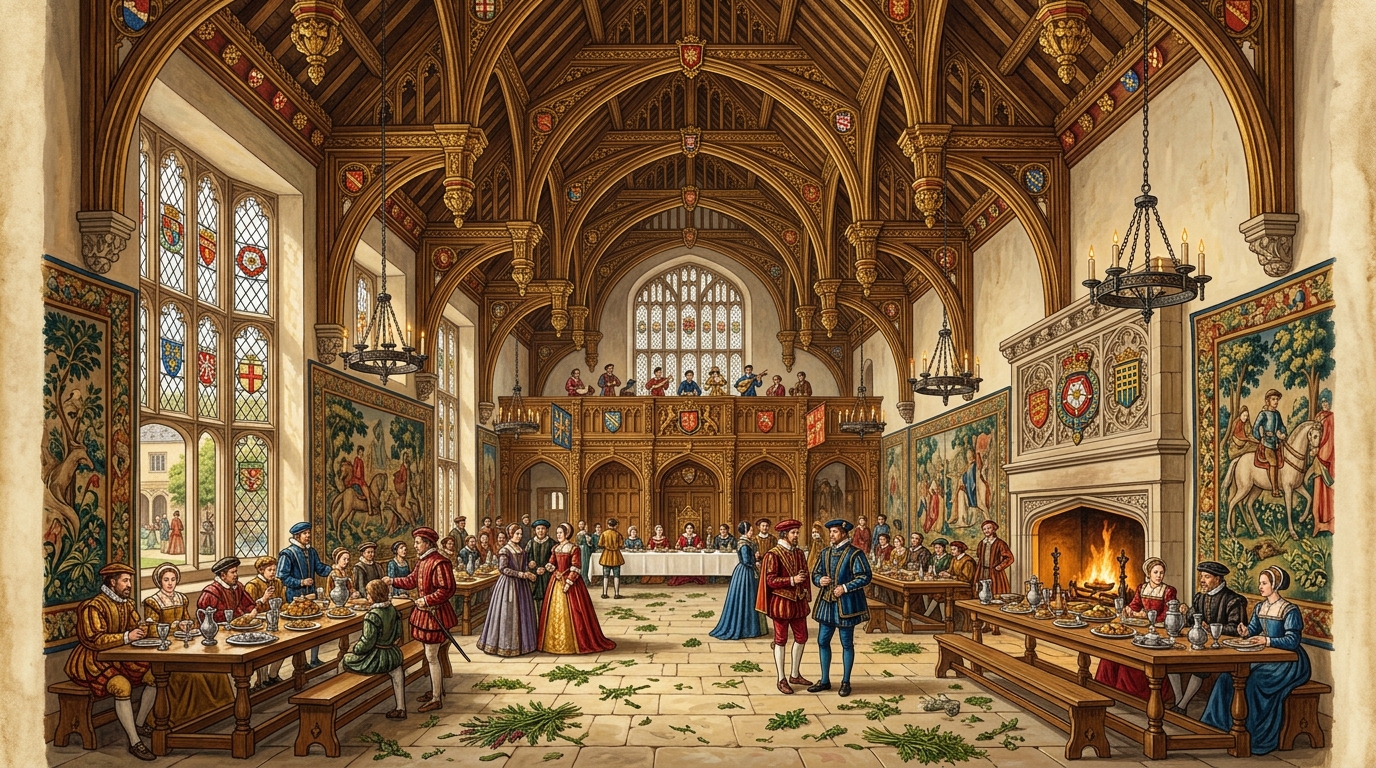
Henry VIII continued and vastly amplified this tradition. His acquisition and transformation of Nonsuch Palace, Hampton Court, and Greenwich saw Tudor royal architecture reach its most extravagant heights. By the mid-sixteenth century, the question of how to defend a royal residence had become almost irrelevant; the question that mattered was how to dazzle, entertain, and display. Large windows, once a catastrophic military vulnerability, became prized features admitting light into grand apartments. Gardens, fountains, and tiltyard towers for spectacle replaced the defensive earthworks of an earlier age.
Significance and Impact: What This Shift Meant for Tudor Society
The transformation of castle design during the Tudor period had consequences that extended far beyond royal residences. When the monarch demonstrates that comfort and artistic display matter more than defensive walls, the nobility takes note. Across Tudor England, aristocratic patrons began constructing country houses that borrowed the language of the palace rather than the castle. Layer Marney Tower in Essex, Compton Wynyates in Warwickshire, and Longleat in Wiltshire all reflect, to varying degrees, this new architectural sensibility: grand, light-filled, and oriented towards domestic pleasure rather than military function.
Did you know? The increasing use of large glazed windows in Tudor great houses was so fashionable, and so expensive, that windows were sometimes removed and taken with a household when they moved. Glass was a luxury commodity, and Tudor inventories occasionally list windows alongside furniture and tapestries as portable valuables.
The political significance of this shift was equally profound. Thurley argues that the Tudor palace served as a carefully managed theatrical space in which royal authority was performed for audiences of courtiers, foreign dignitaries, and supplicants. The sequence of increasingly private apartments through which a visitor had to pass, each requiring greater social status to access, was itself a spatial representation of hierarchical power. The more comfortable and refined the palace, the more it emphasised that Tudor kingship rested on cultural superiority and civilised governance rather than brute force alone. This was a dynasty that had read its Machiavelli, even if it would never have admitted it.
For ordinary Tudor subjects, the impact was more indirect but no less real. The building projects of Henry VII and Henry VIII generated enormous employment for craftsmen, artists, glaziers, and labourers. Continental artists were imported to work on decorative schemes, bringing Renaissance motifs and techniques to English building. This cultural exchange, mediated through architecture, helped integrate England more fully into the broader European Renaissance moment, a process with lasting consequences for English art, literature, and intellectual life.
Connections and Context: Architecture in a Wider Tudor World
It is worth placing Tudor architectural transformation within the broader currents of the age. The relative domestic peace of the Tudor period, which made castle fortifications increasingly unnecessary, was itself the product of deliberate Tudor policy. Cunningham shows how Henry VII worked systematically to reduce the military power of the great noble households that had fuelled the Wars of the Roses, through legislation limiting private retinues and through the careful management of patronage and favour. A nobility that could not easily raise private armies had less need of fortified castles, and less ability to threaten a monarch who no longer needed to hide behind walls.
At the same time, the Tudor period witnessed the dissolution of the monasteries under Henry VIII, which released vast quantities of land, stone, and building materials into the market. Many ambitious Tudor courtiers and gentlemen used the spoils of dissolution to fund exactly the kind of comfortable, display-oriented country houses that the royal example had made fashionable. The irony that the destruction of medieval religious institutions helped fund the construction of elegant Renaissance homes is one of the more piquant details of Tudor social history.
Internationally, England’s Tudor monarchs were acutely aware of their position relative to the great powers of France and the Holy Roman Empire. Francis I of France was building the extraordinary Chateau de Chambord during the same decades that Henry VIII was transforming Hampton Court. The architectural rivalry between these monarchs was as real as their diplomatic and military competition, and understanding Tudor castle and palace design requires keeping one eye on what was happening across the Channel.
Modern Relevance and Fascinating Details
As a historical fiction author, I find the Tudor palace endlessly productive as a narrative setting precisely because it occupies this fascinating middle ground between fortress and home. These were buildings that looked formidable but invited you in; that displayed power openly rather than concealing it behind walls. The tension between public spectacle and private comfort that defines Tudor architecture also defines Tudor court life, making it irresistible territory for fiction.
For modern visitors, surviving Tudor structures offer remarkable insight into this world. Hampton Court Palace, now managed by Historic Royal Palaces, retains enough of its Tudor fabric to convey something of the original experience, from the Great Hall with its spectacular hammerbeam roof to the intimate royal apartments beyond. Did you know? Henry VIII’s tennis court at Hampton Court is one of the oldest surviving royal tennis courts in the world, a reminder that Tudor palace design accommodated leisure and sport as enthusiastically as it did ceremony and governance.
In popular culture, Tudor palaces frequently appear in historical drama, from the sumptuous sets of television productions like Wolf Hall to the detailed architectural reconstructions offered by documentary series. The visual language of these buildings, their distinctive red brick, their terracotta ornament, their expansive courtyards, has become almost synonymous with the Tudor period itself, a testament to how successfully the dynasty embedded its identity in stone.
Conclusion: Architecture as the Mirror of an Age
The evolution of Tudor castle and palace design from defensive fortification to residential showcase is one of the most eloquent expressions of the Tudor achievement. It reflects a dynasty confident enough in its authority to lay down its walls, secure enough in its domestic peace to let in the light, and ambitious enough in its cultural aspirations to transform the built environment of an entire nation. As both Thurley and Cunningham make clear, understanding these buildings means understanding the Tudors themselves.
Whether you are a student of history, a lover of historic houses, or simply curious about why Hampton Court looks so different from a Norman keep, the story of Tudor architecture rewards exploration. The Tudors built to impress, and more than five centuries later, they are still succeeding. Why not visit a Tudor palace for yourself, and see what these extraordinary buildings can still tell us about the people who made them?