Fire and Flame: How Tudor London Lived Under the Constant Threat of Destruction
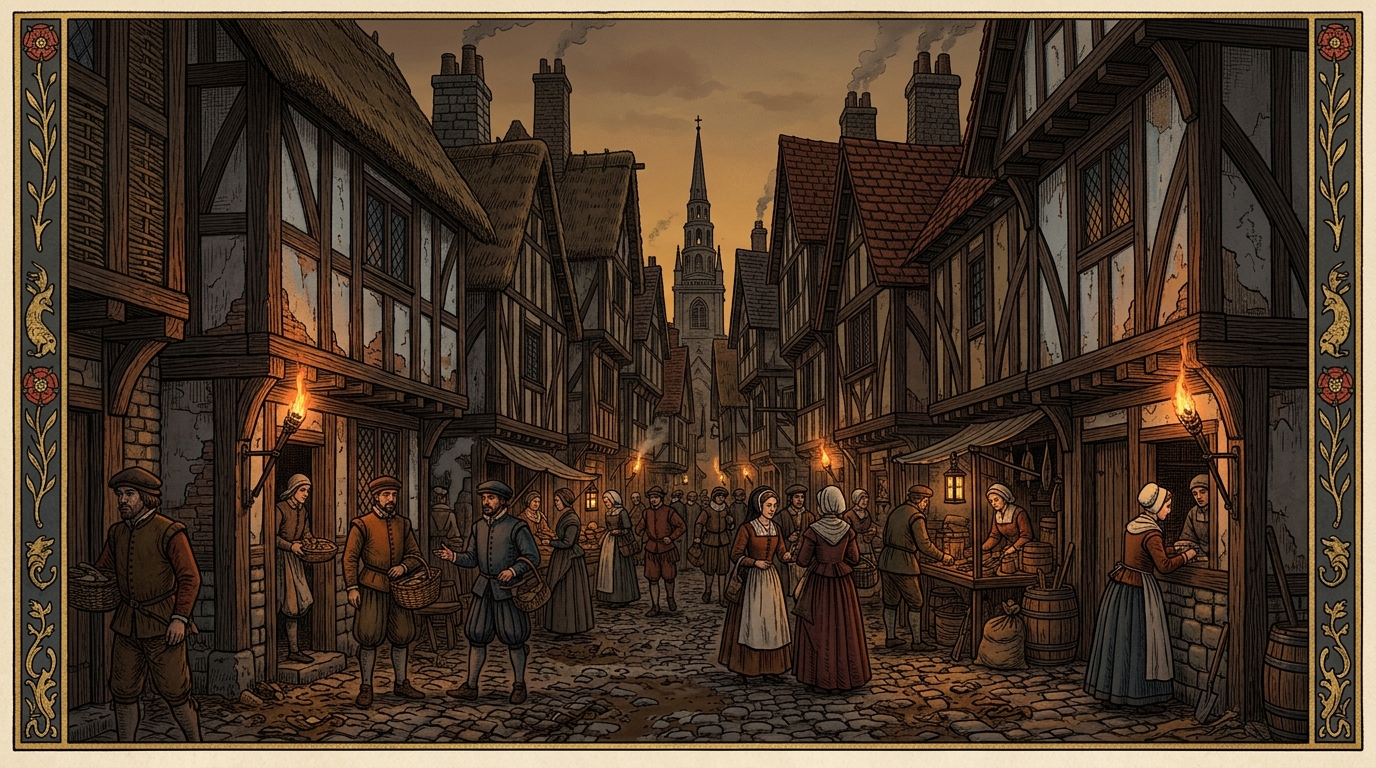
Imagine walking through the streets of sixteenth-century London, the air thick with the smell of smoke, tallow candles, and tightly packed humanity. Overhead, the upper storeys of timber-framed houses lean so close together that neighbours on opposite sides of the street might almost shake hands from their windows. Beneath your feet, straw and refuse line the narrow lanes. Everywhere you look, wood, thatch, and pitch create a city that is essentially one enormous tinderbox waiting for a spark. This was the reality of Tudor London, a metropolis that lived and breathed under the constant, ever-present shadow of fire.
Most people, when they think of London and fire, leap immediately to the Great Fire of 1666, that catastrophic blaze that swept through the medieval city and consumed over thirteen thousand houses in a matter of days. Yet the seeds of that disaster were sown across generations of Tudor urban life, in which fire was not a distant possibility but a daily companion. As T. F. Reddaway observed in his landmark study The Rebuilding of London After the Great Fire (Jonathan Cape, 1940), the city that burned in 1666 was itself the product of centuries of accumulated wooden construction, a built environment shaped by economic pragmatism rather than any concern for safety.
In this post, we will explore what life in Tudor London truly meant in terms of fire risk, how the city was organised and constructed, what catastrophes occurred during the Tudor period itself, and why this history matters both to students of the period and to anyone fascinated by the fragile, combustible world our ancestors inhabited. As a historical fiction author who has spent years researching Tudor daily life, I find few details quite as viscerally illuminating as the simple fact that Londoners of this era did not fear fire as an exceptional disaster. They feared it as they feared the plague: as an inevitable, recurring feature of urban existence.
Historical Background: A City Built to Burn
Tudor London was, by any modern measure, extraordinarily vulnerable. The city that Henry VIII inherited when he took the throne in 1509 was a dense, energetic, and chaotic place, home to perhaps seventy to eighty thousand souls crammed within and around the old Roman walls. By the end of Elizabeth I’s reign in 1603, that population had grown dramatically, swelling to somewhere between two hundred thousand and two hundred and fifty thousand people, all dependent on a building stock that had evolved organically over centuries with little central planning or oversight.
The dominant construction material was timber. Oak-framed buildings, their gaps filled with wattle, daub, and plaster, lined every major street and alleyway. Roofs were frequently thatched, particularly in the earlier Tudor decades, though by the later sixteenth century London authorities were making increasingly urgent efforts to replace thatch with tile. Heating and cooking were done over open hearths. Lighting relied on tallow candles and rushlight. Craftsmen and tradespeople worked with forges, furnaces, and open flames as a matter of course. Bakers, blacksmiths, brewers, and chandlers all operated within the same densely packed urban fabric as ordinary households.
The geography of Tudor London compounded every risk. Streets were narrow, sometimes only a few feet wide, meaning that a fire in one building could leap to its neighbour with terrifying speed. Water supply, while not entirely absent, was primitive by any standard that might meaningfully combat a serious blaze. Conduits and wells provided drinking water, but there was no organised firefighting infrastructure of the kind we might recognise today. The primary response to fire was bucket chains, the pulling down of adjacent buildings to create firebreaks, and the hope that wind conditions might be merciful.
It is worth noting that Tudor fires were not limited to domestic accidents. The period saw deliberate arson used as a tool of political and religious conflict. The burning of Protestant martyrs under Mary I, documented so vividly by John Foxe, took place against a broader cultural backdrop in which fire carried enormous symbolic weight, representing both divine judgement and human destructive capacity. Fire, in Tudor England, was never merely a practical hazard. It was woven into the very fabric of how people understood power, punishment, and providence.
Significance and Impact: What Fires Meant for Tudor Society
The fires that swept through Tudor London and other English cities were not merely local tragedies. They had profound consequences for communities, economies, and the physical shape of urban life. When a major fire destroyed a row of shops or a parish church, it wiped out the livelihoods of craftspeople and traders who had no insurance, no savings buffer, and no state support to fall back upon. The loss of a workshop, a stock of goods, or a set of tools could mean ruin for an entire family within hours.
As J. F. Merritt demonstrates in The Social World of Early Modern Westminster (Manchester University Press, 2005), urban communities in this period were tightly knit networks of obligation and dependency. A fire did not simply destroy property. It disrupted social bonds, displaced tenants, undermined parish structures, and forced the kind of sudden, unplanned mobility that could reshape entire neighbourhoods. The wealthy might rebuild relatively quickly, but the poor were often displaced permanently.
Did you know? The authorities of Tudor London were sufficiently alarmed by fire risk that they issued repeated ordinances throughout the sixteenth century attempting to regulate building materials, particularly targeting thatched roofs. The persistence of these ordinances suggests, rather eloquently, how difficult they were to enforce.
The political implications of fire were also significant. A city perpetually at risk of burning was a city that required constant management, and the management of London was a source of ongoing tension between the Crown, the City of London corporation, and the various parish and ward authorities who exercised day-to-day governance. Fire regulation became one arena in which these competing jurisdictions played out their rivalries and accommodations. The failure to prevent fires was, in this sense, also a failure of governance, and contemporaries were not slow to say so.
Connections and Context: Fire Within the Wider Tudor World
The fire risk of Tudor London did not exist in isolation. Across England, towns and cities faced comparable vulnerabilities, and the period witnessed numerous serious conflagrations beyond the capital. Stratford-upon-Avon, the birthplace of William Shakespeare, suffered significant fire damage during the Tudor period. Tiverton in Devon was repeatedly devastated by fire in the late Tudor and early Stuart years. These were not exceptional events. They were the predictable consequence of how English towns were built and how they functioned.
What connects all of these episodes to the broader Tudor story is the question of continuity and change. The Tudor monarchs were, in various ways, deeply concerned with the ordering and governing of urban space. Henry VIII’s dissolution of the monasteries from the 1530s onwards threw enormous quantities of urban property onto the open market, reshaping the built environment of London and other cities at extraordinary speed. Much of this property was redeveloped quickly, cheaply, and with the same timber and thatch that had always dominated English urban construction. In accelerating urban growth without providing any corresponding infrastructure for safety or planning, the Dissolution arguably increased the fire risk of Tudor cities even as it transformed their social and religious character.
It is also worth remembering that the Tudor period was one of significant technological change in other respects. The spread of printing, the development of new navigational techniques, the beginnings of scientific enquiry that would eventually flower in the Scientific Revolution: all of these suggest a society in rapid intellectual transition. Yet urban firefighting technology barely advanced across the Tudor century. The bucket and the firebreak remained the primary tools of response right up to and beyond 1666. The contrast is striking and perhaps illuminating about which kinds of knowledge and innovation Elizabethan and Jacobean society prioritised.
Modern Relevance and Fascinating Details
For modern readers, there is something both compelling and sobering about the fire vulnerability of Tudor London. We live in a world of building regulations, smoke alarms, sprinkler systems, and professional fire services, and it can be difficult to truly imagine what it felt like to live without any of these protections. Yet the traces of Tudor fire culture are still present in our language and our landscape. The phrase playing with fire, used metaphorically since at least the sixteenth century, carries echoes of a society for which fire was a genuine, daily presence rather than a managed abstraction.
Did you know? The Great Fire of 1666, which is so often treated as an unforeseeable catastrophe, was in many respects the culmination of trends that Tudor observers had already identified and warned against. Reddaway’s research makes clear that the wooden, densely packed city that burned in 1666 was precisely the city that Tudor authorities had repeatedly, and unsuccessfully, tried to reform. The Great Fire was, in a sense, the final reckoning for a century and a half of deferred action.
As a historical fiction author, I find that fire serves as one of the most powerful and flexible metaphors available when writing about the Tudor period. It captures the volatility, the danger, and the extraordinary precariousness of life in this era in ways that no amount of description of political intrigue or religious conflict quite manages. When I place a character in a sixteenth-century London street at night, with a rushlight guttering in the wind and the sound of a neighbour’s forge still audible from the alley, the presence of fire, as threat, as necessity, as constant companion, is always there. It is one of the period details that, once you truly absorb it, changes how you see everything else about Tudor life.
Conclusion: The Burning City and What It Teaches Us
Tudor London was a city of extraordinary vitality, creativity, and ambition. It was also a city that lived, quite literally, on the edge of catastrophe. The wooden buildings that dominated its streetscape, the open flames that lit and heated its homes and workshops, the narrow lanes that made firefighting almost impossible: all of these combined to make fire one of the defining features of Tudor urban experience. Understanding this helps us understand the period more fully, including why the Great Fire of 1666, though it occurred after the Tudor era had ended, felt to many contemporaries less like a bolt from the blue than like the inevitable arrival of something long feared.
If you are interested in exploring Tudor daily life further, I would encourage you to seek out Reddaway’s The Rebuilding of London After the Great Fire and Merritt’s The Social World of Early Modern Westminster, both of which offer rich, detailed portraits of early modern urban life that go far beyond their specific subjects. And the next time you walk through the streets of the City of London, look at the buildings around you and remember: almost everything you can see was built after 1666, because almost everything that stood before was consumed by the fire that a century of Tudor city life had, in so many ways, made inevitable.