
Bloody Mary: The Truth Behind Tudor England’s Most Controversial Queen
Few epithets in British history carry as much weight as ‘Bloody Mary.’ Attached to Queen Mary I of England, it conjures images of burning pyres, religious persecution, and a reign defined by cruelty. Yet the story of England’s first crowned queen is far more complex than this notorious nickname suggests. Between 1553 and 1558, Mary Tudor presided over the execution of approximately 280 Protestants in her determined effort to restore Catholicism to England, an act that would define her legacy for centuries. But who was this woman, and what drove her to such measures? The answer lies deep within the turbulent currents of Tudor religious politics.
As a historical fiction author who has spent years immersed in the Tudor period, I find Mary I to be one of the most misunderstood figures of the sixteenth century. Her story is not simply one of religious fanaticism; it is a tale of personal trauma, political necessity, and a genuine belief that she was saving English souls from Protestant heresy. To understand her actions, we must first understand the world that shaped her.
In this post, we will explore the historical background of Mary’s reign, examine the significance of her religious persecutions, place her actions within the broader context of Tudor history, and consider why she continues to fascinate historians, novelists, and readers alike. Along the way, we will draw on primary sources including John Foxe’s Acts and Monuments (1563) and Linda Porter’s authoritative biography Mary Tudor: The First Queen (2007) to separate myth from historical reality.
Historical Background: Mary Tudor and the Path to Persecution
Mary I was born on 18th February 1516 at the Palace of Placentia in Greenwich, the only surviving child of King Henry VIII and his first wife, Catherine of Aragon. Her early life was one of privilege and promise, but it was shattered when her father sought to annul his marriage to her mother in order to wed Anne Boleyn. The psychological toll of watching her parents’ marriage destroyed, her mother cast aside, and herself declared illegitimate left deep wounds that never fully healed. It is impossible to understand Mary’s later religious zeal without acknowledging this formative trauma.
When Henry VIII broke with Rome in the 1530s and established himself as Supreme Head of the Church of England, England was launched into decades of religious instability. Under Henry’s son, Edward VI, the country lurched decisively towards Protestant reform. Traditional Catholic practices were dismantled, Latin masses were replaced with the Book of Common Prayer, and the visual splendour of Catholic worship was stripped from England’s churches. For Mary, a devout Catholic who had maintained her faith through years of political danger, this represented nothing less than a national catastrophe.
Mary came to the throne in July 1553 following the death of her half-brother Edward VI and the collapse of the brief attempt to place the Protestant Lady Jane Grey on the throne. She was greeted with genuine popular enthusiasm, and her accession represented, to many English people, a return to stability after years of religious upheaval. Her intention to restore England to papal obedience was well known before she even took the crown.
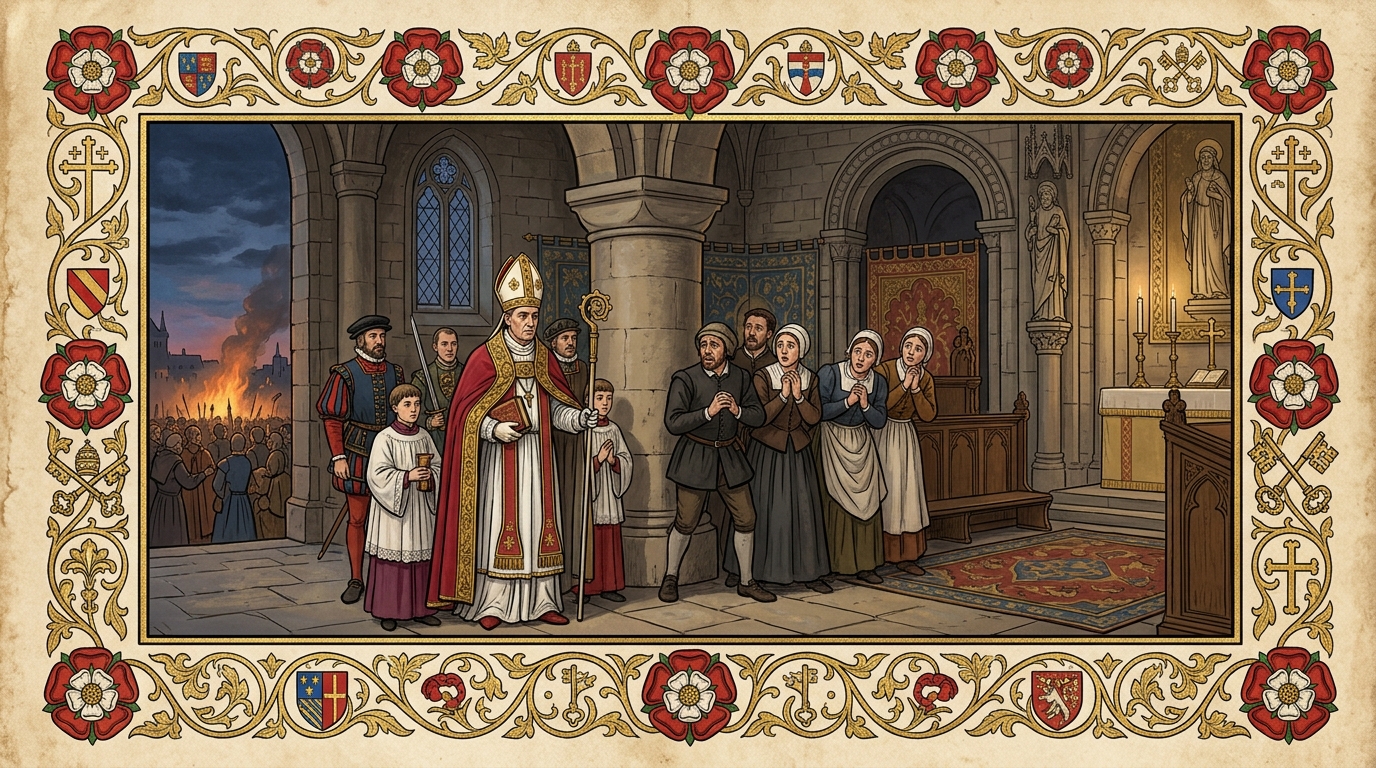
The burnings began in February 1555. The first victim was John Rogers, a clergyman and Bible translator, who was burnt at Smithfield in London on 4th February 1555. Over the following three years, approximately 280 men and women were executed for heresy, the majority by burning at the stake. The victims included bishops of the highest rank, most famously Hugh Latimer, Nicholas Ridley, and Thomas Cranmer, the former Archbishop of Canterbury who had been instrumental in shaping the English Reformation. John Foxe documented their deaths in painstaking and often harrowing detail in his Acts and Monuments, more commonly known as Foxe’s Book of Martyrs, a work that would prove enormously influential in shaping Protestant England’s memory of Mary’s reign.
Significance and Impact: A Reign That Changed England Forever
The significance of Mary’s persecution cannot be overstated. In purely numerical terms, the approximately 280 executions over roughly three and a half years represented a rate of religious killing that shocked contemporaries across Europe. As Linda Porter notes in Mary Tudor: The First Queen, the burnings were not the work of a bloodthirsty tyrant acting alone, but were part of a coordinated policy involving Mary, her advisors, and the restored papal legate Cardinal Reginald Pole. Yet the sheer visibility of the deaths, many conducted in public places such as Smithfield in London, Canterbury, and Colchester, ensured that they left a profound mark on the English Protestant consciousness.
The impact on Tudor society was complex and, in many ways, counterproductive to Mary’s goals. Rather than crushing the Protestant movement, the executions helped to galvanise it. Foxe’s Acts and Monuments, first published in 1563 under Mary’s Protestant half-sister Elizabeth I, transformed the victims into martyrs and heroes of the true faith. The book was subsequently placed in churches across England, ensuring that generations of English men and women grew up viewing Catholicism as a religion of persecution and Protestantism as the faith of courageous martyrs. In a cruel irony, Mary’s attempt to destroy English Protestantism may have done more to cement it than almost any other single event.
Politically, the reign also proved damaging to the Catholic cause in England. Mary’s marriage to Philip II of Spain in 1554, though it brought her personal happiness, was deeply unpopular with the English people, who feared Spanish domination. The loss of Calais, England’s last territory in France, in January 1558 was a humiliation that Mary is reported to have said would be found engraved upon her heart. By the time of her death on 17th November 1558, England was in many respects relieved to see the back of a reign that had brought religious terror, a disastrous foreign marriage, and military failure.
Connections and Context: The Bigger Picture of Tudor Religious Reform
It is worth situating Mary’s persecutions within the wider European context of the sixteenth century. Religious executions were not unique to England. Across Catholic and Protestant Europe, governments put heretics to death as a matter of routine policy. In the Spanish Inquisition, thousands were executed over the course of several centuries. John Calvin’s Geneva, often held up as a model of Protestant governance, also burnt heretics. What made Mary’s burnings distinctive was their concentration within a short period and their targeting of high-profile Protestant leaders whose deaths were widely publicised.
The reign of Mary also connects directly to the subsequent reign of Elizabeth I, which in many ways can only be understood as a reaction to it. Elizabeth’s ‘middle way’ in religion, a moderate Protestantism that avoided the extremes of both Calvinist reform and Catholic restoration, was shaped in part by the experience of her half-sister’s reign. Elizabeth had herself lived through the dangerous years of Mary’s rule, briefly imprisoned in the Tower of London, and her cautious, pragmatic approach to religious settlement bore the marks of that experience.
Did you know? The phrase ‘Bloody Mary’ did not come into widespread use during Mary’s own lifetime. The epithet gained currency largely through the influence of Foxe’s Acts and Monuments and the subsequent Protestant historical tradition. For much of her reign, Mary was known simply as ‘the Queen’ or, more respectfully, as the restorer of the true faith.
Modern Relevance and Fascinating Details
Mary I continues to fascinate historians, historical fiction writers, and general readers for a number of reasons. As the first woman to rule England in her own right, she broke a profound constitutional barrier and paved the way for the remarkable reign of Elizabeth I. Her story raises perennial questions about the relationship between personal belief and political power, about the use of state violence in service of religious conformity, and about how historical memory is constructed and weaponised.
Lesser-known details of Mary’s life add important nuance to the familiar narrative. She was, by many accounts, a woman of genuine personal piety, considerable learning, and real political ability. She succeeded in stabilising English finances, made significant reforms to the navy, and demonstrated real administrative competence in several areas of governance. Linda Porter’s biography offers a compelling rehabilitation of Mary as a ruler who has been unfairly reduced to a single, lurid nickname. As a historical fiction author, I find these complexities endlessly rich material. A character who can be simultaneously a devoted daughter, a conscientious administrator, and the architect of three years of religious terror is precisely the kind of human paradox that makes for compelling storytelling.
In popular culture, Mary has appeared in numerous novels, television dramas, and films, most recently receiving attention in the Philippa Gregory novel The Queen of Martyrs and various Tudor-themed television productions. The cocktail named after her, the Bloody Mary, while its connection to the queen is disputed by drinks historians, has ensured that her name remains in everyday currency in a distinctly peculiar form of immortality.
Conclusion: Beyond the Epithet
Mary I’s attempt to restore Catholicism to England between 1553 and 1558, and the approximately 280 executions that accompanied it, remains one of the most dramatic and consequential episodes in British religious history. The events of her reign shaped the Protestant identity of England for generations, provided the raw material for Foxe’s enduringly influential Acts and Monuments, and helped to ensure that Catholic restoration would never again be seriously attempted after her death.
Yet Mary deserves to be understood as more than her epithet. She was a complex, intelligent, and deeply human figure who lived through extraordinary personal and political upheaval and who genuinely believed she was acting in the best interests of her people and their immortal souls. Whether we judge her harshly or with sympathy, her story remains essential reading for anyone who wishes to understand Tudor England. I would encourage you to explore Linda Porter’s Mary Tudor: The First Queen for a full and balanced account, and to read selections from Foxe’s Acts and Monuments to hear the voices of those who suffered under her reign. The full story of England’s first queen is, in every sense, unforgettable.