
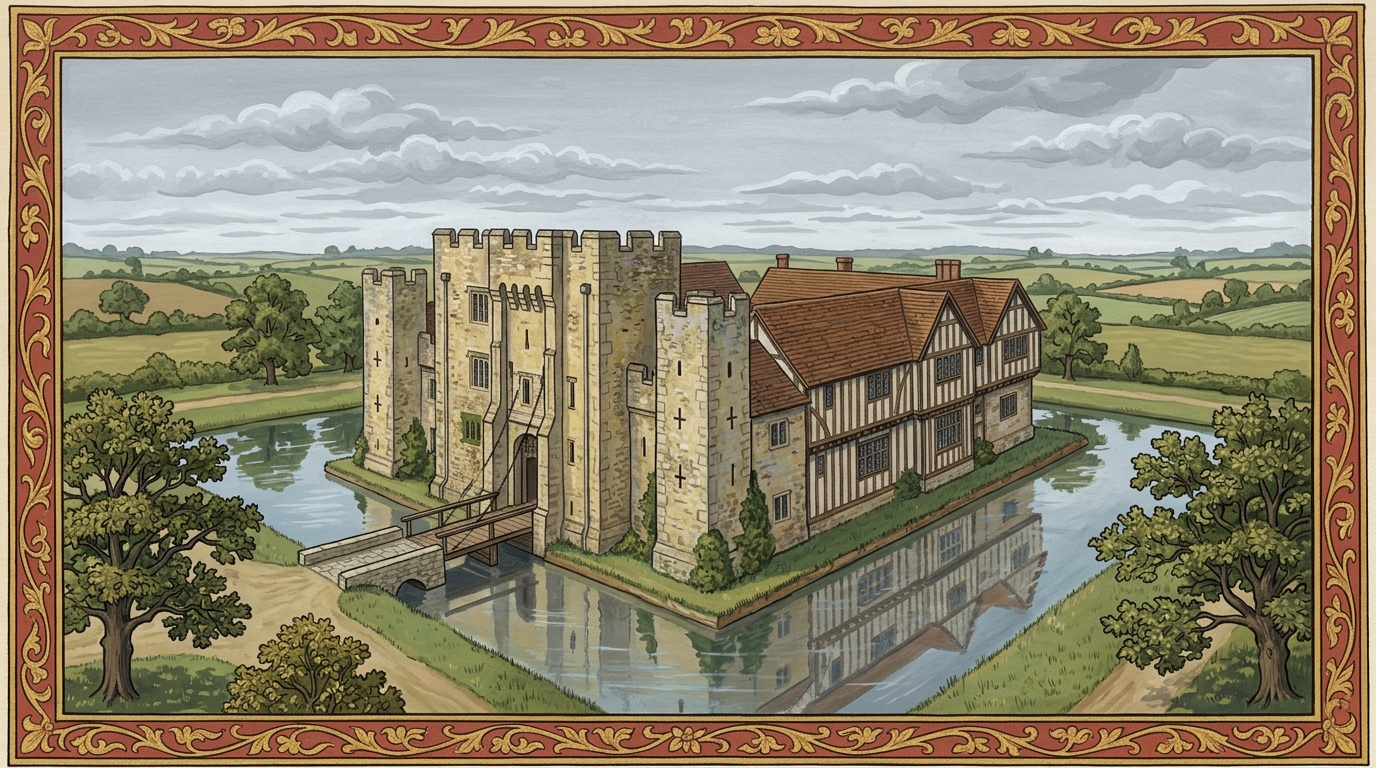
Hever Castle: The Medieval Fortress That Shaped a Queen
Imagine standing at the edge of a centuries-old moat, gazing across still water at a castle that once echoed with the laughter of a young girl who would one day become the most controversial queen in English history. Hever Castle in Kent is one of those rare places where stone and water seem to hold their breath, as though the past is never quite finished with the present. It is the childhood home of Anne Boleyn, the woman whose marriage to Henry VIII shook the foundations of English religious and political life, and whose story continues to fascinate historians, novelists, and visitors from around the world.
Yet the castle we see today is not simply the place where Anne grew up. It is a palimpsest of history, with layers stretching from the thirteenth century all the way to the early twentieth. Understanding those layers tells us something profound not only about Anne herself, but about the extraordinary ambitions of her father, Thomas Boleyn, and the enduring power of Tudor architecture to communicate status, wealth, and aspiration. As someone who has spent years researching Tudor lives for both historical scholarship and fiction, I find Hever Castle endlessly rewarding precisely because it refuses to be a simple story.
In this post, we will explore the castle’s medieval origins, Thomas Boleyn’s ambitious renovations in the early 1500s, and the sweeping twentieth-century restoration that gave Hever much of its current appearance. Along the way, we will consider what all of this meant for Tudor society, for Anne’s own remarkable trajectory, and for the way we understand and visit the castle today.
Historical Background: From Medieval Fortress to Tudor Residence
The history of Hever Castle begins long before any Boleyn set foot within its walls. The castle’s thirteenth-century defensive moat, one of its most striking features, was constructed as a practical military precaution during an era when local lords needed to protect themselves against raids and civil unrest. The moat and the original fortified gatehouse formed the core of what was then a working medieval stronghold, designed for defence rather than domestic comfort. According to Hever Castle’s official historical records and family papers, the structure passed through several hands before the Boleyn family acquired it in the late fifteenth century.
It was Sir Geoffrey Boleyn, a prosperous London merchant and Lord Mayor of the city, who purchased Hever in 1462, beginning the family’s long association with the property. His grandson, Thomas Boleyn, inherited the estate and transformed it in ways that speak volumes about the social climbing that defined the Tudor age. In the early 1500s, Thomas added a substantial timber-framed Tudor residence within the medieval walls, creating a comfortable domestic interior that contrasted sharply with the austere stonework surrounding it. As Eric Ives notes in his authoritative biography The Life and Death of Anne Boleyn (Blackwell, 2004), Thomas was a man of considerable political intelligence and social ambition, qualities that shaped not only his own career at the court of Henry VIII but also the upbringing he provided for his children.
The addition of a Tudor domestic wing was not merely a matter of comfort. It was a deliberate statement. By the early sixteenth century, the old medieval castle was being softened and humanised from within, reflecting Thomas Boleyn’s rising status as a diplomat, courtier, and confidant of the king. The timber-framed rooms, with their carved wooden panels and generous windows, signalled that the Boleyns were no longer simply provincial gentry. They were players on a national, and increasingly international, stage.
It was within this hybrid environment, part medieval fortress, part Tudor manor house, that Anne Boleyn spent her childhood years before being sent abroad to the courts of the Archduchess Margaret in the Netherlands and then the French court of Queen Claude. The formative years she spent at Hever, absorbing the cultural and political ambitions of her father, shaped the remarkable woman she would become.
Significance and Impact: Architecture as Ambition
Why does it matter that Thomas Boleyn chose to insert a Tudor residence within a medieval shell rather than simply building anew? The answer lies at the heart of how Tudor society understood legitimacy and prestige. Medieval stonework carried weight, both literally and metaphorically. By retaining the old fortifications and moat while modernising the interior, Thomas was simultaneously claiming ancient roots and demonstrating contemporary sophistication. It was a calculated architectural argument: the Boleyns belonged here, and they had both the history and the means to prove it.
This strategy of renovation over replacement was not unusual among ambitious Tudor families, but it is particularly resonant at Hever given what happened next. Anne Boleyn’s rise to become Queen of England in 1533 represented the ultimate vindication of her father’s social ambitions, even as it ultimately led to tragedy for the entire family. The castle that Thomas had so carefully updated to reflect his status became, in the public imagination, inseparable from the queen he had helped to create.
The political consequences of Anne’s relationship with the castle rippled outward in unexpected ways. After Anne’s execution in 1536, Henry VIII seized Hever as part of the wider dismantling of the Boleyn family’s influence. The castle was subsequently granted to Henry’s fourth wife, Anne of Cleves, as part of her divorce settlement in 1540, a curious footnote that underlines how thoroughly royal politics could reshape even the most personal of spaces. Hever Castle’s official records document this transfer, reminding us that architecture in the Tudor period was never simply about bricks and mortar. It was about power.
Connections and Context: The Wider Tudor World
To understand Hever Castle fully, we need to place it within the broader context of early Tudor England. The years when Thomas Boleyn was renovating his Kent estate coincided with a period of extraordinary social mobility and cultural energy. Henry VII had stabilised the country after the Wars of the Roses, and his son Henry VIII was projecting an image of Renaissance magnificence that demanded ambitious courtiers keep pace. Men like Thomas Boleyn were under constant pressure to demonstrate their worth through the visible markers of status, including their homes.
It is also worth remembering that the early sixteenth century was a moment of intense architectural activity across England. The great houses of the period, from Hampton Court to Knole in Kent, reflect the same hunger for self-expression through building that we see at Hever. Did you know that Knole, just a few miles from Hever in the Kentish countryside, was also associated with the Tudor court and was later connected to Anne Boleyn’s own complicated family network? The density of Tudor ambition in this corner of England is remarkable.
Meanwhile, the religious upheaval that Anne Boleyn’s marriage to Henry VIII set in motion was beginning to reshape not just politics but the very landscape of England. The dissolution of the monasteries, which began in earnest in the late 1530s, would eventually redistribute enormous quantities of land and property, creating new opportunities for precisely the kind of family that the Boleyns represented. Hever Castle stands as a reminder of that world on the cusp of transformation.
Modern Relevance and Fascinating Details
One of the most surprising facts about Hever Castle is how much of what visitors see today owes not to the Boleyns or even to the Tudor period, but to the extraordinary intervention of William Waldorf Astor in the early twentieth century. Astor, an American-born millionaire who became a British citizen, purchased Hever in 1903 and undertook a sweeping restoration that gave the castle much of its current ornamental appearance. He added an entire Tudor village to house his guests, dug out and enlarged the lake, and lavished enormous sums on creating the gardens that visitors admire today.
Hever Castle’s official records make clear that while Astor was deeply respectful of the castle’s historical fabric, his restoration was as much about creating a romantic vision of the medieval past as it was about strict historical accuracy. The result is a place that is simultaneously genuinely ancient and carefully curated, a distinction that matters enormously for anyone trying to understand what the castle would actually have looked like when Anne Boleyn was a child running along its corridors.
As a historical fiction author, I find this layering of eras endlessly productive. When I walk through Hever’s gardens or stand in the rooms where Anne supposedly slept, I am always conscious that I am moving through multiple histories at once: the thirteenth-century military engineers who dug the moat, the ambitious Thomas Boleyn who imagined a grander future for his family, and the Edwardian millionaire who decided to make the whole thing look like a dream of England. Each layer enriches the others, and together they make Hever one of the most atmospherically complex historic houses in Britain. Did you know that the castle contains a remarkable collection of portraits and artefacts associated with Anne Boleyn herself, including items of jewellery that are believed to have belonged to her personally?
Conclusion: Layers of Stone and Story
Hever Castle is far more than a pretty picture on a travel brochure. It is a place where the ambitions of a medieval lord, a Tudor courtier, a doomed queen, and an Edwardian plutocrat have all left their marks, layered one upon another like the pages of an extraordinary book. The thirteenth-century moat, Thomas Boleyn’s timber-framed Tudor interiors, and William Waldorf Astor’s romantic restoration together tell a story about how history is never simply preserved but always, to some degree, reimagined by those who come after.
For anyone interested in Tudor history, in Anne Boleyn’s extraordinary life, or simply in the way buildings carry memory across centuries, Hever Castle offers an experience that is difficult to match. Whether you visit in person, explore it through the castle’s own historical records and family papers, or encounter it through the pages of Eric Ives’s indispensable biography, you will find a place that continues to ask urgent and fascinating questions about ambition, power, and what it means to belong somewhere. I hope this post has given you a richer sense of everything those ancient stones have to say.