
When Lightning Struck the Heart of Tudor London: The Fall of Old St. Paul’s Spire
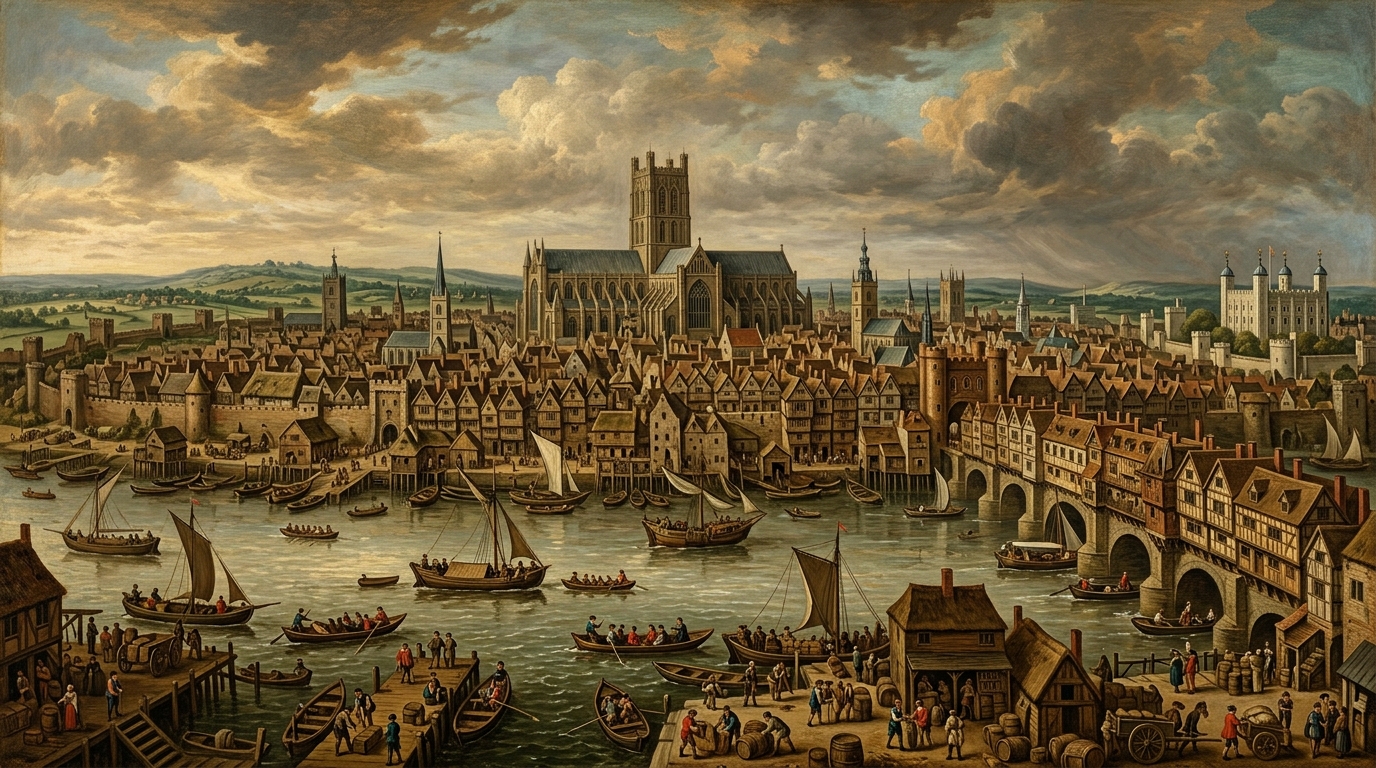
Imagine standing on the banks of the Thames in the early sixteenth century, gazing upon a skyline dominated by a single, breathtaking silhouette. Old St. Paul’s Cathedral rose above medieval London like a stone colossus, its spire soaring to an estimated 489 feet, making it one of the tallest structures in the entire world. For Londoners of the Tudor age, it was not merely a building. It was the very soul of their city, a landmark so familiar that its absence would have been unthinkable. Yet on the fourth of June 1561, the unthinkable happened, and Tudor London was changed for ever.
A violent storm rolled over the city that summer afternoon, and a bolt of lightning found its mark with devastating precision. The great spire of Old St. Paul’s Cathedral caught fire and collapsed, leaving behind a truncated, wounded silhouette that would never be fully restored. What followed was not simply an architectural loss, but a moment that revealed the religious tensions, political anxieties, and cultural fault lines running through Elizabethan England. As the historian Diarmaid MacCulloch explores in Tudor Church Militant (1999), the English Reformation had already transformed the spiritual landscape of the country, and the loss of this iconic spire carried meanings that went far beyond mere structural damage.
In this post, we will explore the remarkable story of Old St. Paul’s Cathedral during the Tudor period: its extraordinary role as a social and religious hub, the catastrophic lightning strike of 1561, and why this moment still resonates with historians, writers, and curious readers today. Whether you have stumbled upon this topic through a search for Tudor London history or you are a seasoned enthusiast of the period, there is something genuinely surprising waiting for you here.
Historical Background: A Cathedral Like No Other
Old St. Paul’s Cathedral occupied the highest point of the City of London, on Ludgate Hill, and had stood in various forms since the seventh century. By the Tudor period, the building that Londoners knew was a magnificent Gothic structure, completed in the thirteenth and fourteenth centuries, with a nave so long it was commonly used as a thoroughfare and marketplace. This was not simply a place of worship. It was, in the most literal sense, the beating heart of Tudor London.
The cathedral’s central aisle, known as Paul’s Walk, functioned as an extraordinary social space. Merchants conducted business there. Lawyers met clients. Servants sought employment by standing with their tools in hand, advertising their skills to potential employers. Booksellers clustered around the churchyard outside, making the precinct one of the great centres of the early print trade in England. Writers, poets, and pamphlet-sellers jostled for attention in the shadow of those ancient stones. It was noisy, chaotic, commercial, and utterly alive.
The spire itself, which had been rebuilt after a fire in 1087 and again following further damage in subsequent centuries, was by the Tudor era still an extraordinary feat of medieval engineering. Standing at a height that modern estimates place at between 450 and 489 feet, it was visible from miles around and served as a navigational landmark for travellers approaching the city. For ordinary Londoners, it was simply always there, as permanent and reassuring as the river itself.
On the fourth of June 1561, during the reign of Queen Elizabeth I, a lightning bolt struck the spire and ignited a fire that burned for several hours. Contemporary accounts described the horror of watching the great wooden structure, covered in lead, burn and then collapse. The damage to the roof of the nave was severe. Molten lead poured through the building. Miraculously, the walls and the basic structure of the cathedral survived, but the spire was gone, leaving behind a stunted tower that gave the building an altogether diminished appearance.
Significance and Impact: More Than Just a Building
The immediate question Elizabethans asked was one that modern readers will find entirely familiar: who was to blame, and what did it mean? In a society that still understood catastrophe through a theological lens, the destruction of a major church by a bolt from heaven was not easily dismissed as mere bad weather. Protestant reformers and Catholic commentators alike seized upon the event to make their respective arguments about God’s favour or displeasure with the religious direction of the realm.
As MacCulloch notes in Tudor Church Militant, the English Reformation had created a febrile atmosphere in which religious buildings, objects, and institutions were constantly being reinterpreted, repurposed, or dismantled. The cathedral itself had already suffered considerable losses during the reigns of Henry VIII and Edward VI, when chantry chapels were dissolved, shrines stripped, and the building’s sacred economy fundamentally disrupted. The lightning strike arrived, therefore, not upon an untouched medieval monument but upon a building already carrying the scars of religious upheaval.
Queen Elizabeth herself took an interest in the restoration of the cathedral, and efforts were made to raise funds for repairs. The nave roof was eventually restored, but the spire was never rebuilt. Various schemes were proposed over the following decades, and money was collected, but the project never reached completion. The reasons were partly financial, partly logistical, and possibly political. A Protestant regime that was dismantling the old ecclesiastical infrastructure had complicated feelings about investing vast resources in restoring the visible grandeur of a Catholic-era monument, however practically important the cathedral remained.
The consequences for the London skyline were permanent and profound. For over a century, until the Great Fire of 1666 finally destroyed Old St. Paul’s altogether, Londoners lived with this truncated reminder of what had been lost. The poet and playwright Ben Jonson referred to Paul’s Walk in his work, and numerous writers of the period set scenes there, but the looming absence of the spire gave the place a slightly melancholy quality that contemporaries clearly noticed and remarked upon.
Connections and Context: The Broader Tudor World
It is worth pausing to consider what else was happening in England in 1561, because historical events are always richer when placed in their proper context. Elizabeth I had been queen for only three years, still navigating the extraordinarily delicate task of establishing a Protestant religious settlement whilst managing the expectations of Catholic nobles, foreign powers, and her own councillors. The same year, Mary Queen of Scots returned to Scotland from France following the death of her husband, Francis II, setting in motion the chain of events that would eventually bring her to England and to her execution in 1587.
Peter Hennessy, in Westminster: A Biography (2007), reminds us how closely the physical fabric of great institutions is bound up with the political and cultural life that surrounds them. The loss of the spire at St. Paul’s was not happening in isolation. It was part of a broader story of transformation, in which the landmarks of Catholic England were being literally and figuratively reshaped by the forces of the Reformation, royal authority, and the new commercial energy of an expanding city.
It is also worth noting that Old St. Paul’s existed in fascinating tension with the newer centres of power described by Hennessy. Westminster, with its Abbey and its Palace, represented royal and parliamentary authority. St. Paul’s represented the City, commerce, and the religious life of ordinary Londoners. The health of one was always, in some sense, a reflection of the health of the other, and the wounded cathedral of post-1561 London was perhaps an apt symbol of an England still finding its footing after decades of religious revolution.
Modern Relevance and Fascinating Details
Did you know that the tradition of book-selling around St. Paul’s Churchyard, already thriving in the Tudor period, continued well into the nineteenth century and helped establish London as one of the great publishing capitals of the world? The connection between Old St. Paul’s and the printed word is one of the most intriguing threads running through the history of the site, and it is one that I find endlessly fascinating as a historical fiction author. When I write scenes set in Tudor London, Paul’s Walk is almost always present, not as backdrop but as a living, breathing character in its own right.
The 1561 lightning strike also raises questions that continue to resonate. How do cities mourn their lost landmarks? How do religious communities interpret disaster? And how does a building’s physical transformation reflect the spiritual and political changes happening around it? These are not merely historical questions. They are deeply human ones, and they are precisely why the story of Old St. Paul’s continues to draw readers and researchers alike.
In popular culture, the Tudor period is often visualised through the lens of the court and the monarchy, but the real texture of Tudor life was found in places like Paul’s Walk, where every stratum of society rubbed shoulders. Television dramas and historical novels have increasingly recognised this, and the cathedral’s unique character as both sacred space and civic marketplace makes it an irresistible setting for storytelling.
Conclusion: A Skyline Changed For Ever
The story of Old St. Paul’s Cathedral and the catastrophic loss of its spire in 1561 is, at its heart, a story about change and what communities lose when familiar landmarks disappear. For Tudor Londoners, the cathedral was not simply a religious building. It was a market, a meeting place, a monument, and a navigational star. When the lightning struck, it took more than a spire with it. It took something irreplaceable from the identity of the city itself.
If this story has caught your imagination, I would encourage you to explore Diarmaid MacCulloch’s Tudor Church Militant and Peter Hennessy’s Westminster: A Biography for richer context and detail. And if you find yourself curious about the daily lives of the people who walked those nave aisles, argued in that churchyard, and looked up in horror on a June afternoon in 1561, then perhaps the world of Tudor historical fiction is waiting for you too. The past, as ever, has much still to say.