
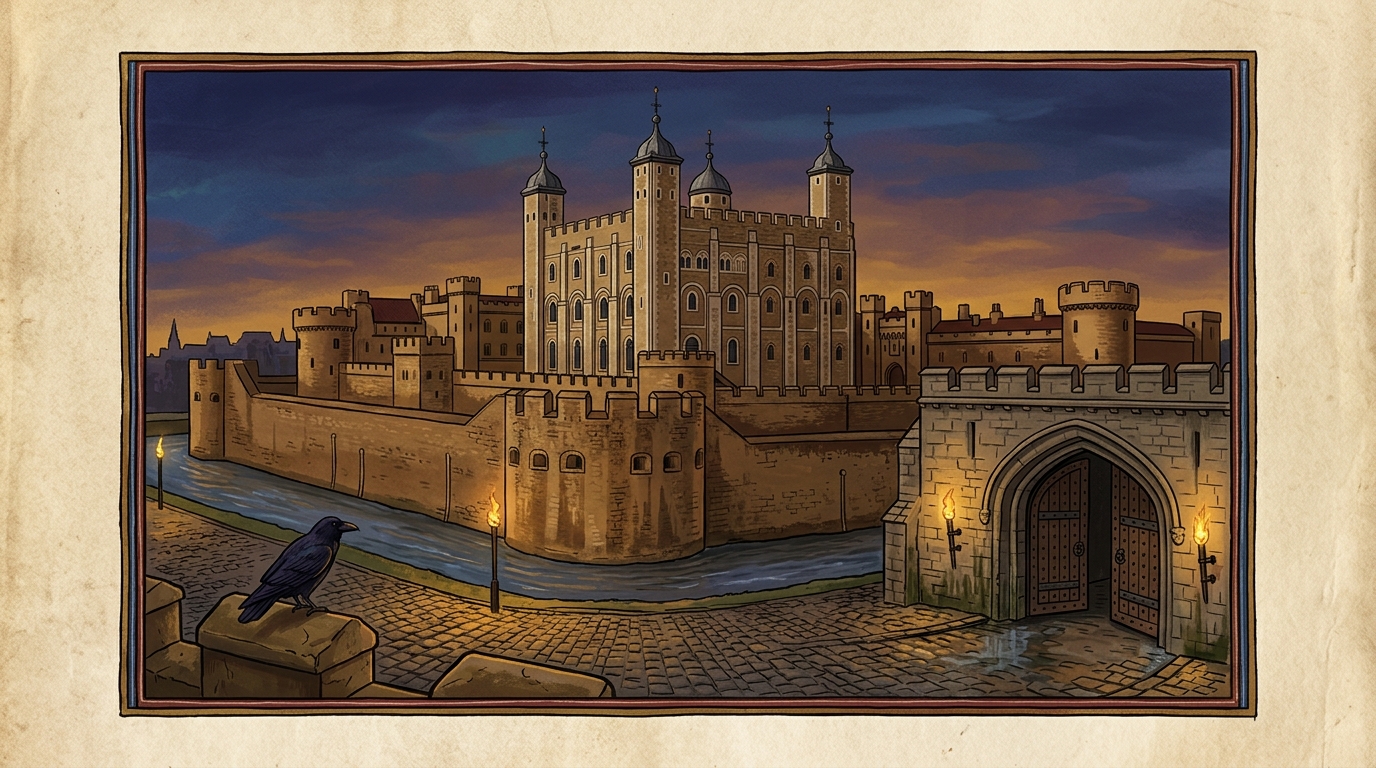
The Tower of London: Royal Palace, Political Prison, and Place of Tudor Execution
Few buildings in the world carry as much historical weight as the Tower of London. Standing on the north bank of the Thames, this ancient fortress has witnessed coronations and conspiracies, celebrations and catastrophes. Yet it is perhaps its role as a place of imprisonment and execution during the Tudor period that continues to capture the imagination of historians, tourists, and storytellers alike. As a historical fiction author who has spent years immersed in the politics and passions of the sixteenth century, I find that no single location better encapsulates the brutal beauty of Tudor power than this complex of towers, courtyards, and dungeons.
During the reign of Henry VIII in particular, the Tower transformed from a prestigious royal residence into something far more sinister: a tool of political control. Queens who had danced at court, nobles who had dined at the king’s table, and reformers who had dared to speak their conscience all found themselves crossing through the Traitors’ Gate, never to return to the life they had known. Understanding the Tower’s dual role during this period illuminates not just the history of a building, but the very nature of Tudor governance.
In this post, we will explore who was imprisoned and executed within the Tower’s walls, why it became such a central instrument of Henry VIII’s reign, and why its stories continue to resonate so powerfully today. Whether you are a student of history, a fan of historical fiction, or simply someone who has always wondered what really happened behind those ancient stone walls, read on.
Historical Background: A Palace Becomes a Prison
The Tower of London was not built with cruelty in mind. As Edward Impey and Geoffrey Parnell detail in The Tower of London: The Official Illustrated History (Merrell Publishers, 2000), the fortress was founded by William the Conqueror in the late eleventh century as a symbol of Norman authority and a secure royal residence. For centuries it functioned as a palace, a treasury, an armoury, and even a menagerie. Early Tudor monarchs, including Henry VII and the young Henry VIII himself, used the Tower as a prestigious stopping point before their coronation processions through London.
The shift towards its more notorious identity accelerated dramatically during Henry VIII’s reign, which lasted from 1509 to 1547. As Henry’s need to control opposition grew, particularly following his break with Rome in the early 1530s, the Tower became an increasingly convenient destination for those who fell foul of the king’s will. Its thick walls, its riverside location, and its existing infrastructure of guards and gates made it ideal for holding high-profile prisoners away from public sympathy.
Two of Henry’s six wives are perhaps the Tower’s most famous prisoners. Anne Boleyn, the king’s second wife and mother of the future Elizabeth I, was arrested in May 1536 on charges of adultery, incest, and treason. Alison Weir, in her meticulously researched The Six Wives of Henry VIII (Grove Press, 1991), notes that the evidence against Anne was largely fabricated, driven by political manoeuvring and Henry’s desire to be free of a marriage that had not produced a male heir. Anne was executed on Tower Green on 19th May 1536. Catherine Howard, Henry’s fifth wife, followed a similarly tragic path, arrested in late 1541 and beheaded on the same green on 13th February 1542. She was likely still in her teens at the time of her death.
Beyond the queens, the Tower held and executed an extraordinary roll call of Tudor figures. Sir Thomas More, the Lord Chancellor who refused to endorse Henry’s supremacy over the Church, was imprisoned in the Tower from April 1534 and executed on Tower Hill on 6th July 1535. Thomas Cromwell, who had himself orchestrated so many imprisonments within those walls, found himself a prisoner there in June 1540 before his own execution the following month. The Tower did not discriminate between the powerful and the pious.
Significance and Impact: Power, Fear, and Political Control
Why does the Tower’s role as a Tudor prison matter so profoundly? Because it reveals the mechanisms by which Tudor monarchs maintained authority in an age without standing armies, reliable bureaucracies, or modern communication systems. The threat of the Tower was itself a form of governance. Knowing that the king could imprison even a queen, even a Lord Chancellor, even a beloved courtier, kept the nobility and the clergy in a state of carefully managed anxiety.
The executions of Anne Boleyn and Catherine Howard sent a particularly chilling message to the women of the Tudor court. As Weir observes, Anne’s downfall demonstrated that no position, however exalted, offered genuine security if the king’s favour was withdrawn. For the ladies who served at court, witnessed the trials, and attended the funerals, the lesson was unmistakable: loyalty to the king must be absolute and visible.
The political consequences rippled outward from the Tower in lasting ways. The execution of Thomas More in 1535, for example, shocked Catholic Europe and confirmed to many continental observers that Henry VIII had crossed a line from which there could be no return. It deepened the schism between England and Rome and accelerated the pace of religious change. In this sense, decisions made within the Tower’s walls helped to shape the religious landscape of England for generations.
There is also the question of legal precedent. The use of Acts of Attainder, which allowed Parliament to convict individuals of treason without a full trial, became a troublingly efficient tool during this period. Anne Boleyn was tried before a jury, but others were not afforded even that formality. The Tower was where the consequences of these legislative shortcuts were most visibly, and most violently, enacted.
Connections and Context: The Tudor World Beyond the Tower Gates
It would be a mistake to view the Tower in isolation. Its story is interwoven with the broader political and religious upheaval of the sixteenth century. The break with Rome, formalised through the Act of Supremacy in 1534, created an entirely new category of treason: denying the king’s spiritual authority. Suddenly, silence or hesitation could be as dangerous as open rebellion, and the Tower’s population grew accordingly.
The Tower also connects directly to the story of the Tudor succession crisis. Lady Jane Grey, the young Protestant claimant who was queen for just nine days in 1553, was imprisoned in the Tower following the accession of the Catholic Mary I. Jane was executed there in February 1554, aged only sixteen or seventeen. Her story, like those of Anne and Catherine before her, reminds us that the Tudor succession was never simply a matter of bloodline; it was a contest played out in courtrooms, council chambers, and ultimately on Tower Green.
Did you know? The future Elizabeth I was herself imprisoned in the Tower in 1554, suspected of involvement in Wyatt’s Rebellion against her half-sister Mary. She entered through the Traitors’ Gate on 18th March 1554 and was held for approximately two months before being released to house arrest. The woman who would become one of England’s greatest monarchs very nearly met the same fate as her mother, Anne Boleyn, within those same walls.
Modern Relevance and Fascinating Details: Why the Tower Still Captivates
The Tower of London today attracts millions of visitors each year and remains one of the most recognisable landmarks in the world. Yet its enduring appeal goes beyond tourism. It has become a cultural touchstone for exploring questions of power, justice, gender, and the relationship between the state and the individual. These are not merely historical questions; they are perennial ones, which explains why the Tower and its stories keep returning to popular culture in new forms.
In historical fiction, the Tower appears again and again as a setting of almost unbearable dramatic tension. Hilary Mantel’s Booker Prize-winning Wolf Hall trilogy portrays the Tower with psychological acuity, using its physical presence to mirror the moral claustrophobia of Tudor politics. As someone who writes in this genre myself, I can attest that the Tower is an irresistible setting precisely because it collapses the distance between historical fact and human emotion. When you write a character entering through the Traitors’ Gate, you do not need to manufacture dread; the history provides it.
There are also details about the Tower that continue to surprise even well-read visitors. The famous ravens, whose presence is said by legend to guarantee the survival of the kingdom, are actually a relatively recent tradition, likely dating from the Victorian era rather than deep antiquity. The so-called Bloody Tower, long associated with the mysterious disappearance of the young Princes in the Tower in 1483, takes its name not from that event but from a later popular association. Impey and Parnell note that the building was originally called the Garden Tower. History, as ever, is more complicated than its legends suggest.
Conclusion: Walls That Still Speak
The Tower of London endures as one of history’s most powerful symbols because it holds within its stones so many of humanity’s most urgent stories: the abuse of power, the courage of the condemned, the fragility of favour, and the extraordinary resilience of those who survived its shadow. From Anne Boleyn’s composed final speech on Tower Green to the young Elizabeth I arriving by barge through the Traitors’ Gate, these are stories that refuse to stay in the past.
Whether you are approaching Tudor history for the first time or returning to it after years of study, the Tower repays every visit and every reading. I would encourage you to explore Alison Weir’s The Six Wives of Henry VIII and Impey and Parnell’s The Tower of London: The Official Illustrated History for authoritative starting points, and to visit the Tower itself if you are ever in London. Stand on Tower Green, look up at the White Tower, and listen. The walls, as they say, have ears, and in this case, they have centuries of extraordinary stories still waiting to be heard.