
Dressed to Impress? Not If the Tudor State Had Anything to Say About It
Imagine being fined, publicly shamed, or even imprisoned simply for wearing the wrong colour of fabric. In Tudor England, this was not a distant possibility but a very real legal threat. The sumptuary laws of the sixteenth century represent one of the most fascinating and revealing aspects of Tudor social control, a system designed to ensure that every person in the kingdom looked exactly the part assigned to them by birth and station. As a historical fiction author, I find these laws endlessly compelling, because they illuminate the anxieties, ambitions, and contradictions of an age in which social mobility was simultaneously feared and pursued.
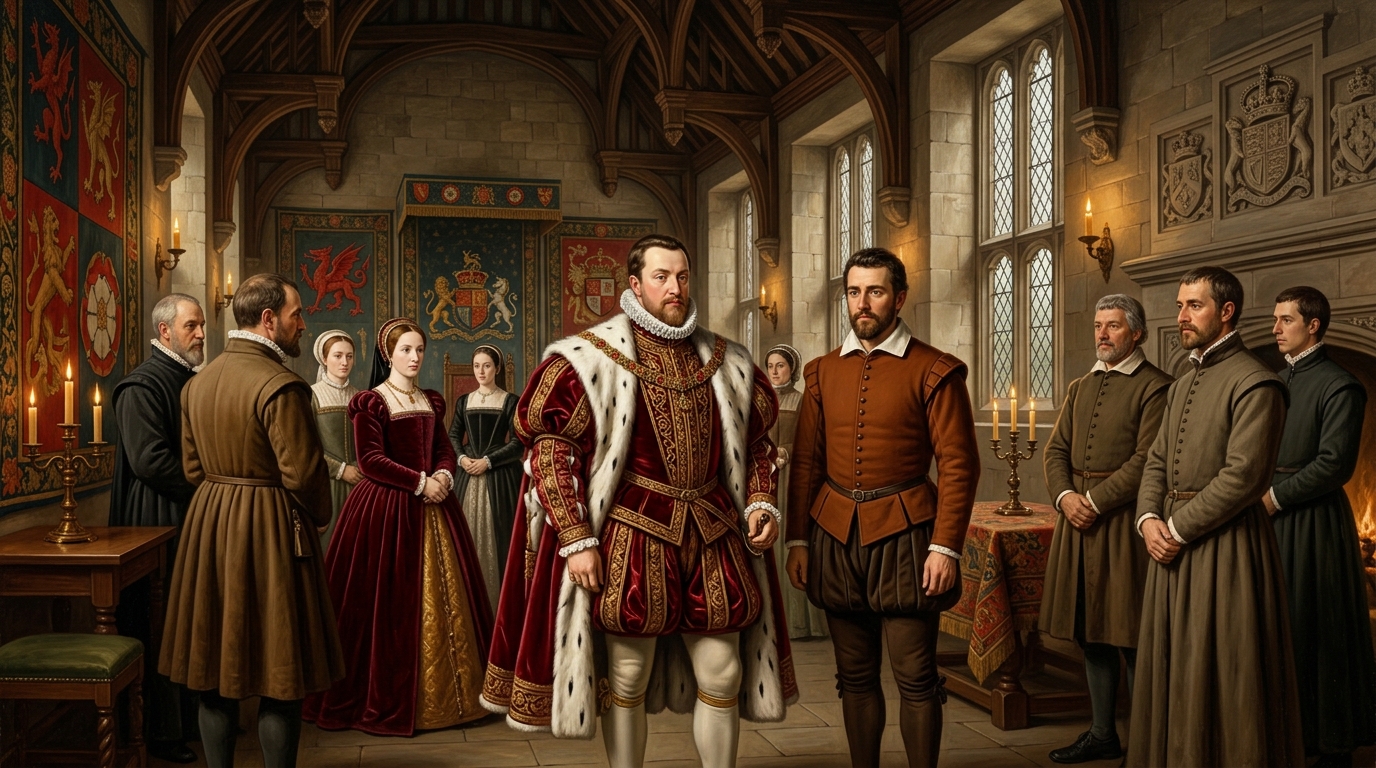
Tudor London was a city of extraordinary visual drama. Merchants rubbed shoulders with minor gentry, foreign dignitaries paraded through Cheapside, and ambitious young men arrived daily from the countryside hoping to make their fortunes. In this environment, clothing was not merely fashion; it was a language. Every silk doublet, every sable trim, every yard of crimson velvet spoke volumes about who you were, or who you were trying to be. The Crown understood this perfectly, and it responded with legislation designed to make sure the visual grammar of social hierarchy remained legible to all.
In this post, we will explore who the sumptuary laws targeted, how they worked in practice, why they ultimately struggled to achieve their aims, and why this centuries-old obsession with controlling dress still resonates so powerfully today.
The Historical Background: Legislating the Wardrobe
Sumptuary legislation in England did not begin with the Tudors. Medieval monarchs had attempted similar measures, but it was under the Tudors that such laws were codified and enforced with particular vigour. The most significant piece of Tudor sumptuary legislation was the Act of Apparel of 1533, passed under Henry VIII, though subsequent monarchs continued to issue proclamations and statutes throughout the sixteenth century. Elizabeth I was particularly active in this regard, issuing a series of detailed proclamations between the 1560s and the 1590s that specified precisely which fabrics, colours, and decorative elements could be worn by which ranks of society.
The laws were extraordinarily granular. According to N.B. Harte, writing in Trade, Government and Society in Pre-Industrial England (1972), the Tudor statutes distinguished between dozens of social categories, from dukes and earls down to yeomen and common labourers, with specific provisions governing the use of silk, velvet, cloth of gold, sable fur, and crimson or purple dyes. Purple, for instance, was reserved for members of the royal family. Velvet of crimson or blue was restricted to knights of the Garter and those of higher rank. Even the length of a gentleman’s sword or the number of cuts permitted on his doublet sleeve could fall under regulatory scrutiny.
The mechanisms of enforcement were threefold. Offenders could face financial penalties, with fines structured to escalate for repeat violations. They could be subject to the forfeiture of the offending garments themselves. And, perhaps most powerfully of all, they risked public shaming in a society where reputation was everything. Harte notes that enforcement was patchy and inconsistent, relying heavily on local officials and informers, but the threat alone was sufficient to shape behaviour among those with something to lose.
Geographically, London was the epicentre of both the problem and the attempted solution. The capital’s booming cloth and luxury goods trade meant that fine fabrics were increasingly available to those who could afford them, regardless of their social rank. As Keith Wrightson observes in English Society 1580-1680 (Rutgers University Press, 1982), the period witnessed significant social fluidity, with successful merchants, lawyers, and traders accumulating wealth that rivalled or exceeded that of the established gentry. It was precisely this fluidity that made sumptuary regulation feel so urgent to the Crown.
Significance and Impact: Why Fabric Became a Political Issue
To modern eyes, legislating what people wear might seem absurd, even tyrannical. But within the Tudor worldview, the sumptuary laws made a coherent and deeply-felt kind of sense. The Elizabethan social order was understood as divinely ordained, a Great Chain of Being in which every individual occupied a fixed and purposeful position. If a prosperous draper dressed like a knight, the visual order of society was disrupted, and with it, the very foundations of hierarchy and governance. Clothing was not superficial; it was constitutional.
The laws also had a significant economic dimension. Wrightson highlights the Crown’s concern about the drain of English wealth into foreign luxury goods, particularly Italian silks and French velvets. By restricting who could wear imported fabrics, the legislation aimed to reduce conspicuous consumption among those deemed insufficiently ranked to justify such expenditure. There was, in this sense, a proto-mercantilist logic at work alongside the social one.
Did you know? The penalties for non-compliance were not trivial. Under Elizabethan proclamations, a gentleman wearing cloth of gold without the requisite rank could forfeit both the garment and a substantial fine. Some proclamations specified fines of up to ten pounds per day of offence, a sum that would represent several months’ wages for a skilled craftsman.
Yet for all their apparent rigidity, the sumptuary laws also reveal the cracks in the system they were designed to protect. The very frequency with which new proclamations were issued, roughly every decade under Elizabeth, suggests that earlier efforts had failed to achieve compliance. Harte’s analysis makes clear that enforcement was chronically under-resourced and that social emulation, the desire of each rank to imitate the one above it, proved irresistible to a population growing wealthier and more aspirational by the decade.
Connections and Context: The Bigger Tudor Picture
The sumptuary laws cannot be understood in isolation. They emerged from, and fed back into, a broader set of Tudor anxieties about order, hierarchy, and the pace of social change. The sixteenth century was, as Wrightson’s scholarship makes abundantly clear, a period of dramatic economic transformation. Population growth, price inflation, the dissolution of the monasteries, and the expansion of trade all combined to create a society in which old certainties were under pressure. The gentry complained loudly about upstart merchants; merchants complained about the privileges of the nobility. Everyone, it seemed, was trying to dress above their station.
The sumptuary laws also intersected with the Tudor preoccupation with gender. Women’s dress was regulated alongside men’s, with specific provisions governing the fabrics and furs that women of different ranks might wear. A knight’s wife enjoyed different entitlements from a merchant’s wife, and both were distinct from those of a countess. For historical fiction writers, this gendered dimension opens up rich narrative territory: the ambitious merchant’s wife who quietly acquires a length of prohibited velvet, or the impoverished gentlewoman who must maintain appearances on a dwindling income.
It is also worth noting that the Elizabethan period saw the sumptuary laws reach their most elaborate development just as the commercial theatre was rising to prominence. The great playwrights of the age, including Shakespeare, were acutely aware of the relationship between clothing and identity. Cross-dressing plots, disguised identities, and mistaken social ranks were theatrical staples precisely because the audience lived in a world where such confusions carried real consequences.
Modern Relevance and Fascinating Details
The sumptuary laws of Tudor England might seem remote, but they speak directly to concerns that remain very much alive. Contemporary debates about dress codes in schools and workplaces, about the relationship between appearance and social mobility, and about the cultural significance of fashion all echo the fundamental questions that Tudor legislators were grappling with. Who gets to look a certain way? Who controls the visual language of status? And what happens when people refuse to comply?
Did you know? The Tudor sumptuary laws were repealed in 1604, early in the reign of James I, not because the social anxieties that had generated them had disappeared, but because they had proven essentially unenforceable. The commercial energy of early modern England had simply outrun the capacity of the state to police it through dress.
For readers of historical fiction, the sumptuary laws offer an extraordinarily rich source of narrative tension. In my own writing, I am constantly drawn to the moment when a character reaches for a forbidden fabric, knowing the risk and choosing it anyway. That gesture of sartorial defiance encapsulates so much about the Tudor age: the hunger for self-expression, the pressure of hierarchy, and the quiet, persistent human desire to be seen as more than the world has decided you are. Authors such as Hilary Mantel understood this instinctively; in the Wolf Hall trilogy, the careful attention to what characters wear is never merely decorative but always deeply revealing of power and ambition.
Conclusion: The Political Wardrobe
Tudor sumptuary laws represent far more than a quirky footnote in the history of fashion. They were a serious attempt by the Crown to manage social change through visual control, and their ultimate failure tells us as much about the vitality and ambition of Tudor society as their existence tells us about its official anxieties. As Harte and Wrightson both make clear, the tension between the ideal of a stable, legible social hierarchy and the reality of a mobile, commercially dynamic population was one of the defining features of early modern England.
Whether you come to this history as a curious reader, a student of the Tudor period, or a fellow traveller in the world of historical fiction, I hope this exploration has offered a fresh perspective on a society that was, in so many ways, far more complicated and contested than its portraits suggest. If you would like to explore further, I recommend both Harte’s essay and Wrightson’s landmark study as starting points for a deeper understanding of the world that produced these extraordinary, impossible laws.