
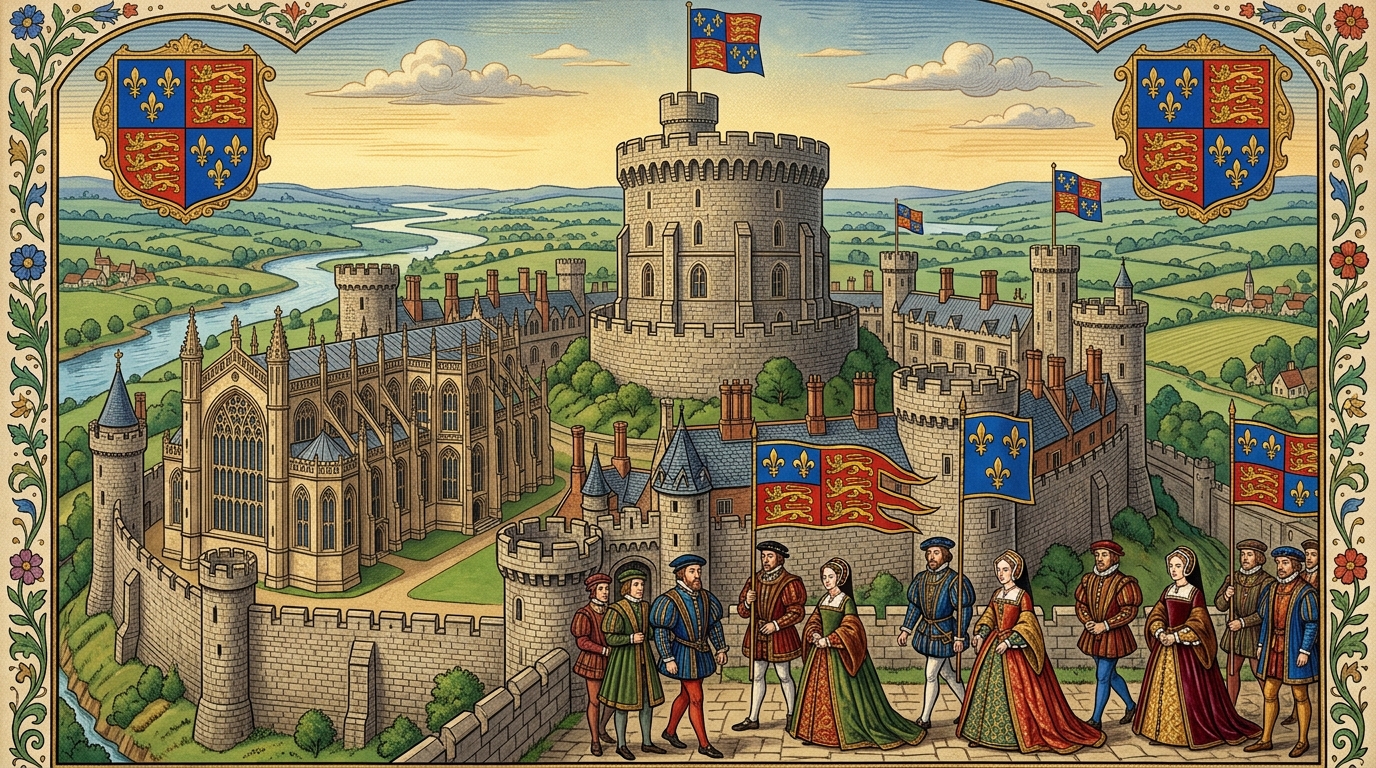
Windsor Castle and the Tudors: A Royal Fortress at the Heart of an Empire
Imagine standing within the ancient walls of Windsor Castle in the year 1509, watching a young, golden-haired king stride through its great halls with the confidence of a man who believed himself chosen by God. Henry VIII had inherited not merely a crown but a stage upon which he would perform the grandest drama in English history, and Windsor Castle was one of his most beloved theatres. For those of us fascinated by the Tudor period, Windsor represents something extraordinary: a place where the personal and the political collided daily, where love affairs were conducted alongside affairs of state, and where the very architecture reflected the ambitions of a dynasty determined to leave its mark on history.
Windsor Castle had been a royal residence for centuries before the Tudors arrived, but it was during the sixteenth century that the castle truly became a symbol of royal magnificence and English power. As John Martin Robinson notes in his authoritative work Windsor Castle: A Thousand Years of a Royal Palace (Boydell Press, 2008), the castle underwent significant transformation during the Tudor period, evolving from a medieval fortress into something approaching the palatial splendour we recognise today. The Royal Collection Trust Windsor Castle historical archives further confirm that every Tudor monarch left their particular imprint upon the buildings, gardens, and ceremonial life of this remarkable place.
In this post, we shall explore Windsor Castle’s role throughout the Tudor period, examining how Henry VIII and his successors used it as both a practical residence and a powerful statement of royal authority. We will look at the ceremonies conducted there, the personalities who shaped its character, and the reasons why Windsor remains so central to our understanding of Tudor England. Whether you are a seasoned historian or simply someone captivated by one of history’s most colourful dynasties, what follows will illuminate the castle’s enduring significance.
Historical Background: The Tudors and Their Castle
The Tudor dynasty’s relationship with Windsor Castle began with Henry VII, who inherited a residence that had been favoured by English monarchs since William the Conqueror first raised a fortress on the chalk ridge above the Thames in the eleventh century. By the time the first Tudor king took the throne in 1485, Windsor already possessed centuries of royal association, including its role as home to the Order of the Garter, England’s most prestigious chivalric order, founded by Edward III in 1348. This heritage made Windsor invaluable to the Tudors, who were acutely conscious of their need to legitimise a dynasty whose claim to the throne had not always been straightforward.
It was Henry VIII, however, who transformed Windsor most dramatically. Reigning from 1509 to 1547, Henry invested heavily in the castle’s infrastructure and ceremonial life. He constructed the magnificent long gallery and improved the royal lodgings substantially, ensuring that Windsor could accommodate the elaborate court culture he favoured. The castle sat conveniently close to London, roughly twenty miles to the west, making it ideal for a monarch who moved frequently between residences. Henry used Windsor for hunting in the surrounding Great Park, for diplomatic receptions, and for the solemn annual ceremonies of the Order of the Garter held in St George’s Chapel, which remains one of the finest examples of Perpendicular Gothic architecture in England.
Edward VI, Mary I, and Elizabeth I each continued to use Windsor as a primary royal residence, though their relationships with the castle reflected their different personalities and priorities. Elizabeth I, who reigned from 1558 to 1603, was particularly attached to Windsor and spent considerable time there during the summer months. She reportedly walked the long terrace she commissioned, taking the air and conducting business simultaneously, a habit that speaks to her formidable work ethic. The Royal Collection Trust archives record that Elizabeth undertook significant building works at Windsor, including the construction of the North Terrace, which offered commanding views across the Thames valley.
The castle’s geographical position was no accident of history. Windsor occupied a strategically important site commanding a broad sweep of the river Thames and the surrounding countryside. As a fortress, it could be defended; as a palace, it could impress. The Tudors were astute enough to understand that these two qualities were not in contradiction but were, in fact, mutually reinforcing. A king who could project power through magnificent architecture was also projecting military strength, and Windsor embodied both aspirations simultaneously.
Significance and Impact: Windsor as a Stage for Tudor Power
The importance of Windsor Castle to Tudor England extended far beyond its practical function as a comfortable royal residence. It served as a crucial arena for the performance of royal power at a time when the physical presence of the monarch carried enormous symbolic weight. State ceremonies conducted at Windsor, particularly those connected to the Order of the Garter, were elaborate theatrical productions designed to reinforce hierarchies, reward loyalty, and demonstrate to foreign observers that the Tudor monarchy was legitimate, powerful, and cultured.
The Order of the Garter ceremonies held annually at St George’s Chapel were among the most significant recurring events in the Tudor calendar. Membership of the order was restricted to the monarch and a small number of knights, making election to it one of the highest honours available to an English nobleman or a foreign prince. When Henry VIII admitted foreign rulers and their representatives to the order, he was conducting diplomacy through ceremony, using Windsor’s magnificent setting to communicate England’s status as a major European power. The chapel itself, largely completed during the reign of Edward IV but embellished and maintained by the Tudors, provided a setting of extraordinary Gothic beauty that lent gravitas to these occasions.
Beyond formal ceremony, Windsor shaped the everyday rhythms of Tudor court life in ways that influenced politics and culture profoundly. Proximity to the monarch at Windsor, as at all royal residences, translated directly into political influence. Courtiers who secured accommodation within the castle’s walls, who were present when the king walked in the park or dined in the great hall, were courtiers who could whisper in the royal ear. This geography of power meant that Windsor was not merely a building but a social ecosystem in which careers were made and broken.
Did you know? Henry VIII is believed to have been at Windsor when he learned of the failure of Anne Boleyn’s miscarriage in 1536, one of the events that contributed to her downfall. The castle’s walls witnessed not only the grandeur of Tudor ceremony but also its darkest personal dramas.
Connections and Context: Windsor in the Broader Tudor World
Understanding Windsor Castle’s role requires placing it within the broader context of Tudor royal itinerancy. Tudor monarchs did not reside permanently in any single place but moved continuously between a network of palaces, manors, and hunting lodges. Greenwich, Richmond, Hampton Court, Nonsuch, and Whitehall all featured prominently in this circuit, yet Windsor occupied a unique position within it because of its combination of defensive strength, hunting grounds, and ceremonial significance. When plague threatened London, Windsor’s distance from the capital made it a safe retreat; when diplomatic visitors required impressing, its ancient associations and Gothic splendour made it an ideal venue.
The castle’s history during the Tudor period intersects with some of the most dramatic episodes of the age. The break with Rome under Henry VIII inevitably affected Windsor, as it affected every religious institution in England. The chapel’s clergy were subject to the same upheavals as monastic communities elsewhere, though St George’s Chapel survived the dissolution era relatively intact, its royal connection offering a degree of protection. Elizabeth I’s long reign saw Windsor become associated with the confident Protestant identity she cultivated, a place where England’s particular version of reformed religion was practised with royal authority and visible splendour.
Readers interested in exploring further might consider the connections between Windsor and the wider European Renaissance. The aesthetic ambitions Henry VIII brought to Windsor were partly inspired by his observations of French and Flemish court culture, and the castle’s development during his reign reflects the broader Europeanisation of English court life that characterised the early sixteenth century.
Modern Relevance and Fascinating Details
Windsor Castle remains a working royal residence today, occupied by members of the Royal Family and open to the public, which makes the Tudor history explored in this post not merely academic but physically accessible. Visitors walking through St George’s Chapel today are walking through the same space where Henry VIII attended Garter ceremonies, where his own tomb now lies alongside that of Jane Seymour, the third of his six wives and the one who gave him his longed-for male heir. This continuity between past and present is one of Windsor’s most remarkable qualities and one that historical fiction authors, myself included, find endlessly compelling.
As a writer of historical fiction, I have spent considerable time researching the physical layout and daily rhythms of Tudor Windsor, and what strikes me most is how human it feels despite its grandeur. The records suggest that the castle was noisy, crowded, and occasionally chaotic, full of servants, courtiers, animals, and the incessant business of governance. The romantic image of serene royal dignity gives way, upon closer examination, to something far more vivid and rather more interesting. It is precisely this gap between myth and reality that makes the Tudor period so endlessly rewarding to explore.
Did you know? Henry VIII’s will specified that he wished to be buried at Windsor alongside Jane Seymour, a final testament to the castle’s personal significance for a king who made so many of his most consequential decisions within its walls. The joint tomb in St George’s Chapel remains one of the most visited sites in the entire castle complex.
Conclusion: Why Windsor Still Matters
Windsor Castle’s role during the Tudor period was neither incidental nor merely decorative. It was a place where English history was made, where royal authority was performed and reinforced, and where the personal lives of some of history’s most fascinating individuals played out against a backdrop of stone towers and Gothic chapels. From Henry VIII’s ambitious building works to Elizabeth I’s terraced walks overlooking the Thames, the Tudors shaped Windsor just as surely as Windsor shaped them.
If you have been inspired to explore further, the Royal Collection Trust offers extensive online resources relating to Windsor Castle’s history, and John Martin Robinson’s Windsor Castle: A Thousand Years of a Royal Palace remains the definitive scholarly account. Whether you approach this history as a researcher, a visitor, or a reader of historical fiction, Windsor Castle rewards attention and repays curiosity. The stones, after all, remember everything.