
Anne Boleyn: The Queen Who Changed England Forever
Of all the stories that emerged from the turbulent court of Henry VIII, none is more dramatic, more debated, or more devastating than that of Anne Boleyn. A woman of fierce intelligence and political ambition, Anne rose from courtier to queen in a manner that shook the very foundations of English religious and political life. Yet within three years of her coronation, she was dead, executed on charges that historians have questioned ever since. How did one of Tudor England’s most powerful women fall so swiftly, and what does her story reveal about the dangerous world of sixteenth-century politics?
As a historical fiction author and Tudor history enthusiast, I find Anne Boleyn endlessly compelling precisely because her story resists simple interpretation. She was neither purely victim nor purely villain. She was a woman navigating an extraordinarily perilous environment with remarkable skill, right up until the moment that skill was no longer enough. Understanding her rise and fall means understanding Henry VIII himself, the Reformation, and the razor-thin line between royal favour and royal wrath.
In this post, we will explore the historical background of Anne Boleyn’s marriage to Henry VIII, the charges brought against her in 1536, the lasting significance of her execution, and the reasons why her story continues to captivate readers, historians, and popular culture audiences more than four centuries after her death.
Historical Background: From Courtier to Queen
Anne Boleyn was born around 1501 or 1507, the precise date remaining a point of scholarly debate, into a family with strong connections to the English court. Her father, Sir Thomas Boleyn, was a skilled diplomat, and Anne spent formative years in the courts of the Habsburg Netherlands and, crucially, France, where she absorbed the sophisticated cultural and intellectual fashions of the day. As Alison Weir notes in The Six Wives of Henry VIII (1991), Anne returned to the English court around 1521 as a polished, confident young woman, quite unlike the typical English courtier of the time.
Henry VIII first became seriously interested in Anne Boleyn around 1526, by which point he had been married to his first wife, Katherine of Aragon, for over seventeen years. The marriage had produced one surviving child, the future Mary I, but no male heir. Henry had already begun seeking an annulment from Rome, arguing that his marriage to Katherine, his brother Arthur’s widow, had been invalid from the start. Anne’s entry into his life accelerated this pursuit dramatically. Unlike her sister Mary, who had previously been the king’s mistress, Anne refused to become merely another royal conquest. She held out for marriage, a decision that altered the course of English history.
The years between roughly 1527 and 1533 were consumed by what contemporaries called the King’s Great Matter, the long, grinding effort to obtain a papal annulment that the Pope, under pressure from Katherine’s nephew the Holy Roman Emperor Charles V, refused to grant. Henry’s solution was breathtaking in its audacity: he broke with Rome entirely, establishing himself as the Supreme Head of the Church of England. This was not solely Anne’s doing, but her influence on Henry’s thinking during this period should not be underestimated. David Starkey, in Six Wives: The Queens of Henry VIII (2003), argues convincingly that Anne was an active participant in shaping the religious and political reforms of these years, not merely a passive recipient of royal affection.
Henry and Anne were secretly married in late 1532 or early January 1533, with their union publicly confirmed after Archbishop Thomas Cranmer formally annulled Henry’s marriage to Katherine in May 1533. Anne was crowned queen at Westminster Abbey on 1st June 1533 in a magnificent ceremony. In September of that year, she gave birth to the future Elizabeth I. The joy, however, was muted. Henry had wanted a son.
The Fall: Charges, Trial, and Execution
The speed of Anne Boleyn’s downfall remains one of the most shocking episodes in Tudor history. By early 1536, the political landscape had shifted dramatically. Anne had suffered at least one miscarriage, possibly of a son, in January of that year. Henry’s eye had turned towards Jane Seymour. Thomas Cromwell, Henry’s chief minister, had reasons of his own to move against Anne. Within weeks, the machinery of destruction was in motion.
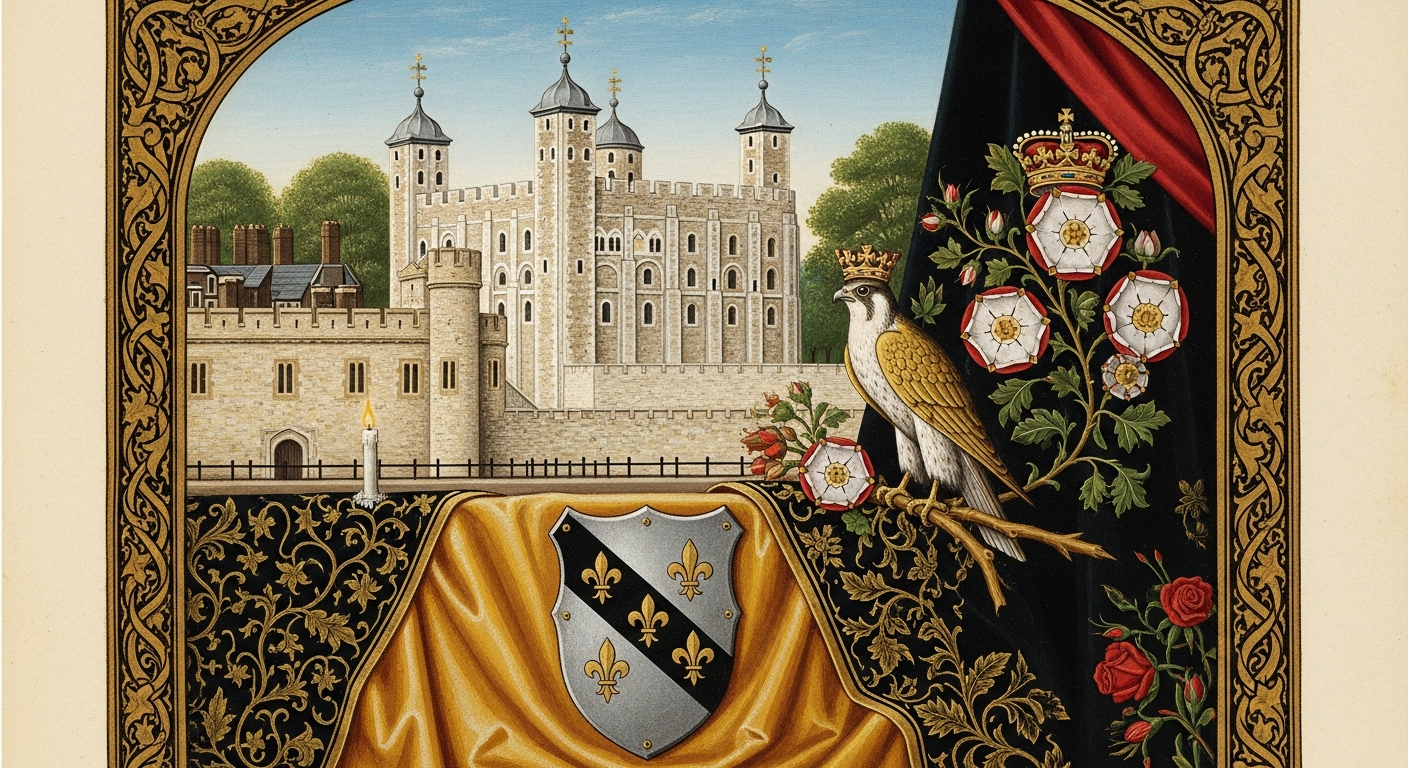
In April and May 1536, Anne was arrested and charged with adultery with five men, including her own brother George Boleyn, as well as conspiracy to murder the king. The charges also included treason. She was tried in the Tower of London before a court of peers that included her own father, Thomas Boleyn. Found guilty on 15th May 1536, she was beheaded on Tower Green on 19th May 1536. The five men accused alongside her had already been executed two days earlier.
Were the charges credible? Most modern historians, including both Weir and Starkey, regard them with deep scepticism. Weir, while acknowledging uncertainties, leans towards viewing the charges as largely fabricated or at least vastly exaggerated. Starkey similarly situates the fall within the political machinations of Cromwell and the factional rivalries of the Tudor court. The evidence presented at trial was thin, the confessions extracted under duress, and the speed of the entire process from arrest to execution suggests a predetermined outcome rather than a genuine legal inquiry.
Significance and Impact: Why Anne Boleyn’s Execution Mattered
The execution of a crowned queen of England was, quite simply, without precedent. Henry VIII had created a new and terrifying template: a king could destroy even his wife if he chose to do so. This had profound consequences for every subsequent queen consort, for the aristocracy, and for the culture of the Tudor court itself.
Beyond the personal, Anne’s fall had enormous religious implications. She had been a patron of Protestant reformers and a supporter of the English Bible. Her death did not reverse the Reformation, but it removed one of its most significant advocates from the centre of power. Her daughter Elizabeth, however, would eventually reign as Elizabeth I and cement the Protestant settlement in England, giving Anne’s legacy an extraordinary posthumous dimension.
Politically, the ease with which Henry dispatched Anne sent a clear message to every member of the court. Favour was not security. Even the queen’s crown offered no protection if the king withdrew his support. As Starkey observes, the Tudor court after 1536 was a noticeably more cautious, more fearful place. The fates of Anne’s alleged co-conspirators, most of them young men drawn from the very heart of courtly life, served as a brutal warning to an entire generation.
Connections and Context: Tudor England in 1536
It is worth pausing to appreciate just how extraordinary the year 1536 was in Tudor history. Katherine of Aragon died in January of that year. Anne Boleyn was executed in May. Henry married Jane Seymour just eleven days after Anne’s death. The dissolution of the smaller monasteries began in the same year. The Pilgrimage of Grace, a massive popular uprising in the north of England partly provoked by the religious changes of the period, broke out in October.
Did you know that Thomas Cromwell, the architect of Anne’s downfall, would himself be executed just four years later in 1540, on equally questionable charges? The very machinery he had used against Anne was ultimately turned upon him when he fell from royal favour after arranging Henry’s disastrous marriage to Anne of Cleves. There is a grim symmetry to his fate that Tudor historians find impossible to ignore.
Anne’s story also connects intimately to the wider question of how Henry VIII’s six marriages shaped English history. As Weir’s comprehensive account makes clear, each marriage was inseparable from the political, dynastic, and religious pressures of its moment. Anne’s marriage was the most consequential of all, producing the break with Rome and the heir who would become one of England’s greatest monarchs.
Modern Relevance: Why Anne Boleyn Still Captivates Us
Anne Boleyn has never been more popular than she is today. She appears in novels, television dramas, films, and podcasts with remarkable regularity. Hilary Mantel’s celebrated Wolf Hall trilogy, perhaps the most acclaimed work of historical fiction produced in Britain this century, placed Anne and the Tudor court at the very centre of contemporary literary culture. The 2015 BBC adaptation brought these characters to an entirely new audience.
What explains this enduring fascination? Partly it is the sheer drama of the story. Partly it is the questions that remain genuinely unanswered. Was Anne guilty of any of the charges against her? What actually happened during the years of her marriage to Henry? What did she truly believe, and how much of her influence was real? These are questions that historians continue to debate and that novelists and dramatists find endlessly generative.
As someone who writes historical fiction set in the Tudor period, I find that Anne Boleyn represents something particularly resonant for modern readers: a brilliant, ambitious woman whose success and destruction were both shaped by a world in which she could never fully control her own fate, yet who fought for that control more fiercely than almost anyone around her. That tension between agency and constraint speaks directly to contemporary concerns in a way that feels anything but historical.
Conclusion: A Legacy That Refuses to Be Silenced
Anne Boleyn was queen of England for less than three years, yet her impact on British history is incalculable. She helped drive the English Reformation, mothered one of England’s greatest monarchs, and established the terrifying precedent that even a queen was not safe from a king’s wrath. Her execution in 1536 on charges that most historians regard as deeply suspect remains one of the most disturbing episodes in Tudor history.
Whether you come to her story through the rigorous scholarship of Alison Weir or David Starkey, through the extraordinary fiction of Hilary Mantel, or simply through a curiosity about the woman Henry VIII loved and destroyed, Anne Boleyn rewards serious attention. Her life raises questions about power, gender, faith, and justice that are as urgent today as they were in sixteenth-century England. If this post has sparked your curiosity, I encourage you to explore the sources cited here and to keep asking the questions that Anne’s story so brilliantly provokes.