
The Sword That Fell on Tower Green: Anne Boleyn’s Execution and the Mercy Henry VIII Never Truly Showed
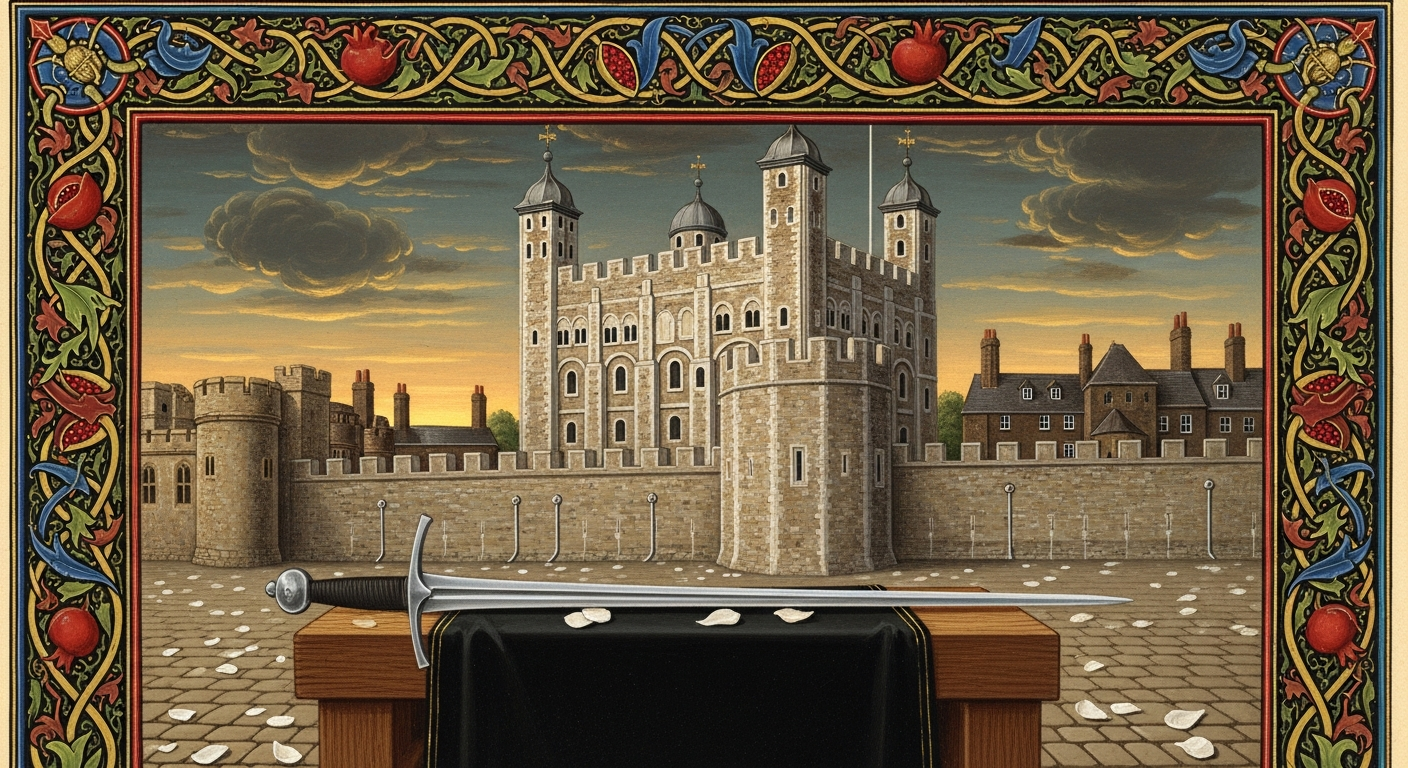
On the morning of 19th May 1536, a young French swordsman raised his blade at Tower Green within the walls of the Tower of London, and in a single swift stroke, brought the reign of England’s most controversial queen to a violent close. Anne Boleyn, second wife of King Henry VIII, mother of the future Queen Elizabeth I, and the woman who had reshaped England’s religious and political landscape, was dead. Yet even in this final, brutal moment, there was something distinctly unusual about her end. Unlike the vast majority of those condemned to die on English scaffolds, Anne was not executed by axe. She was executed by sword, a detail that has fascinated historians, novelists, and Tudor enthusiasts for nearly five centuries.
Why does this matter? Because the choice of a sword over an axe was, in theory, an act of mercy orchestrated by the very man who had signed her death warrant. Henry VIII, it seems, had arranged for a skilled executioner to be imported specifically from France, a country renowned for its more refined method of beheading. Whether this represented genuine remorse, a performance of kingly magnanimity, or simply the calculated image management of a Tudor monarch, remains one of the most debated questions in English history. As someone who has spent years researching and writing about this period, I find this detail endlessly revealing about both Henry’s character and the brutal theatre of Tudor power.
In this post, we will explore the full story of Anne Boleyn’s execution, examining the historical evidence, the political circumstances that led to her death, and the lasting significance of that single, merciful sword stroke. Along the way, we will draw on primary sources including Letters and Papers, Foreign and Domestic, of the Reign of Henry VIII, Volume 10, as well as the excellent scholarship of Elizabeth Norton in Anne Boleyn: Henry VIII’s Obsession (Amberley Publishing, 2009).
Historical Background: Who Was Anne Boleyn, and How Did She Come to Die?
Anne Boleyn was born around 1501, likely in Norfolk, into the ambitious Boleyn family. Educated partly in France and at the sophisticated court of Margaret of Austria in the Netherlands, she returned to England a polished, intelligent young woman whose sharp wit and unconventional beauty captivated Henry VIII sometime around 1526. Unlike her predecessors as royal mistress, Anne refused to become merely a passing favourite. She held out for the crown itself, a gamble that would reshape England entirely. Henry’s obsession with Anne drove him to seek an annulment from his first wife, Catherine of Aragon, and when Rome refused to grant it, Henry broke with the Catholic Church altogether, establishing the Church of England with himself at its head. Anne and Henry were secretly married in late 1532 or early 1533, and she was crowned Queen of England in a magnificent ceremony at Westminster Abbey in June 1533.
Yet the marriage that had shaken Christendom proved fragile. Anne gave birth to the future Elizabeth I in September 1533, but her subsequent pregnancies ended in miscarriage or stillbirth, most devastatingly in January 1536 when she lost what appears to have been a son. By this point, Henry’s eye had already fallen upon Jane Seymour, and powerful enemies at court were circling. In April and May of 1536, Anne was arrested on charges of adultery with five men, including her own brother George Boleyn, as well as charges of plotting the king’s death. These charges are now widely regarded by historians as fabrications, almost certainly engineered by Thomas Cromwell and others who wished to remove her from power. Elizabeth Norton’s biography makes a compelling case that the evidence against Anne was constructed rather than discovered, assembled by those who understood exactly what Henry wanted to hear.
Anne was tried at the Tower of London on 15th May 1536. The verdict was a foregone conclusion. She was found guilty of high treason and condemned to death, to be executed either by burning or beheading, at the king’s pleasure. Henry chose beheading, and he went one step further. Rather than the standard English method of execution by axe, which was notoriously unreliable and often required multiple blows, Henry arranged for a swordsman to be brought from Calais or Saint-Omer, a professional executioner skilled in the French manner of decapitation.
The execution took place on 19th May 1536 at Tower Green, a relatively private location within the Tower complex, rather than the more public Tower Hill outside its walls. This too was a concession of sorts, sparing Anne the spectacle of a truly public death. According to contemporary accounts recorded in Letters and Papers, Foreign and Domestic, the execution was swift and effective. Anne reportedly conducted herself with extraordinary composure, delivering a speech from the scaffold that was careful, dignified, and notably free of any direct accusation against the king. She knelt upright, without a block, her eyes bound with a white linen cloth, and the sword fell cleanly. By all accounts, it was over in a moment.
Significance and Impact: Why the Sword Matters
The choice of a sword over an axe was not merely practical. In Tudor England, the method of execution carried profound social and symbolic weight. Beheading by sword was considered the more honourable death, associated with Continental aristocracy and, in particular, with French nobility. By granting Anne this form of execution, Henry was making a statement, however hollow, that she retained a certain dignity even in her disgrace. As Elizabeth Norton notes, it was a gesture that spoke volumes about the complicated mixture of guilt, affection, and calculation that characterised Henry’s feelings towards his second wife.
The political impact of Anne’s death was immediate and sweeping. Within twenty-four hours, Henry was betrothed to Jane Seymour. Within eleven days, they were married. The speed of this transition shocked many observers across Europe, and the imperial ambassador Eustace Chapuys, who had despised Anne as a heretic and usurper, nonetheless recorded his astonishment at Henry’s behaviour. Anne’s fall also effectively ended the careers of many of her supporters at court, reshaping the factions that would dominate Tudor politics for years to come.
Perhaps most significantly, Anne’s execution left her daughter Elizabeth in a deeply precarious position. Declared illegitimate by act of Parliament, the future Elizabeth I spent her early years navigating the dangerous terrain of a court that had seen her mother destroyed. That this child would eventually become one of England’s greatest monarchs, in part shaped by the lessons of her mother’s fate, is one of history’s most extraordinary ironies.
Connections and Context: The Wider Tudor World of May 1536
It is worth pausing to consider what else was happening in England and Europe as Anne Boleyn knelt on Tower Green. Catherine of Aragon, Henry’s first wife, had died in January 1536, removing one political obstacle but arguably accelerating the chain of events that destroyed Anne. Thomas Cromwell, the architect of so much Tudor policy including the dissolution of the monasteries, was at the height of his power in the spring of 1536, though he too would eventually fall victim to Henry’s volatile favour in 1540.
Anne’s execution also came at a moment of considerable religious tension. The break with Rome was still relatively recent, and England’s religious identity was far from settled. Anne herself had been a genuine patron of evangelical reform, and her death was a blow to those at court who favoured a more Protestant direction for the Church of England. Did you know that Anne Boleyn is sometimes credited with influencing Henry’s support for an English translation of the Bible, having presented him with a copy of William Tyndale’s English New Testament? Her death did not extinguish the reforming impulse she had helped nurture, but it certainly slowed it.
The execution also resonated across the Channel. Francis I of France and the Holy Roman Emperor Charles V both watched events in England with keen interest, each calculating how Anne’s fall and Jane Seymour’s rise might affect their own diplomatic relationships with Henry.
Modern Relevance and Fascinating Details: Anne Boleyn in the Twenty-First Century
Five centuries after her death, Anne Boleyn remains one of the most written-about women in English history. She appears in countless works of historical fiction, from Hilary Mantel’s magnificent Wolf Hall trilogy to Philippa Gregory’s The Other Boleyn Girl. As a historical fiction author myself, I find Anne endlessly compelling precisely because of her contradictions: brilliant yet vulnerable, politically astute yet ultimately outmanoeuvred, condemned by accusations almost certainly false, yet remembered more vividly than almost any of her contemporaries.
The detail of the French swordsman continues to capture popular imagination, and rightly so. Did you know that the executioner is sometimes referred to in historical accounts as the Hangman of Calais, though his precise identity remains unconfirmed? The Letters and Papers record payments associated with the execution but do not name him definitively, leaving one of history’s small mysteries tantalizingly unsolved. Some accounts suggest Anne did not know the swordsman had arrived, and that a distraction was deliberately created to make her look away before the blow fell, sparing her the anticipation of the final moment.
In terms of popular culture, the question of whether Henry VIII truly showed mercy to Anne Boleyn continues to generate debate in documentaries, podcasts, university seminars, and online forums. It is the kind of question that cuts to the heart of how we understand power, gender, and justice in history.
Conclusion: A Sword Stroke and Its Long Shadow
Anne Boleyn’s execution on 19th May 1536 was simultaneously an act of political necessity, judicial murder, and, in the strangest possible sense, royal consideration. The imported French swordsman, the quiet setting of Tower Green, the swift and relatively painless death: these were the last gifts Henry VIII gave to the woman he had once moved heaven and earth to make his queen. Whether they reflect genuine feeling or merely the performance of mercy is a question history cannot fully answer.
What we can say with certainty is that Anne Boleyn’s story did not end on Tower Green. It continued through her daughter Elizabeth, through the religious transformation she helped set in motion, and through the extraordinary hold she has retained on the historical imagination ever since. If you want to explore further, I recommend beginning with Elizabeth Norton’s Anne Boleyn: Henry VIII’s Obsession and then diving into the remarkable primary evidence preserved in Letters and Papers, Foreign and Domestic, of the Reign of Henry VIII. The details you will find there are more extraordinary than any fiction.