
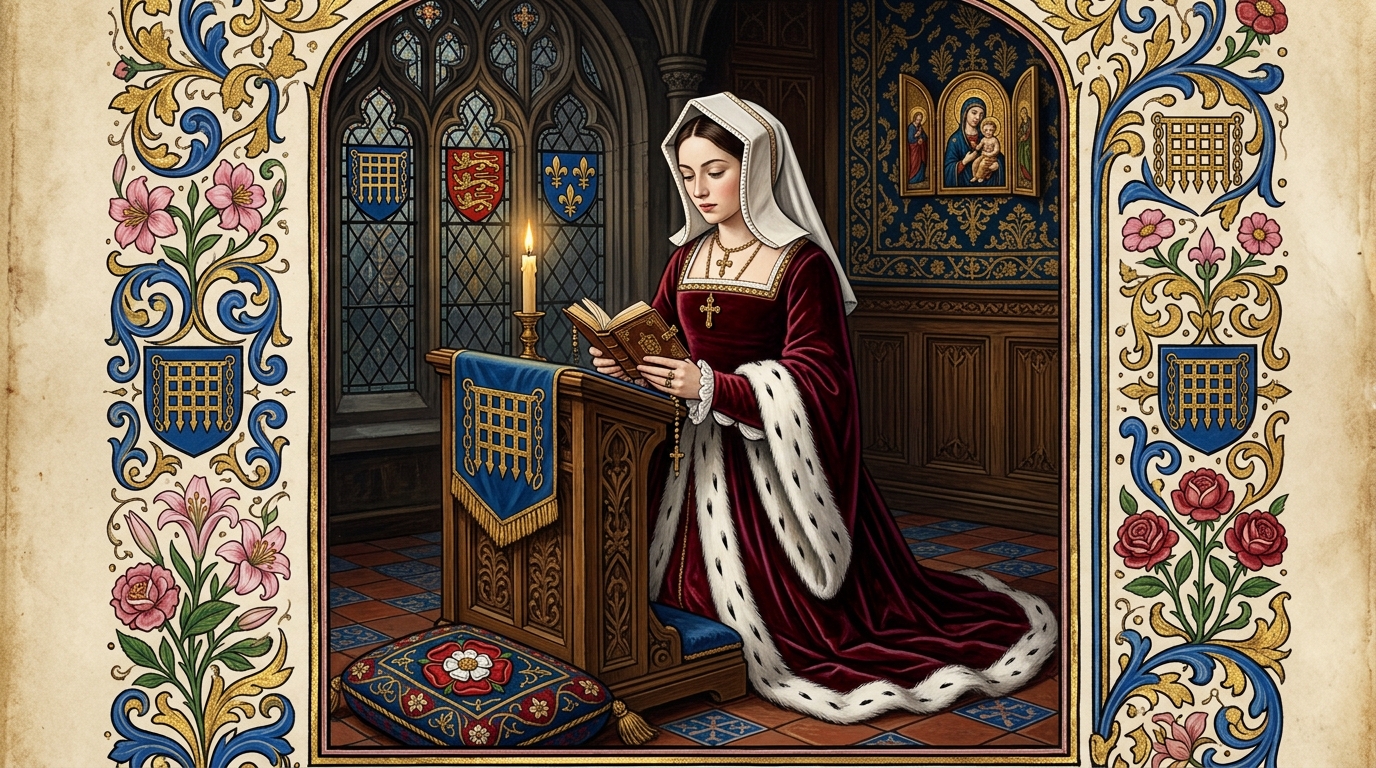
The Youngest Mother in Tudor History: Margaret Beaufort’s Story of Survival and Power
Imagine being twelve years old, newly married, and facing a pregnancy that your own body was not ready to endure. This was the reality for Lady Margaret Beaufort, one of the most remarkable women in English history, whose ordeal as a child bride would shape not only her own extraordinary life but the entire course of the Tudor dynasty. Her story raises questions that historians, medical professionals, and readers of historical fiction continue to find both troubling and utterly compelling: how did a thirteen-year-old girl survive childbirth in fifteenth-century England, and what did that experience cost her?
Margaret Beaufort is frequently remembered as the formidable matriarch who engineered her son Henry VII’s path to the throne, the woman who outlasted rivals, navigated conspiracies, and ultimately saw her bloodline crowned at Westminster. Yet behind the image of the politically shrewd countess lies a girl whose earliest experience of adulthood was defined by physical trauma and permanent consequence. Understanding what happened to Margaret in 1457 offers a window into the brutal realities of medieval childhood, aristocratic marriage, and the expectations placed upon women whose bodies were considered dynastic instruments rather than their own.
In this post, we will explore the circumstances of Margaret’s pregnancy, the lasting physical damage she sustained, and why this deeply personal history carries such significant weight for our understanding of Tudor England. We will draw upon the authoritative scholarship of The King’s Mother by Michael K. Jones and Malcolm G. Underwood (Cambridge University Press, 1992), as well as primary sources including The Paston Letters, to piece together a story that is at once intimate and historically momentous.
Historical Background: A Child Bride in Fifteenth-Century England
To understand Margaret Beaufort’s situation, we must first appreciate the political landscape of 1450s England. The Wars of the Roses were tearing the country apart, and noble families were acutely aware that dynastic survival depended upon securing advantageous marriages as swiftly as possible. Margaret was born in May 1443, the daughter of John Beaufort, 1st Duke of Somerset, and Margaret Beauchamp of Bletso. Through her father, she was a direct descendant of John of Gaunt, the third surviving son of Edward III, which made her Lancastrian blood both a precious asset and a dangerous liability.
Her first betrothal, arranged when she was barely an infant, was to John de la Pole, son of the Duke of Suffolk. That arrangement was dissolved in 1453, and the wardship of the young heiress passed to Jasper and Edmund Tudor, half-brothers of King Henry VI. It was Edmund Tudor, Earl of Richmond, who married Margaret in 1455. She was twelve years old. He was approximately twenty-four. According to Jones and Underwood in The King’s Mother, there is evidence to suggest that Margaret herself had expressed a preference for Edmund over another candidate, though one must treat any notion of genuine agency with considerable caution given her age and the pressures surrounding her.
Edmund Tudor wasted little time in consummating the marriage and Margaret fell pregnant almost immediately. Before their child could be born, Edmund was captured by Yorkist forces and imprisoned at Carmarthen Castle, where he died of plague in November 1456. Margaret, heavily pregnant and widowed at twelve, took refuge with her brother-in-law Jasper Tudor at Pembroke Castle in Wales. It was there, on 28 January 1457, that she gave birth to the future King Henry VII. She was thirteen years old.
The birth was, by all accounts, extraordinarily difficult. Margaret’s young body was simply not physically mature enough to bear a child safely, and the labour left her with permanent internal damage. As Jones and Underwood document, she never conceived again despite subsequently marrying Sir Henry Stafford in 1458 and later Thomas Stanley, 1st Earl of Derby in 1472. The medical consensus, supported by historical evidence, is that the trauma of her first confinement rendered her unable to have further children.
Significance and Impact: The Price of Dynastic Ambition
The immediate human cost to Margaret Beaufort was profound. At an age when most modern children are in secondary school, she had endured widowhood, an agonising labour, and permanent physical injury. Yet the historical significance of these events extends far beyond one woman’s suffering. Margaret’s experience illuminates the systematic exploitation of female bodies within the aristocratic marriage market, a practice that was not considered cruel by contemporaries but rather entirely rational and even advantageous.
The fact that Margaret produced only one child, and that child happened to be Henry Tudor, the man who would end the Wars of the Roses and establish the Tudor dynasty, is one of history’s most striking ironies. Had her body not been damaged, had she borne further children by Edmund or subsequent husbands, the dynastic calculations surrounding Henry’s claim to the throne might have looked very different. Her singular focus on her only son’s advancement, which would consume the rest of her long life, was shaped in part by the knowledge that he was irreplaceable.
For Tudor society more broadly, Margaret’s story reflects the intersection of gender, power, and bodily autonomy, or rather the complete absence of it. Noble women were expected to produce heirs; their health and comfort were secondary considerations. The Paston Letters, that invaluable collection of fifteenth-century correspondence, offer glimpses into the lives of gentry families navigating similar pressures, with young women discussed in terms of their dowries and childbearing potential rather than their personal wellbeing. Margaret’s case was extreme, but it was not entirely unusual in its underlying logic.
It is also worth noting the political consequences of Margaret’s reduced fertility for the Tudor succession itself. Henry VII had only four children who survived infancy, and the fragility of the Tudor line would become a defining anxiety of the sixteenth century. The obsession with male heirs that drove Henry VIII to six marriages and the break with Rome can be traced, in part, back to this foundational dynastic vulnerability.
Connections and Context: Margaret Beaufort and the Wider Tudor World
Margaret Beaufort’s story does not exist in isolation. It connects directly to some of the most significant threads running through Tudor history. Her son Henry VII’s claim to the throne rested heavily upon her Beaufort descent, and it was Margaret’s tireless political networking, including her role in the Buckingham rebellion of 1483 against Richard III, that helped make his eventual victory at Bosworth in 1485 possible. She is, in many respects, the true architect of the Tudor dynasty.
It is also worth considering her story alongside those of other young noblewomen of the period. Catherine of Aragon, to give a later example, was sent to England at sixteen to marry Prince Arthur, who died shortly afterwards, leaving her in a prolonged state of political limbo. The pattern of young women deployed as diplomatic and dynastic tools runs consistently through the period. What makes Margaret’s case distinctive is that she survived, thrived, and ultimately wielded extraordinary power, becoming one of the most influential women in England by the end of her life.
Did you know that Margaret Beaufort went on to found two Cambridge colleges? Christ’s College and St John’s College both owe their existence to her patronage, and she was a significant figure in the development of early English printing, having commissioned translations and texts from William Caxton and his successor Wynkyn de Worde. The frightened girl at Pembroke Castle became a patron of learning, a political force, and a deeply pious noblewoman who took a vow of chastity in 1499 with her husband Stanley’s consent.
Modern Relevance and Fascinating Details
Why does Margaret Beaufort’s story continue to captivate readers and historians five centuries after her death? Partly, it is the sheer improbability of her trajectory: from traumatised child widow to the mother of a king, from political prisoner to one of the most powerful women in England. Her life resists easy categorisation and rewards close examination.
As a historical fiction author, I find Margaret endlessly fascinating precisely because her inner life remains so elusive. We know the outlines of what she endured, but we can only speculate about how she processed the loss of Edmund Tudor, the agony of her confinement, and the knowledge that she would bear no more children. What we can say is that she channelled whatever grief or resilience she possessed into a single-minded devotion to Henry that never wavered, even through decades of separation, exile, and political danger.
In popular culture, Margaret has received increasing attention in recent years. Philippa Gregory’s novel The Red Queen (2010) brought her story to a wide audience, and the television adaptation The White Queen (2013) featured her as a driven, somewhat unsettling figure of maternal obsession. More nuanced portrayals have followed as scholars and novelists alike grapple with the complexity of a woman who was simultaneously a victim of her era’s expectations and one of its most formidable survivors. Her age at the time of Henry’s birth is a detail that consistently shocks modern readers, serving as a stark reminder of how differently childhood, marriage, and women’s bodies were regarded in the medieval world.
Conclusion: A Legacy Forged in Suffering and Determination
Margaret Beaufort’s pregnancy at twelve and her traumatic labour at thirteen were not footnotes in Tudor history. They were foundational events that shaped a woman, a dynasty, and an era. The permanent physical damage she sustained ensured that Henry Tudor remained her only child, concentrating her formidable energies entirely upon his survival and eventual triumph. Her story asks us to look beyond the political narrative of the Wars of the Roses and consider the human cost borne by the women caught within it.
Drawing upon the scholarship of Jones and Underwood in The King’s Mother and the contemporary evidence preserved in sources like The Paston Letters, we can begin to appreciate the full dimensions of Margaret’s experience. She is not simply the mother of Henry VII; she is a figure who deserves to be understood on her own terms, as someone who endured extraordinary hardship and built from it a life of remarkable consequence. If you would like to explore her story further, I would encourage you to seek out Jones and Underwood’s biography, which remains the definitive scholarly account of this most extraordinary woman.