
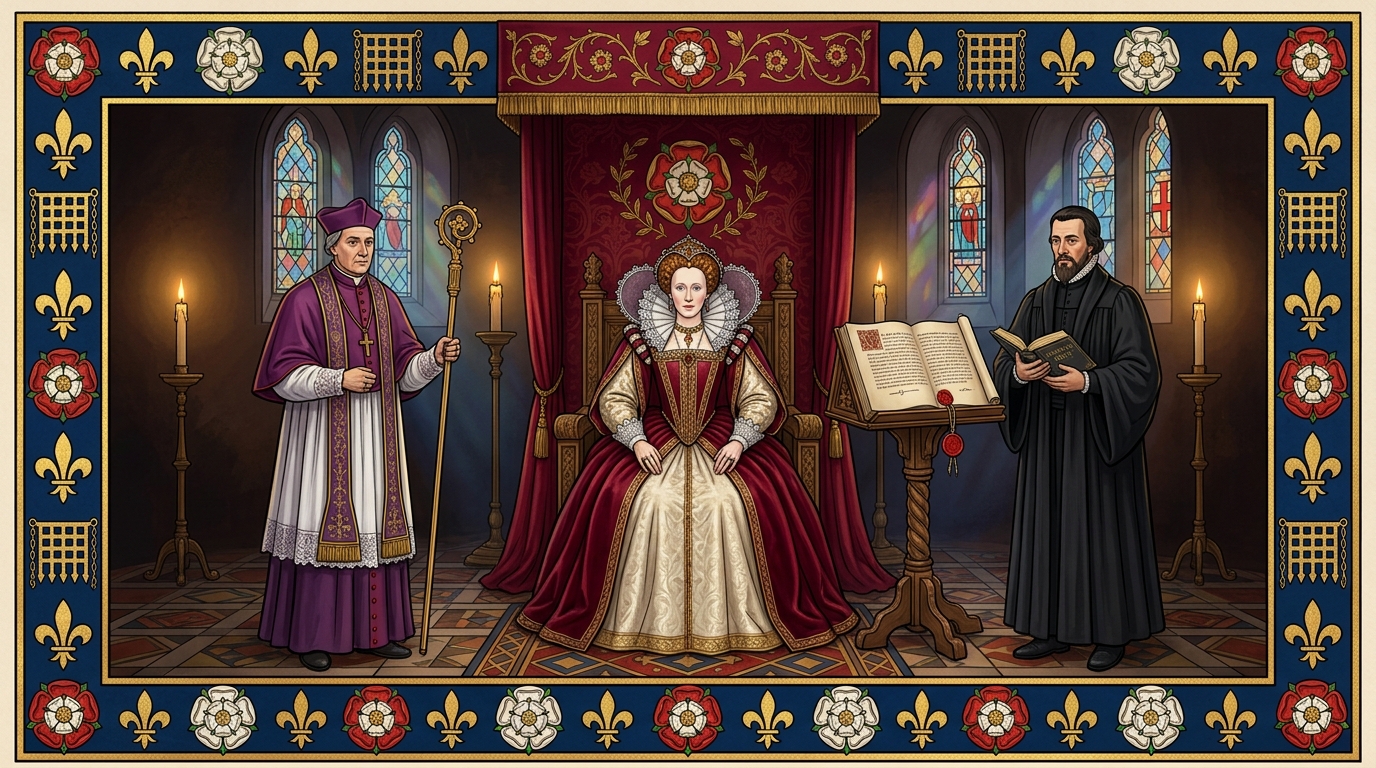
Elizabeth I and the Elizabethan Religious Settlement of 1559: England’s Defining Moment of Faith and Politics
Imagine inheriting a kingdom torn apart by religious conflict, where your father had broken with Rome, your brother had pushed radical Protestantism, and your sister had burned nearly three hundred people at the stake in the name of Catholic restoration. This was the extraordinary and terrifying situation facing Elizabeth I when she ascended the throne in November 1558. What she did next would shape England’s spiritual and political identity for centuries to come. The Elizabethan Religious Settlement of 1559 was not simply a piece of legislation; it was an act of extraordinary political genius that sought to hold a fractured nation together through carefully calibrated compromise.
The Settlement, established through two landmark pieces of legislation, the Act of Supremacy (1559) and the Act of Uniformity (1559), created what historians have long described as a ‘middle way’ between the competing extremes of Roman Catholicism and radical Protestantism. It established the enduring character of the Church of England: broadly Protestant in doctrine, yet retaining enough traditional ceremony and structure to avoid alienating those with more conservative sympathies. Understanding this Settlement is essential to understanding Tudor England, and indeed, modern Britain.
In this post, we will explore the circumstances that made the Settlement necessary, the key figures who shaped it, its profound impact on Tudor society, and why this five-hundred-year-old piece of religious statecraft still resonates today. Whether you are a student of history, a lover of historical fiction, or simply curious about how England became the country it is, this story has something remarkable to offer you.
Historical Background: A Kingdom in Religious Crisis
To appreciate the Settlement fully, we must understand the chaos that preceded it. Henry VIII’s break with Rome in the 1530s had set England on an uncertain religious course. His son, Edward VI, had steered the country sharply towards Protestant reform under the influence of powerful councillors like Thomas Cranmer, Archbishop of Canterbury. Then, with brutal abruptness, Mary I reversed course entirely upon her accession in 1553, restoring papal authority and presiding over the burning of nearly three hundred Protestant men and women, earning herself the lasting epithet ‘Bloody Mary’ in Protestant memory.
When Elizabeth came to the throne at the age of twenty-five, she faced a kingdom that was exhausted, divided, and deeply uncertain about its religious future. The question of what England believed was not merely a matter of personal conscience; it was bound up with questions of loyalty, treason, foreign policy, and the very stability of the crown. Catholic powers in Europe, most notably Spain and France, watched England closely, and a misstep could invite invasion or internal rebellion.
Elizabeth herself was widely understood to hold Protestant sympathies, shaped by her education under humanist tutors and her experiences under Mary’s reign, during which she had been imprisoned in the Tower of London and walked a careful, dangerous line. However, she was also acutely pragmatic. As Patrick Collinson observed in his landmark study ‘The Elizabethan Puritan Movement’ (1967), Elizabeth’s religious policy was shaped as much by political necessity as by personal conviction, and she resisted pressure from more zealous Protestant reformers throughout her reign.
The Settlement took shape rapidly in the first year of her reign. Parliament passed the Act of Supremacy in April 1559, which restored royal supremacy over the Church of England, naming Elizabeth ‘Supreme Governor’ rather than ‘Supreme Head’, a subtle but significant distinction that made the title slightly more palatable to those with Catholic sympathies. The Act of Uniformity followed shortly after, reimposing a revised version of Cranmer’s Book of Common Prayer and requiring attendance at Church of England services, enforced through modest fines for non-compliance.
Significance and Impact: Holding a Nation Together
The genius of the Elizabethan Religious Settlement lay in its deliberate ambiguity. The Thirty-Nine Articles, which were finalised in 1563 to define the doctrinal basis of the Church of England, were carefully worded to allow for a range of interpretations. On key theological questions, such as the nature of the Eucharist, the language was intentionally broad enough that moderate Catholics and moderate Protestants could each read their own views into it. This was not sloppiness; it was strategy.
The impact on Tudor society was enormous and far-reaching. Religiously, the Settlement ended the immediate cycle of violent reversal that had characterised the reigns of Edward and Mary. Politically, it gave the crown a stable instrument of national unity. The Church of England became, in effect, a branch of the state, with bishops appointed by the crown and the monarch serving as its supreme governor. This fusion of ecclesiastical and royal authority reinforced Elizabeth’s power in ways that went far beyond mere theology.
However, the Settlement did not please everyone, and this is a crucial point often overlooked in simplified accounts. On the Catholic side, those who remained loyal to Rome, known as recusants, faced increasing penalties as the reign progressed, particularly after Pope Pius V excommunicated Elizabeth in 1570, effectively releasing her Catholic subjects from their obligation of loyalty. On the Protestant side, those we might broadly call Puritans, who wanted further reformation of the church to purge it of what they saw as lingering Catholic ceremony, grew increasingly frustrated with what they considered a half-finished Reformation. Collinson’s ‘The Elizabethan Puritan Movement’ documents this tension brilliantly, showing how the very Settlement that created stability also planted the seeds of the conflicts that would eventually lead to the Civil War of the following century.
For ordinary Tudor men and women, the Settlement meant that attendance at church on Sundays became a legal obligation as well as a religious one. Parish churches were gradually transformed: altars were replaced with communion tables, Latin gave way to English, and the visual splendour of Catholic worship was stripped away. These changes reshaped the daily rhythms of English life in ways both profound and deeply personal.
Connections and Context: The Wider Tudor World
The Religious Settlement did not exist in isolation. It must be understood alongside the other defining challenges of Elizabeth’s early reign. In 1559, the same year the Settlement was enacted, England was negotiating the Treaty of Cateau-Cambresis, which ended a costly war with France and confirmed the loss of Calais, England’s last territory on the French mainland. The foreign policy pressures Elizabeth faced made domestic religious stability not merely desirable but absolutely essential.
It is also worth noting the role of key advisers in shaping the Settlement. William Cecil, Elizabeth’s Principal Secretary and later Lord Treasurer, was a consistent voice for moderate Protestant reform and political prudence. Matthew Parker, who became Archbishop of Canterbury in 1559, was a learned and relatively moderate churchman who helped give the Church of England its distinctive scholarly and ceremonial character. These men worked alongside Elizabeth to craft a Settlement that was politically viable as well as theologically defensible.
The Settlement also connects directly to the later crises of Elizabeth’s reign. The arrival of Mary Queen of Scots in England in 1568, the Rising of the Northern Earls in 1569, the papal excommunication of 1570, and the plots of the 1580s associated with the Spanish Armada of 1588 all played out against the backdrop of the religious fault lines that the Settlement had sought, but ultimately could not fully bridge. Understanding 1559 is the essential key to understanding the entire Elizabethan era.
Modern Relevance and Fascinating Details
Did you know that Elizabeth’s choice of the title ‘Supreme Governor’ rather than ‘Supreme Head’ was not merely a gesture to Catholic sensibilities? It also reflected a subtle but real conviction among some Protestants that no woman could be the spiritual head of a church, since that role belonged to Christ alone. Elizabeth’s advisers found the compromise title a neat solution to two very different objections simultaneously. This kind of layered, multi-audience political communication was characteristic of Elizabethan governance at its finest.
As a historical fiction author, I find the Settlement endlessly fascinating as a narrative device because it reveals character so vividly. Elizabeth is often portrayed in fiction as a monarch of iron will and dramatic flair, and that is certainly part of her story. But the Religious Settlement shows us a different and equally compelling side: a ruler of exceptional patience and political subtlety, willing to accept imperfect compromise in the service of long-term stability. It is, in many ways, the act of a realist rather than an idealist, and that realism is what made her reign one of the most remarkable in English history.
The Settlement continues to shape British life in ways most people rarely consider. The Church of England remains the established church of England today, with the monarch serving as its Supreme Governor. The Book of Common Prayer, though no longer universally used, remains a touchstone of English literary and liturgical tradition. The architecture of the Elizabethan settlement, the idea of a broad, inclusive national church that accommodates a range of beliefs, continues to influence debates about religion, identity, and public life in contemporary Britain.
Conclusion: The Legacy of the Middle Way
The Elizabethan Religious Settlement of 1559 was one of the most consequential acts of statecraft in English history. Through the Act of Supremacy and the Act of Uniformity, Elizabeth I established a Church of England that was distinctively Protestant yet deliberately inclusive, royal in authority yet national in character. It was not a perfect solution, and the tensions it contained would eventually erupt in the following century. But as an act of political management in extraordinarily difficult circumstances, it was a masterpiece.
Whether you approach this period as a student, a researcher, or simply a curious reader drawn to the drama of Tudor England, the Religious Settlement repays close attention. It tells us something profound about how societies navigate moments of deep ideological division, and how leadership, at its best, can hold competing communities together long enough for something durable to take root. If you would like to explore this period further, I recommend beginning with the primary sources: the texts of the 1559 Acts themselves are widely available, and Patrick Collinson’s scholarship remains the gold standard for understanding the religious tensions of the Elizabethan age.