
The Day England Changed Forever: How the 1549 Book of Common Prayer Transformed Tudor Religious Life
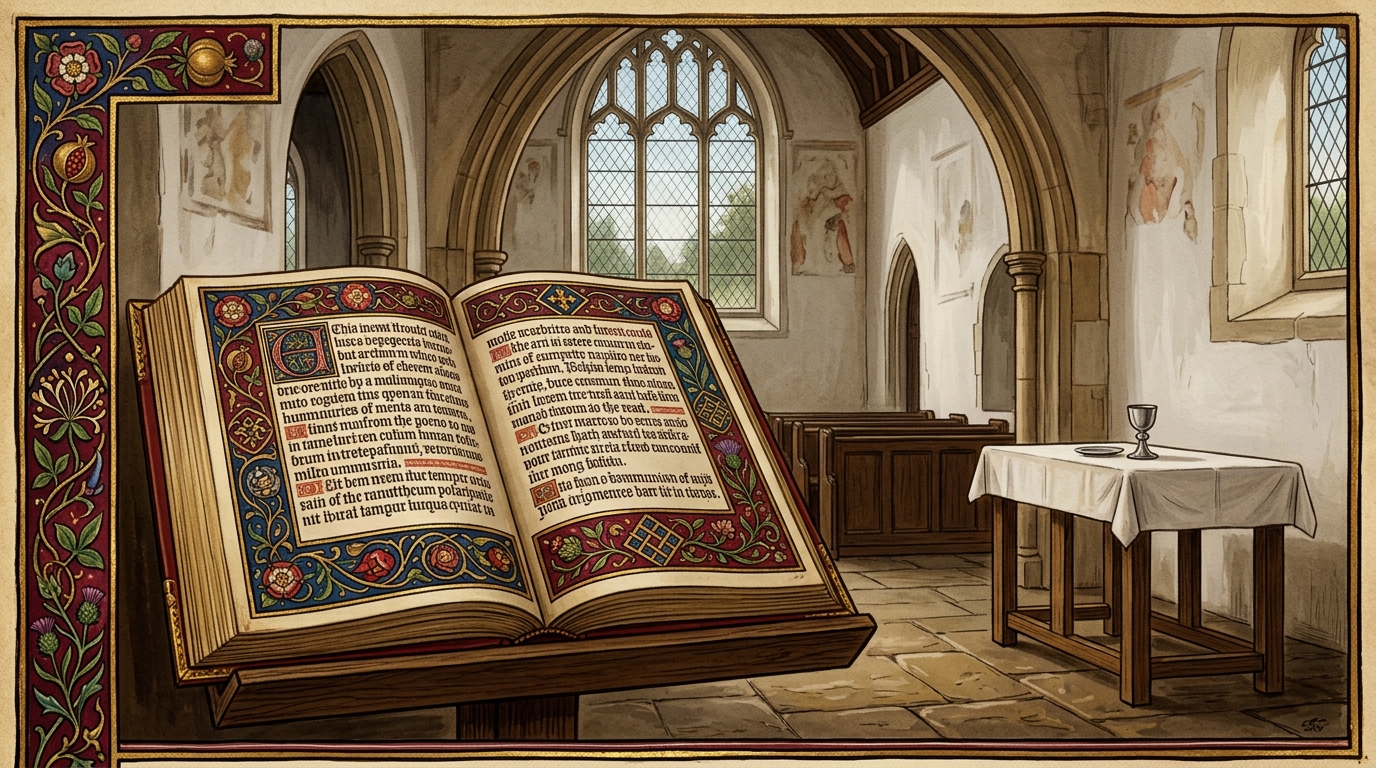
Imagine walking into your local parish church one Sunday morning in June 1549 and finding that everything you have ever known about worship has been swept away overnight. The familiar Latin chants that your grandparents and great-grandparents had heard throughout their lives are gone. The priest now faces the congregation and speaks in plain English. The ancient rituals that had structured the rhythms of birth, marriage, and death for centuries have been stripped back, simplified, or abolished entirely. This was the reality facing ordinary Tudor men and women when the Book of Common Prayer came into force on Whit Sunday, 9th June 1549, one of the most dramatic and consequential moments in English religious history.
The introduction of this single document represents far more than a change in church services. It was nothing less than a revolution in how the English people understood their relationship with God, their monarch, and one another. Under the young King Edward VI, who had come to the throne in 1547 at just nine years of age, Protestant reformers finally had the opportunity they had been waiting for. With the conservative hand of Henry VIII removed, the architects of religious change moved swiftly and decisively to reshape the spiritual landscape of England from the ground up.
In this post, we will explore the origins and significance of the 1549 Book of Common Prayer, examining who created it, why it provoked such fierce resistance, and why its legacy continues to resonate in English culture and religious life to this day. Whether you are a Tudor history enthusiast, a student, or simply curious about how England became a Protestant nation, this story has everything: political intrigue, religious passion, popular rebellion, and some of the most beautiful prose ever written in the English language.
Historical Background: The Making of a Revolutionary Document
To understand why the Book of Common Prayer was so significant, we must first appreciate the extraordinary speed of religious change during Edward VI's reign. Henry VIII had broken with Rome in the 1530s, but his reformation had been largely political rather than theological. He had dissolved the monasteries, rejected papal authority, and declared himself Supreme Head of the Church of England, yet he had kept many traditional Catholic practices in place. The Latin Mass continued, transubstantiation remained official doctrine, and clergy were forbidden to marry. When Henry died in January 1547, England was a country caught awkwardly between the old faith and the new.
Edward VI was a different matter entirely. Raised by Protestant tutors and deeply committed to Reformed theology, the young king was an enthusiastic supporter of the changes his advisors wished to implement. Real power during his minority lay with his uncle Edward Seymour, Duke of Somerset, who served as Lord Protector, and later with John Dudley, Duke of Northumberland. Both men were broadly sympathetic to Protestant reform, and they gave Archbishop of Canterbury Thomas Cranmer the freedom and authority he needed to reshape the English church.
Cranmer was the principal architect of the Book of Common Prayer. A scholar of extraordinary gifts, he had been quietly developing his reforming ideas for years, and now he set about creating a single, unified liturgy for the Church of England. Drawing on a wide range of sources, including Lutheran liturgies from Germany, the ancient Sarum Rite used in Salisbury, and the work of continental reformers such as Martin Bucer, Cranmer produced a document of remarkable theological depth and literary beauty. The first edition was authorised by the Act of Uniformity in January 1549 and came into mandatory use across England that June.
The book was, as Cranmer's original draft demonstrates, a careful piece of theological compromise. It retained enough familiar ceremonial to comfort traditionalists whilst introducing unmistakably Protestant elements. Services were now conducted entirely in English rather than Latin, making them accessible to ordinary worshippers for the first time. The emphasis shifted from the sacrifice of the Mass to a commemorative, communal act of worship. Yet, as the historian Eamon Duffy notes in his landmark study The Stripping of the Altars: Traditional Religion in England 1400-1580 (1992), the book was not welcomed by everyone, and its imposition represented a profound rupture with a living devotional culture that had deep roots in English parish life.
Significance and Impact: A Nation Divided
The immediate impact of the Book of Common Prayer was dramatic and, in some parts of the country, violent. In the summer of 1549, just weeks after the new liturgy came into force, the Prayer Book Rebellion broke out in Devon and Cornwall. Thousands of men took up arms against the religious changes, famously dismissing the new English service as 'a Christmas game' and demanding a return to the Latin Mass. The rebels besieged Exeter and sent petitions to the young king, but their rising was eventually crushed by royal forces, with significant loss of life. The rebellion stands as powerful evidence that, whatever the Protestant reformers believed, the religious changes were far from universally welcomed.
Duffy's research in The Stripping of the Altars has been particularly influential in helping modern readers understand the depth of traditional religious feeling that the reforms disrupted. Rather than portraying pre-Reformation Catholicism as superstitious and corrupt, Duffy demonstrates that it was a rich, participatory, and deeply meaningful system of belief and practice. The parish church, with its images, candles, chantries, and seasonal ceremonies, was the centre of community life. When reformers stripped the altars, removed the images, and replaced Latin with English, they were not simply changing church furniture. They were dismantling a whole way of understanding the world.
Yet the Book of Common Prayer also had profound positive consequences. By establishing a single, standardised liturgy across the country, it began the long process of creating a shared national religious identity. Cranmer's prose, with its rhythmic beauty and clarity, would go on to influence the development of the English language itself. Phrases from the Prayer Book entered everyday speech and have never left it. The book also represented a significant step towards making religion more accessible and democratic, placing the words of scripture and liturgy directly in the hands of ordinary English men and women.
Politically, the imposition of the new prayer book accelerated the radicalisation of religious debate. Those who thought the 1549 book did not go far enough in breaking with Rome pushed for further reform, leading to a revised and much more thoroughly Protestant second edition in 1552. Those who felt the changes had gone too far waited anxiously for an opportunity to reverse them, an opportunity that came with the accession of the Catholic Queen Mary I in 1553, who abolished the Prayer Book and restored the Latin Mass.
Connections and Context: The Wider Tudor World
The story of the Book of Common Prayer cannot be separated from the broader political turbulence of Edward VI's reign. The same year the prayer book came into force, 1549, also saw Kett's Rebellion in Norfolk, a major popular uprising driven primarily by economic grievances related to enclosure of common land. The near-simultaneous eruption of two major rebellions within months of each other placed enormous pressure on Somerset's government and ultimately contributed to his fall from power later that year. England in 1549 was a country under serious strain, and the religious changes were playing out against a backdrop of social and economic anxiety.
It is also worth remembering that England's reformation was happening in an international context. Across Europe, the Protestant and Catholic churches were engaged in a struggle for the future of Christianity. The Council of Trent, which was defining Catholic doctrine in response to the Protestant challenge, was meeting during this very period. In Germany, the Schmalkaldic Wars had recently demonstrated how violently religious disagreements could tear societies apart. Cranmer was in regular correspondence with leading continental reformers, and the Book of Common Prayer was very much part of this wider European conversation about the nature of true Christian worship.
Did you know that Archbishop Cranmer had been secretly married since the 1530s, at a time when clerical celibacy was still officially required in England? His wife, Margaret, had to be kept hidden for years, a remarkable personal situation for the man who would go on to create the Church of England's defining documents of worship and doctrine.
Modern Relevance and Fascinating Details
The Book of Common Prayer has never entirely disappeared. A revised version remains in use in the Church of England today, and Cranmer's language still echoes through Anglican services around the world. For many worshippers, the traditional phrasing of the marriage service, the funeral rites, and the Collect prayers carry an emotional and spiritual weight that no modern translation has quite managed to replicate. As a historical fiction author, I find the Prayer Book an endlessly rich resource, not just as historical background but as a living document that reveals how Tudor people thought about love, mortality, community, and the divine.
Lesser-known details continue to surprise even seasoned Tudor enthusiasts. The 1549 Prayer Book contained a service for the purification of women after childbirth, known as the Churching of Women, a practice with roots stretching back to the Old Testament. It also included prayers for the monarch that made the political theology of the Tudor church explicit: loyalty to the king or queen was presented as a religious duty, intertwined with loyalty to God. This fusion of religious and political authority was central to the Tudor project and shaped English political culture for generations.
In popular culture, the Tudor reformations continue to fascinate. From Hilary Mantel's Wolf Hall trilogy to numerous television dramas and historical novels, the religious upheavals of the sixteenth century provide an inexhaustible source of human drama, moral complexity, and political intrigue. The Book of Common Prayer sits at the heart of this story, a document that changed England forever and whose echoes we can still hear today.
Conclusion: Why This Story Still Matters
The introduction of the Book of Common Prayer in 1549 was one of the defining moments of Tudor England and, by extension, of British history. It represented the point at which Protestant reform moved from being a royal policy imposed from above to something that touched the daily lives of every man, woman, and child in the country. It provoked rebellion, inspired devotion, shaped the English language, and established the foundations of the Church of England as we know it today. The work of Thomas Cranmer, documented in his original draft and analysed so compellingly by Eamon Duffy in The Stripping of the Altars, reminds us that religious change is never merely a matter of theology. It is always, at its core, about people, their identities, their communities, and their deepest beliefs about what gives life meaning.
If this glimpse into the Tudor reformation has sparked your curiosity, there is much more to explore. Consider reading Duffy's The Stripping of the Altars for a richly detailed account of pre-Reformation English religious life, or seek out a facsimile of Cranmer's 1549 Prayer Book to see this extraordinary document in its original form. The world of Edward VI's England is one of the most turbulent, fascinating, and consequential periods in British history, and the Book of Common Prayer is your key to understanding it.