
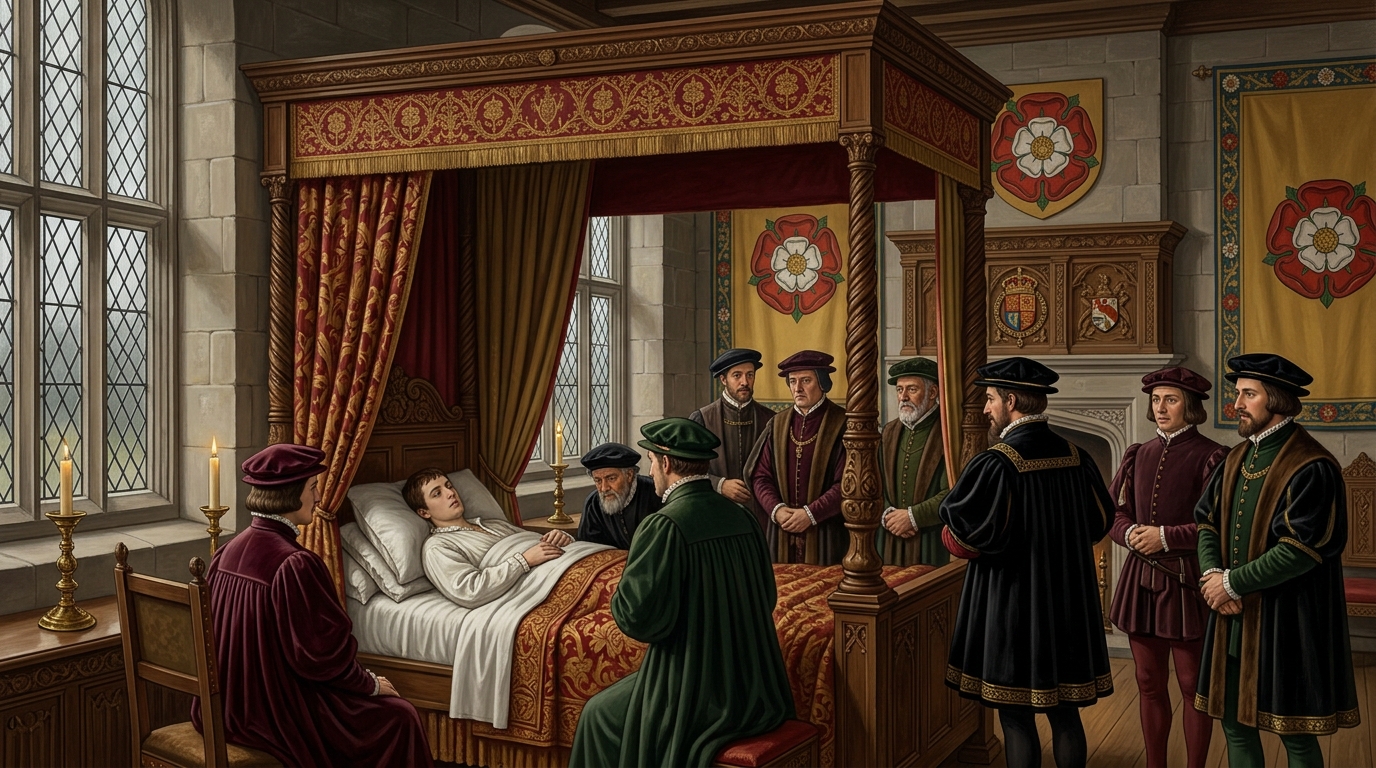
The Boy King’s Final Days: Edward VI and the Succession Crisis of 1553
Imagine a fifteen-year-old king, once full of promise and Protestant zeal, lying gravely ill at Greenwich Palace whilst the most powerful men in England scrambled to control what came next. On 4th June 1553, that was precisely the reality facing the Tudor court. Edward VI, the only legitimate son of Henry VIII, was dying, and everyone at court knew it. What followed would become one of the most dramatic and contested episodes in English history, culminating in the brief, tragic reign of Lady Jane Grey, a young woman who never wanted a crown in the first place.
This blog post explores the circumstances surrounding Edward’s final illness, the political machinations that shaped the succession crisis, and why these turbulent weeks in the summer of 1553 continue to fascinate historians, historical fiction authors, and Tudor enthusiasts alike. Whether you are asking ‘why did Lady Jane Grey become queen?’ or ‘what illness killed Edward VI?’, the answers all lead back to those desperate days at Greenwich.
As a historical fiction author with a deep interest in the Tudor period, I have spent years studying the personalities and power struggles of this extraordinary dynasty. The story of Edward VI’s decline is not simply a tale of illness and intrigue; it is a window into the fragility of power, the dangers of religious reform, and the very human cost of dynastic ambition.
Historical Background: Edward VI and the Crisis at Greenwich Palace
Edward VI was born on 12th October 1537 at Hampton Court Palace, the long-awaited male heir of Henry VIII and his third wife, Jane Seymour. He came to the throne on 28th January 1547 at just nine years of age, making him one of the youngest monarchs ever to rule England. As Jennifer Loach details in her authoritative biography Edward VI: The Young King, Edward was a remarkably intelligent and studious child, deeply committed to the Protestant Reformation that had reshaped England under his father’s reign. Under the protectorates of his uncles Edward Seymour and later John Dudley, Duke of Northumberland, England lurched further towards Protestant reform, dismantling much of what remained of Catholic tradition in English religious life.
By early 1553, however, it was clear that the young king’s health was failing. Edward had long suffered from respiratory complaints, and by the spring of that year, his condition had deteriorated sharply. Historians and medical scholars have debated his precise illness for centuries. The most widely accepted modern view is that Edward suffered from pulmonary tuberculosis, possibly complicated by another infection. Jasper Ridley, in The Tudors, notes that contemporaries described his symptoms in alarming terms, including a persistent cough, fever, and a general wasting of the body that left courtiers in little doubt about the prognosis.
Greenwich Palace, situated on the south bank of the Thames, was a favourite royal residence and the birthplace of both Henry VIII and his daughters Mary and Elizabeth. It was here that Edward spent his final weeks, surrounded by physicians, courtiers, and the ever-present figure of John Dudley, Duke of Northumberland, who had dominated the royal council since 1550. Northumberland understood better than anyone that Edward’s death would, under the existing terms of Henry VIII’s Third Succession Act and the king’s own will, place the staunchly Catholic Princess Mary on the throne, undoing everything the Protestant reformers had worked to achieve.
It was against this backdrop that the extraordinary plan to alter the succession began to take shape. Edward himself, deeply committed to his Protestant faith, was persuaded to draft what became known as the ‘Device for the Succession’, a legal document that sought to bypass both his half-sisters, Mary and Elizabeth, and place the crown on the head of a Protestant heir. The chosen candidate was Lady Jane Grey, the sixteen-year-old great-niece of Henry VIII, who had recently been married to Northumberland’s son, Guildford Dudley. Whether Edward acted entirely of his own volition or was manipulated by Northumberland remains one of the great debates in Tudor historiography.
Significance and Impact: Why June 1553 Changed England Forever
The events of early June 1553 represent a pivotal moment not just in Tudor history but in the broader story of English religious and constitutional development. By this point, the king’s death was a matter of when, not if, and the succession plan was already in motion. The significance of what unfolded cannot be overstated. Had Northumberland’s scheme succeeded, England might have remained a firmly Protestant nation, avoiding the traumatic reversal of the Reformation that would characterise the reign of Mary I.
Instead, as Jasper Ridley observes in The Tudors, the brief reign of Lady Jane Grey, which lasted a mere nine days following Edward’s death on 6th July 1553, ended in abject failure. The English people, whatever their religious sympathies, recognised Mary as the legitimate heir, and her supporters rapidly overwhelmed those backing Jane. Northumberland’s gamble collapsed almost immediately, and the consequences were severe. Jane Grey was imprisoned in the Tower of London, and she would ultimately be executed on 12th February 1554, a victim of her family’s ambition rather than any genuine desire for power on her own part.
The impact on Tudor society was profound. Mary I’s accession marked the beginning of a Catholic restoration that would see the heresy laws reinstated and nearly three hundred Protestants burned at the stake, earning her the enduring and deeply unfair sobriquet ‘Bloody Mary’. The Protestant reforms of Edward’s reign were swiftly dismantled, and England was briefly reconciled with Rome. For ordinary English men and women, these years of rapid religious change created profound uncertainty and suffering, as communities were torn apart by shifting official doctrine.
Did you know? Edward VI is credited with establishing many of England’s grammar schools, some of which still bear his name today. His reign, though brief, had a lasting educational legacy that is often overshadowed by the drama of his death and the succession crisis that followed.
Connections and Context: The Wider Tudor World in 1553
To understand the crisis of June 1553 fully, it is essential to see it within the broader context of mid-Tudor politics and the European Reformation. England in the early 1550s was a nation still adjusting to the seismic changes of the previous two decades. The dissolution of the monasteries, the break with Rome, and the introduction of the Book of Common Prayer had all transformed English religious and social life within living memory. Many people, particularly in the more conservative north and west of the country, remained deeply attached to Catholic practice, whilst a committed Protestant minority, concentrated largely in London and the south-east, pushed for ever more radical reform.
On the wider European stage, the struggle between Protestantism and Catholicism was playing out with even greater violence. The Holy Roman Emperor Charles V was locked in conflict with Protestant princes in Germany, and the fate of England’s Reformation was watched with intense interest by rulers across the continent. Mary I’s subsequent marriage to Philip II of Spain, Charles’s son, would draw England uncomfortably close to the heart of Catholic Europe, further inflaming Protestant anxieties.
It is also worth noting that Princess Elizabeth, Edward’s younger half-sister and the future Elizabeth I, navigated these dangerous months with characteristic caution. She carefully avoided any association with Northumberland’s scheme, positioning herself as a loyal subject whilst awaiting her moment. Her survival through the reign of Mary I, despite repeated suspicion and a period of imprisonment in the Tower, stands as a testament to her extraordinary political instincts. The seeds of Elizabethan England were sown in these fraught, dangerous years of mid-Tudor uncertainty.
Modern Relevance and Fascinating Details
Why does the story of Edward VI’s final illness continue to captivate us more than four and a half centuries later? Part of the answer lies in its sheer human drama. Here was a brilliant, idealistic young man, robbed of the chance to shape the kingdom he cared so deeply about, surrounded by adults who were using his dying wishes to serve their own interests. Jennifer Loach’s biography Edward VI: The Young King is particularly sensitive in its portrayal of Edward as a genuinely complex individual, not merely a pawn in Northumberland’s game but a young man with real convictions and real grief at his own situation.
The story of Lady Jane Grey has inspired countless works of historical fiction, and as someone who writes in this genre, I find her story almost unbearably poignant. She was, by all contemporary accounts, a young woman of exceptional learning and sincere Protestant faith who was thrust into an impossible position by the ambitions of others. Her famous reported comment, upon being offered the crown, that it did not belong to her, speaks to a clarity of judgement that the adults around her conspicuously lacked.
Did you know? The famous portrait long believed to depict Lady Jane Grey, showing a young woman in Tudor dress, was reattributed by the National Portrait Gallery in 2006. The sitter is now thought to be Catherine Parr, Henry VIII’s sixth wife. The true face of Jane Grey remains, fittingly, something of a mystery.
In popular culture, the Tudor succession crisis of 1553 has been depicted in numerous television dramas, novels, and films. The 1986 film Lady Jane, starring Helena Bonham Carter, brought the story to a new generation, albeit with considerable dramatic licence. More recently, authors such as Hilary Mantel and Alison Weir have explored adjacent corners of the Tudor world, keeping public appetite for this period very much alive.
Conclusion: A Kingdom Held in the Balance
The events of 4th June 1553 and the weeks surrounding them remind us that history is rarely made by grand forces alone. It is shaped by individuals, by illness and ambition, by faith and fear, and by the desperate calculations of men and women trying to survive in extraordinarily dangerous times. Edward VI’s declining health at Greenwich Palace set in motion a chain of events that would determine the religious character of England for generations to come, touch the lives of millions of ordinary people, and send Lady Jane Grey to her death before her seventeenth birthday.
If you would like to explore this period further, Jennifer Loach’s Edward VI: The Young King remains the essential scholarly biography, whilst Jasper Ridley’s The Tudors provides an excellent broader context. The mid-Tudor period, so often overshadowed by the reigns of Henry VIII and Elizabeth I, rewards closer examination with some of the most gripping and consequential stories in English history. I would encourage you to dive in, ask questions, and never stop being curious about the extraordinary world of the Tudors.