
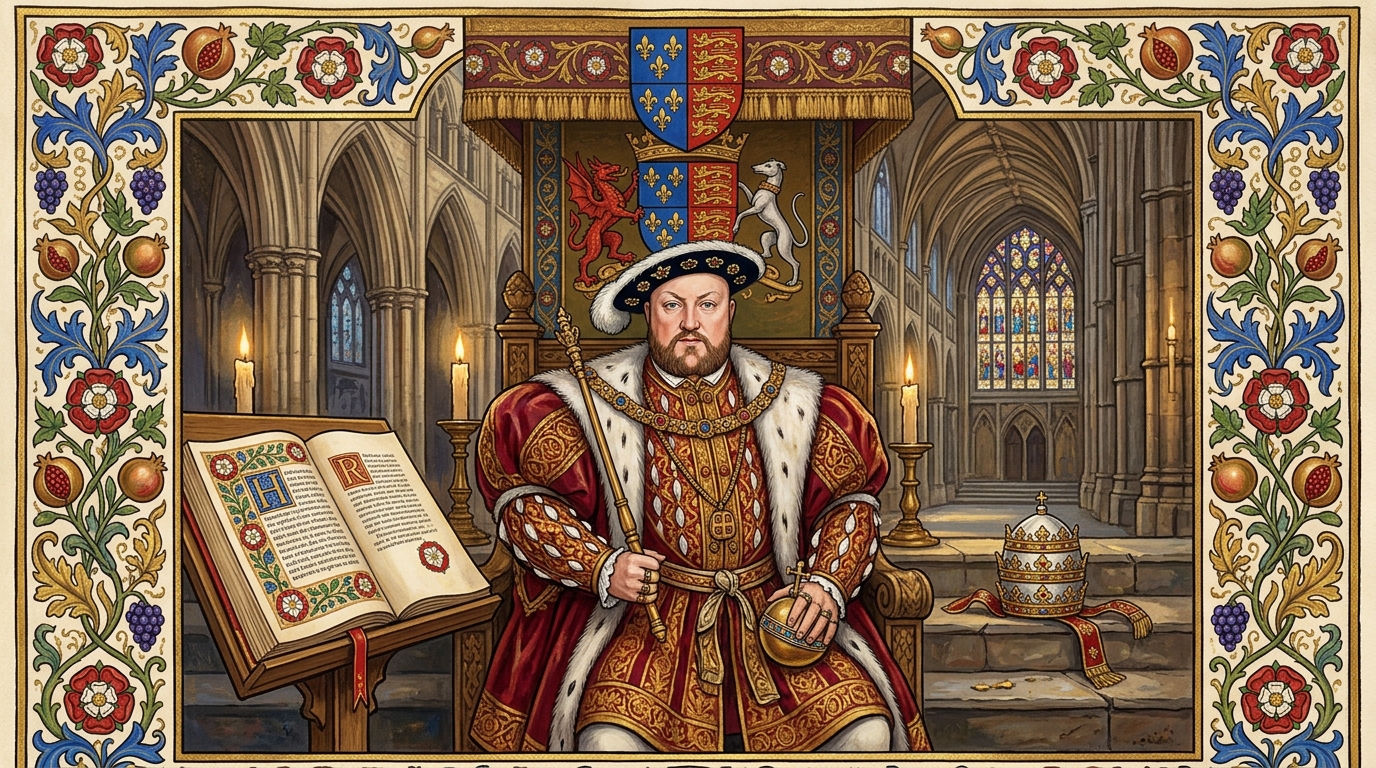
How Henry VIII’s Desire for Divorce Shattered Christendom: The English Reformation of 1534
Few moments in history have been shaped so dramatically by one man’s personal desires colliding with the immense weight of institutional power. When Henry VIII broke with the Roman Catholic Church in 1534, he did not merely sign a piece of legislation. He cracked the very foundations of Western Christendom, rewrote the spiritual landscape of England, and set in motion consequences that would echo for centuries. As a historical fiction author who has spent years immersed in the Tudor period, I find this moment endlessly fascinating precisely because it sits at that electric intersection of the deeply personal and the profoundly political.
The story of the English Reformation is, at its heart, a story about power: who holds it, who wants it, and what people are willing to destroy to obtain it. Henry VIII’s break with Rome was not a carefully considered theological journey. It was a calculated act of political will, driven by his desperate need to annul his marriage to Catherine of Aragon and secure a male heir for the Tudor dynasty. Yet the consequences of that act transformed England’s religion, culture, and national identity in ways that Henry himself could scarcely have imagined.
In this post, we will explore exactly why Henry VIII broke with Rome, who was involved in making it happen, what the Act of Supremacy of 1534 actually meant in practice, and why this moment continues to captivate historians, novelists, and readers alike. Whether you are encountering this story for the first time or returning to deepen your understanding, there is always something new to discover in the extraordinary drama of Tudor England.
Historical Background: The Marriage, the Pope, and the Break
To understand why Henry VIII broke with Rome, we must begin with Catherine of Aragon. Henry had married Catherine in 1509, and for nearly two decades she had been his queen. The problem, in Henry’s eyes, was one of succession. Catherine had failed to produce a surviving male heir, and by the late 1520s, Henry had convinced himself that their marriage was cursed, citing a passage from the Book of Leviticus which suggested it was unlawful to marry a brother’s widow. Catherine had previously been married to Henry’s elder brother, Arthur, who died in 1502.
Henry sought an annulment from Pope Clement VII, arguing that the original papal dispensation permitting his marriage to Catherine had been invalid. However, Clement VII was in an extraordinarily difficult position. Catherine of Aragon was the aunt of Holy Roman Emperor Charles V, whose troops had sacked Rome in 1527 and effectively held the Pope as a political prisoner. Granting Henry his annulment was simply not something Clement could safely do, regardless of the theological arguments presented. The case dragged on for years, becoming known as the King’s Great Matter, and Henry’s frustration grew to a fury.
It was Thomas Cromwell, Henry’s brilliant and ruthless chief minister, who provided the solution. Working alongside the reformist Archbishop of Canterbury, Thomas Cranmer, Cromwell constructed a legal and theological framework that would place the English Church under royal authority rather than papal jurisdiction. The result was the Act of Supremacy, passed by Parliament in 1534, which declared Henry VIII to be the only Supreme Head in Earth of the Church of England. This was not a declaration made in a vacuum. It was the culmination of years of parliamentary legislation, carefully orchestrated by Cromwell, that systematically dismantled papal authority in England piece by piece.
Diarmaid MacCulloch, writing in Tudor Church Militant (Oxford University Press, 1999), emphasises the degree to which the Reformation under Henry was driven by political necessity rather than genuine Protestant conviction. Henry VIII was, in many respects, theologically conservative. He had even been awarded the title Defender of the Faith by Pope Leo X in 1521 for writing a treatise against Martin Luther. The irony of a man who attacked Lutheranism becoming the architect of England’s break with Rome is one of history’s more delicious contradictions.
Significance and Impact: What the Break With Rome Actually Meant
The immediate practical consequence of the Act of Supremacy was that Henry VIII could now have his marriage to Catherine of Aragon annulled by Thomas Cranmer, acting as Archbishop of Canterbury under royal authority rather than papal oversight. Cranmer duly pronounced the marriage void in May 1533, and Henry’s secret marriage to Anne Boleyn, which had taken place earlier that year, was declared valid. Anne was crowned queen, and in September 1533 she gave birth to a daughter who would one day become Elizabeth I.
Beyond the personal, however, the break with Rome had seismic consequences for Tudor society. Those who refused to acknowledge Henry as Supreme Head of the Church faced charges of treason. The most famous victims of this policy were Sir Thomas More, Henry’s former Lord Chancellor and a man of immense personal integrity, and Bishop John Fisher of Rochester. Both were executed in 1535 for refusing to take the Oath of Supremacy. Their deaths sent a chilling message about the price of conscience in the new religious order.
The dissolution of the monasteries, which followed between 1536 and 1541, was another dramatic consequence of the break with Rome. Cromwell oversaw the closure of hundreds of monastic houses across England, transferring their considerable wealth to the Crown. MacCulloch notes that this redistribution of monastic lands reshaped the social and economic landscape of England, creating a new class of landowners whose wealth was bound up with the Reformation settlement and who therefore had a powerful personal interest in ensuring it was never reversed. The physical landscape changed too: the ruins of abbeys and priories that still dot the English countryside are among the most visible legacies of Henry’s break with Rome.
Culturally, the Reformation introduced the English Bible into parish churches. In 1538, Cromwell ordered that a copy of the Bible in English be placed in every church in the land. For ordinary people, hearing scripture in their own language was a revolutionary experience, and it began a slow but irreversible transformation in how English people related to their faith.
Connections and Context: The Wider World of Tudor England
It is important to place Henry’s break with Rome within its broader European context. The 1530s were a period of intense religious upheaval across the continent. Martin Luther had nailed his Ninety-Five Theses to the church door at Wittenberg in 1517, and the Protestant Reformation was spreading rapidly through Germany and Switzerland. John Calvin was beginning to develop the theological system that would bear his name. The Catholic Church itself was moving towards the Counter-Reformation and the Council of Trent. England’s break with Rome was therefore not an isolated event but part of a continent-wide crisis in religious authority.
Closer to home, the English Reformation set the stage for the extraordinary religious volatility of the mid-Tudor period. After Henry’s death in 1547, his son Edward VI pursued a more aggressively Protestant programme. Mary I then attempted to restore Catholicism, earning the sobriquet Bloody Mary for her persecution of Protestants. It was only under Elizabeth I that a more stable, if always contested, Protestant settlement was achieved. The groundwork for all of this drama was laid by Henry’s break with Rome in 1534.
Did you know? Thomas Cranmer, the Archbishop of Canterbury who annulled Henry’s marriage to Catherine and helped shape the English Reformation, was ultimately burned at the stake for heresy under Mary I in 1556. His execution took place in Oxford, and he famously thrust his right hand into the flames first, as it had signed a recantation of his Protestant beliefs that he later withdrew.
Modern Relevance and Fascinating Details
The Church of England, which traces its origins directly to Henry VIII’s Act of Supremacy, remains the established church of England today, with the reigning monarch serving as its Supreme Governor. The title has changed slightly over the centuries, but the fundamental principle established in 1534 endures. When one considers that this constitutional arrangement began as a solution to a royal divorce, the pragmatic, almost accidental quality of English religious identity becomes clearer.
The story of Henry VIII and the break with Rome has proven irresistible to novelists, playwrights, and filmmakers. Hilary Mantel’s Wolf Hall trilogy, which centres on Thomas Cromwell, brought this period to an entirely new generation of readers and viewers, winning the Booker Prize twice in the process. As a historical fiction author myself, I am endlessly drawn to the moral complexity of figures like Cromwell, More, and Cranmer, each of whom navigated impossible choices under a king whose favour was as dangerous as his anger. The period offers an almost unparalleled richness of character, conflict, and consequence.
Did you know? The famous phrase Defender of the Faith, abbreviated as Fid. Def. or F.D. on British coins, was originally a papal title granted to Henry VIII. Even after he broke with Rome and was excommunicated, Henry retained the title through an act of Parliament. British monarchs have used it ever since, which means the very coins in your pocket carry a title awarded to the man who defied the papacy.
Conclusion: A Divorce That Changed the World
Henry VIII’s break with Rome in 1534 began as a personal crisis and became a national transformation. The Act of Supremacy, born of a king’s frustrated desire for a male heir and his rage at papal intransigence, reshaped the religious, political, cultural, and social fabric of England in ways that are still visible today. From the ruins of dissolved monasteries to the Church of England itself, from the English Bible in every parish church to the constitutional position of the monarch as head of a national church, the fingerprints of 1534 are everywhere.
If this introduction to one of history’s most consequential ruptures has whetted your appetite, I encourage you to explore further. Diarmaid MacCulloch’s Tudor Church Militant is an excellent scholarly starting point, while the primary source of the Act of Supremacy itself remains startling in its directness and ambition. The Tudor period rewards every curious reader who ventures into it, and the story of Henry’s break with Rome is as good a place as any to begin that journey.