The Royal Wedding That Changed British History Forever
Imagine a thirteen-year-old girl, a princess of England, travelling north through the autumn mists to marry a king she had never met, in a country she had never visited. The year was 1503, and that young woman was Margaret Tudor, eldest daughter of Henry VII and elder sister of the future Henry VIII. Her marriage to King James IV of Scotland was arranged as a diplomatic transaction, a piece of political theatre designed to bring peace between two perpetually quarrelling kingdoms. Yet what unfolded from this carefully choreographed union would ripple through the centuries in ways that no one at the time could possibly have anticipated.
Nearly a hundred years after Margaret rode northwards to her Scottish destiny, her great-grandson James VI of Scotland would ride southwards to claim the English throne as James I of England, uniting the two crowns in a single remarkable stroke of dynastic fortune. The union of 1503 planted a seed that would eventually grow into the United Kingdom as we know it today. Understanding Margaret Tudor's story means understanding one of the most consequential royal marriages in British history.
In this post, we will explore who Margaret Tudor was, why her marriage to James IV mattered so profoundly, how it connected to the broader sweep of Tudor politics, and why this story continues to fascinate historians, novelists, and anyone curious about how a single wedding can alter the fate of nations.
Historical Background: A Princess Sent North
Who was Margaret Tudor? Born on 28th November 1489 at Westminster Palace, Margaret was the second child of King Henry VII and his queen, Elizabeth of York. She grew up in the glittering but politically charged world of the early Tudor court, acutely aware that royal daughters were valuable diplomatic currency. Her father, a shrewd and cautious king who had won his throne at the Battle of Bosworth in 1485, understood better than most that well-arranged marriages could accomplish what armies could not.
King James IV of Scotland was, by contrast, already an experienced monarch and man of the world when negotiations for the match began. Born in 1473, he had ruled Scotland since 1488 and was renowned across Europe as one of the most cultured and chivalrous kings of his age. As Rosalind K. Marshall notes in Scottish Queens, 1034-1714, James was a genuinely remarkable figure: multilingual, deeply interested in medicine and science, and possessed of considerable personal charm. He was also, by the time of his marriage, approximately thirty years old to Margaret's thirteen, an age gap that was entirely unremarkable by the standards of the period.
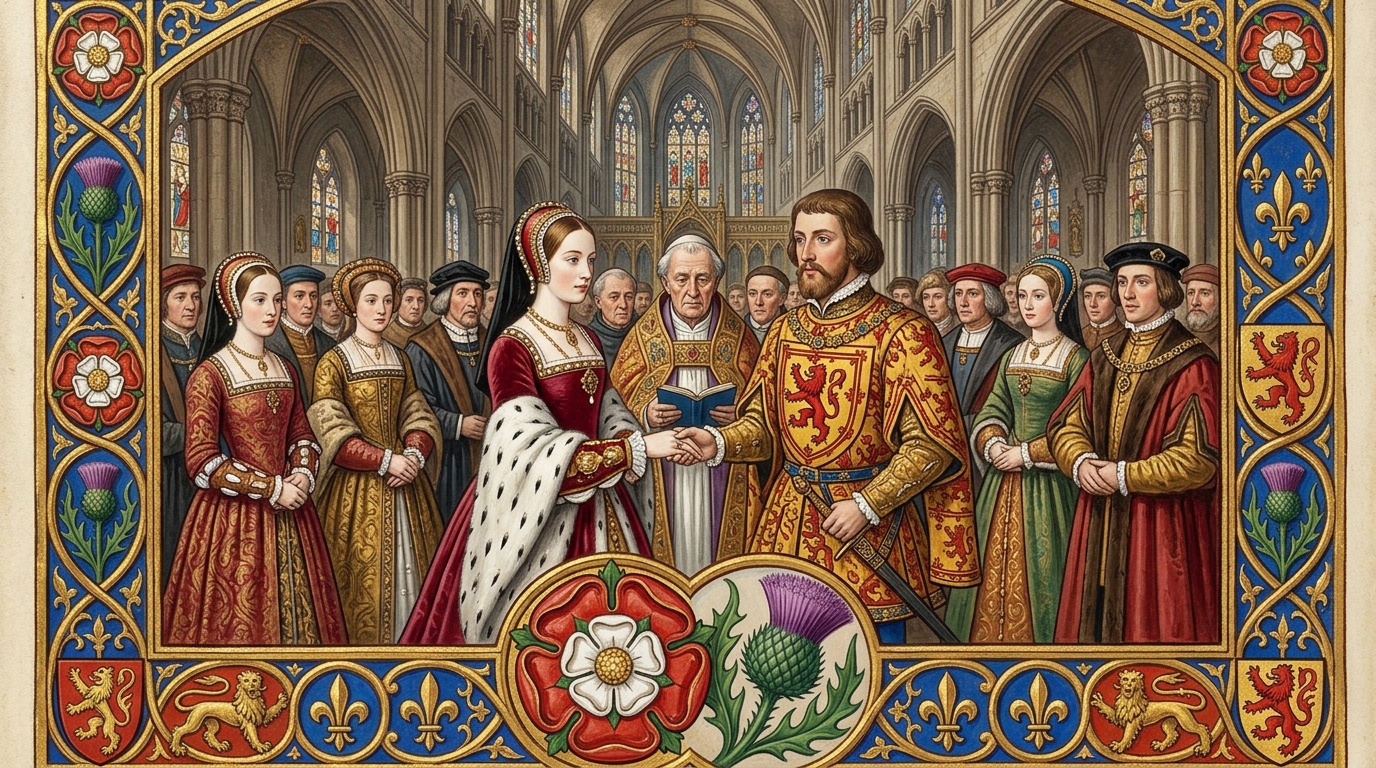
The marriage negotiations were formalised in the Treaty of Perpetual Peace, signed in 1502, which aimed to end the long cycle of Anglo-Scottish conflict. On 8th August 1503, Margaret and James were married at the Palace of Holyroodhouse in Edinburgh in a ceremony of considerable magnificence. The poet William Dunbar composed his celebrated allegory The Thrissill and the Rois (The Thistle and the Rose) to celebrate the occasion, a poem that remains one of the most elegant tributes to a royal wedding in Scottish literary history.
The journey north itself was an extraordinary affair. Margaret travelled with a large retinue, and contemporary accounts describe the pageantry and festivities that greeted her at each stopping point along the way. Jenny Wormald, in her authoritative study Court, Kirk, and Community: Scotland 1470-1625, places this marriage within the broader context of Scottish political culture, emphasising how significant it was for the Scottish court to welcome an English princess of such direct royal lineage. For Henry VII, sending his daughter north was both a calculated risk and a statement of confidence in the durability of the peace.
Significance and Impact: The Thistle and the Rose Intertwined
Why does the marriage of Margaret Tudor and James IV matter so much? On the most immediate level, it created a formal alliance between England and Scotland at a moment when both kingdoms needed stability. Henry VII had spent his reign consolidating a dynasty that had been anything but secure, and peace on his northern border freed him to pursue commercial and diplomatic ambitions elsewhere in Europe. For James IV, the English alliance brought prestige and the possibility of a more settled relationship with his powerful southern neighbour.
Yet the deeper significance lies in what came after. Margaret and James had a son, James V of Scotland, who in turn had a daughter, Mary Queen of Scots. Mary's son, born in 1566 at Edinburgh Castle, was James VI of Scotland. When Queen Elizabeth I of England died childless in March 1603, it was this great-great-grandson of Henry VII through the Scottish line who inherited her throne. The Union of the Crowns in 1603 was the direct dynastic consequence of that wedding at Holyroodhouse a century earlier.
The irony is considerable. Henry VII had famously worried aloud about what might happen if the English crown should one day pass to a Scottish ruler through his daughter's line. According to later tradition, he consoled himself with the thought that in such a scenario, the greater realm would absorb the lesser, and England would effectively gain Scotland rather than lose itself to it. Whatever one makes of that somewhat self-satisfied reasoning, he was not entirely wrong: when James VI became James I of England, it was the Scottish king who moved his court to London, not the other way around.
Margaret's own life after the marriage was turbulent in ways that the celebrations of 1503 gave no hint of. She was widowed at just twenty-three when James IV was killed at the Battle of Flodden in September 1513, a catastrophic Scottish defeat against English forces. She subsequently made two further marriages, both controversial, and spent much of her later life navigating the treacherous political currents of Scottish regency politics. Marshall's account of her life underscores what a genuinely formidable and determined woman she was, far more than a passive pawn in the games of kings.
Connections and Context: A Tudor World in Motion
Margaret's marriage must be understood within the extraordinary decade that produced it. In 1503, her younger brother Henry was still a prince, twelve years old and destined for the Church before the death of his elder brother Arthur changed everything. The world that would become synonymous with the name Tudor, the world of the Reformation, of Thomas Cromwell and Thomas More, of the six wives and the break with Rome, lay entirely in the future.
It is also worth noting that 1503 was the year of another significant Tudor marriage: Margaret's younger sister Mary Tudor would later marry Louis XII of France in 1514, continuing Henry VII's strategy of using his children as diplomatic instruments across Europe. The Tudor dynasty was, in this sense, conducting a sustained foreign policy through the altar as much as through the battlefield. Wormald's contextualisation of Scottish political life in this period reminds us that the Scottish court was itself deeply embedded in European networks, particularly through the Auld Alliance with France, which made James IV's choice of an English bride a genuinely significant diplomatic pivot.
The Treaty of Perpetual Peace, for all its grand title, did not in fact prevent conflict. Flodden followed barely a decade later, and Anglo-Scottish relations remained fraught throughout the sixteenth century. Yet the dynastic connection established by Margaret's marriage proved more durable than any treaty. Bloodlines outlasted battlefields.
Modern Relevance and Fascinating Details
Did you know that the poem written to celebrate Margaret's wedding, Dunbar's The Thrissill and the Rois, is still read and studied today as one of the finest examples of late medieval Scottish poetry? The thistle and the rose as symbols of Scotland and England, intertwined through the union of 1503, remain part of British heraldic imagery to this day. You can find both on the Royal Coat of Arms of the United Kingdom.
For those interested in historical fiction, Margaret Tudor has attracted considerable attention from novelists drawn to her remarkable and often painful story. As someone who writes historical fiction set in the Tudor period, I find Margaret endlessly compelling precisely because she occupies such an ambiguous position: she is simultaneously a central figure in the dynastic story of Britain and a woman whose personal life was marked by loss, conflict, and extraordinary resilience. She was queen of a country very different from the one she had grown up in, and she adapted, strategised, and survived in ways that deserve far more popular recognition than she typically receives.
In terms of contemporary relevance, the question of Scottish independence and its relationship to English political decisions has never been more alive. The story of how two kingdoms came to share a monarch, beginning with a teenage girl's journey north in 1503, offers a genuinely useful historical lens through which to consider questions of union, identity, and sovereignty that remain deeply contested today. History rarely repeats itself exactly, but it does, as the saying goes, rhyme.
Conclusion: A Wedding Worth Remembering
The marriage of Margaret Tudor and James IV of Scotland in 1503 is one of those historical moments that looks modest in its immediate context but proves transformative in retrospect. A peace treaty, a diplomatic arrangement, a young princess sent to a foreign court: these are the bare bones. The flesh on those bones is a story of dynastic ambition, personal courage, and the extraordinary capacity of a single union to reshape the political landscape of an entire island over the course of a century.
If you would like to explore further, the works of Rosalind K. Marshall and Jenny Wormald cited throughout this post are excellent starting points for anyone wishing to understand both Margaret's life and the broader world of sixteenth-century Scotland. And if the idea of experiencing this history through the medium of fiction appeals to you, Margaret Tudor's story rewards imaginative engagement as richly as any in the Tudor era. She was, in every sense, the woman who made Britain.