
The Birth of London’s Theatre Scene: How the 1570s Changed English Drama Forever
Imagine London in 1576. The streets are alive with noise, commerce, and spectacle, yet there is no permanent home for the players who entertain the city’s residents. Actors perform in inn yards, at court, and in the halls of the wealthy, their art dependent on borrowed spaces and the goodwill of landlords. Then, almost overnight, everything changes. A carpenter turned entrepreneur named James Burbage erects a remarkable timber structure in Shoreditch, and with that single act of ambition, he transforms English theatrical history forever.
The opening of The Theatre in 1576, followed swiftly by its neighbour The Curtain in 1577, marks one of the most significant cultural turning points of the Elizabethan Age. These were not simply new buildings. They were a declaration that drama had found its permanent home in London, and that the city would become the undisputed centre of English theatrical life for generations to come. As Andrew Gurr explores in The Shakespearean Playing Companies, the establishment of these playhouses fundamentally reshaped the relationship between performers, audiences, and the civic authorities who regarded popular entertainment with deep suspicion.
In this post, we will explore who built these extraordinary venues, why they appeared when they did, what forces they unleashed upon Tudor society, and why their legacy still resonates with anyone who loves theatre, history, or the turbulent world of Elizabethan England. Whether you are a student of Tudor history, a lover of historical fiction, or simply someone curious about how modern entertainment culture began, the story of London’s first playhouses is one you will not want to miss.
Historical Background: James Burbage and the Birth of Purpose-Built Theatre
To understand why the 1570s proved so pivotal, we need to appreciate the theatrical landscape that preceded The Theatre. Before 1576, playing companies performed wherever they could find space. Inn yards such as The Bell and The Cross Keys in the City of London offered natural performance spaces, with galleries above providing views for wealthier patrons and an open yard for the standing crowd. These arrangements were profitable enough, but they were precarious. The City of London’s authorities, largely Puritan in sympathy, were hostile to organised public performances, citing concerns about plague, disorder, and moral corruption.
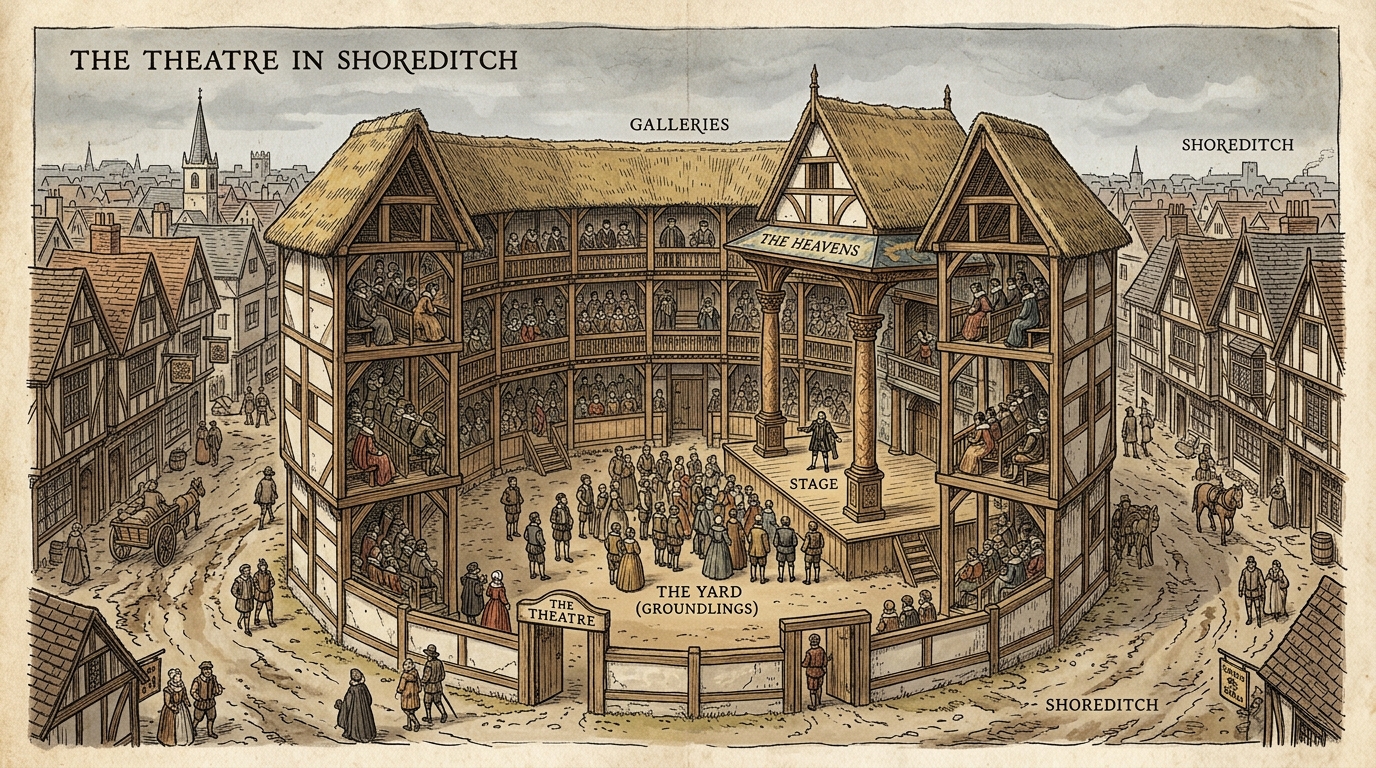
James Burbage was a joiner by trade but a visionary by temperament. As a leading member of the Earl of Leicester’s Men, one of the most prominent playing companies of the period, he understood better than most what a purpose-built venue could offer. In 1576, he leased land in Shoreditch, just outside the City’s jurisdiction and therefore beyond the reach of its censorious aldermen, and constructed The Theatre. The name itself was a bold statement, drawn directly from the classical Latin theatrum, signalling Burbage’s ambition to connect his enterprise with the prestige of ancient drama.
The Curtain followed in 1577, built nearby by Henry Lanman, and for a time the two venues operated in a cooperative arrangement that allowed playing companies to use both spaces. As Gurr’s scholarship makes clear, these early playhouses were not merely venues but complex commercial enterprises, with sharers, hired men, and boy players all operating within carefully structured hierarchies. The buildings themselves were substantial timber and plaster structures, circular or polygonal in form, capable of holding audiences of perhaps two to three thousand people across their galleries and yard spaces.
It is worth noting the precise geography of this theatrical revolution. Shoreditch, in the parish of St Leonard’s, sat just north of the City walls in the liberty of Holywell. This location was deliberate and strategic. Beyond the City’s legal authority but close enough for Londoners to walk to easily, it represented a kind of cultural no man’s land where the new entertainment industry could flourish without constant interference. The south bank of the Thames, which would later house the Globe and the Rose, was still some years away from becoming London’s other great theatrical district.
Significance and Impact: Why These Playhouses Transformed Tudor Culture
The consequences of Burbage’s venture extended far beyond bricks and timber. By creating a permanent, purpose-built space for drama, The Theatre and The Curtain fundamentally altered the economics of theatrical production. Playing companies could now plan seasons in advance, invest in costumes and properties, and develop a loyal audience base. This stability encouraged playwrights to produce work of greater ambition and complexity, knowing that a regular venue and a professional company would be available to perform it.
Tanya Pollard’s research in Drugs and Theater in Early Modern England illuminates another fascinating dimension of this transformation. The theatrical experience in Elizabethan London was deeply sensory and communal, involving not just sight and sound but the physical atmosphere of crowded bodies, the smells of the city, and even the consumption of food, drink, and tobacco within the playhouse itself. The purpose-built venue made these experiences more intense and more regulable, creating a defined social space in which the act of watching drama became a distinct cultural practice rather than simply a diversion annexed to some other activity.
For Tudor society more broadly, the playhouses represented both opportunity and anxiety. The civic authorities of London fought a sustained battle against the theatres throughout the Elizabethan period, issuing orders to restrict performances, close venues during outbreaks of plague, and limit the number of playing days each week. Yet the popularity of the playhouses was such that these restrictions were only partially effective. Thousands of Londoners from every social rank, from apprentices and servants to merchants and nobles, attended performances regularly, and the drama they watched engaged directly with the political, religious, and social questions of the age.
Perhaps most significantly, the permanent playhouses created the conditions in which William Shakespeare could develop his craft. Shakespeare arrived in London in the late 1580s, by which point The Theatre and The Curtain had already established the commercial and artistic infrastructure that would support his career. Without the stability that Burbage’s vision had introduced, the explosion of dramatic talent that defines the Elizabethan and Jacobean stage might simply never have occurred.
Connections and Context: The Wider Elizabethan World
The emergence of London’s first playhouses did not occur in isolation. The 1570s were a decade of intense religious and political tension in England. Elizabeth I had been on the throne since 1558 and was navigating the complex aftermath of the Reformation, the threat of Catholic conspiracy, and the growing ambitions of Protestant nonconformists. Drama, with its capacity to comment obliquely on power, religion, and society, was regarded by the authorities as potentially seditious, which explains much of the hostility directed at the new playhouses.
At the same time, Elizabeth’s court actively patronised theatrical performance. The Queen herself enjoyed dramatic entertainment, and the system of noble patronage that required playing companies to hold a licence from a great lord provided them with a degree of protection against civic interference. The Earl of Leicester’s Men, the company associated with Burbage, benefited directly from the favour of Robert Dudley, Earl of Leicester, who was himself closely connected to the Queen. This tension between royal approval and civic disapproval would define the theatrical world throughout the Elizabethan period.
It is also worth connecting the theatrical revolution of the 1570s to broader shifts in English culture. The grammar school education that was expanding across Tudor England produced a generation of writers who could draw on classical models while addressing contemporary English experience. The printing press had created a reading public hungry for entertainment and information. London itself was growing rapidly, its population swelling with migrants from across England and beyond, creating the mass audience that commercial theatre required. The playhouses did not create these conditions, but they channelled them into one of the most extraordinary cultural flowerings in European history.
Modern Relevance and Fascinating Details
Did you know that The Theatre itself was literally dismantled and transported across London when Burbage’s lease expired? In the winter of 1598 to 1599, the Burbage family, led by James’s son Richard, took apart the timber frame of The Theatre and carried it south across the Thames to Bankside, where it was used to construct the Globe Theatre. This extraordinary act of theatrical recycling means that the most famous playhouse in history was built, at least in part, from the bones of the very first purpose-built venue.
As a historical fiction author, I find the social world of these early playhouses endlessly compelling. The playhouse was one of the few spaces in Tudor London where different social ranks genuinely mixed, where a nobleman in a gallery box might watch the same performance as an apprentice standing in the yard below. The drama itself frequently reflected this social complexity, with characters moving between worlds and speaking truths that the rigid hierarchies of everyday life would never permit. For anyone writing historical fiction set in Elizabethan England, the playhouse is not merely a setting but a mirror of the entire society.
The legacy of these first playhouses continues to shape our cultural landscape today. The modern reconstruction of the Globe Theatre on Bankside, which opened in 1997, draws hundreds of thousands of visitors each year and performs Shakespeare’s plays in conditions close to those that Elizabethan audiences would have recognised. The open-air performance space, the standing groundlings, the intimate relationship between actors and audience: all of these features can be traced directly back to the design principles established in Shoreditch in 1576. Every time a modern audience stands in the yard of the Globe, they are, in a very real sense, stepping into a space that James Burbage first imagined nearly four and a half centuries ago.
Conclusion: A Revolution Built in Timber and Ambition
The construction of The Theatre in 1576 and The Curtain in 1577 was far more than a local development in London’s entertainment industry. It was the founding moment of a theatrical tradition that would produce Shakespeare, Marlowe, Jonson, and Webster, and that would shape English drama for centuries to come. As Andrew Gurr’s scholarship demonstrates, these venues created the professional infrastructure that made great drama possible, while Tanya Pollard’s work reminds us that the theatrical experience they offered was rich, sensory, and deeply embedded in the social life of Tudor London.
If you are keen to explore this fascinating period further, I would encourage you to seek out Gurr’s The Shakespearean Playing Companies for a detailed account of the commercial and artistic structures of Elizabethan theatre. You might also visit the reconstructed Globe on Bankside, where the story that began in Shoreditch in 1576 continues to unfold each summer. The first playhouses may be long gone, but the tradition they established is very much alive, and understanding their origins is the key to understanding everything that followed.