
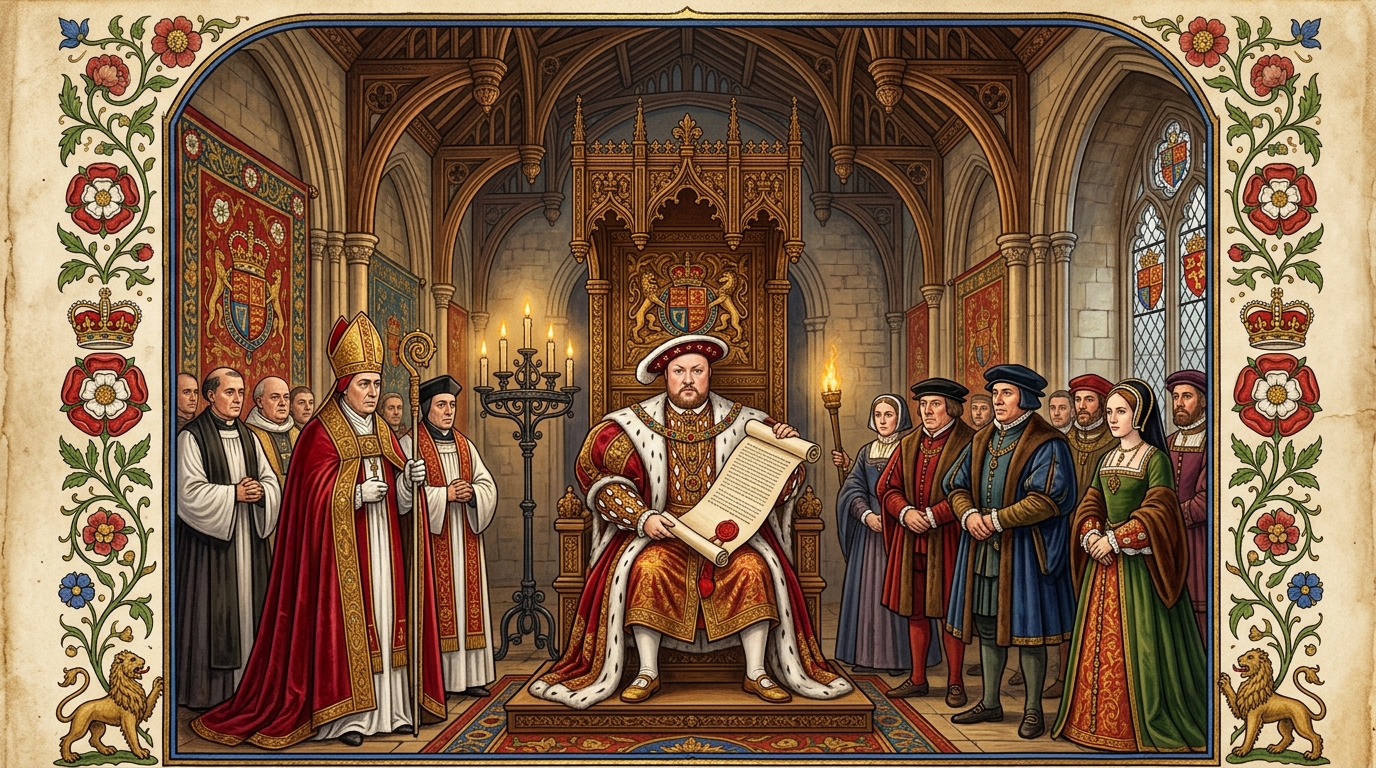
How Henry VIII Changed England Forever: The Act of Supremacy 1534
Imagine a king so determined to end his marriage that he tore apart the religious fabric of an entire nation. In 1534, Henry VIII did exactly that, reshaping England’s relationship with Rome in ways that continue to echo through British history, politics, and culture to this very day. The Act of Supremacy was not, as many assume, a grand theological statement or a principled stand against papal corruption. It was, at its heart, a personal crisis transformed into constitutional revolution.
As a historical fiction author who has spent years immersed in Tudor court life, I find the English Reformation endlessly fascinating precisely because of this human contradiction at its centre. A king who considered himself a devoted Catholic, who had once earned the title Fidei Defensor (Defender of the Faith) from Pope Leo X for his writings against Martin Luther, became the very man who severed England from Rome. The story of how and why that happened is one of the most compelling in all of British history.
In this post, we will explore the circumstances that led to the Act of Supremacy, its profound consequences for Tudor society, its connections to the broader European Reformation, and why this pivotal moment continues to captivate historians, novelists, and readers alike. Whether you are researching Tudor England, exploring the roots of the Church of England, or simply curious about one of history’s most dramatic royal power struggles, this is the story you need to know.
Historical Background: A King, a Queen, and a Pope
To understand the Act of Supremacy, we must first understand the marriage that made it necessary. Henry VIII had been wed to Catherine of Aragon since 1509, a union that had produced only one surviving child, Princess Mary. By the mid-1520s, Henry was increasingly convinced that Catherine would not provide him with the male heir he desperately needed to secure the Tudor dynasty. He also found himself deeply attracted to the ambitious and sharp-minded Anne Boleyn, a lady at court who refused to become merely his mistress.
Henry petitioned Pope Clement VII for an annulment, arguing that his marriage to Catherine had been invalid from the start because she had previously been married to his brother, Prince Arthur. Under normal circumstances, a pope might have accommodated such a request from a powerful monarch. These were not normal circumstances. Catherine of Aragon was the aunt of Holy Roman Emperor Charles V, whose troops had sacked Rome in 1527 and who held enormous influence over the papacy. Pope Clement was, in the blunt assessment of historian J.J. Scarisbrick in his landmark 1968 biography Henry VIII, effectively a political prisoner of Charles V. He could not grant Henry what he wanted without risking catastrophic consequences.
Years of negotiation, legal wrangling, and political manoeuvring followed. Henry’s chief minister, Cardinal Thomas Wolsey, failed to secure the annulment and was stripped of his offices in 1529, dying before he could face trial for treason. His successor, the brilliant and pragmatic Thomas Cromwell, devised a more radical solution. Rather than continuing to beg Rome for permission, why not simply remove Rome’s authority over England altogether? The solution was elegant in its audacity and devastating in its implications.
On 3rd November 1534, Parliament passed the Act of Supremacy, which formally declared that Henry VIII was the only supreme head in earth of the Church of England. This was not merely a political manoeuvre; it was a seismic constitutional shift. England had been part of the Roman Catholic Church for nearly a thousand years. With a single piece of legislation, that relationship was severed. As the Parliamentary Records of the Act of Supremacy make clear, the Crown now held authority over doctrine, church appointments, and ecclesiastical revenues that had previously belonged to Rome.
Significance and Impact: A Nation Transformed
The immediate consequences of the Act of Supremacy were swift and often brutal. Those who refused to acknowledge Henry as Supreme Head of the Church faced charges of treason. Most famously, Sir Thomas More, the former Lord Chancellor and one of Europe’s most respected humanist scholars, was executed in July 1535 for refusing to swear the oath acknowledging royal supremacy. His friend and fellow Catholic Bishop John Fisher of Rochester met the same fate. These were not obscure figures; they were men of European renown, and their deaths sent a chilling message across the continent.
The Act also triggered the Dissolution of the Monasteries, the process by which Henry seized the vast wealth and landholdings of England’s religious houses between 1536 and 1541. This was not merely religious reform; it was the largest transfer of land in England since the Norman Conquest. Cromwell orchestrated the process with characteristic efficiency, and the redistribution of monastic lands to the Tudor nobility fundamentally reshaped the social and economic landscape of the country.
For ordinary Tudor men and women, the changes were profound and often confusing. Church services, religious customs, and the very structure of parish life had remained largely unchanged for generations. Now, the authority that had governed baptisms, marriages, deaths, and moral behaviour answered not to Rome but to the Crown. As Scarisbrick notes, Henry himself had little interest in Protestant theology; he continued to believe in transubstantiation and required clerical celibacy even after the break with Rome. This was a revolution in governance, not in doctrine, at least not initially.
Did you know? Henry VIII retained the title Defender of the Faith even after breaking with Rome. Parliament confirmed the title for him in 1544, and it remains part of the British monarch’s official title to this day, appearing on British coins as the abbreviation F.D. or Fid. Def.
Connections and Context: England and the European Reformation
The English Reformation did not occur in isolation. Across Europe, the Catholic Church’s authority was being challenged by reformers inspired by Martin Luther‘s 1517 protests in Wittenberg and later by John Calvin‘s theological writings from Geneva. In Germany, Scandinavia, and parts of Switzerland, Protestant ideas were reshaping religious life. Henry’s break with Rome, though motivated by personal rather than theological concerns, opened the door for genuine Protestant reform to enter England.
Under Henry’s son, the young Edward VI, who reigned from 1547 to 1553, England moved rapidly in a Protestant direction. The Book of Common Prayer was introduced in 1549, creating an English-language liturgy that drew on Protestant theology. The pendulum swung back violently under Henry’s eldest daughter, Mary I, who restored Catholicism and burned nearly 300 Protestants at the stake between 1553 and 1558, earning her the enduring sobriquet Bloody Mary. It was only under Elizabeth I, beginning in 1558, that the Elizabethan Religious Settlement established a moderate Protestant Church of England that would endure.
The Act of Supremacy must also be understood alongside Henry’s other great legislative achievement of this period, the Act of Succession (1534), which declared Princess Mary illegitimate and named any children born to Anne Boleyn as heirs to the throne. Together, these Acts represent Cromwell’s genius for using Parliament as an instrument of royal power, a model that would shape English constitutional development for centuries.
Modern Relevance and Fascinating Details
Why does a piece of sixteenth-century legislation still matter today? The Church of England, which traces its origins directly to Henry’s Act of Supremacy, remains the established church of England, with the monarch as its Supreme Governor. The relationship between Crown, Parliament, and church that Henry and Cromwell forged in 1534 laid the groundwork for England’s distinctive constitutional tradition. Debates about the established church, its role in the House of Lords, and its place in a diverse modern society all have roots in that remarkable year.
For those of us who write historical fiction, the Act of Supremacy offers extraordinary dramatic material. The personal anguish of Thomas More, the calculating brilliance of Cromwell, the desperation of Catherine of Aragon, the ambition of Anne Boleyn: these are characters of Shakespearean complexity. Hilary Mantel’s celebrated Wolf Hall trilogy brought Cromwell’s pivotal role in these events to a vast modern audience, reminding readers that history is made by complicated human beings operating under impossible pressures. My own fiction keeps returning to this period because the Tudor court in the 1530s was a place where a single misjudged word could mean the difference between a lordship and a scaffold.
Did you know? Anne Boleyn, whose pursuit Henry had made the break with Rome possible, was executed in May 1536, just two years after the Act of Supremacy was passed. Henry married Jane Seymour eleven days later. The revolution he had unleashed to marry Anne long outlasted the marriage itself.
Conclusion: The King Who Remade England
The Act of Supremacy of 1534 stands as one of the most consequential pieces of legislation in British history. Born from Henry VIII’s personal crisis and engineered by Thomas Cromwell’s constitutional ingenuity, it severed England from nearly a millennium of Roman Catholic tradition and established a new order in which Crown and Parliament shared authority over the nation’s spiritual as well as temporal life. J.J. Scarisbrick’s magisterial biography reminds us that Henry was no Protestant revolutionary; he was a king who wanted a divorce and found a way to get one that happened to change the world.
The ripple effects of that moment in 1534 touched everything: the dissolution of the monasteries, the English Bible, the Book of Common Prayer, the Elizabethan Settlement, and ultimately the constitutional monarchy we know today. If you want to understand modern Britain, its established church, its Parliament, its monarchy, and its complex relationship with European institutions, the story begins here, in the marital frustrations of a Tudor king and the remarkable revolution they set in motion. I hope this exploration has sparked your curiosity to dig deeper into one of history’s most dramatic turning points.