
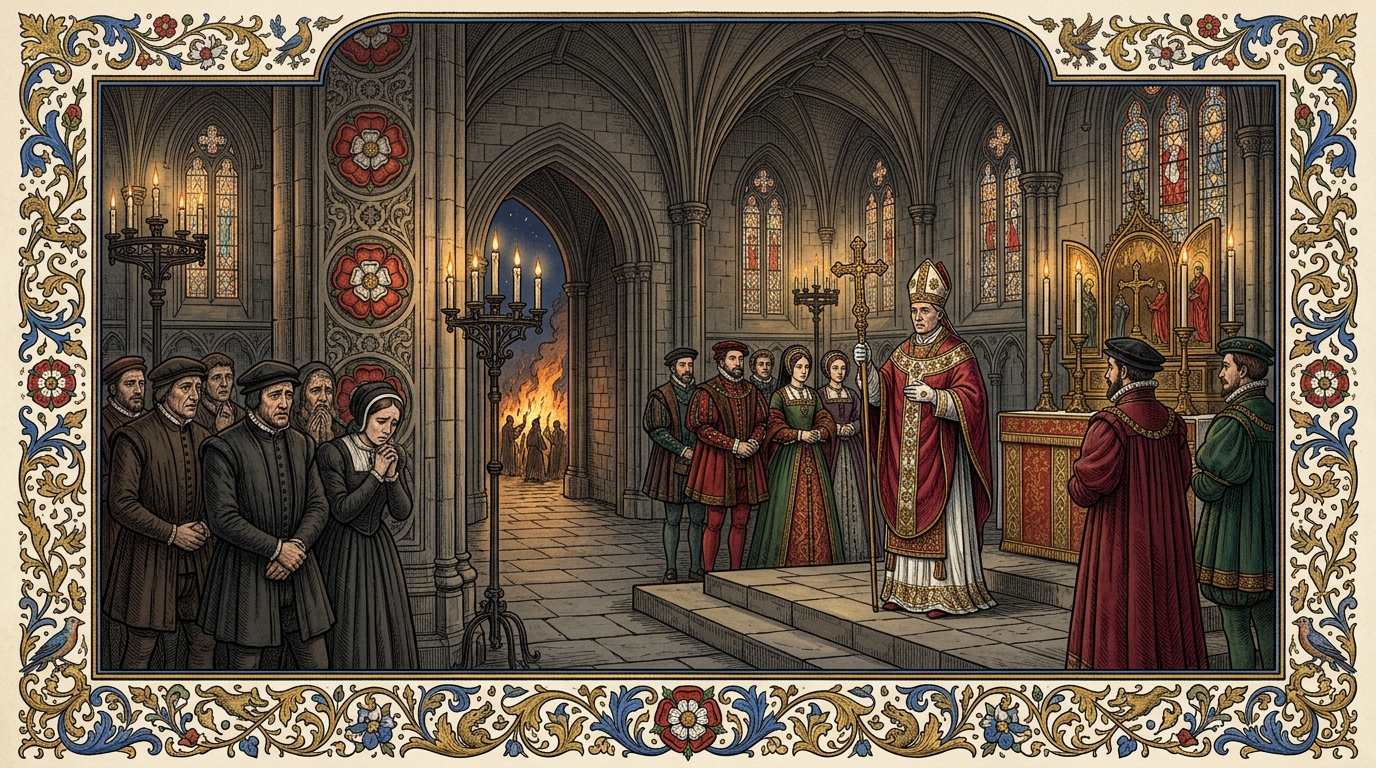
Bloody Mary: How England’s First Queen Regnant Tried to Turn Back the Reformation
Few epithets in English history carry as much weight as ‘Bloody Mary.’ Queen Mary I of England, who reigned from 1553 to 1558, remains one of the most controversial and misunderstood monarchs in the Tudor dynasty. Her determined campaign to restore Roman Catholicism to England led to the execution of approximately 280 Protestant men and women, a wave of religious persecution that would define her legacy for centuries. Yet the real story of Mary Tudor is far more complex than the simplified villain of popular imagination, and understanding her reign tells us something profound about the violent, turbulent nature of the English Reformation itself.
As a historical fiction author who has spent years immersed in the Tudor period, I find Mary’s story endlessly compelling precisely because it resists easy judgement. She was a woman of genuine religious conviction, a daughter who had suffered enormously under her father Henry VIII’s break with Rome, and a queen determined to undo what she saw as a catastrophic theological error. Whether one views her as a faithful Catholic martyr to a lost cause or as a ruthless persecutor of innocent people depends enormously on where one stands, which is exactly what makes this period of history so rich for exploration.
In this post, we will examine who Mary Tudor was, what drove her restoration campaign, how it affected ordinary English men and women, and why her story continues to resonate today. We will draw on John Foxe’s contemporaneous Acts and Monuments (1563) and David Loades’s authoritative biography Mary Tudor: A Life (Basil Blackwell, 1989) to build as accurate and nuanced a picture as possible.
Historical Background: The Making of a Catholic Queen
Mary Tudor was born on 18 February 1516, the daughter of King Henry VIII and his first wife, Catherine of Aragon. Her early life was shaped by her parents’ tumultuous marriage and its catastrophic dissolution. When Henry sought an annulment from Catherine in order to marry Anne Boleyn, he set in motion the English Reformation, breaking with Rome and establishing himself as Supreme Head of the Church of England. For Mary, who was deeply devoted to her mother and to the Catholic faith, these events were a personal and spiritual catastrophe. She was declared illegitimate, stripped of her title as princess, and forced to serve in the household of her infant half-sister Elizabeth. These humiliations left lasting marks on her character and her convictions.
After the reigns of Henry VIII and his son Edward VI, who took Protestant reform considerably further than his father, Mary came to the throne in July 1553 following Lady Jane Grey’s brief nine-day reign. She was thirty-seven years old, and she arrived as queen with a clear theological mission. As David Loades explains in Mary Tudor: A Life, she was utterly sincere in her Catholic faith and genuinely believed that England’s spiritual health depended upon its return to Rome. This was not cynical politics; it was a deeply held personal crusade.
Almost immediately, Mary moved to dismantle the Protestant legislative framework. She repealed the Edwardian religious statutes and restored the heresy laws that had lapsed under her brother’s reign. In 1554, she married Philip II of Spain, a match deeply unpopular with her English subjects, who feared Spanish domination and associated the marriage with the reimposition of Catholic orthodoxy. Parliament was persuaded to reconcile England with Rome, and Cardinal Reginald Pole returned from exile to serve as Archbishop of Canterbury after the execution of Thomas Cranmer, the Protestant architect of the Book of Common Prayer.
The burnings began in February 1555. The first victims were John Rogers and Laurence Saunders, both Protestant clergymen. Over the next three and a half years, approximately 280 people were burned at the stake for heresy, the majority of them in the south-east of England. John Foxe documented their stories in painstaking and sometimes harrowing detail in Acts and Monuments, commonly known as Foxe’s Book of Martyrs, which became one of the most widely read books in Elizabethan England and cemented the Protestant narrative of Mary’s reign as one of brutal, unjustified persecution.
Significance and Impact: A Kingdom Divided by Faith
The significance of Mary’s restoration campaign cannot be overstated, both in terms of its immediate human cost and its long-term consequences for English religious identity. The approximately 280 executions represented the largest wave of state-sponsored religious violence in English history up to that point. The victims ranged from prominent bishops such as Hugh Latimer, Nicholas Ridley, and Thomas Cranmer to ordinary working people, including weavers, farmers, and tradeswomen. This breadth of suffering gave the persecution a particular power in Protestant memory, suggesting that no one was safe from the queen’s theological zeal.
The burnings also triggered a significant wave of Protestant emigration. Hundreds of English Protestants fled to cities on the European continent, particularly Geneva, Frankfurt, and Zurich, where they came into contact with the most radical currents of Reformed theology. When they returned after Mary’s death in 1558, they brought with them ideas that would push English Protestantism in a more explicitly Calvinist direction, ultimately contributing to the tensions that would lead, generations later, to the English Civil War. Mary’s persecution, therefore, did not crush Protestantism in England; it arguably radicalised it.
Within Tudor society, the Marian restoration also created deep anxieties about the relationship between royal authority and individual conscience. Foxe’s Acts and Monuments presented the martyrs as heroic witnesses to truth, men and women who chose death over spiritual compromise. This narrative, powerfully told and widely circulated, helped construct a distinctly English Protestant identity built around the idea of faithful suffering in the face of Catholic tyranny. It was a story that would shape English self-understanding for generations.
Politically, Mary’s reign demonstrated the severe limits of any attempt to reverse the Reformation by force. Despite her genuine efforts, she faced consistent resistance, passive and active, from a population that had spent two decades absorbing Protestant ideas. As Loades notes, the English church she restored was, in many ways, a weakened institution lacking the resources and personnel to embed a genuine Catholic revival before her death ended the experiment.
Connections and Context: The Wider Reformation World
It is important to place Mary’s persecution within its broader European context. Religious violence was by no means unusual in sixteenth-century Europe. The French Wars of Religion, the Spanish Inquisition, and the suppression of the Anabaptist movement in various Protestant territories all demonstrate that the burning of heretics was considered a legitimate instrument of religious policy across confessional boundaries. Protestant rulers executed Catholics too; Henry VIII himself had burned Protestants alongside Catholics for differing heresies. Mary’s persecution was distinctive not in its existence but in its scale and concentration over a short period.
Did you know? Thomas Cranmer, the Archbishop of Canterbury who had been the principal author of the Protestant Book of Common Prayer, initially recanted his Protestant beliefs under pressure during Mary’s reign, hoping to save his life. When it became clear he would be burned regardless, he dramatically withdrew his recantation at the stake in March 1556, thrusting his right hand, which had signed the recantation documents, into the flames first. Foxe recorded this act in vivid detail, and it became one of the most celebrated stories of Protestant martyrdom.
Mary’s reign also coincided with England’s loss of Calais in January 1558, the last English territory on the French mainland. This military humiliation, combined with a devastating influenza epidemic that killed thousands and the failure of her marriage to Philip II to produce an heir, contributed to a sense that God was punishing rather than rewarding her restoration campaign. Mary herself, according to some accounts, acknowledged that the loss of Calais was engraved upon her heart. She died in November 1558, to be succeeded by her Protestant half-sister Elizabeth, whose reign would define English Protestantism for the next half century.
Modern Relevance and Fascinating Details
Mary Tudor’s story continues to fascinate historians, novelists, and general readers alike, partly because it forces us to confront uncomfortable questions about religious conviction, state power, and historical memory. The epithet ‘Bloody Mary’ was not widely used during her own lifetime; it gained currency in subsequent Protestant propaganda and became so embedded in popular culture that it eventually gave its name to a well-known cocktail, a rather extraordinary journey for a sixteenth-century queen’s reputation.
In recent decades, historians including David Loades have worked to rehabilitate Mary’s historical image, or at least to understand her on her own terms rather than solely through the lens of Foxe’s Protestant polemic. This revisionist scholarship does not minimise the suffering of those burned under her authority, but it does contextualise her actions within the norms and beliefs of her time and insists that she deserves to be understood as a complex human being rather than a simple monster. For historical fiction authors, this tension between the woman and her legend makes her one of the most rewarding Tudor figures to explore.
Did you know? Mary I is sometimes credited with being England’s first queen regnant, that is, a queen who ruled in her own right rather than as a consort. Her successful accession, despite the attempt to place the Protestant Lady Jane Grey on the throne, demonstrated that a woman could command sufficient loyalty to rule England alone, a precedent that paved the way for her sister Elizabeth’s long and celebrated reign.
Mary also appears frequently in popular culture and historical fiction, often depicted as a tragic figure consumed by religious fanaticism, though more nuanced portrayals have emerged in recent years. Works of historical fiction set in her court grapple with the tension between her personal warmth and her political ruthlessness, and with the way that sincere religious belief can coexist with, and even motivate, tremendous cruelty.
Conclusion: A Reign That Reshaped England
Mary I’s attempt to restore Catholicism to England was one of the most dramatic and consequential episodes of the Tudor period. Her repeal of Protestant legislation, her reconciliation with Rome, and above all her authorisation of the burning of approximately 280 Protestant dissenters between 1555 and 1558 left an indelible mark on English religious, political, and cultural life. The Protestant emigres who fled her persecution returned with hardened convictions; the martyrs recorded by John Foxe became the foundation of a powerful national Protestant mythology; and the failure of the restoration demonstrated, conclusively, that the English Reformation could not simply be legislated away.
Whether Mary deserves her fearsome epithet or whether she was a woman of genuine faith destroyed by circumstance, grief, and a cause that history was against, is a question that historians and readers continue to debate. What is certain is that her reign was a turning point, a moment when England’s future as a Protestant nation was tested, contested, and ultimately confirmed. If you want to explore this extraordinary period further, I recommend beginning with David Loades’s biography and then losing yourself in the harrowing testimonies of Foxe’s Acts and Monuments, one of the strangest, most moving, and most historically significant books in the English language.