
Anne Boleyn: The Radical Religious Reformer History Almost Forgot
When most people think of Anne Boleyn, they picture a captivating woman at the centre of one of history’s most dramatic royal love affairs, a queen whose fall from grace was as swift as her rise to power. Yet this familiar portrait obscures something far more significant about the second wife of Henry VIII. Anne Boleyn was not merely a passenger in the English Reformation; she was one of its most determined and influential architects. Her commitment to evangelical Protestantism was deeper, more radical, and more consequential than popular history has ever given her credit for.
The question historians are increasingly asking is not simply what role did Anne Boleyn play in the English Reformation? but rather how much of the religious transformation of sixteenth-century England can be traced directly to her patronage, her book collection, and her deliberate promotion of Protestant texts. The answers, drawn from scholars such as David Starkey and Susan Brigden, are genuinely startling.
In this post, we will explore Anne Boleyn’s overlooked identity as a patron of religious reform, her active support for the distribution of English-language Bibles, and why this aspect of her legacy matters enormously, both for understanding Tudor history and for appreciating the woman herself.
Historical Background: Anne Boleyn and the World of Evangelical Reform
To understand Anne Boleyn’s religious radicalism, we must first understand the extraordinary moment in which she lived. The 1520s and 1530s were decades of seismic religious upheaval across Europe. Martin Luther had nailed his Ninety-Five Theses to the church door in Wittenberg in 1517, and the shockwaves were still rippling outward. In England, a small but passionate community of evangelical reformers was gathering momentum, reading smuggled texts, sharing forbidden ideas, and daring to imagine a Christianity stripped of what they saw as Catholic corruption and superstition.
Anne Boleyn was not a passive observer of this movement. As David Starkey argues in Six Wives: The Queens of Henry VIII (2003), Anne had encountered reformist ideas during her time at the French court, and she returned to England with an intellectual formation that was genuinely sympathetic to the evangelical cause. She was, in other words, already primed for reform before she ever caught the eye of Henry VIII. Her religious convictions were not a performance designed to please the king; they were a core part of who she was.
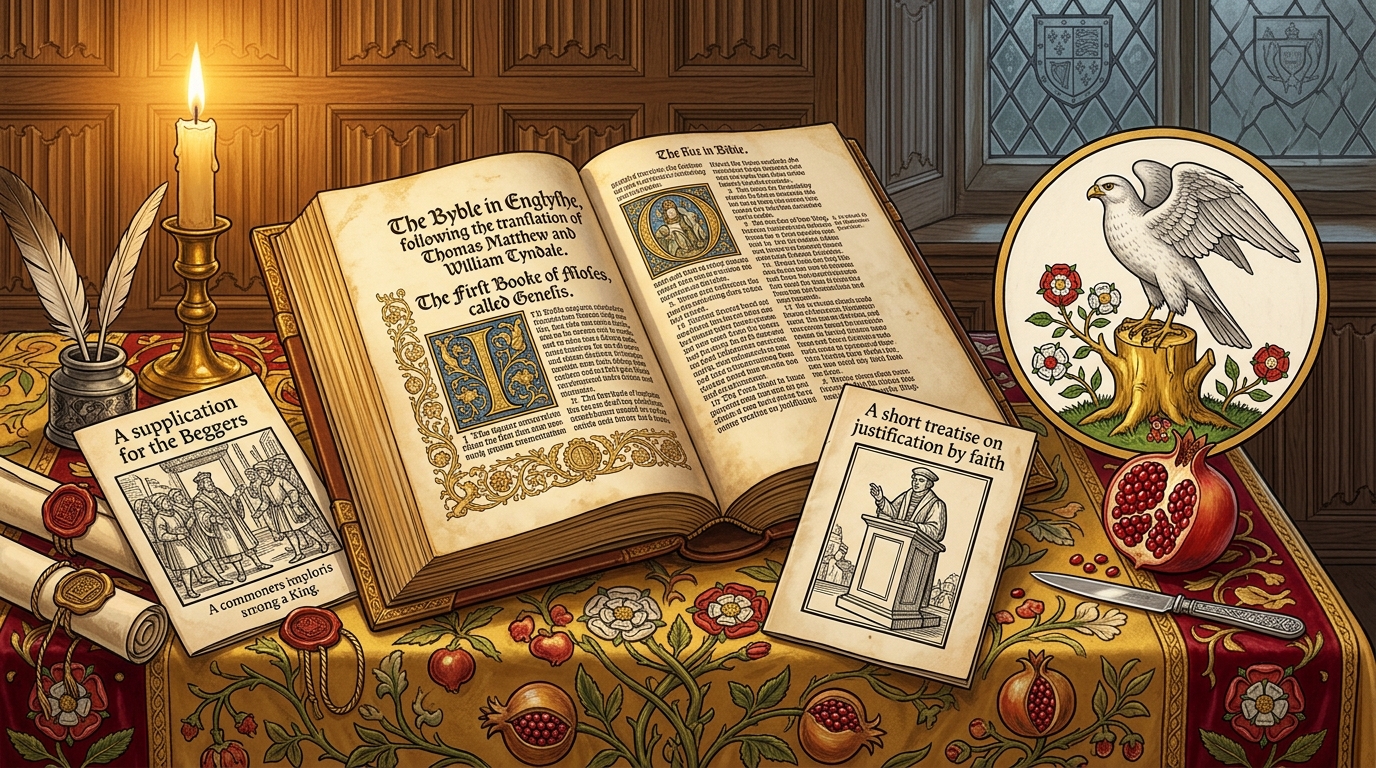
The circumstances of her rise to power gave Anne an extraordinary platform to act on those convictions. As Henry’s pursuit of an annulment from Katherine of Aragon dragged on through the late 1520s, Anne was uniquely positioned to influence the religious direction of the English court. She used that position deliberately and strategically. She kept a copy of William Tyndale’s The Obedience of a Christian Man in her chambers, a text that was, at the time, considered dangerously radical for its arguments about royal supremacy over the Church. When Henry read it, reportedly at Anne’s prompting, he declared it ‘a book for me and all kings to read.’ The implications were profound.
Beyond individual texts, Anne actively promoted the work of reformist thinkers and used her patronage to support men who shared her evangelical sympathies. She championed figures such as Hugh Latimer, who would later become one of the most celebrated Protestant martyrs of the Tudor period. Susan Brigden, writing in New Worlds, Lost Worlds: The Rule of the Tudors 1485-1603 (2000), emphasises that Anne’s household became something of a refuge and a launching pad for reformers who might otherwise have struggled to find a hearing at court.
Significance and Impact: Why Anne Boleyn’s Patronage Changed England
The significance of Anne Boleyn’s religious activism cannot be overstated. Her most consequential contribution was arguably her support for the distribution of English-language Bibles. In the early sixteenth century, the idea that ordinary English men and women should be able to read scripture in their own language was considered revolutionary and, by many in the Catholic establishment, deeply dangerous. The Church had long maintained that the Bible should remain in Latin, accessible only to the clergy and the educated elite.
Anne challenged this orthodoxy directly. She supported efforts to place English Bibles in the hands of ordinary people, and her influence helped create the conditions in which Miles Coverdale’s 1535 English Bible and, later, the Great Bible of 1539 could be produced and distributed. The Great Bible, which was eventually ordered to be placed in every parish church in England, owes something of its existence to the intellectual and political environment that Anne helped create. As a historical fiction author who has spent years researching this period, I find this detail endlessly fascinating: a woman who was executed in 1536 helped set in motion a transformation that would shape English religious life for centuries.
The impact on Tudor society was enormous. Access to scripture in English fundamentally altered the relationship between ordinary people and their faith. It empowered literate laypeople to engage with religious questions directly, bypassing clerical intermediaries. It fuelled debate, dissent, and ultimately the broader Protestant settlement that would define Elizabethan England. When we ask how did the English Reformation happen?, Anne Boleyn’s name deserves to be part of that answer far more prominently than it usually is.
There were, of course, consequences for Anne herself. Her association with religious radicalism made her powerful enemies, particularly among conservatives at court such as Thomas Howard, Duke of Norfolk, and Stephen Gardiner, Bishop of Winchester. The reformist agenda she championed was threatening to established interests both religious and political. It would be simplistic to suggest that her religious views directly caused her downfall in 1536, but they certainly contributed to the complex web of resentments and rivalries that surrounded her.
Connections and Context: The Wider Tudor Reformation
Anne Boleyn’s religious activism did not occur in isolation. It was deeply connected to the broader political drama of Henry VIII’s break with Rome, which was formalised through a series of parliamentary acts between 1532 and 1534. The Act of Supremacy in 1534 declared Henry the Supreme Head of the Church of England, a revolutionary claim that owed something, intellectually, to the very texts Anne had been promoting. The connections between her personal patronage and the formal machinery of religious change are striking.
It is also worth noting what was happening elsewhere in England during this period. Thomas Cromwell, Henry’s chief minister from 1532 onwards, shared many of Anne’s reformist sympathies and worked to advance the evangelical cause through the machinery of government. The two were allies, at least initially, in pushing England towards Protestantism. Their relationship complicates the simple narrative of Anne as a romantic figure and reminds us that she was, above all, a political operator with a serious ideological agenda.
Did you know? Anne Boleyn’s own annotated copy of the French Bible survives to this day. It offers a remarkable window into her personal engagement with scripture and her reformist convictions, providing tangible, physical evidence of the intellectual life that official histories have so often overlooked.
Modern Relevance and Fascinating Details
Why does any of this matter in the twenty-first century? Partly because getting history right is always worthwhile, but also because the distorted image of Anne Boleyn has real consequences for how we understand women’s agency in the past. The tendency to reduce her to a romantic protagonist, the woman who tempted a king, strips her of her intellectual seriousness and her genuine historical significance. Recovering her identity as a religious reformer is an act of historical justice.
In popular culture, Anne Boleyn has enjoyed an extraordinary renaissance in recent years. From Hilary Mantel’s magnificent Wolf Hall trilogy to numerous television dramatisations, she has become one of the most compelling figures in historical fiction. Yet even in these sophisticated retellings, her religious radicalism is sometimes underplayed in favour of the personal drama of her relationship with Henry. As someone who writes historical fiction set in the Tudor period, I am acutely aware of the temptation to prioritise narrative excitement over ideological complexity. But the truth is that Anne’s religious convictions are not a distraction from her story; they are the heart of it.
The lesser-known detail that perhaps surprises people most is the sheer courage that Anne’s religious stance required. To promote evangelical texts in the 1520s and 1530s was genuinely dangerous. Men and women were being burned for heresy. The intellectual world Anne moved in was one of real risk, and her willingness to navigate that world, to use her position to advance ideas that many powerful people found deeply threatening, speaks to a character far more formidable than the romantic figure of popular imagination.
Conclusion: Reassessing Anne Boleyn’s Legacy
Anne Boleyn was executed on 19th May 1536, condemned on charges that most historians now regard as fabricated. She had been queen for less than three years. Yet the religious transformation she helped set in motion outlasted her by centuries. Her promotion of evangelical Protestant texts, her support for English-language scripture, and her patronage of reformist thinkers placed her at the very centre of one of the most significant events in English history. To understand the English Reformation fully, we must take Anne Boleyn’s religious radicalism seriously.
If this post has sparked your curiosity, I would encourage you to explore David Starkey’s Six Wives and Susan Brigden’s New Worlds, Lost Worlds, both of which offer rich, nuanced accounts of this extraordinary period. Anne Boleyn was many things: a queen, a mother, a political strategist, and a woman caught in impossible circumstances. But she was also, and perhaps above all, a genuine believer who used every resource at her disposal to reshape the religious life of her nation. That is a legacy worth remembering.