From Condemned Queen to Mother of a Golden Age: Anne Boleyn and Elizabeth I
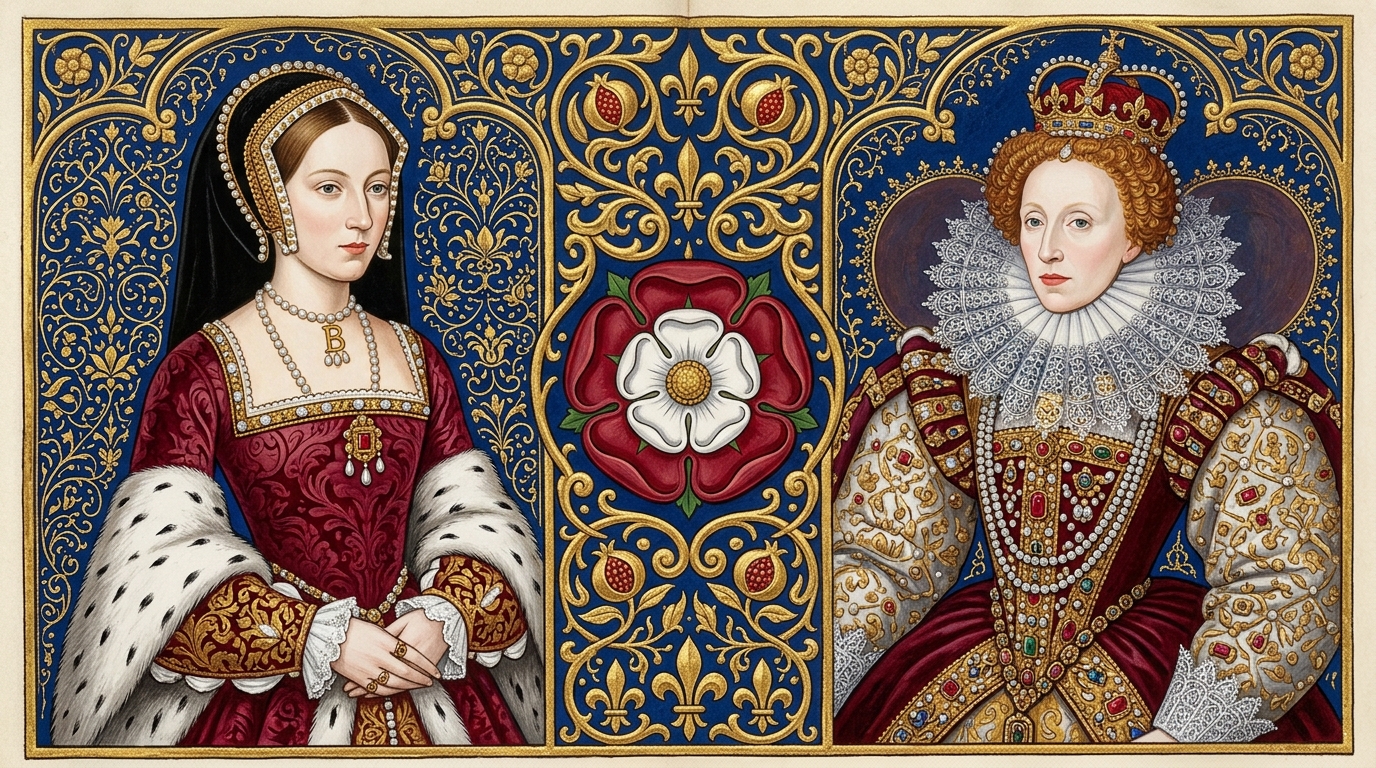
Few stories in English history carry the weight of tragedy and triumph quite like the tale of Anne Boleyn and her daughter Elizabeth. A mother executed before her child could form a single memory of her, and yet that child grew to become one of the most celebrated monarchs England has ever known. The connection between these two women, separated by the executioner’s block and decades of political turmoil, remains one of the most compelling threads running through the entire Tudor period.
Anne Boleyn was beheaded on 19th May 1536 at the Tower of London, on charges that most historians today regard as almost certainly fabricated. Her daughter, the future Queen Elizabeth I, was not yet three years old. To understand how a child so utterly abandoned by fortune, stripped of her mother, declared illegitimate, and shuffled around the royal household, could eventually reign for forty-five years and lend her name to an entire age of English culture and achievement, is to understand the astonishing resilience at the heart of Tudor history.
In this post, we will explore the circumstances of Anne Boleyn’s rise and fall, the remarkable journey her daughter made from royal outcast to queen regnant, and why this story continues to captivate readers, historians, and writers of historical fiction to this day. Along the way, we will draw on the scholarship of Neville Williams and David Loades, two authoritative voices on Elizabethan history, to ensure that the picture we paint is as accurate as it is dramatic.
Historical Background: A Queen Condemned, a Princess Forgotten
Anne Boleyn’s story begins in the early 1520s, when she returned to the English court after time spent in France. Educated, sharp-witted, and possessed of a magnetism that contemporaries found difficult to describe without resorting to superlatives, she quickly attracted the attention of King Henry VIII. Henry was already married to Catherine of Aragon, but his passion for Anne, combined with his desperate need for a male heir, set in motion the chain of events we now call the English Reformation. Henry broke with Rome, established himself as Supreme Head of the Church of England, annulled his marriage to Catherine, and wed Anne in a secret ceremony in January 1533.
On 7th September 1533, at the Palace of Placentia in Greenwich, Anne gave birth to a daughter. The child was christened Elizabeth, almost certainly in honour of both Henry’s mother, Elizabeth of York, and Anne’s own mother, Elizabeth Howard. Henry had desperately wanted a son, and the disappointment surrounding Elizabeth’s birth was palpable. Yet the little princess was still recognised as heir to the throne, and elaborate plans were made for her household at Hatfield House in Hertfordshire.
The marriage between Henry and Anne deteriorated rapidly. Anne suffered at least two miscarriages after Elizabeth’s birth, including, in January 1536, what appeared to be a male foetus. Henry, by this point infatuated with Jane Seymour, moved against his queen with devastating speed. Anne was arrested in May 1536 and accused of adultery, incest, and even plotting the king’s death. As Neville Williams observed in The Life and Times of Elizabeth I (1972), these charges were almost universally regarded even at the time as a judicial murder dressed up in the language of treason. Anne was convicted and executed within a matter of weeks.
In the immediate aftermath, Elizabeth was declared illegitimate by Act of Parliament, just as her half-sister Mary, Catherine of Aragon’s daughter, had been declared illegitimate before her. The little girl at Hatfield was now, in the eyes of the law, nobody’s heir. She was, however, still very much alive, still very much her father’s daughter, and possessed of an intellect and a will that would eventually astonish all of Europe.
Significance and Impact: How a Mother’s Fate Shaped a Queen’s Character
The execution of Anne Boleyn did not merely deprive Elizabeth of a mother. It shaped the entire psychological and political landscape of her life. Growing up in an era when the wrong word, the wrong alliance, or even the wrong expression of religious belief could mean imprisonment or death, Elizabeth learned early the arts of caution, ambiguity, and survival. David Loades, in Elizabeth I: A Life (2003), notes that Elizabeth’s famous reluctance to commit herself on matters of succession and marriage almost certainly had its roots in the instability and danger of her early years.
The religious upheaval that Anne Boleyn had helped to unleash also proved enormously consequential for Elizabeth’s reign. Anne was a committed supporter of Protestant reform, and she ensured that her daughter received a humanist education shaped by reforming principles. Elizabeth’s tutors included some of the finest scholars of the age, among them Roger Ascham, who later wrote warmly of his royal pupil’s extraordinary linguistic abilities. By the time Elizabeth came to the throne in November 1558, she was fluent in Latin, French, Italian, and Greek, a range of accomplishment that commanded respect across the courts of Europe.
Perhaps most significantly, Anne Boleyn’s fall taught Elizabeth a lesson about power that she never forgot: that a monarch, and particularly a female monarch, could never afford to appear weak or dependent. Elizabeth’s celebrated policy of deliberate ambiguity in matters of marriage, her famous declaration that she was married to England, her masterly use of the imagery of the Virgin Queen, all of these strategies owed something to the fate of the mother she never truly knew. In refusing to give any man dominion over her person or her kingdom, Elizabeth was, in a sense, ensuring that no future Henry VIII could ever do to her what her father had done to Anne.
Connections and Context: The Tudor World in Which Elizabeth Came of Age
To understand Elizabeth’s journey to the throne, it is important to appreciate how turbulent the decades following Anne’s execution truly were. Henry VIII went on to marry four more times after Anne. His son by Jane Seymour, Edward VI, succeeded him in 1547 and reigned until 1553, presiding over a period of intense Protestant reform. Edward was followed by Mary I, Catherine of Aragon’s daughter, who restored Catholicism with considerable violence, earning herself the epithet Bloody Mary from Protestant martyrologists.
Throughout this period, Elizabeth’s position was precarious in the extreme. During Mary’s reign, she was imprisoned in the Tower of London for a time, suspected of involvement in a Protestant rebellion led by Sir Thomas Wyatt the Younger in 1554. That she emerged from the Tower alive, when so many others did not, speaks to both her political intelligence and a considerable measure of good fortune. As Loades makes clear, Elizabeth’s survival under Mary was not guaranteed, and the experience of those years left a permanent mark on her approach to governance.
Did you know? Elizabeth and her half-sister Mary were once so close that Mary gave the young Elizabeth a gift of a beautiful gown. The relationship between the two women deteriorated dramatically as religious and political pressures mounted, but it is a reminder that Tudor family dynamics were never simply matters of cold dynastic calculation.
Modern Relevance and Fascinating Details: Why This Story Still Captivates Us
As a historical fiction author, I find the relationship between Anne Boleyn and Elizabeth I endlessly rich precisely because it is a story about absence as much as presence. Elizabeth almost certainly knew very little about her mother during her childhood. Anne was a subject not easily discussed at the court of Henry VIII, and later, under Edward and Mary, there was little incentive to celebrate the memory of a woman who had been convicted of treason and adultery. And yet Elizabeth kept small, quiet tokens of her mother’s memory close to her throughout her life.
One of the most poignant details recorded by historians is that Elizabeth owned a locket ring, discovered at Chequers in the twentieth century, containing miniature portraits of both herself and a woman widely believed to be Anne Boleyn. That such a thing existed at all, hidden, personal, and profoundly intimate, suggests that the bond between mother and daughter was not entirely severed by execution and political necessity. It is the kind of detail that stops you in your tracks as a writer and reminds you that behind the grand sweep of history there are always private griefs and private devotions.
In popular culture, the figures of Anne Boleyn and Elizabeth I have inspired an extraordinary range of novels, films, television dramas, and even musical works. From Hilary Mantel’s Booker Prize-winning Wolf Hall trilogy to the Netflix drama Anne Boleyn and countless representations of Elizabeth on stage and screen, this corner of Tudor history shows no sign of exhausting its capacity to fascinate new audiences. The questions it raises, about power, gender, survival, and legacy, remain urgently relevant in the twenty-first century.
Conclusion: A Legacy Written in Defiance of Tragedy
The story of Anne Boleyn and Elizabeth I is, at its heart, a story about what survives. A woman condemned by the most powerful man in England, stripped of her title, her marriage declared void, and her daughter declared a bastard, nonetheless left behind a legacy that would shape English history for centuries. Elizabeth I’s reign, which lasted from 1558 to 1603, saw England establish itself as a major maritime power, produce some of the greatest literature in the English language, and develop a sense of national identity that still resonates today. As Williams argues in The Life and Times of Elizabeth I, the Elizabethan age was not simply a product of fortunate circumstance; it was the achievement of a woman of quite exceptional intelligence and determination.
Whether you come to this story as a historian, a reader of historical fiction, or simply someone who stumbled upon a fascinating corner of the past, the connection between Anne Boleyn and Elizabeth I rewards further exploration. I would encourage you to seek out the scholarship of Neville Williams and David Loades, whose careful and authoritative work underpins much of what we know about this period. And if you find yourself wondering, as I often do, what Anne Boleyn might have made of the daughter she barely knew, perhaps that is the most compelling question Tudor history has to offer.