
Elizabeth I and the Elizabethan Religious Settlement of 1559: How One Queen Forged a Nation’s Faith
Imagine inheriting a kingdom torn apart by religious conflict, where the wrong choice of faith could ignite civil war, invite foreign invasion, or send you to the scaffold. This was the extraordinary predicament facing Elizabeth I when she ascended the English throne in November 1558. Her father Henry VIII had broken with Rome. Her brother Edward VI had pushed England towards radical Protestantism. Her sister Mary I had dragged it back to Roman Catholicism, burning nearly three hundred Protestants in the process. Elizabeth faced an almost impossible task: to settle the religious question once and for all, and to do it in a way that kept her fractious subjects from each other’s throats.
The solution she forged in 1559, known as the Elizabethan Religious Settlement, was one of the most politically brilliant acts of the Tudor age. It created a Church of England that was Protestant in doctrine yet retained enough Catholic ceremonial to make the transition bearable for those who mourned the old ways. It was, in the words of later historians, a via media, a middle way, and it shaped the character of Anglicanism for centuries to come. Understanding this settlement means understanding not just Tudor England, but the very foundations of British religious and cultural identity.
In this post, we will explore who shaped the settlement, why it took the precise form it did, what consequences it unleashed across Tudor society, and why it remains a subject of fascination for historians, theologians, and historical fiction writers alike. Whether you are searching for a clear explanation of what the Elizabethan Religious Settlement actually was, or looking to understand its lasting legacy, you have come to the right place.
Historical Background: The Making of a Religious Compromise
To understand the settlement of 1559, we must first appreciate the chaotic religious landscape Elizabeth inherited. Henry VIII had severed England from papal authority through the Act of Supremacy of 1534, but his church had remained largely Catholic in doctrine and practice. Under Edward VI, Protestant reformers, many influenced by Continental thinkers such as Calvin and Zwingli, had pushed through sweeping changes, including a new prayer book in 1552 that stripped the mass of its traditional character. Then came Mary I, who restored papal obedience and oversaw the burning of Protestants, earning the grim sobriquet Bloody Mary. By 1558, England had changed its official religion four times in roughly twenty-five years. The population was exhausted, confused, and deeply divided.
Elizabeth herself was almost certainly Protestant by personal conviction, shaped by her humanist education and the reforming influence of figures such as Roger Ascham, her tutor. Yet she was also a consummate political pragmatist. She understood that approximately half her subjects still held Catholic sympathies, particularly in the north and west of the country. She also faced the very real threat that a radical Protestant settlement might alienate powerful Catholic monarchs on the Continent, most notably Philip II of Spain, who had been her brother-in-law and had thus far restrained himself from acting against England.
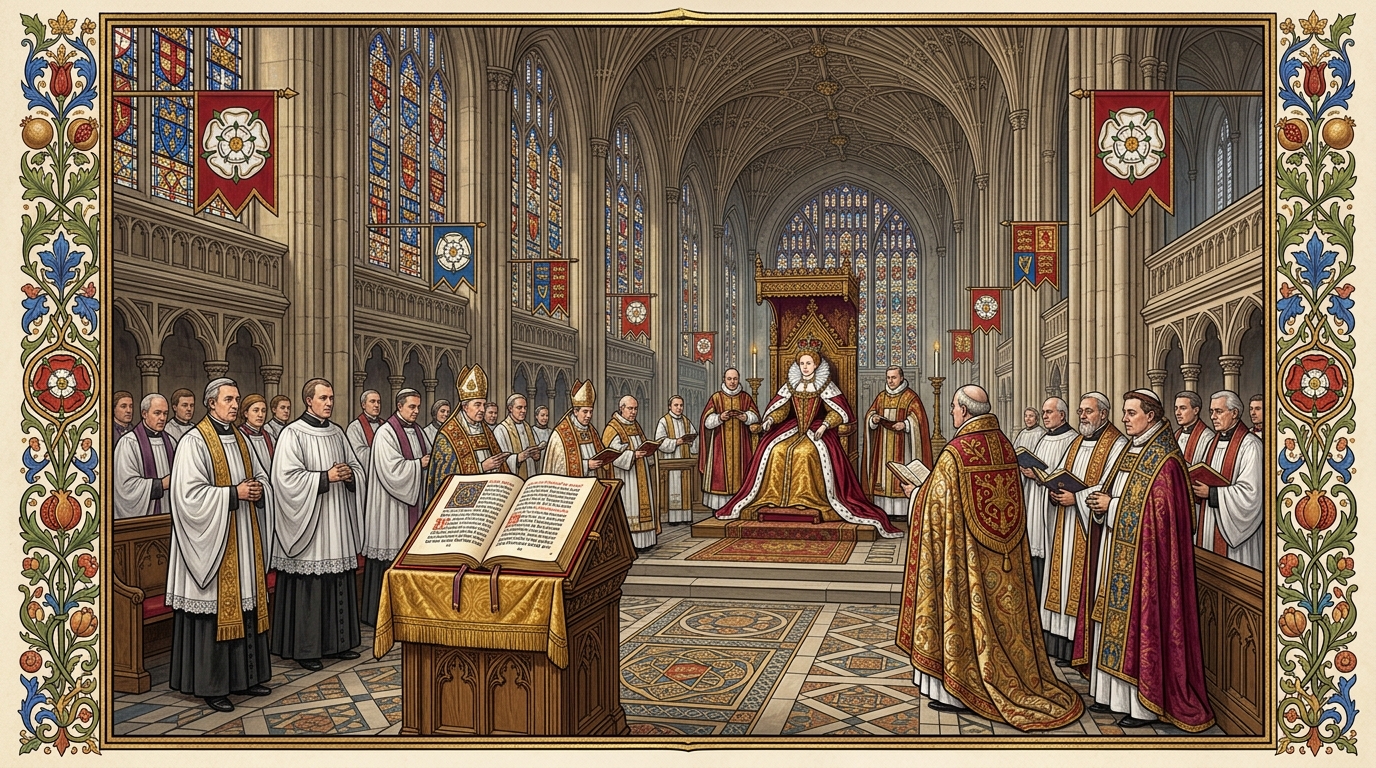
The settlement was achieved through two landmark pieces of legislation passed by Parliament in the spring of 1559. The Act of Supremacy, drawing on its 1534 predecessor, restored royal authority over the church, though Elizabeth took the title of Supreme Governor rather than Supreme Head, a subtle but significant modification that acknowledged the theological awkwardness of a woman claiming headship of a church. The Act of Uniformity imposed a revised version of the 1552 Book of Common Prayer, though with crucial modifications designed to make it more palatable to traditionalists. The words of administration at communion were altered to include both Protestant and Catholic formulations simultaneously, allowing communicants of differing beliefs to interpret the sacrament according to their own conscience.
The key architects of the settlement alongside Elizabeth herself included her principal secretary William Cecil and the newly appointed Archbishop of Canterbury Matthew Parker. Parker, a mild-mannered Cambridge scholar, would spend the next decade trying to hold the new church together against pressure from both Catholic recusants on one side and increasingly impatient Protestant puritans on the other. As the historian Patrick Collinson demonstrates in his landmark study The Elizabethan Puritan Movement (1967), this pressure from the godly Protestant left would prove a defining challenge for the Elizabethan church throughout the queen’s reign.
Significance and Impact: Why the Settlement Mattered
The immediate political significance of the settlement can hardly be overstated. By threading the needle between Protestant and Catholic sensibilities, Elizabeth bought herself something invaluable: time. The settlement did not satisfy everyone, but it satisfied enough people, or at least alienated fewer people to the point of active rebellion, to give the new regime the stability it desperately needed. This was a remarkable achievement for a young queen, twenty-five years old, female, and widely regarded by European Catholic powers as illegitimate by birth.
For ordinary Tudor men and women, the settlement meant tangible, visible changes to the rhythm of religious life. Church services would henceforth be conducted in English rather than Latin. The elaborate ceremonial of the Catholic mass, with its elevation of the host and ringing of bells, was abolished. Yet the clergy continued to wear vestments, the church calendar retained many traditional saints’ days, and the physical fabric of the parish church, its stained glass, its choir stalls, its altar rails, was largely left intact. This was deliberate. Elizabeth famously had no desire, as she put it, to make windows into men’s souls. What mattered was outward conformity, not inward conviction.
The long-term consequences were profound and not always peaceful. The settlement created deep tensions within the Church of England almost from its inception. Puritans, those energetic Protestant reformers who believed the church had not been sufficiently cleansed of Catholic corruption, grew increasingly vocal and frustrated. As Collinson’s research shows, by the 1560s and 1570s a significant puritan movement was pushing for the abolition of vestments, the reform of church governance, and a more thoroughly Calvinist theology. These tensions would simmer throughout Elizabeth’s reign and eventually contribute to the explosive conflicts of the seventeenth century, including the Civil War that cost Charles I his head in 1649.
The settlement also had profound implications for English national identity. In defining England as a Protestant nation, it created a powerful sense of difference from Catholic Spain and France, a distinction that would be reinforced by events such as the Spanish Armada of 1588. English Protestantism became intertwined with notions of English liberty and independence in ways that persisted long after the Tudor dynasty itself had passed into history.
Connections and Context: The Broader Tudor World
It is impossible to understand the Elizabethan Religious Settlement in isolation from the broader European context of the mid-sixteenth century. The Reformation had been tearing apart the unity of Western Christendom since Martin Luther’s challenge to Rome in 1517. By 1559, religious wars were convulsing France, where Huguenot Protestants faced increasingly violent persecution. In Scotland, Elizabeth’s cousin Mary Queen of Scots would soon find herself caught between Catholic loyalty and Protestant rebellion. The Council of Trent, which concluded in 1563, marked Rome’s formal response to Protestant challenges and hardened the lines of confessional conflict across Europe.
Within England itself, 1559 was also the year Elizabeth began navigating the treacherous waters of the marriage question. Parliament and her councillors were already pressing her to marry and produce an heir, and her choice of husband would inevitably carry religious implications. A Catholic marriage might undermine the settlement; a Protestant one might provoke Catholic powers. Elizabeth’s eventual decision never to marry must be understood partly in this religious and political context.
Did you know? The Thirty-Nine Articles of 1563, which defined the doctrinal basis of the Church of England, were a direct product of the settlement and remain technically in force today. Every Church of England clergyman is still required to acknowledge them, though their interpretation has evolved considerably over the centuries.
Modern Relevance and Fascinating Details
From my perspective as both a Tudor historian and a historical fiction writer, the Elizabethan Religious Settlement is irresistible material precisely because it is so deeply human. Behind the parliamentary Acts and theological arguments are real people wrestling with questions of conscience, loyalty, power, and survival. What did it feel like for a priest who had celebrated the Catholic mass all his adult life to stand before his congregation and conduct an English Protestant service? What went through the mind of a parishioner who knelt at the same altar rail her grandmother had knelt at, but now heard different words, saw different gestures, and was told to understand them in a different way?
These questions resonate because they are not merely historical. The Anglican Communion today, with its seventy-seven million members across the globe, is a direct institutional descendant of the 1559 settlement. The ongoing debates within Anglicanism about theology, liturgy, gender, and sexuality are in many respects continuations of the same fundamental tension that Elizabeth tried, with considerable genius, to manage: how do you hold together people of genuinely different convictions within a single institutional church?
The settlement also appears, directly and indirectly, in a remarkable amount of popular culture and historical fiction. Hilary Mantel’s celebrated Wolf Hall trilogy, though centred on the Henrician period, casts a long shadow forward to the Elizabethan church. Numerous television dramas and novels set in Elizabethan England use the tensions created by the settlement as dramatic fuel, from priest holes concealing Catholic recusants to puritan characters railing against the compromises of the established church. These stories endure because the settlement created a world of genuine moral complexity, one in which there were no easy answers and no villains who were entirely wrong.
Conclusion: A Settlement for the Ages
The Elizabethan Religious Settlement of 1559 was not a perfect solution to England’s religious divisions, and Elizabeth herself never claimed it was. It left Catholics marginalised and increasingly persecuted, particularly after the papal bull of 1570 that excommunicated Elizabeth and released her subjects from their allegiance. It left committed Protestants frustrated by what they regarded as a half-reformed church still cluttered with popish remnants. But it achieved something genuinely remarkable: it gave England a degree of religious stability at a moment when stability was desperately needed, and it created an institutional framework that proved flexible enough to survive for centuries.
The Acts of Supremacy and Uniformity (1559), together with the scholarly work of historians such as Patrick Collinson, allow us to understand this settlement not as a dry constitutional arrangement but as a living, contested, and endlessly fascinating moment in the story of a nation finding its identity. If you would like to explore further, I would encourage you to look at the primary sources directly, to read Collinson’s magisterial study, and perhaps to visit one of England’s great parish churches, where the physical legacy of this extraordinary compromise is still visible in stone, glass, and timber today.