
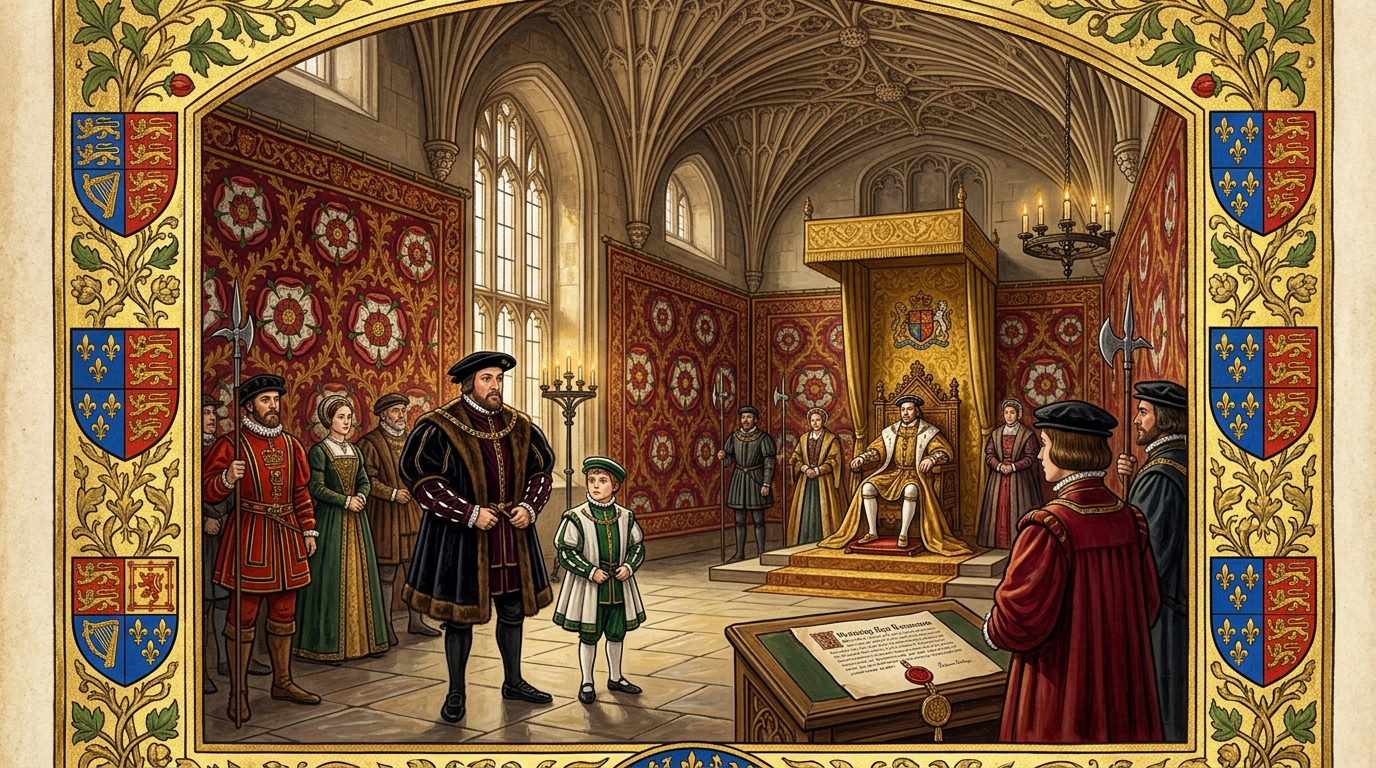
Henry VIII, Catherine of Aragon, and the Royal Divorce That Changed England Forever
Few moments in English history carry the seismic weight of Henry VIII’s decision to annul his marriage to Catherine of Aragon. What began as a personal obsession quietly took root in 1527 and grew into one of the most consequential political and religious ruptures the Western world had ever witnessed. By the time the dust had settled, England had broken with Rome, a queen had been cast aside, and the very fabric of Tudor society had been rewoven. If you have ever wondered why Henry VIII occupies such a singular place in the popular imagination, the answer lies largely in this extraordinary chapter of his reign.
As both a Tudor history enthusiast and a historical fiction author, I find this period endlessly compelling precisely because it sits at the intersection of the deeply personal and the monumentally political. Henry was not simply a king manoeuvring for dynastic advantage; he was a man who had spent eighteen years married to a woman he had once genuinely admired, and who now found himself convinced that God had turned against their union. Understanding how he reached that conclusion, and the extraordinary lengths to which he went to justify it, reveals a great deal about power, faith, and self-deception in the Tudor age.
In this post, we will examine who the key figures were, what circumstances drove Henry’s fateful decision, why the annulment mattered so profoundly for England and Europe, and what fascinating details continue to surprise even seasoned historians today. Whether you are a newcomer to Tudor history or a devoted reader of the period, there is something here to deepen your understanding of one of history’s most dramatic royal marriages.
Historical Background: Eighteen Years of Marriage and the Question of an Heir
Henry VIII married Catherine of Aragon in June 1509, just weeks after ascending to the throne at the age of seventeen. Catherine was the widow of his elder brother Arthur, and the marriage required a papal dispensation on the grounds that the union with Arthur had never been consummated. Henry reportedly adored Catherine in those early years. She was educated, dignified, and politically astute, serving briefly as regent of England in 1513 while Henry campaigned in France. It was, by most accounts, a promising beginning.
The trouble, as Alison Weir details in The Six Wives of Henry VIII (1991), was Catherine’s repeated failure to produce a surviving male heir. Between 1510 and 1518, she endured a devastating series of pregnancies, only one of which produced a living child: the future Mary I, born in 1516. Sons were either stillborn or died within weeks. For Henry, whose entire dynastic purpose rested on securing the succession, this was a crisis of the first order. A daughter could not, in the prevailing view, reliably hold the throne against rival claimants.
By 1527, Henry had begun to convince himself that the marriage was cursed by God. He turned to a passage in Leviticus which warned that a man who married his brother’s widow would be childless, and he argued, conveniently, that the papal dispensation that had permitted his marriage to Catherine had been unlawfully granted. He began formally seeking an annulment from Pope Clement VII, a process that would drag on for six agonising years and ultimately prove impossible through conventional ecclesiastical channels, not least because Clement was effectively a prisoner of the Holy Roman Emperor Charles V, who happened to be Catherine’s nephew.
It was during this period that Henry made one of his most calculated and, frankly, ruthless moves. He pointed to his illegitimate son, Henry FitzRoy, born in 1519 to his mistress Bessie Blount, as living proof that the failure to produce a male heir lay with Catherine rather than with himself. FitzRoy was healthy, vigorous, and unmistakably Henry’s child. As David Starkey observes in Six Wives: The Queens of Henry VIII (2003), Henry elevated FitzRoy to the dukedom of Richmond and Somerset in 1525 in a move that was as much a public statement about Catherine’s inadequacy as it was a recognition of the boy’s existence. It was a deeply cruel gesture towards a queen who had done nothing wrong except fail to carry a son to term.
Significance and Impact: A Marriage, a Break with Rome, and a Nation Transformed
The significance of Henry’s pursuit of an annulment cannot be overstated. When Pope Clement VII proved unable or unwilling to grant the annulment, Henry did not simply accept defeat. Instead, with the guidance of Thomas Cromwell and the theological arguments of Thomas Cranmer, he engineered a revolution. Between 1532 and 1534, a series of parliamentary acts severed England’s ties to Rome and declared Henry the Supreme Head of the Church of England. A marriage dispute had, with breathtaking speed, become a reformation.
For Catherine of Aragon personally, the consequences were devastating. She refused until her dying day in January 1536 to accept the title of Princess Dowager, insisting that she was Henry’s lawful wife and queen. She was separated from her daughter Mary, denied access to the court she had graced for decades, and moved through a series of increasingly uncomfortable residences. Weir’s sympathetic portrait of Catherine emphasises the extraordinary dignity with which she bore her humiliation, maintaining her position through years of isolation and declining health.
For Tudor society more broadly, the break with Rome triggered consequences that rippled through generations. The dissolution of the monasteries redistributed vast quantities of land and wealth, creating a new class of landowners whose prosperity was directly tied to the Protestant settlement. Religious conflict, temporarily suppressed, would erupt repeatedly under Edward VI, Mary I, and Elizabeth I. In a very real sense, the seeds of England’s long struggle over faith and sovereignty were planted in the soil of Henry’s determination to rid himself of his first wife.
Did you know? Catherine of Aragon reportedly signed her final letter to Henry simply as Catherine the Queen, a defiant act of identity that moved even some of Henry’s own courtiers to admiration.
Connections and Context: What Else Was Happening in Tudor England?
It is worth remembering that Henry’s marital crisis unfolded against an extraordinarily turbulent European backdrop. The Protestant Reformation, ignited by Martin Luther’s challenge to Rome in 1517, was reshaping the religious landscape of the continent. The sack of Rome in 1527 by the forces of Charles V, occurring in the very same year Henry began pursuing his annulment, left Pope Clement entirely dependent on imperial goodwill and therefore incapable of ruling against Catherine’s nephew. Henry’s personal crisis and the broader European crisis were, in this sense, inextricably linked.
Closer to home, the figure of Anne Boleyn must not be overlooked. Henry had fallen deeply and passionately under her spell by 1527, and many historians argue that his desire for Anne was at least as powerful a motivation as his dynastic anxieties. Anne was clever, ambitious, and, crucially, refused to become Henry’s mistress as her sister Mary had done before her. She held out for marriage, and in doing so she changed the course of English history. The relationship between Henry’s theological arguments, his dynastic needs, and his infatuation with Anne forms one of the most complex and debated triangles in all of Tudor historiography.
Henry FitzRoy, meanwhile, stands as a poignant footnote to this entire episode. The boy whom Henry had used as evidence of his own fertility died in July 1536 at the age of seventeen, possibly of tuberculosis, just months after Catherine herself had died and just weeks after Anne Boleyn had been executed. By then, Henry had already married Jane Seymour, who would finally give him the legitimate male heir he craved: the future Edward VI, born in October 1537.
Modern Relevance and Fascinating Details: Why This Story Still Captivates Us
The story of Henry and Catherine endures in the popular imagination for reasons that go well beyond mere historical curiosity. At its heart, it is a story about the collision between personal desire and institutional power, between a man’s sense of entitlement and a woman’s principled refusal to be erased. In an age when questions of bodily autonomy, political legitimacy, and religious authority remain urgently relevant, the annulment saga speaks across the centuries with remarkable directness.
From a historical fiction perspective, this period offers almost unparalleled dramatic richness. Hilary Mantel’s Wolf Hall trilogy, Philippa Gregory’s The Other Boleyn Girl, and numerous television adaptations including the BBC’s The Six Wives of Henry VIII and the Showtime series The Tudors have brought these characters to millions of readers and viewers worldwide. Each retelling tends to reflect the preoccupations of its own era, whether that is sympathy for Catherine’s plight, fascination with Anne’s ambition, or a broader interest in how women navigated power within profoundly constraining structures.
Did you know? Henry VIII was by no means the only Tudor monarch to grapple with questions of marital legitimacy. The very circumstances of his own parents’ marriage, and the legitimacy of his claim to the throne, had been contested during his father’s reign. Dynastic anxiety was, in a very real sense, a Tudor inheritance.
Conclusion: A Marriage That Made a Nation
Henry VIII’s eighteen-year marriage to Catherine of Aragon, and its spectacular unravelling, is not simply a story of royal scandal or personal failure. It is the story of how one man’s conviction that God had cursed his marriage, combined with his use of poor Bessie Blount’s son as a propaganda tool, set in motion a chain of events that transformed England’s relationship with Rome, reshapedits social order, and left an indelible mark on its national identity. As Alison Weir and David Starkey both make clear in their authoritative accounts, there are no simple villains or victims here, only human beings caught in circumstances of almost impossible complexity.
If this brief exploration has whetted your appetite, I encourage you to dive deeper into the primary sources and the outstanding secondary literature available. The Tudor period rewards every hour you give it, and the story of Henry and Catherine is as fine a place as any to begin. Feel free to leave your questions or thoughts in the comments below; there is always more to discover in the world of the Tudors.