
Jane Seymour: The Tudor Queen Who Gave Henry VIII His Greatest Wish and Paid the Ultimate Price
Of all the stories that emerge from the turbulent court of Henry VIII, few are as simultaneously triumphant and tragic as that of Jane Seymour. She was the quiet, pale-complexioned lady-in-waiting who became queen, fulfilled the king’s most desperate dynastic ambition, and then vanished from the world before she could enjoy a moment of her hard-won security. In the ruthless theatre of Tudor politics, Jane’s story stands apart precisely because she achieved what none of Henry’s other wives could: she gave England a legitimate male heir. Yet the price she paid was the highest imaginable.
As a historical fiction author who has spent years immersed in the world of Tudor England, I find Jane Seymour endlessly compelling. She is so often overshadowed by the more flamboyant figures of Catherine of Aragon and Anne Boleyn, yet her brief reign as queen contains enough drama, political intrigue, and human tragedy to fill several novels. This post explores the full arc of her story, from her origins in Wiltshire to her death at Hampton Court Palace in October 1537, and examines why her legacy continued to shape the Tudor dynasty long after her death.
By the end of this article, you will understand not only who Jane Seymour was, but why her role in Tudor history was so pivotal, how her son Edward VI transformed England, and what the circumstances of her death reveal about the brutal realities of sixteenth-century life for women of every rank.
Historical Background: From Wiltshire Lady to Queen of England
Jane Seymour was born around 1508 or 1509 at Wolf Hall in Wiltshire, the ancestral home of the Seymour family. She was the daughter of Sir John Seymour and Margery Wentworth, and came from a moderately prosperous gentry family with good connections to the royal court. As Alison Weir notes in The Six Wives of Henry VIII (Grove Press, 1991), Jane was considered gentle, modest, and somewhat reserved in her manner, qualities that would later make her enormously attractive to a king exhausted by the bold, sharp-tongued Anne Boleyn.
Jane entered royal service as a lady-in-waiting, first to Catherine of Aragon and later to Anne Boleyn herself. It was in this capacity that Henry VIII first noticed her, reportedly around 1535. The king began paying her marked attention, sending her gifts and letters, though contemporary accounts suggest Jane initially deflected his advances with careful propriety. Whether this was genuine virtue or calculated strategy has been debated by historians ever since. David Loades, in The Tudor Queens (National Archives, 2009), suggests that the Seymour family were actively encouraging the relationship, recognising the extraordinary opportunity it presented.
The timing of Henry’s infatuation with Jane was devastating for Anne Boleyn. By early 1536, Anne had suffered a miscarriage of what appeared to be a male foetus, and Henry’s patience with her was entirely exhausted. Anne was arrested in May 1536 on charges of adultery and treason. She was executed on 19th May 1536, and Henry VIII married Jane Seymour just eleven days later, on 30th May 1536, at the Palace of Whitehall. The indecent haste of the marriage shocked many observers across Europe, though Henry showed no visible embarrassment.
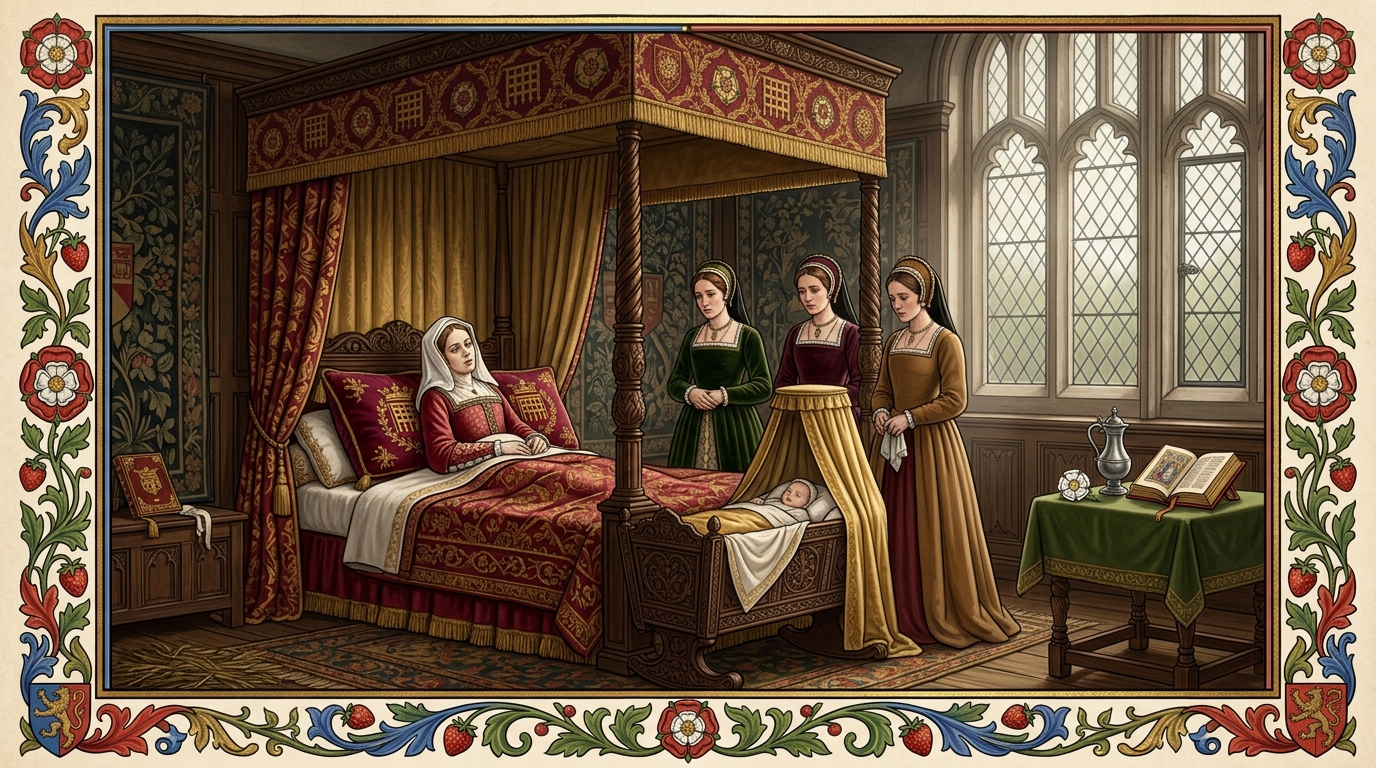
Jane was formally proclaimed queen consort, though she was never crowned. The coronation was repeatedly postponed, ostensibly because of plague in London, though some historians speculate Henry wished to wait until Jane had proved herself by producing an heir. If so, the wait was not long. Jane conceived in early 1537, and the court buzzed with anticipation. On 12th October 1537, after a labour described by contemporaries as long and extremely difficult, Jane gave birth to a healthy boy at Hampton Court Palace. The child was named Edward, the name of so many English kings before him, and the kingdom erupted in celebration.
Significance and Impact: The Heir That Changed Everything
The birth of Edward VI was not merely a personal triumph for Henry VIII. It was a moment of enormous political and dynastic consequence. For nearly three decades, Henry had been consumed by the question of succession. His marriage to Catherine of Aragon had produced only one surviving child, the Princess Mary. His marriage to Anne Boleyn had produced another daughter, the Princess Elizabeth. A legitimate male heir was considered absolutely essential to securing the Tudor dynasty and preventing a catastrophic succession crisis upon Henry’s death.
Jane’s achievement therefore cannot be overstated. As Weir emphasises, she gave Henry what he had wanted above all else, and in doing so she secured not only her own place in history but the continuation of the Tudor line in its male form. Henry would later refer to Jane as his true wife, and he wore black mourning clothes for her for an extended period following her death, an unusual display of grief for a man not known for sentimentality.
The consequences for Tudor society were profound. With a male heir finally secured, the question of whether England’s Protestant Reformation would survive became bound up with Edward’s own fate. The young prince was raised in a firmly Protestant household, and when he became king in 1547 at the age of nine, his reign oversaw the most radical phase of the English Reformation, a direct result of the religious climate carefully cultivated around him from birth.
For women at the Tudor court, Jane’s story carried a different and darker lesson. Her death, just twelve days after Edward’s birth, underlined the lethal dangers of childbirth at every level of society. Postnatal complications, most likely puerperal fever, claimed her on 24th October 1537. She was approximately 28 years old. The very act that made her indispensable to the king ultimately killed her.
Connections and Context: The Wider Tudor World of 1537
To understand Jane’s story fully, it is worth considering what else was happening in England during the months surrounding Edward’s birth. The year 1536 had seen not only the executions of Anne Boleyn and her alleged co-conspirators, but also the dissolution of the smaller monasteries and the Pilgrimage of Grace, a massive popular uprising in the north of England that protested against Henry’s religious reforms. By 1537, the Pilgrimage of Grace had been brutally suppressed, and Henry was consolidating his position as Supreme Head of the Church of England.
Jane Seymour’s own religious sympathies appear to have been traditionally Catholic in inclination, and she reportedly interceded with Henry on behalf of the monasteries, asking him to reconsider their dissolution. According to Loades, Henry warned her sharply to remember what had happened to the last queen who had meddled in his affairs, a chilling reference to Anne Boleyn’s fate. Jane wisely retreated and did not press the matter again.
It is also worth noting that Jane’s brothers, Edward Seymour and Thomas Seymour, were among the most ambitious men at court. Edward Seymour in particular would go on to become Lord Protector of England during his nephew Edward VI’s minority, wielding enormous political power in the years following Henry’s death in 1547. Jane’s elevation to queenship had turbocharged her family’s fortunes in ways that outlasted her own brief life by many years.
Modern Relevance and Fascinating Details: Why Jane Still Captivates Us
Jane Seymour occupies a curious place in popular culture. She is frequently depicted as the nice one among Henry’s wives, the gentle, self-effacing counterpart to the more dramatic Catherine and Anne. This characterisation, while not entirely unfair, does flatten a considerably more complex figure. The woman who manoeuvred herself from lady-in-waiting to queen in the shadow of Anne Boleyn’s execution was navigating extraordinarily dangerous terrain, and she did so with considerable skill.
Did you know? Henry VIII was so grief-stricken by Jane’s death that he reportedly went into seclusion at Windsor Castle and refused to conduct public business for several weeks. When he eventually remarried, choosing Anne of Cleves in 1540 for purely diplomatic reasons, the marriage was famously disastrous and was annulled within six months. Many historians argue that Henry never emotionally recovered from Jane’s death, and that she represented, in his mind at least, the ideal wife precisely because she died before she could disappoint him.
In historical fiction, Jane has been portrayed in numerous novels and television series. Hilary Mantel’s celebrated Wolf Hall trilogy gives her a relatively minor but memorable presence, while the television series The Tudors offered a more romanticised interpretation. As a historical fiction author myself, I find the gaps in Jane’s story particularly intriguing. We know so little of her inner life, her private thoughts, her feelings about the whirlwind that carried her from Wolf Hall to Hampton Court and then to an early grave. Those silences are precisely where fiction can breathe and explore.
Conclusion: A Queen Remembered for What She Gave and What She Lost
Jane Seymour’s place in Tudor history is secured not by the length of her reign, which lasted barely eighteen months, but by the magnitude of what she accomplished within it. She gave Henry VIII his long-awaited male heir, helped stabilise a court still reeling from the shock of Anne Boleyn’s execution, and provided the Tudor dynasty with the son who would become Edward VI. She paid for that achievement with her life.
Her story raises questions that continue to resonate: about the cost of ambition, about the impossible demands placed on women by dynastic politics, and about the thin line between triumph and tragedy in the Tudor court. If you would like to explore further, Alison Weir’s The Six Wives of Henry VIII and David Loades’s The Tudor Queens are both excellent starting points. And if you are drawn to the human drama behind the historical record, the world of Tudor historical fiction offers a rich and endlessly rewarding landscape to explore.