The Fires of Faith: Mary I’s Persecutions and the Protestant Martyrs of August 1557
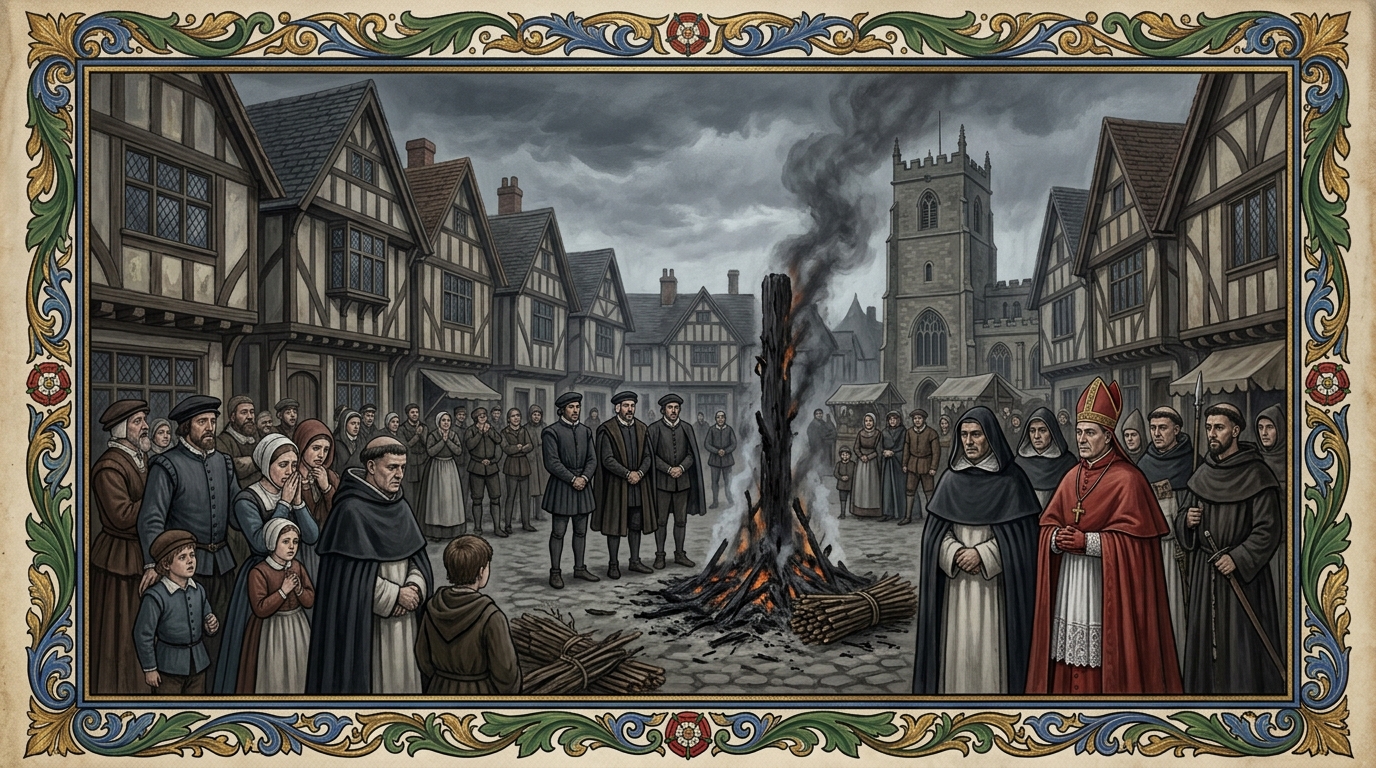
Imagine standing in a crowded marketplace, watching flames consume a fellow human being for the simple act of believing differently. This was the grim reality for thousands of ordinary Tudor men and women during the reign of Queen Mary I of England. On 27th August 1557, as summer drew towards its close, more Protestant executions were carried out under the queen’s orders, adding yet more names to what historians would come to call the Marian Persecutions. These were not the actions of a distant, abstract monarch. They were deliberate, legally sanctioned acts of religious violence that would ultimately claim approximately 280 lives between 1555 and 1558.
Mary Tudor is one of the most misunderstood and contested figures in English history. To her Catholic supporters, she was a devout queen restoring England to the true faith after years of Protestant heresy under her father Henry VIII and brother Edward VI. To her Protestant subjects and the reformers who chronicled her reign, she was ‘Bloody Mary’, a queen whose zeal for Rome came at a terrible human cost. The truth, as is so often the case in history, is considerably more complicated than either portrait suggests.
In this post, we will explore the context of the August 1557 executions, examine the broader Marian Persecutions, consider the lasting impact on English religious and political life, and ask why these events still resonate so powerfully today. Whether you are a Tudor history enthusiast, a student, or simply curious about how religious conflict shapes nations, this chapter of England’s past has much to teach us.
Historical Background: Who Were the Marian Martyrs?
To understand the executions of August 1557, we must first understand the world Mary inherited when she took the throne in July 1553. England had lurched between religious identities for over two decades. Henry VIII had broken with Rome in the 1530s, not out of Protestant conviction, but out of political necessity. His son Edward VI had pushed England decisively towards a Reformed, Protestant settlement. When Mary, the daughter of Henry’s first wife Catherine of Aragon and a lifelong Catholic, came to power, she was determined to reverse this process entirely.
Mary’s religious programme moved quickly. By 1554, England had been formally reconciled with Rome under the papal legate Cardinal Reginald Pole. The old heresy laws were revived, and in February 1555, the burnings began. The first victims included prominent reformers such as John Hooper, Bishop of Gloucester, and Hugh Latimer, the celebrated preacher who famously encouraged fellow martyr Nicholas Ridley at the stake in October 1555 with the words, ‘We shall this day light such a candle by God’s grace in England as I trust shall never be put out.’ These executions, recorded meticulously by John Foxe in his landmark work Acts and Monuments (first published in 1563), became the foundational texts of English Protestant identity.
By the time we reach August 1557, the persecutions had been grinding on for over two years. The victims were not only bishops and prominent reformers. As Linda Porter notes in her authoritative biography The First Queen: Mary Tudor (2007), the majority of those who died were ordinary people: weavers, farmers, tradespeople, and women from modest backgrounds. They came predominantly from the south-east of England, particularly Kent, Essex, and London, where Protestant sympathies ran deepest. Their crime, in the eyes of the Marian authorities, was the refusal to recant their Protestant beliefs and accept the Catholic Mass.
The executions were carried out publicly, often at local market towns, to serve as a warning to communities. Burning at the stake was the prescribed penalty for heresy under English law, and the process required both ecclesiastical condemnation and civil execution. Bishops, particularly Edmund Bonner of London, played central roles in examining suspected heretics, and their names became synonymous with the persecutions in Protestant memory.
Significance and Impact: How Did the Persecutions Shape England?
The immediate political calculation behind the Marian Persecutions was straightforward. Mary and her advisers believed that visible punishment of heresy would deter others from Protestant practice and hasten England’s return to Catholic orthodoxy. In this aim, the policy was a profound failure. As John Foxe documented so exhaustively, the courage and composure of many of the martyrs made a deep impression on those who witnessed their deaths. Rather than frightening people away from Protestantism, the burnings often created sympathy for the condemned and suspicion of the authorities who ordered their deaths.
The Acts and Monuments, commonly known as Foxe’s Book of Martyrs, became one of the most widely read books in Elizabethan England, second only to the Bible itself. It was ordered to be placed in churches and cathedrals, ensuring that every parish in the country had access to its vivid, often harrowing accounts of Protestant suffering. This single text did more than perhaps any other to embed an anti-Catholic, anti-Spanish identity into the heart of English national consciousness for generations to come.
The social impact of the persecutions was equally significant. In communities where burnings took place, the divisions they created between neighbours, between those who reported heretics and those who sheltered them, left lasting wounds. Linda Porter argues convincingly that Mary’s persecution policy, however sincere her religious motivations, alienated precisely those moderate, pragmatic English men and women whose support she needed to secure a lasting Catholic restoration. By the time Mary died in November 1558, England was not more Catholic. If anything, the fires had hardened Protestant resolve.
There is also a question of gender and power worth noting. A significant proportion of the Marian martyrs were women, including Rose Allen and Joan Waste, a blind woman from Derby who was burned in August 1556. Their stories challenge the assumption that religious martyrdom was exclusively a male domain and remind us that ordinary Tudor women exercised profound moral and theological agency, even in circumstances of extreme danger.
Connections and Context: What Else Was Happening in 1557?
The summer of 1557 was a turbulent moment for England beyond the domestic tragedy of the persecutions. England was at war with France, drawn into the conflict as a consequence of Mary’s marriage to King Philip II of Spain in 1554. The war was going badly, and in January 1558, England would suffer the catastrophic loss of Calais, its last territorial possession in France, a humiliation that Mary reportedly said would be found engraved on her heart at her death.
Philip II was, in fact, significantly less enthusiastic about the burnings than is sometimes assumed. Spanish diplomats in England expressed concern that the executions were generating dangerous levels of public hostility and undermining the broader project of Catholic restoration. This is a detail that tends to surprise people accustomed to thinking of Philip as the embodiment of Counter-Reformation zeal. The reality is that even within the Catholic world, Mary’s policy was viewed with some unease.
Meanwhile, the young Princess Elizabeth, Mary’s Protestant half-sister and eventual successor, was watching events carefully from her semi-exile at Hatfield House in Hertfordshire. Elizabeth had survived the dangerous early years of Mary’s reign through a combination of political caution and calculated ambiguity about her own religious beliefs. The lessons she drew from the Marian Persecutions would deeply inform her own, notably more pragmatic approach to religious settlement after 1558.
Modern Relevance and Fascinating Details
Why do the events of August 1557 still matter to us today? Partly, they matter because they are part of the direct lineage of English national identity. The Church of England, the British monarchy’s complex relationship with Rome, even certain strands of political thought about individual conscience versus state authority, all have roots in the conflicts of Mary’s reign. As a historical fiction author, I find this period endlessly compelling precisely because it forces characters to confront the hardest possible questions: what do you believe, and how far will you go to defend it?
Did you know? The term ‘Bloody Mary’ did not become widely associated with the queen until well after her death. During her own lifetime and in the immediate aftermath of her reign, she was referred to in far more neutral terms even by her Protestant critics. The nickname reflects later Protestant propaganda rather than contemporary usage, reminding us how powerfully historical reputation can be shaped by those who control the narrative.
The Marian Persecutions have appeared in numerous works of historical fiction and popular culture. Hilary Mantel’s Wolf Hall trilogy, while focused on an earlier period, casts a long shadow over the religious conflicts that made Mary’s persecutions possible. More directly, novelists such as C.J. Sansom have used the period to explore questions of religious identity, political survival, and moral compromise. The martyrs themselves continue to be commemorated: the Foxe’s Book of Martyrs Memorial in Smithfield, London, marks the site where many of the London burnings took place, a quietly powerful reminder in the middle of one of the city’s most ancient market areas.
Conclusion: Remembering the Marian Martyrs
The executions of 27th August 1557 were not extraordinary events within the grim calendar of Mary I’s reign. They were, by that point in the persecutions, almost routine. And yet each death represented a unique human story, a person who had made a choice about faith and paid for it with their life. Collectively, those approximately 280 deaths transformed English religious culture in ways that Mary could never have intended or foreseen. They created a Protestant martyrology that would sustain English Reformed Christianity through decades of uncertainty and eventually help to define a specifically English relationship to religious authority.
Understanding Mary I requires us to resist both the temptation to demonise her as a simple fanatic and the revisionist urge to rehabilitate her entirely. She was, as Linda Porter persuasively argues, a complex woman of genuine conviction operating within the brutal political and religious logic of her time. If you want to explore this extraordinary period further, Acts and Monuments by John Foxe remains essential reading, as does Porter’s balanced and deeply researched biography. The fires of 1557 have long since gone cold, but the questions they raise about faith, power, and conscience remain as urgent as ever.