The Death That Shook a Kingdom: Amy Robsart, Robert Dudley, and the Scandal That Nearly Destroyed Elizabeth I
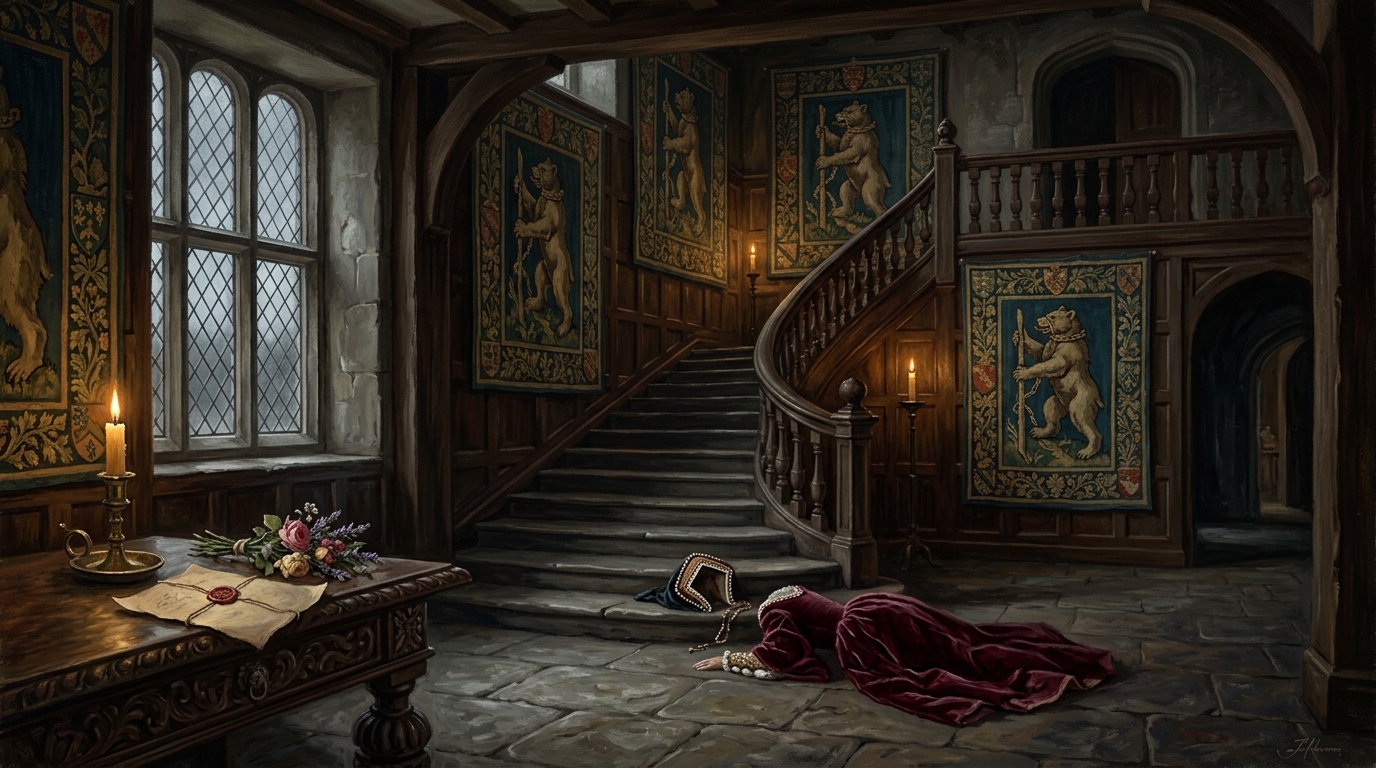
On the morning of 8th September 1560, the body of Amy Robsart, wife of Robert Dudley, was discovered at the foot of a staircase at Cumnor Place in Oxfordshire. She had been alone in the house, having sent all her servants to a local fair. Her neck was broken. Within days, the whispers had become a roar that echoed across every court in Europe: had the Queen’s beloved favourite murdered his own wife to clear the path for a royal marriage? It was the most explosive scandal of the Elizabethan age, and its consequences would ripple through English history for decades to come.
As both a Tudor history specialist and a historical fiction author, I find the Amy Robsart affair endlessly compelling precisely because it sits at the intersection of love, ambition, politics, and mystery. The questions it raises have never been definitively answered. Did Dudley arrange his wife’s death? Was it suicide? Was it a tragic accident? Or, as some historians have suggested, was it the work of Dudley’s enemies, designed to ruin him? The truth, buried beneath five centuries of speculation, remains tantalisingly out of reach.
In this post, we will explore who Amy Robsart was, what the historical record tells us about her death, why the scandal mattered so profoundly to Elizabethan England, and why it continues to fascinate historians, novelists, and readers today. Drawing on the Calendar of State Papers, Domestic Series, of the Reign of Elizabeth I and Chris Skidmore’s meticulous 2010 study Death and the Virgin: Elizabeth, Dudley, and the Birth of the English Renaissance, we will attempt to untangle one of Tudor history’s most enduring mysteries.
Historical Background: Who Was Amy Robsart, and What Happened at Cumnor Place?
Amy Robsart was born around 1532, the daughter of Sir John Robsart, a prosperous Norfolk landowner. She married Robert Dudley in June 1550, when both were teenagers, in a match that appears to have been a genuine love match at its outset. Dudley was the son of John Dudley, Duke of Northumberland, one of the most powerful men in England under Edward VI. The union promised a glittering future. But history intervened brutally: after the disastrous attempt to place Lady Jane Grey on the throne in 1553, the Dudley family fell from grace, and Robert himself was imprisoned in the Tower of London. Amy’s loyalty during this period was unwavering.
When Elizabeth I came to the throne in November 1558, Robert Dudley’s fortunes reversed with startling speed. The new queen appointed him Master of the Horse, a prestigious position that required constant attendance at court. It quickly became apparent to everyone that Elizabeth was deeply, perhaps dangerously, attached to Dudley. Contemporary observers noted their easy familiarity, their shared laughter, the way the Queen’s eyes followed him across a room. By 1559, the Spanish ambassador Feria was reporting to Philip II that Elizabeth intended to marry her Master of the Horse. There was only one obstacle: Amy Robsart, living quietly in a series of rented country houses while her husband danced attendance on the Queen.
By the summer of 1560, rumours of Amy’s ill health were circulating at court. In a remarkable letter recorded in the Calendar of State Papers, Dudley’s own agent Thomas Blount wrote that Amy seemed to have ‘a strange mind.’ Some historians have interpreted this as evidence of depression or suicidal ideation; others see it as consistent with the behaviour of a woman suffering from breast cancer, which can affect mood and, crucially, weaken bones. On that fateful Sunday in September, Amy dismissed her entire household to the fair at Abingdon, insisting they leave despite the protests of at least one servant who felt it inappropriate. When they returned, she was dead at the bottom of the staircase, her headdress still neatly in place on her broken neck.
A coroner’s jury returned a verdict of accidental death. But as Chris Skidmore documents exhaustively in Death and the Virgin, the investigation was compromised from the outset. Dudley himself wrote anxiously to Blount, instructing him to ensure a thorough inquiry, though whether this reflected genuine concern or careful self-protection is impossible to determine. The verdict satisfied almost no one, and the scandal it unleashed was immediate and devastating.
Significance and Impact: How Amy Robsart’s Death Changed English History
The political consequences of Amy Robsart’s death were swift and far-reaching. William Cecil, Elizabeth’s chief minister and no admirer of Dudley, recognised instantly that the scandal could be used to destroy his rival’s influence over the Queen. Cecil had reportedly told the Spanish ambassador just weeks before Amy’s death that Dudley would become king of England over his dead body. Now, ironically, it was Amy’s death that threatened to achieve precisely what Cecil feared: if Elizabeth married Dudley, she would be marrying a man all of Europe believed to be a murderer.
The damage to England’s international reputation was immediate. The Calendar of State Papers records the alarm of English ambassadors abroad, who reported that the scandal was being used to discredit Elizabeth in every European court. In Scotland, John Knox thundered that God had revealed Elizabeth’s wickedness. In France, Mary Queen of Scots reportedly remarked that the Queen of England was about to marry her horsekeeper, who had killed his wife to make room for her. The comment was almost certainly apocryphal, but it captured the prevailing mood perfectly.
For Elizabeth herself, the affair presented an agonising personal dilemma. She was, by all accounts, genuinely in love with Dudley, or as close to love as her complicated psychology permitted. Yet she was also a supremely astute political operator who understood that marrying a suspected murderer would undermine her authority, her legitimacy, and her carefully constructed image as the Virgin Queen. In the end, she chose her crown. Dudley was never arrested, never formally accused, and never married the Queen, though he remained her closest companion for nearly thirty years. As Skidmore argues convincingly, the events of September 1560 may have permanently foreclosed the possibility of Elizabeth’s marriage, not just to Dudley, but to anyone.
Did you know? Robert Dudley was eventually created Earl of Leicester in 1564, a title that brought him wealth and status but never the one prize he truly sought: Elizabeth’s hand in marriage. He did eventually remarry, secretly, in 1578, a match that enraged the Queen and nearly ended their long friendship entirely.
Connections and Context: The Wider Tudor World in 1560
It is worth pausing to consider what else was happening in England in the autumn of 1560, because context transforms our understanding of the Amy Robsart affair. Elizabeth had been queen for less than two years. Her reign was fragile: she was unmarried, her succession was uncertain, and England had only recently emerged from the religious turmoil of her sister Mary I’s reign. The Protestant settlement of 1559 had been achieved, but it remained contested. Scotland was in the grip of a Protestant revolution backed by English money. France was a constant threat. In this atmosphere of precarious stability, a scandal involving the Queen’s favourite and his dead wife was not merely salacious gossip. It was a potential constitutional crisis.
The affair also illuminates the extraordinary position women occupied in Tudor England. Amy Robsart had no legal recourse against a husband who effectively abandoned her for the Queen. She could not divorce him. She could not recover her social standing without him. She existed in a kind of limbo, wealthy enough to maintain a household but invisible in the world that mattered. Her death, whatever its cause, was in many ways the logical endpoint of her impossible situation. It is a detail that historical novelists, including myself, find both heartbreaking and dramatically irresistible.
The Robsart affair connects, too, to broader questions about Elizabeth’s relationship with the institution of marriage itself. Throughout her reign, the Queen would be pressed repeatedly by Parliament, her councillors, and foreign ambassadors to marry and produce an heir. She consistently refused or deflected. Whether the trauma of 1560 hardened her resistance is a question historians continue to debate, but it is difficult to read Skidmore’s account without concluding that the events of that September morning at Cumnor Place left marks that never fully healed.
Modern Relevance and Fascinating Details: Why the Mystery Still Captivates Us
The Amy Robsart case has never lost its power to fascinate, and the reasons are not difficult to understand. It combines the essential ingredients of a great historical mystery: a suspicious death, powerful suspects, a love triangle at the highest level of society, and an ending that satisfies no one. In recent decades, medical historians have added a new dimension to the debate. The theory that Amy was suffering from advanced breast cancer, which can cause spontaneous fractures in bones, was examined seriously by Professor Ian Aird as early as 1956 and has been revisited by subsequent researchers. If Amy’s spine had been weakened by metastatic disease, she might have tumbled down even a shallow staircase with fatal results through no human agency whatsoever. It is a sobering possibility that deserves more attention than it typically receives in popular accounts.
In popular culture, Amy Robsart has been portrayed in novels, plays, and television dramas for centuries. Sir Walter Scott made her the tragic heroine of his 1821 novel Kenilworth, though his version takes considerable liberties with the historical record. More recently, she has appeared in Philippa Gregory’s fiction and in television productions exploring the Elizabethan court. As a historical fiction author myself, I am acutely aware of the responsibility these narratives carry: the temptation to resolve the mystery is powerful, but the honest approach is to honour its irreducible uncertainty. We simply do not know what happened at Cumnor Place. And sometimes, as any good novelist knows, the unanswered question is more compelling than any resolution.
Conclusion: A Mystery That History Cannot Solve
The death of Amy Robsart remains one of the great unsolved puzzles of Tudor history. Whether she fell by accident, was driven to despair by her impossible circumstances, or was murdered on the orders of her husband or his enemies, we cannot say with certainty. What we can say is that her death changed the course of English history. It may have prevented a royal marriage, shaped the character of Elizabeth’s reign, and cemented the image of a queen who stood alone. The Calendar of State Papers and Chris Skidmore’s remarkable Death and the Virgin give us the clearest possible picture of events, yet the heart of the mystery remains dark.
If you want to explore the Tudor world further, the Amy Robsart affair is an ideal starting point: it touches on politics, gender, religion, medicine, and the nature of power itself. I would encourage you to read Skidmore’s book for a rigorous, sympathetic account that does justice to all the principal figures, Amy Robsart above all. She deserves to be remembered as more than a footnote to Robert Dudley’s ambitions or Elizabeth’s romantic life. She was a real woman, living in impossible circumstances, whose death we have spent five centuries trying to understand.