
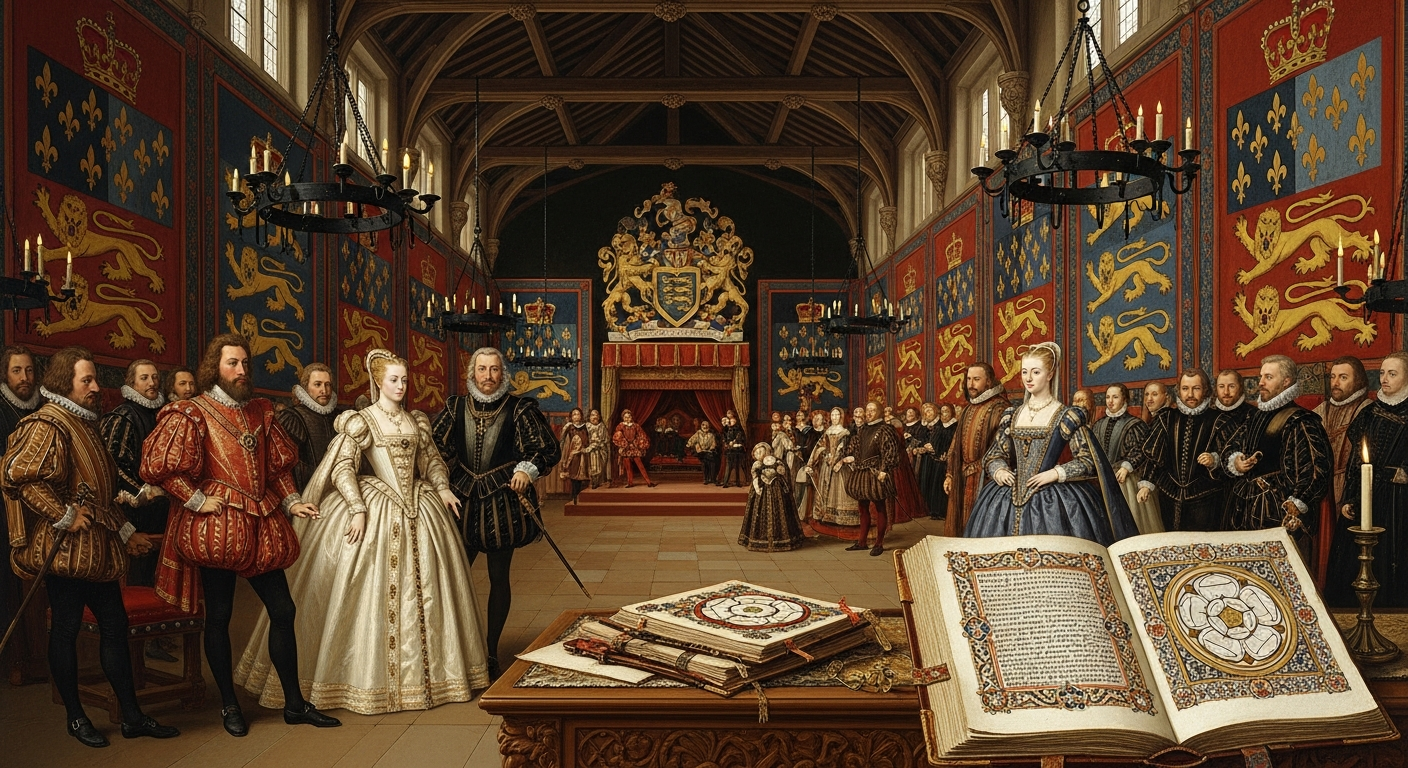
Elizabeth I and the Golden Age of English Renaissance Culture: How a Queen Became a Muse
Imagine a court so dazzling with intellectual brilliance that it inspired some of the greatest works of literature the English language has ever produced. At the centre of this extraordinary cultural flowering stood one woman: Elizabeth I of England, whose reign from 1558 to 1603 transformed the royal court into the beating heart of the English Renaissance. This was not merely a happy coincidence of timing. Elizabeth deliberately cultivated an image of herself as a patron of the arts, a philosopher-queen, and a living symbol of England’s greatness, and the poets and playwrights of her age responded with some of their most ambitious and enduring works.
The relationship between Elizabeth and the artists of her era raises fascinating questions that still captivate historians and readers today. How did royal patronage shape the literature we now consider timeless? What did it mean for a writer like Edmund Spenser to dedicate his magnum opus to a living monarch? And how did a theatre culture that included William Shakespeare navigate the intensely political atmosphere of the Elizabethan court? These questions lie at the intersection of politics, art, and power, and the answers reveal a world far more complex and compelling than simple admiration between a queen and her subjects.
In this post, we shall explore how Elizabeth I’s court became the defining centre of English Renaissance culture, examining the key figures involved, the circumstances that made this cultural explosion possible, and why it continues to resonate with readers, scholars, and lovers of historical fiction to this day.
Historical Background: A Queen Who Understood the Power of Image
Elizabeth Tudor came to the throne in November 1558 after one of the most turbulent successions in English history. The daughter of Henry VIII and Anne Boleyn, she had survived the reigns of her half-brother Edward VI and her half-sister Mary I, navigating extraordinary political danger before finally ascending to power at the age of twenty-five. From the very beginning of her reign, Elizabeth understood something that many monarchs before her had not fully grasped: that art, literature, and spectacle were not mere entertainments but powerful instruments of statecraft.
The Elizabethan court was centred primarily at Whitehall Palace in London, though Elizabeth was famously peripatetic, conducting royal progresses throughout England that brought her into contact with her subjects and allowed local nobles to demonstrate their loyalty through lavish entertainments. It was during these progresses, as well as through the formal life of the court, that the queen’s patronage of arts and letters became most visible. Writers, musicians, and dramatists competed fiercely for royal favour, understanding that a dedication to the queen or a performance before her could make a career.
Edmund Spenser represents perhaps the most striking example of a writer who staked his literary ambitions on royal patronage. Born around 1552 and educated at Cambridge, Spenser had already produced his pastoral sequence The Shepheardes Calender in 1579 before embarking on his most ambitious project. When the first three books of The Faerie Queene were published in 1590, Spenser included an elaborate dedicatory letter addressed directly to Elizabeth herself, describing his grand design to present ‘in the person of Prince Arthure… the image of a brave knight, perfected in the twelve private morall vertues.’ More significantly, he made clear that his allegorical queen, Gloriana, was intended as a direct celebration of Elizabeth, praising her as the ideal monarch and the embodiment of virtue and majesty.
Meanwhile, the world of the theatre was developing its own complex relationship with royal power. The Lord Chamberlain’s Men, the playing company to which William Shakespeare belonged, became the King’s Men upon the accession of James I in 1603, but during Elizabeth’s reign they performed regularly at court. As the theatre historian Louis Montrose argues in his authoritative study The Purpose of Playing: Shakespeare and the Cultural Politics of the Elizabethan Theatre (1996), the Elizabethan stage was never simply an escape from politics. Rather, the theatre was deeply enmeshed in the cultural and ideological life of the court, reflecting, questioning, and sometimes subtly challenging the assumptions of royal power.
Significance and Impact: Why This Cultural Moment Changed Everything
The significance of Elizabeth’s cultural patronage extends far beyond the individual works it inspired. The queen’s deliberate cultivation of a literary culture around her court helped to establish English as a language worthy of great art. Earlier in the sixteenth century, Latin had still dominated serious intellectual and literary discourse. The outpouring of vernacular literature during Elizabeth’s reign, from Spenser’s epic poetry to the plays of Christopher Marlowe and William Shakespeare, fundamentally changed the status of the English language and established the foundations of the literary tradition we inherit today.
The political dimensions of this cultural patronage were equally profound. As Montrose’s scholarship illuminates, the image of Elizabeth that writers and artists constructed served a crucial ideological function. A queen regnant was a deeply anomalous figure in sixteenth-century Europe, where political authority was overwhelmingly understood as masculine. The elaborate mythology built around Elizabeth, celebrating her as a virgin queen, a Gloriana, a second Astraea or goddess of justice, helped to naturalise her rule and deflect questions about female sovereignty. Spenser’s dedication of The Faerie Queene was not merely flattery; it was a sophisticated act of political mythmaking.
The consequences for English literature were immeasurable. The competitive atmosphere of the Elizabethan court, where writers vied for patronage and recognition, drove artistic ambition to extraordinary heights. It is no coincidence that the 1590s, the decade when Elizabeth’s court was at the peak of its cultural influence, also produced some of Shakespeare’s greatest early works, including A Midsummer Night’s Dream, Richard II, and the history plays that explored the nature of kingship with remarkable complexity and subtlety. Did you know that A Midsummer Night’s Dream is widely believed to have been written for performance at an aristocratic wedding, possibly with the queen herself in attendance?
Connections and Context: The Broader World of Elizabethan England
To understand Elizabeth’s cultural patronage fully, it is essential to see it in the context of the broader challenges facing her reign. The 1580s and 1590s were decades of intense anxiety. The threat of Catholic invasion, most dramatically embodied by the Spanish Armada of 1588, created a climate in which national identity and the glorification of England’s Protestant queen carried urgent political weight. Spenser began writing The Faerie Queene during precisely this period, and the poem’s celebration of Protestant virtue and English greatness was deeply responsive to the anxieties of the age.
At the same time, the reign of Elizabeth saw England’s first sustained engagement with the wider world through exploration and trade. Figures such as Sir Walter Raleigh and Sir Francis Drake brought a sense of boundless possibility to the Elizabethan imagination, and this spirit of adventure permeated the literature of the period. Raleigh himself was a poet of genuine accomplishment and a significant patron of Spenser, having helped to bring The Faerie Queene to publication. The connections between exploration, courtly culture, and literary production were intimate and mutually reinforcing.
It is also worth noting that Elizabeth’s court was not the only centre of cultural life in this period. The great households of nobles such as the Earl of Leicester and the Earl of Essex served as important secondary sites of patronage, and the public theatres of London, including the Globe, built in 1599, reached audiences far beyond the court. The Elizabethan cultural moment was, in this sense, a genuinely national phenomenon, even if Elizabeth herself stood at its symbolic centre.
Modern Relevance and Fascinating Details: Why We Are Still Captivated
As a historical fiction author, I find the Elizabethan court endlessly compelling precisely because it is a world where art and power are so visibly intertwined. The characters who populate it, the brilliant, ambitious, often dangerous men and women who wrote poems, staged plays, and jostled for royal favour, are irresistible subjects for fiction. But beyond the drama of individual lives, there is something profoundly modern about the Elizabethan understanding of image-making and cultural power. Elizabeth’s court anticipated, in remarkable ways, our contemporary world of personal branding and carefully managed public identity.
Did you know that Elizabeth reportedly spoke six languages fluently, including Latin, Greek, French, Italian, and Spanish? Her intellectual accomplishments were genuine, and they made her a credible patron whose approval carried real cultural weight. Writers dedicated works to her not merely because she was queen, but because she was understood to be capable of appreciating their achievement. This combination of political power and intellectual authority gave the Elizabethan court its unique character as a cultural institution.
In popular culture, the Elizabethan age continues to exercise a powerful hold on the imagination. Films such as Shakespeare in Love (1998) and television series including the recent wave of Tudor dramas have brought the world of Elizabethan theatre and courtly culture to new audiences. Meanwhile, the academic study of this period continues to generate rich and sometimes surprising new perspectives. Montrose’s work on the cultural politics of the Elizabethan theatre, for example, opened up new ways of reading Shakespeare’s plays not simply as timeless literary masterpieces but as historically situated interventions in a specific political and cultural moment.
Conclusion: A Legacy That Endures
Elizabeth I’s court stands as one of history’s most remarkable examples of the relationship between political power and cultural production. By making herself the centre of a rich and competitive literary culture, the queen both inspired some of the greatest works in the English language and secured her own image for posterity. Spenser’s Gloriana, Shakespeare’s complex kings and queens, the whole brilliant, anxious, ambitious world of Elizabethan letters: all of this flows, in one way or another, from the extraordinary circumstance of a woman who understood that art could serve power, and that power, in turn, could be transformed by art.
Whether you come to this subject as a lover of Shakespeare, a student of Tudor history, or simply someone fascinated by the ways in which culture and politics interweave, the Elizabethan age offers endlessly rewarding material for exploration. I warmly encourage you to read Spenser’s dedicatory letters in The Faerie Queene for yourself, to dip into Montrose’s compelling study of Elizabethan theatre, and to allow yourself to be drawn into one of the most fascinating cultural moments in the history of the English-speaking world.