
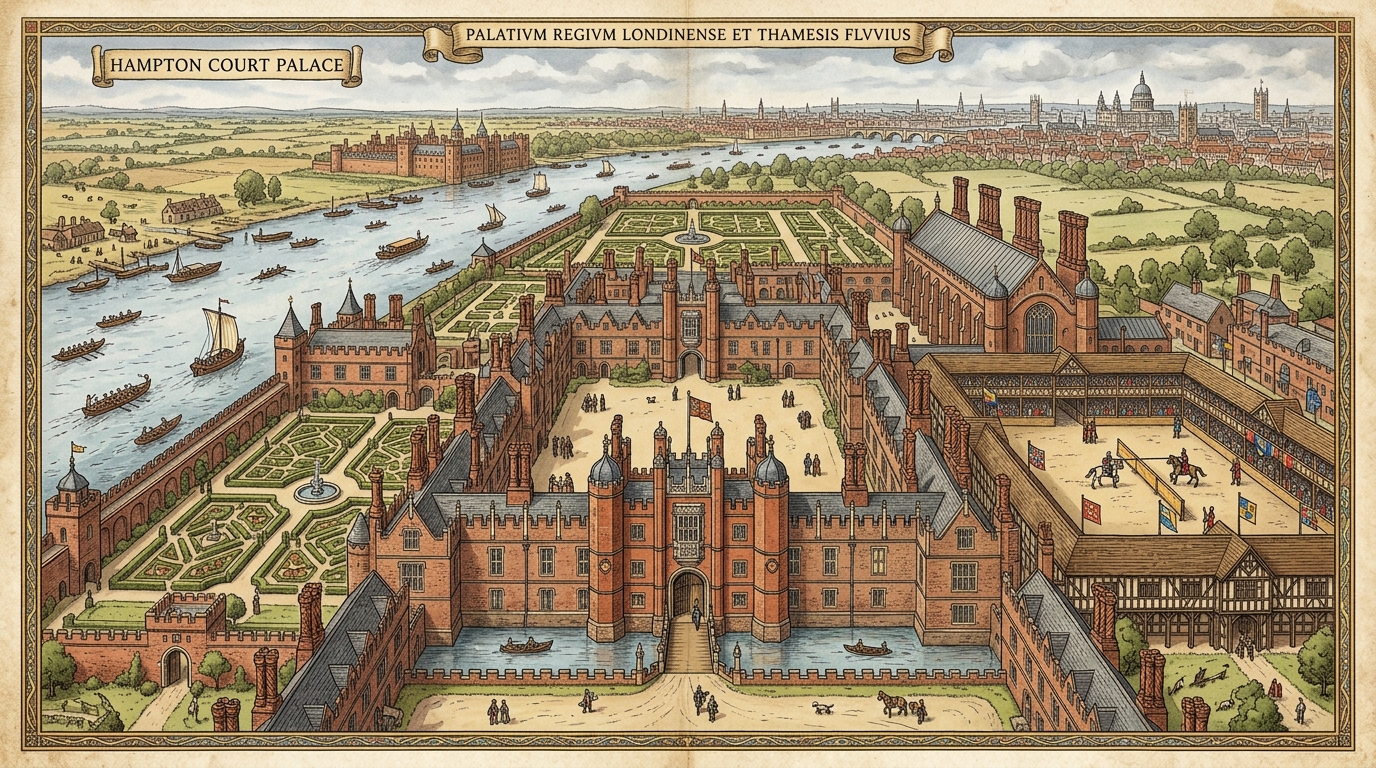
The Palace That Swallowed a City: Henry VIII’s Whitehall and the Making of Tudor Power
Imagine a royal residence so vast that it stretched across 23 acres of prime London real estate, straddling the main road between Westminster and the City, its buildings, galleries, and gardens sprawling in every direction. This was Whitehall Palace, the extraordinary complex that became the beating heart of Tudor England after 1530 and one of the largest palaces in all of Europe. As a historical fiction author who has spent years wandering the streets that once lay beneath its foundations, I find it endlessly fascinating that so little of this colossus survives today, yet its influence on British history, politics, and culture proved utterly transformative.
Most visitors to modern London walk along Whitehall without realising they are treading ground that was once the most powerful address in the kingdom. The name itself survives, attached to a street rather than a palace, a ghost of stone and ambition. Yet in its Tudor heyday, Whitehall Palace was not merely a home for monarchs. It was a statement of intent, a physical manifestation of royal supremacy, and a place where decisions were made that would reshape England and its relationship with Rome, Europe, and the very nature of kingship itself.
In this post, we shall explore how Whitehall came to be, why it mattered so profoundly to Tudor society, and what remarkable details about this lost palace continue to surprise historians and general readers alike. Whether you are researching Tudor architecture, Henry VIII’s court life, or simply want to understand how one building shaped a dynasty, you will find much to discover here.
Historical Background: How a Cardinal’s Palace Became a King’s Domain
The story of Whitehall Palace begins not with a king but with a cardinal. Thomas Wolsey, Henry VIII’s enormously powerful Lord Chancellor, acquired the property known as York Place from the Archbishopric of York in the early sixteenth century. Wolsey transformed it into one of the grandest private residences in England, lavishing money and attention on buildings, gardens, and furnishings that rivalled many royal palaces of the period. As Simon Thurley notes in his authoritative study The Royal Palaces of Tudor England (Yale University Press, 1993), Wolsey’s York Place was already a remarkable complex before Henry ever set eyes upon it as a potential acquisition.
The decisive moment came in 1530, when Wolsey’s catastrophic fall from favour, precipitated by his failure to secure Henry’s annulment from Catherine of Aragon, left York Place vulnerable. Henry moved swiftly to acquire the property, and what followed was one of the most ambitious building programmes of the entire Tudor period. The king did not merely take Wolsey’s palace. He consumed it, expanded it, and rebuilt it on a scale that beggared belief. According to H.M. Colvin’s monumental The History of the King’s Works, Volume 4: 1485-1660 (H.M. Stationery Office, 1982), the resulting complex grew to encompass approximately 23 acres, making it one of the largest palaces in Europe at the time.
Henry’s Whitehall was not a single coherent building in the manner of, say, the Palace of Versailles that would come later in France. Instead, it was a sprawling accumulation of structures: lodgings, galleries, kitchens, tennis courts, a tiltyard for jousting, cockpit arenas, and elaborate gardens. The palace actually straddled the public road between Westminster and Charing Cross, connected by the famous Holbein Gate and the King Street Gate, so that royal life literally unfolded above the heads of ordinary Londoners passing below.
It was at Whitehall that Henry conducted much of his later reign, and it was here that he died in January 1547. His successors, including Edward VI, Mary I, and Elizabeth I, all maintained Whitehall as their principal London residence, cementing its status as the true seat of Tudor power.
Significance and Impact: Power, Politics, and the Tudor Court
Why does the sheer size of Whitehall Palace matter? Because in the Tudor world, scale was a political language. A palace of 23 acres was not built for comfort alone. It was built to impress ambassadors, intimidate rivals, and communicate to the world that the English monarchy was a force to be reckoned with. When foreign dignitaries arrived at Whitehall, they encountered a complex specifically designed to overwhelm, to suggest limitless resources and unassailable authority.
The palace’s layout also reflected the intricate social hierarchies of Tudor court life. Access was carefully controlled, with different areas open to different ranks. The further into the palace one penetrated, the more exclusive the company. The Privy Chamber, the Presence Chamber, and ultimately the Bedchamber formed concentric rings of privilege around the royal person. Understanding who had access to which rooms tells us a great deal about the fluid, dangerous nature of Tudor politics, where proximity to the monarch could mean everything.
Whitehall also served as the administrative centre of the realm. Government business, diplomatic negotiations, and legal proceedings all took place within or adjacent to its walls. The concentration of royal, administrative, and ecclesiastical power in one location helped to centralise Tudor governance in ways that had lasting consequences for the English state. As Thurley’s research makes clear, this was not accidental. Henry VIII understood instinctively that architecture could serve political ends, and Whitehall was perhaps his greatest political instrument.
For those interested in the English Reformation, Whitehall holds particular significance. It was within the palace complex that Henry and his advisers, including Thomas Cromwell, worked through the legislative and theological machinery of the Break with Rome. The palace witnessed the drafting of the Act of Supremacy, the dissolution of the monasteries, and the profound reshaping of English religious life. In this sense, Whitehall was not merely a backdrop to history. It was a crucible in which Tudor England was forged.
Connections and Context: Whitehall in the Wider Tudor World
To understand Whitehall fully, one must appreciate what else was happening in England during the 1530s and beyond. Henry’s acquisition and expansion of the palace coincided precisely with his break from Rome, his marriage to Anne Boleyn, and his increasingly autocratic style of rule. The building of a new, grander palace was part of the same psychological and political impulse that drove the Reformation: a desire to demonstrate that Henry VIII was answerable to no authority beyond God and his own will.
It is also worth noting that Whitehall existed alongside other significant Tudor palaces. Hampton Court, also acquired from Wolsey, served as a more rural retreat. Greenwich Palace was favoured for celebrations and was the birthplace of both Henry himself and his daughter Elizabeth. Richmond Palace offered yet another option. Together, these residences formed a circuit of royal power around the Thames Valley, with Whitehall increasingly dominant as the reign progressed.
Did you know? The famous painter Hans Holbein the Younger was closely associated with the Whitehall court, and his monumental mural depicting Henry VIII, Jane Seymour, Henry VII, and Elizabeth of York was painted directly onto the wall of the Privy Chamber. Though the original was destroyed in the fire of 1698, copies survive and continue to define our visual image of the Tudor dynasty.
Modern Relevance and Fascinating Details: The Lost Palace Beneath Our Feet
For readers who love surprising historical details, Whitehall Palace offers them in abundance. Consider that the palace contained a bowling alley, multiple tennis courts, and a cockpit for animal baiting, reflecting the full spectrum of Tudor leisure pursuits. Henry VIII, notorious for his physical appetites, designed Whitehall partly as a pleasure palace, a place where the diversions of the court could be pursued alongside the business of government.
The palace’s eventual fate is equally striking. A series of fires, culminating in the devastating conflagration of 1698, destroyed almost the entire complex. Today, only the Banqueting House survives, designed by Inigo Jones and completed in 1622 for James I. This beautiful building, now open to visitors, stands as the sole above-ground remnant of what was once a 23-acre labyrinth of Tudor ambition. Beneath the modern streets and offices of Whitehall, archaeological investigations have occasionally uncovered fragments of the palace’s fabric, tantalising glimpses of a lost world.
As a historical fiction author, I find the lost quality of Whitehall endlessly evocative. There is something profoundly moving about the fact that a palace which once dominated European imaginations now exists primarily in documents, paintings, and the scholarly reconstructions found in works like Colvin’s History of the King’s Works. It invites us to exercise our own historical imagination, to people those vanished corridors with the figures we know from the historical record and, inevitably, from the novels, films, and television series that have kept Tudor history so vividly alive in popular culture. Hilary Mantel’s Wolf Hall trilogy, for instance, brilliantly evokes the claustrophobic intimacy of Tudor palace life, even as it reminds us how much has been lost.
Conclusion: A Palace Worth Remembering
Whitehall Palace stands as one of the great lost monuments of English history. Its 23 acres of buildings, gardens, and galleries once made it a rival to any royal residence in Europe, a physical expression of Tudor ambition at its most extravagant and most purposeful. From its origins as Wolsey’s York Place to its role as the primary seat of power for five Tudor monarchs, Whitehall shaped English history in ways that continue to resonate today.
Understanding Whitehall means understanding the Tudors themselves: their hunger for magnificence, their acute awareness of architecture as political theatre, and their determination to place England at the centre of the European stage. If you would like to explore further, Simon Thurley’s The Royal Palaces of Tudor England and H.M. Colvin’s The History of the King’s Works remain the definitive starting points. And if you find yourself walking along Whitehall on a grey London afternoon, take a moment to look up at the Banqueting House and let your imagination do the rest. The palace may be gone, but its story is very much alive.