
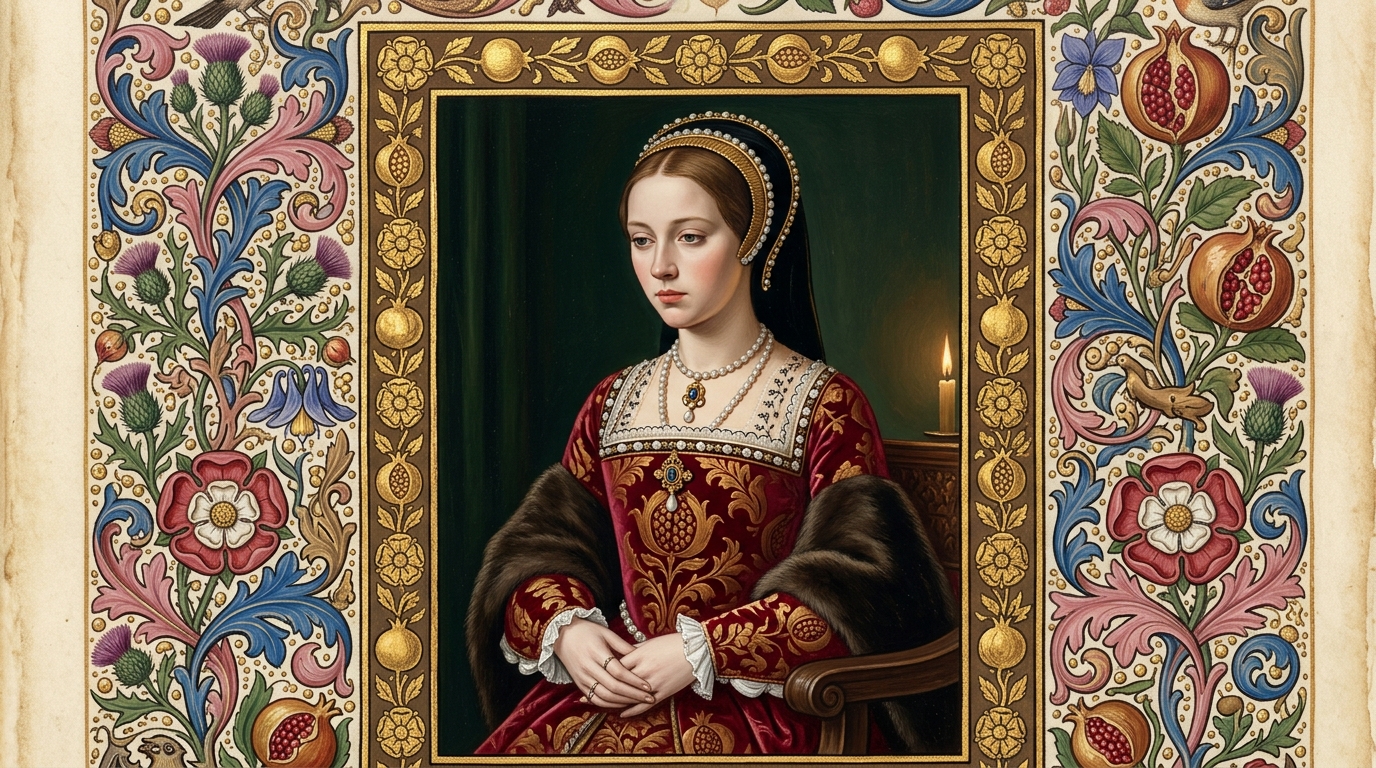
Catherine Howard: The Tragic Queen Who Paid the Ultimate Price
Of all the wives of Henry VIII, perhaps none inspire quite as much sorrow as Catherine Howard, the young woman who briefly wore the crown before losing her head at the Tower of London in February 1542. She was, by most accounts, no more than nineteen years old when she was executed, making her one of the youngest queens consort in English history to meet such a fate. Her story raises questions that historians and readers continue to wrestle with today: Was she a scheming adulteress, as her husband’s court declared? Or was she an exploited young woman, manipulated by powerful men and ultimately sacrificed for political convenience?
As a historical fiction author who has spent years immersed in the Tudor court, I find Catherine Howard’s story uniquely compelling precisely because it sits at the intersection of personal vulnerability and political brutality. The more one examines the evidence, the more complicated the picture becomes. This post will explore who Catherine Howard really was, what led to her downfall, and why her case continues to matter to anyone seeking to understand the realities of power and gender in Tudor England.
Whether you are a seasoned Tudor historian, a student encountering this period for the first time, or simply someone who stumbled across her name in a television drama, this comprehensive guide will give you the full picture of Catherine Howard’s life, her alleged crimes, her execution, and her enduring legacy.
Historical Background: A Young Woman at the Heart of a Dangerous Court
Catherine Howard was born around 1523, though the exact date remains uncertain, into the powerful Howard family. She was a niece of Thomas Howard, the third Duke of Norfolk, one of the most formidable political operators in Henry VIII’s England. Her father, Lord Edmund Howard, was a less successful figure, and Catherine’s early years were spent largely in the household of her step-grandmother, Agnes Tilney, the Dowager Duchess of Norfolk. It was there, in the relatively unsupervised dormitories of a great noble household, that Catherine first encountered the older men who would later be cited as evidence of her moral ruin.
Two relationships in particular came to define the charges against her. Henry Manox, a music teacher, allegedly engaged in inappropriate physical contact with a young Catherine, though he later claimed the relationship did not progress to full intercourse. Francis Dereham, a gentleman in the Dowager Duchess’s household, was accused of a more substantial relationship with Catherine, with testimony suggesting they had referred to each other as husband and wife. These relationships, formed when Catherine was likely between thirteen and sixteen years old, would later be used as weapons against her.
Catherine came to the attention of Henry VIII in 1540, at a time when the king was desperate to escape his disastrous marriage to Anne of Cleves. The Howard family, recognising an opportunity to restore their influence at court, presented Catherine strategically. Henry was smitten almost immediately. He married her on 28 July 1540, just nineteen days after his marriage to Anne of Cleves was annulled. For a brief period, Henry called Catherine his rose without a thorn, showering her with gifts and affection. She was, for a time, the most powerful woman in England.
The marriage began to unravel in the autumn of 1541. Archbishop Thomas Cranmer received information from a Protestant reformer named John Lassells, whose sister Mary had served in the Dowager Duchess’s household and knew of Catherine’s past. Cranmer, recognising the political sensitivity of the matter, passed the information to Henry in written form rather than verbally. Investigations followed, and under intense pressure, both Manox and Dereham provided testimony about their past interactions with the queen. More damaging still was evidence that Thomas Culpeper, a gentleman of the king’s privy chamber, had been meeting privately with Catherine during the royal progress of 1541, facilitated by Catherine’s lady-in-waiting Jane Boleyn, widow of George Boleyn.
Significance and Impact: Power, Vulnerability, and Tudor Justice
The fall of Catherine Howard sent shockwaves through the Tudor court, and its significance extended far beyond the fate of one young woman. As Robert Hutchinson notes in The Last Days of Henry VIII, the episode illustrated just how precarious life at Henry’s court had become in his later years, with paranoia, political rivalry, and the king’s increasingly volatile temperament combining to create an atmosphere of genuine danger for those closest to the throne.
Dereham and Culpeper were arrested and put on trial. Culpeper and Dereham were executed in December 1541, with Culpeper receiving the more merciful death of beheading while Dereham was hanged, drawn, and quartered. Jane Boleyn, who had facilitated the alleged meetings between Catherine and Culpeper, was also condemned. The Chronicle of the Grey Friars of London, edited by J.G. Nichols, records with unsettling brevity the executions of this period, offering a contemporary glimpse into how swiftly the machinery of Tudor justice could operate when the king’s honour was perceived to be at stake.
Catherine herself was attainted by Act of Parliament rather than tried in open court, a procedure that conveniently avoided the need to produce and test evidence publicly. She was beheaded on Tower Green on 13 February 1542. Lady Rochford, Jane Boleyn, followed her to the block on the same day. The act of attainder used against Catherine was particularly striking in its reach: it made it treasonous for any woman with an unchaste past to marry the king without disclosing it, a law that effectively criminalised the concealment of prior relationships.
The political dimensions of Catherine’s downfall deserve serious consideration. Thomas Cranmer and the Protestant reformers at court had reason to want the Howard family’s influence diminished. The Howards were associated with religious conservatism and had benefited enormously from Catherine’s rise. Her destruction weakened the Duke of Norfolk’s position considerably and shifted the balance of power at court. Whether the charges against Catherine were entirely fabricated remains a matter of debate, but many historians now argue that the political motivation behind her exposure was substantial.
Connections and Context: The Howard Family and the Wider Tudor World
It is impossible to understand Catherine Howard without understanding the broader story of the Howard family and their relationship with the Tudor crown. The Howards had already experienced the devastating consequences of royal displeasure: Catherine’s cousin Anne Boleyn had been executed in 1536 on charges of adultery and treason. The parallels between the two cousins are striking and would not have been lost on contemporaries. Both were young women presented to the king by ambitious family members, and both ultimately died on Tower Green.
The year 1541 was also a turbulent one in England more broadly. Henry VIII was ageing and increasingly unwell, his leg ulcers causing him constant pain and affecting his temperament. The political landscape was shifting as reformers and conservatives jockeyed for position. The dissolution of the monasteries, largely completed by 1541, had transformed the economic and religious landscape of the country. Catherine’s downfall occurred against this backdrop of institutional upheaval and personal royal volatility.
Did you know that the Act of Attainder passed against Catherine Howard also retroactively condemned her for conduct that was not illegal at the time it occurred? This legislative sleight of hand allowed Parliament to criminalise her past behaviour without the inconvenience of proving it constituted treason under existing law. It is a detail that tells us a great deal about how justice functioned, or rather failed to function, when powerful interests demanded a particular outcome.
Modern Relevance and Fascinating Details: Why Catherine Howard Still Matters
Catherine Howard’s story resonates with modern readers in ways that feel immediate and uncomfortable. Contemporary debates about the age of consent, the exploitation of young women by older men in positions of authority, and the way in which female sexuality has historically been weaponised against women all find vivid expression in her case. Many historians, including those writing in recent decades, have reframed the relationships Catherine had before her marriage not as evidence of her loose character but as evidence of her exploitation by men who should have known better.
The question of whether Catherine was guilty of adultery with Culpeper during her marriage remains genuinely unresolved. Letters survived from Catherine to Culpeper, one of which addresses him as master Culpeper and expresses affection, but the nature of the relationship is not definitively established by the surviving evidence. Culpeper himself confessed under what was likely torture, and his testimony cannot be taken at face value. Some historians argue the relationship was never consummated and may not even have been romantic in the fully physical sense.
In popular culture, Catherine Howard has appeared in numerous historical novels, television dramas, and stage productions, often portrayed as either a naive victim or a reckless young woman who failed to appreciate the dangers surrounding her. As a historical fiction author, I find her most interesting precisely in the ambiguity: a young woman navigating an extraordinarily dangerous environment with limited resources, limited power, and limited understanding of the forces arrayed against her. The most honest portrayals resist the urge to reduce her to a simple cautionary tale.
Conclusion: A Life Curtailed, a Legacy Enduring
Catherine Howard lived a short life in extraordinary circumstances, and her execution in February 1542 marked one of the most troubling moments in Henry VIII’s reign. The charges against her may have been politically motivated, the evidence was never properly tested in open court, and the young woman at the centre of the storm had precious little power to defend herself. Whether she was guilty or innocent, her story illuminates the brutal realities of Tudor court politics and the particular dangers faced by young women in positions of proximity to power.
If you want to explore Catherine Howard’s story further, the Chronicle of the Grey Friars of London offers a fascinating contemporary perspective, while Robert Hutchinson’s The Last Days of Henry VIII provides essential context for understanding the political world in which her downfall occurred. Her story is not simply a footnote in the biography of a tyrannical king. It is a history worth knowing in its own right.